
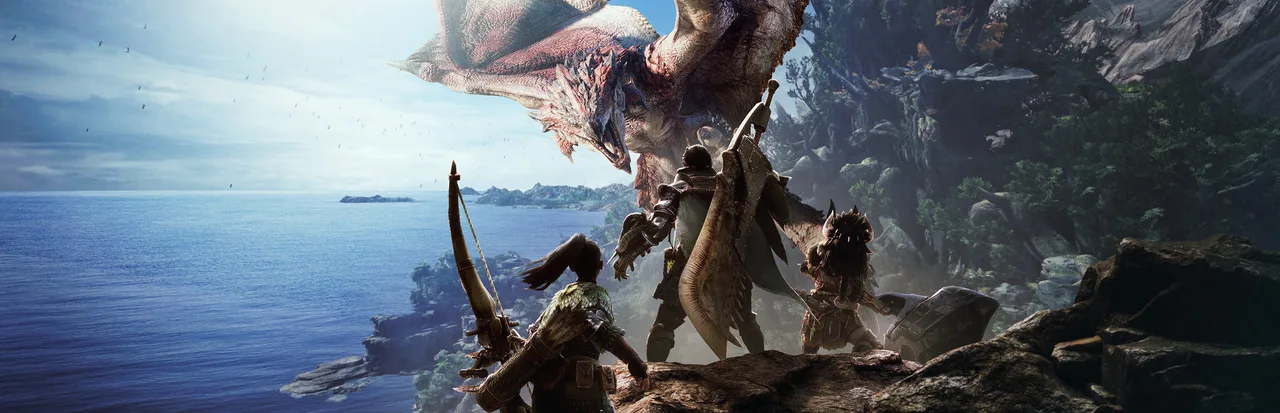
About Monster Hunter: World
Monster Hunter: World came to PlayStation 4 and Xbox One on 26 January 2018, and to PC on 9 August 2018. Iceborne, the Master Rank expansion, followed on 6 September 2019 for consoles and 9 January 2020 for PC. This review covers the base game with its free title updates, plus Iceborne, which needs the base game to play.
The map is the second weapon
Older Monster Hunter split a hunt into numbered zones with a loading screen between each one. World replaced that with one continuous map per locale and filled it with things that matter: ledges to leap from, boulders you can drop on a monster's head, water that slows it down, and other monsters crossing the same ground who would sooner fight each other than you. The fights are still about commitment and timing, but plenty of the thinking now happens before you swing. Pick your ground, use it, and let two large monsters solve a problem you were going to have to solve alone.
Tracking changed with it. Scoutflies light up a trail of footprints, scratches and carcasses until it points at your target, and that one change is the biggest reason this is the entry that stuck for people who had bounced off the older games. The density is still there. It is just no longer hidden.
The Slinger does more than it looks like it should
Every hunter carries a Slinger on the left arm. It fires stones and knives that make a monster flinch, carries capture nets, and pulls you across gaps and up onto ledges. Around it sit mantles for temporary buffs, environmental traps you set off with the right ammunition, and the Palico that fights beside you. Fourteen weapon types sit at the centre of all of it, each with its own moveset and its own idea of what a good opening looks like.
Where the base game ends
High Rank is the base game's ceiling, and its endgame is a gem hunt. Decorations slot into armour to finish off your skills, tempered monsters drop the better ones, and augmentations push a weapon further once you have the materials. The free title updates built on that rather than replacing it. The first of them added Deviljho, the Kulve Taroth siege arrived a month later with a new siege mode and a loot system, and the Final Fantasy XIV collaboration brought Behemoth that summer.
None of that costs extra. A copy bought today is the whole base game with every title update already inside it, so there is no version to chase and no season pass sitting on top.
Iceborne is a second game that needs the first
Iceborne is an expansion rather than a sequel, and it will not run on its own. It needs the base game installed, and the split worth knowing is between what you own and what you have finished. The combat additions — the Clutch Claw, the new weapon moves and the drawn-weapon Slinger — are live for Iceborne owners as soon as the expansion is installed. The expansion's own story and Master Rank are the gated half, and they open once the base game's story is finished and you have reached Hunter Rank 16. Master Rank is the third difficulty tier above Low and High: its own gear, its own monsters and a new hub in Seliana, reached through the snow of the Hoarfrost Reach.
This is where the Clutch Claw lives, and it is the tool most often remembered as part of the base game. It turns the Slinger into a grappling hook. Cling to a monster and you can steer it, drive it into a wall with a Flinch Shot, or soften a part so your weapon cuts deeper. Iceborne also lets you fire the Slinger with your weapon out, gives all fourteen weapon types new attacks and combos, adds pendants for your weapons, and adds Raider Ride: whistle for a small monster and it carries you to a marker on the map while you sort your items.
Master Rank's endgame is the Guiding Lands, a locale stitched together from the biomes of the other maps that only opens once the Iceborne story is finished. What it feeds is the deep end of the tier: the Great Spiritvein Gems and other rare drops that push finished Master Rank gear further through weapon augmentation and custom upgrades. Ordinary Master Rank gear comes much earlier, forged from the monsters you meet on the way up. Layered armour arrives properly here too, so a set can be worn for its look while you keep the stats you actually want.
The expansion's update run matched the base game's: free, and generous with it. Rajang came first, then the Safi'jiiva siege alongside a Tundra region for the Guiding Lands and Stygian Zinogre, then Raging Brachydios and Furious Rajang, then Alatreon with Frostfang Barioth, and finally Fatalis on 1 October 2020, which Capcom billed as Iceborne's last major addition.
Iceborne reached consoles first, and PC did not get it until the following January. The port then spent its opening months catching up: Rajang arrived in February 2020, and the Safi'jiiva siege with the Tundra region and Stygian Zinogre in March. After that, Capcom synced the two, so every update from late April 2020 onward landed on PC and console on the same day, Alatreon and Fatalis included.
Where it lands
Monster Hunter: World has sold more than 30 million copies, and on Steam the base game's page sits at Very Positive across roughly 517,000 reviews. Iceborne's own page sits at Mixed across about 24,000. That gap is the honest shape of the package. World is the half built for people arriving from other games, and Iceborne is the half aimed at hunters who wanted more once High Rank ran out and were content to grind Master Rank for it.
If you are buying one, the base game is the safer bet. If you already know you like this loop, the Master Edition is the one that includes both, and the expansion is the part that decides whether this lasts you a month or a year.
Should you play it
Yes, if you want the Monster Hunter that explains itself. The fights reward patience more than raw reaction, the ecosystem does real work inside a hunt instead of sitting in the background, and the hunt, carve, craft loop has enough pull to carry a long evening. Fourteen weapon types means the loadout you pick in your first hour is rarely the one you settle on later, and switching is cheap.
The friction that remains is mostly social. Co-op is drop-in and runs up to four hunters, and there are two ways into a hunt: join an online session by invite or session search, or fire an SOS flare that opens your quest to hunters outside it. The flare sits alongside the lobby, not in place of it. Story assignments are the one real snag, since each hunter has to watch that quest's cutscenes on their own before anyone else can drop in, and the flare stays locked during that first discovery, but the hunt itself is a group one once the scenes are done. Online play on consoles sits behind the usual subscription; on PC there is none.
Skip it if you want a Monster Hunter that explains nothing and punishes everything. World still expects you to learn a monster's tells, and the Master Rank content expects a real build rather than good reflexes, which is a different sort of homework.
Three things before you buy
Iceborne is an expansion and it needs the base game. The bundle that contains both is sold as Monster Hunter World: Iceborne Master Edition, which is the simplest way to buy the whole thing, while the Deluxe and Digital Deluxe versions add cosmetic kits on top. Layered armour changes how your character looks and nothing else.
Release timing depended on your platform. Consoles got the base game on 26 January 2018, PC on 9 August 2018, and Iceborne reached consoles on 6 September 2019 but PC only on 9 January 2020. There is no cross-play and no cross-save, so you hunt with players on the same system and your save stays where you made it.
World is a PlayStation 4 and Xbox One game that plays on PS5 and Xbox Series X|S through backward compatibility rather than as a native version, and PlayStation notes that some PS4 features can be absent on PS5. The PC release carries the extras you would expect from a later port: uncapped framerate, a high-resolution texture pack, ultrawide support and DirectX 12. The Horizon Zero Dawn collaboration, which puts Aloy's gear in the game, is a PlayStation exclusive.
Go deeper with V4mp
- Developer
- Capcom
- Genre
- Action RPG
Explore Monster Hunter: World further
Explore the wiki for detailed reference pages on the game's world, systems, items and locations.