
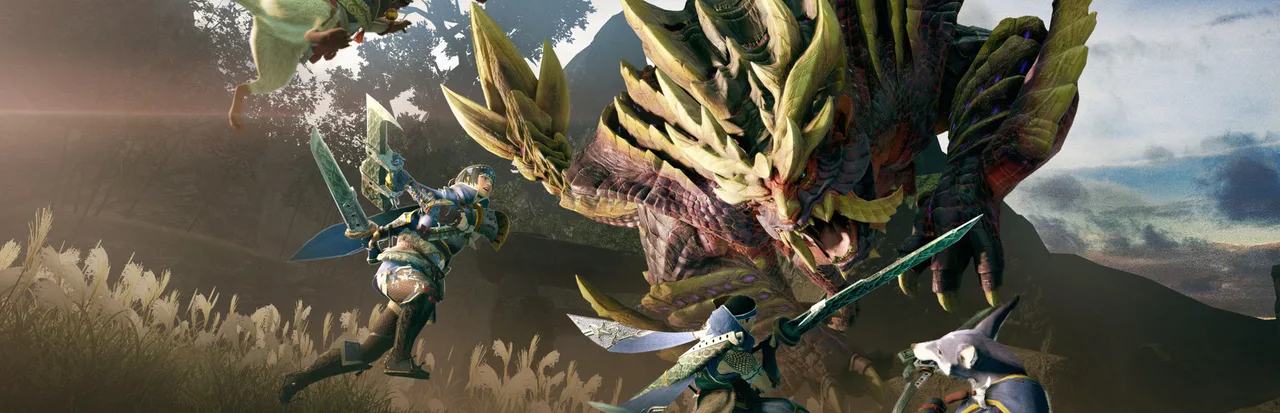
About Monster Hunter Rise
As Kamura’s hunter, you take on quests to protect the village from the Rampage, a dangerous wave of monsters. Prepare a weapon and companions, use Wirebugs to move and attack, then turn hunt rewards into improved gear as Village and Gathering Hub quests lead toward harder monsters.
Monster Hunter Rise is set around Kamura Village, where a returning threat called the Rampage puts the community on alert. The player becomes one of Kamura’s hunters, taking assignments from Hinoa and Minoto while learning how the village prepares to defend itself. The story advances through Village Quests and urgent hunts, with Magnamalo among the monsters tied to the danger facing Kamura. The central work remains familiar to the series: travel to a hunting ground, understand a monster’s behaviour, bring it down or capture it, and use the materials to prepare for the next target.
The two quest paths serve different roles. Hinoa offers Village Quests, which are solo missions that introduce the story and gradually teach mechanics. Minoto assigns Gathering Hub quests designed for multiplayer, though they can also be attempted alone. Completing important quests opens urgent assignments; clearing those raises Hunter Rank and makes additional hunts available. Village and Hub progression are tracked separately, so the game can be approached as a guided single-player route, a cooperative hunt ladder, or a mix of both. Subquests add small objectives—such as gathering materials or hunting a particular kind of monster—alongside a main assignment.
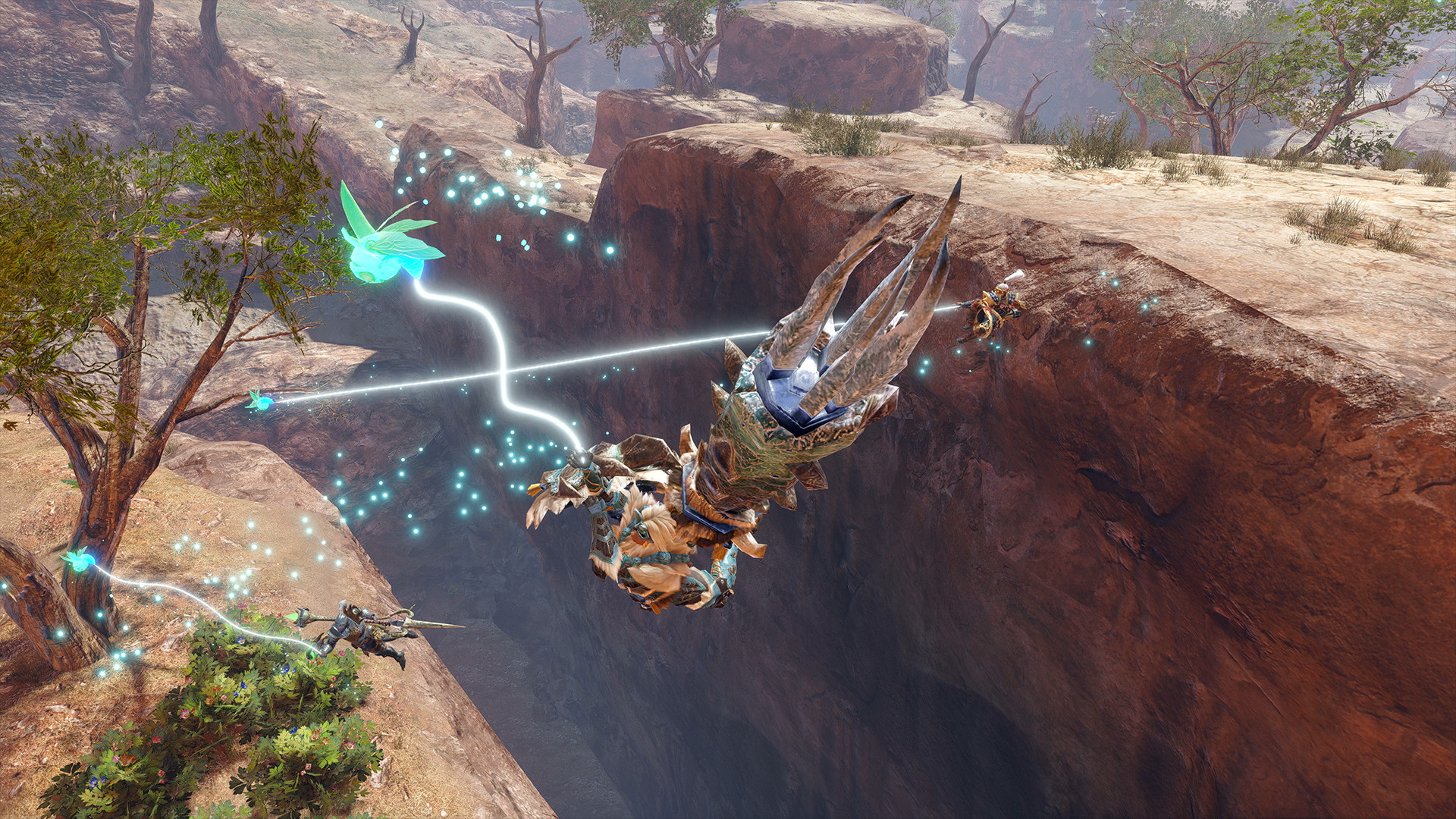
Rise’s defining mobility tool is the Wirebug. Its limited charges recharge after use, and a Wiredash can pull the hunter upward or launch them forward, helping cross uneven terrain, evade attacks or recover positioning. When a weapon is drawn, Wirebugs also power Silkbind attacks, special moves unique to each weapon type. The same tool therefore affects both travel and combat, making charge timing part of a hunt’s rhythm. Wild Wirebugs found in the field can temporarily provide an extra use, while Great Wirebugs placed at marked points launch hunters toward otherwise remote parts of a locale.
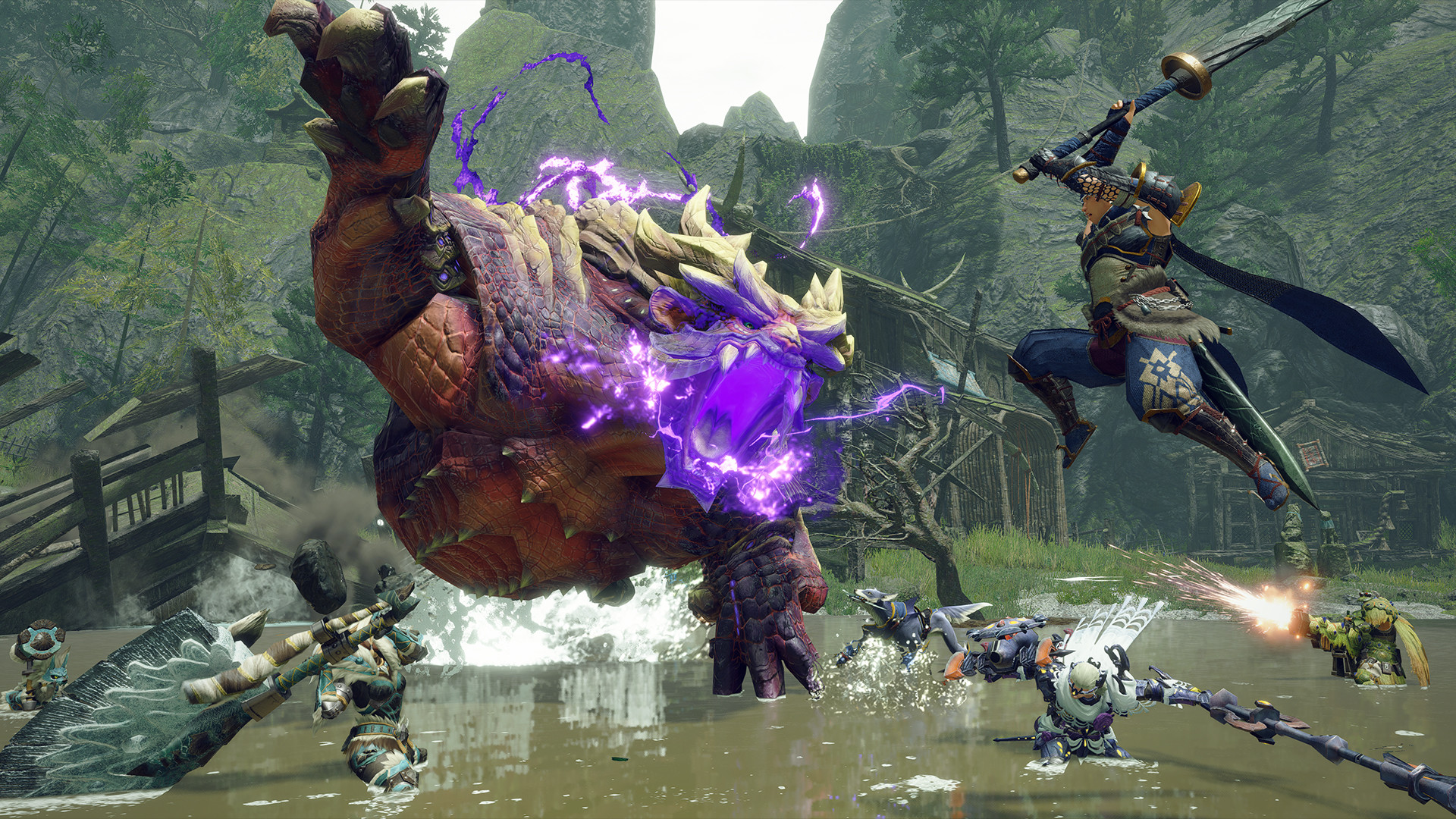
Fourteen weapon types give hunts distinct rhythms, from slower heavy strikes to faster strings of attacks and ranged tools. Each requires attention to a monster’s movement and openings; striking different body parts can affect how effective an attack is. Switch Skills unlock as the hunter progresses and let a weapon replace selected attacks with alternatives, changing its moveset without changing the weapon category. The Training Area offers room to test weapons and Wirebug actions before a quest. In the field, the hunter can also gather endemic life with temporary effects, such as restoring health or improving defence, and use local routes to reach a fight from a useful angle.
A monster can be set up for Wyvern Riding after sufficient Silkbind attacks or by drawing it into a clash with another monster. The hunter can then steer the mounted creature for a short time, attack another monster or launch the mount into a wall. These encounters create openings and can scatter extra materials across the ground. The system makes rival creatures part of the hunt’s tactical landscape: a second monster may be a threat, but it can also become a tool for weakening the intended target before returning to the hunter’s own weapon and combinations.
The Buddy Plaza and Kamura’s services support the hunt between missions. A Palamute can carry the hunter quickly across a locale and join combat, while a Palico brings its own support abilities; solo quests allow two companions to accompany the hunter. Reserve buddies need not remain idle: the Meowcenaries can be sent along gathering routes to return with materials, and the Argosy can barter for selected supplies. The canteen’s Bunny Dango offers a choice of temporary quest benefits, so selecting a meal is another part of preparing for a difficult hunt rather than simply restoring a meter.
Monster parts and gathered resources feed the familiar equipment progression. The smithy turns them into weapon upgrades and armour, and Armor Spheres earned through side objectives can strengthen armour pieces. A new weapon path may call for materials from a particular target, giving a reason to repeat a hunt with a different build or objective. Equipment changes are handled through an Item Box in Kamura or the tent at camp; the separate Supply Box at camp provides quest provisions such as first-aid medicines and rations. Online groups can join Hub Quests, coordinating attacks and support while the village story remains a separate solo route. On Nintendo Switch, hunters can also play Hub Quests through local wireless, with each player using their own console and copy. Senri the Mailman in Kamura provides the lobby options before the party chooses a Hub Quest.
The Rampage gives that preparation a different objective from a regular field hunt. Kamura’s Stronghold uses barricades to slow incoming monsters and defensive installations to discourage their advance, while hunters work together to repel the onslaught. It places the village’s safety at the centre of the quest rather than asking for a single target to be pursued across a locale. The ordinary hunt remains essential preparation: materials from dangerous monsters can be forged into better weapons and armour before the next defence. This connects Kamura’s story threat to the same equipment loop that supports each individual hunt.
Monster Hunter Rise launched on the Nintendo Switch on 26 March 2021, came to PC on 12 January 2022, and arrived on PlayStation 4 and PlayStation 5, Xbox One and Xbox Series X|S, and the Windows Store, on 20 January 2023. This review covers the base game with its free title updates, plus the Sunbreak expansion that carries the Master Rank endgame.
The Wirebug changes every hunt
The Wirebug is a stock of charges rather than a single cooldown. Wiredashing, Wirefall and Silkbind attacks all draw on it, the charges come back on their own, and the price differs by move: a dash is cheap enough to use constantly, while a weapon's Silkbind attacks are the expensive, deliberate option that competes with the Wirefall you may want for an escape. Wall-running is the exception: you spend a bug to launch into a run, the climb itself runs on stamina rather than eating more charges, and you can also start one straight from a dash or a jump without spending anything, which turns half a map into a shortcut.
Every one of the 14 weapons has its own Silkbind attacks and you carry two into a hunt, while Switch Skills change your ordinary moves. Two hunters using the same weapon can be playing recognisably different games because of it. Sunbreak adds Switch Skill Swap, which lets you load two Switch Skill sets and flip between them mid-hunt, with a Swap Evade to cover the switch. That is the most interesting thing the expansion does, because it removes the old either-or choice between two competing moves.
Riding monsters is a real second system
Get a monster into a mountable state and you can ride it. Enough damage from Wirebug moves will do it, and so will letting two monsters fight, or firing off a Puppet Spider. Once you are up there you steer, pick a fast light attack or a slow heavy one, launch the monster into a wall or into another monster, and spend a full riding gauge on a Mounted Punisher. Time the launch well and you can spring back onto the monster and slam it into the wall a second time. Then you dismount and leave the target on the floor. It is not optional once you learn it: the fast hunts are the ones where the monsters do part of the damage for you.
The rest of the traversal kit matters just as much. A Palamute carries you across a map, so walking between fights stops being the default, and riding one costs you nothing from the Wirebug. Wirefall is the opposite: it picks you up out of a knockdown instead of leaving you to eat whatever comes next, but it spends a charge, so the escape competes with your Silkbind attacks. Iceblight slows charge recovery down, and that is one of the few times Rise takes your mobility away.
Kamura, and the mode that splits people
Village quests are the solo opening path rather than the whole game: they ease you in, and nobody else can join you. Hub quests run solo or with up to four hunters, and the difficulty scales to the number of players in the hunt, adjusting on the fly as they join or leave. The Hub is also where the rank progression lives. Around the two of them sit arena quests and challenge quests, which hand you preset gear and rank you on clear time, plus requests from villagers and repeatable event quests. The outlier is the Rampage.
A Rampage is waves of monsters throwing themselves at a fortified stretch of the village, with hunting installations you place on platforms and either fire yourself or leave to run automatically, and a Major Threat to repel at the end of each wave. It breaks the normal rules: fainting does not fail a Rampage quest, but losing the gate guarding the final area does. That turns a hunt into something closer to tower defence with Monster Hunter parts, and plenty of hunters skip it. Worth knowing before you do: Defender Tickets come from Rampage quests, and they are what Rampage weapons, armour and Ramp-up skills are built with. Skipping the mode closes recipes rather than just saving time.
Sunbreak is where the game gets long
Sunbreak is an expansion rather than a second game. It moves the story to the Elgado outpost, adds Master Rank and a new roster of monsters, and it keeps the door shut until you finish the base game's HR 7 hub quest, Serpent Goddess of Thunder.
The endgame inside it is Anomaly quests. Those open at Master Rank 10 and put you against Qurio-afflicted monsters that hit harder and move faster, with glowing Anomaly Cores appearing on their bodies while they are in a Delirious state. Hit the cores enough and they detonate for heavy damage. The materials you get back are what Rarity 10 weapons are made from. Anomaly Investigations arrived with the first title update and add randomly determined conditions and rising levels as your Anomaly Research Level climbs, with Special Investigations as the top tier added in the fifth update. Qurious Crafting spends the same materials on weapon augmentations, which are fixed and slot-based, and on armour augmentation, which is randomised every single roll.
Followers are the friendlier half of the Master Rank package. Follower quests team you up with a named character from Elgado or Kamura, one or two at a time, and completing them unlocks those characters as Support Survey companions you can take into other quests with weapons you choose for them. The third title update widened that to almost every Master Rank quest, Anomaly quests included.
The free update run finished in 2023: five title updates plus a bonus update, from August 2022 to June 2023, ending with Primordial Malzeno. Capcom's own patch list runs on to version 16.0.2 in January 2024. None of that was a limited-time event, so a copy bought today already contains all of it, including the Forlorn Arena, layered weapons, the Risen elder dragons and Amatsu.
Where it lands
Rise has sold more than 15 million copies and Sunbreak more than 8 million. On Steam the base game sits at Very Positive across roughly 126,000 reviews, while the expansion's own store page sits at Mixed across about 6,800. That gap is worth a look before you buy Sunbreak. The base game is the generous half: 14 weapons, a movement system the older games do not have, and a difficulty curve that lets you learn a monster before it punishes you for getting greedy. Sunbreak is the long half, and its endgame is a grind with randomised armour augmentation sitting in the middle of it. If you like a ladder to climb, that is the appeal. If you want the hunts and nothing after them, the base game stands on its own.
Should you play it
Yes, if you want a Monster Hunter where moving is as interesting as fighting. The Wirebug makes a hunt feel like a pursuit rather than a series of committed swings, and the Silkbind and Switch Skill loadouts give each of the 14 weapons room to be played your way. On PlayStation 5 you also get a choice of 4K at up to 60 frames a second or 1080p at up to 120, plus 3D audio and DualSense trigger feedback on gunner weapons and shield blocks.
Before you spend anything, check your subscription. Rise sits in the PlayStation Plus Game Catalogue, so an Extra-tier plan covers it right now, though catalogue games come and go. It was also a monthly game in March 2026, and that only helps if you added it to your library during that month and have kept your membership going since.
Skip it if the Rampage and the anomaly grind sound like homework. The base game is still worth playing for the movement and the monsters, but the version of Rise that keeps people busy for hundreds of hours is the one grinding Afflicted monsters for materials between title updates, and that part is a job as much as a hunt.
Three things before you buy
Sunbreak is an expansion and it needs the base game. The Monster Hunter Rise + Sunbreak Set bundles the two together, and the Deluxe Kits are layered armour and cosmetic extras with no effect on your stats.
Every copy of the base game includes the free title update content, which is an extra story ending, more monsters and more gear on top of the launch version. What you buy today is not the 2021 game, whichever platform you buy it on.
Cross-play and cross-save stay inside a platform family rather than spanning them, so decide with your friends before you commit to a copy. PlayStation 4 and PlayStation 5 players hunt together, and the Xbox One, Xbox Series X|S and Windows versions share cross-play and carry the same save between them. The Steam version is the odd one out: it has no cross-play or cross-save with any other platform, and a Switch hunter cannot join a PlayStation hunt either.
Go deeper with V4mp
- Developer
- Capcom
- Genre
- Action RPG
Explore Monster Hunter Rise further
Explore the wiki for detailed reference pages on the game's world, systems, items and locations.