
About Clash Royale
Clash Royale turns the Clash universe into short real-time arena battles. Build an eight-card deck, spend regenerating Elixir to deploy troops, spells and buildings, and protect your Crown Towers while pressuring the opponent’s. Trophy Road, Ranked, rotating modes and clan play add longer goals to a duel built around timing, card cycles and tower damage.
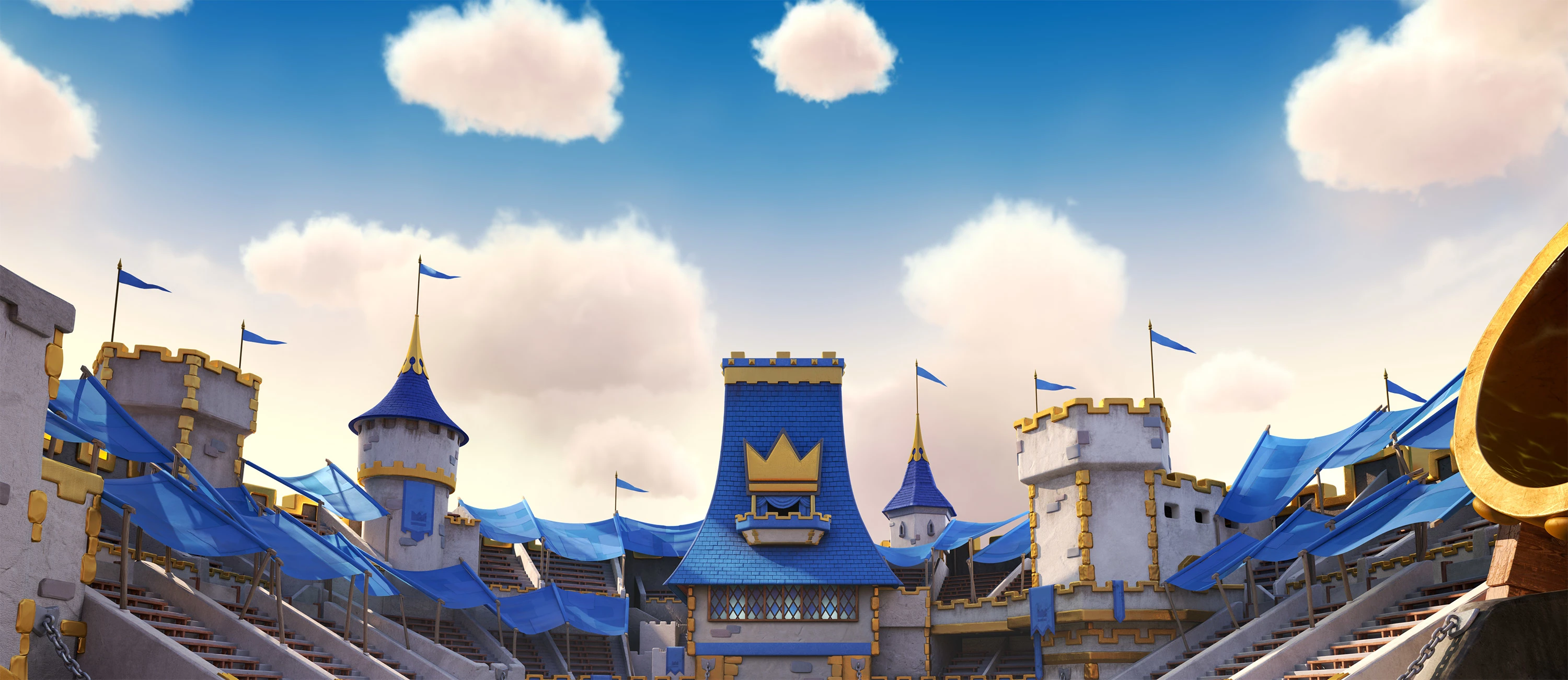
Clash Royale is a competitive strategy game set in Supercell’s Clash fantasy, where familiar troops and spells become cards in a compact real-time battlefield. Two players face each other across a river, with bridges creating two approach lanes and three Crown Towers on each side: two side towers guard the King Tower. The immediate objective is to destroy more enemy towers before the match ends; taking the King Tower ends the fight at once. Troops move and attack under their own rules after deployment, so the player’s work is to choose the right unit, place it in the right lane and time it against the opposing push. The board stays legible, but every card changes the shape of the next few seconds.
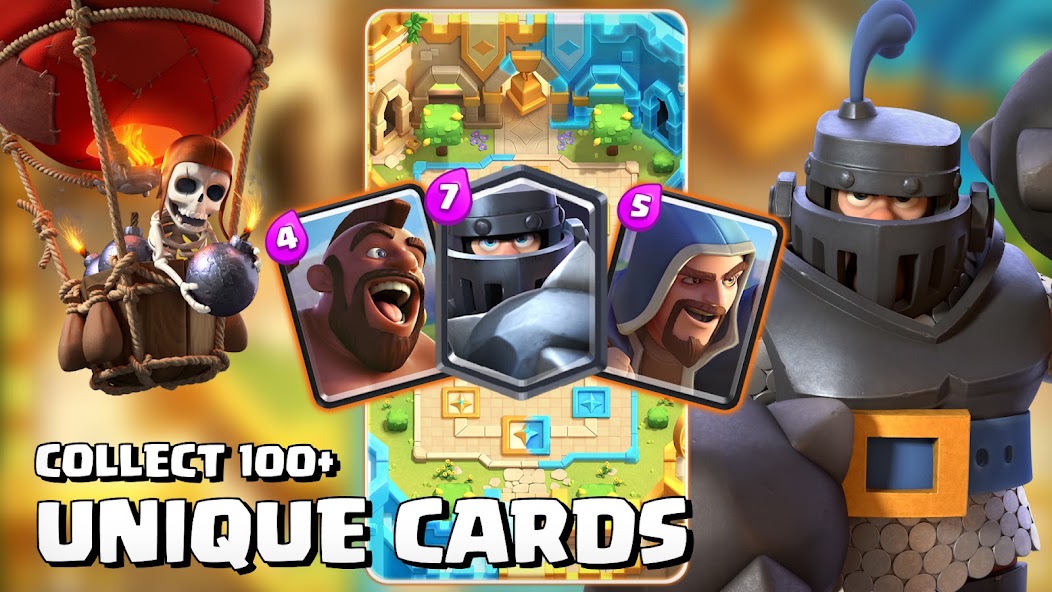
An eight-card deck is the player’s tactical kit. Cards include ground and flying troops, buildings, spells and Champions, each with an Elixir cost and battlefield role. Elixir replenishes during a match, making every deployment an economic choice: a costly unit may anchor an attack, while cheaper cards can interrupt an enemy or cycle the deck back toward a needed answer. Only four cards are in hand at once; after one is played, another enters the rotation. Recognizing the opponent’s recent cards therefore matters alongside tracking their available resource. A deck is not simply a collection of strongest units, but a sequence of answers and threats that can defend efficiently, support a push or pressure both lanes.
The bridges and tower ranges turn placement into a central skill. A defender can draw enemy troops toward a building, split attention between lanes or let a unit cross before surrounding it. Spells can damage troops and towers, but their value often comes from striking a group or disrupting a deployment. Ground troops cannot cross the river everywhere, while flying units ignore many ground obstacles and need suitable anti-air responses. A push becomes a chain of decisions: whether to add support behind a surviving tank, spend a spell to remove a counter, or preserve Elixir for defense. Because troops continue acting after deployment, small timing and spacing differences can decide whether an attack reaches a tower or is absorbed in the arena.
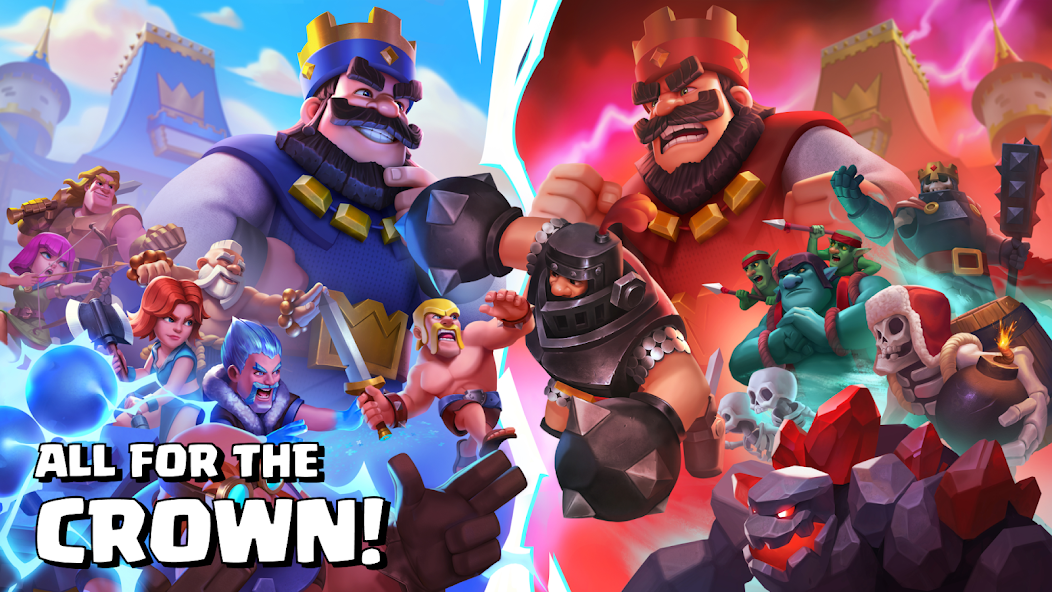
Card collection gives the game a long-term progression layer. New cards appear through progression and rewards, while copies and Gold can upgrade cards to improve their battle level. Wild Cards and other resources support targeted development; card level changes how units withstand and deal damage, so collection and upgrading affect the tools available as well as account progress. Some cards have Evolutions: shards unlock an Evolution, the card must occupy an Evolution Slot, and repeated plays cycle it until its enhanced form becomes available. The transformed version is deployed like the regular card and then returns to its standard state, requiring another cycle. This adds a visible sequence to deck planning: the player weighs when a powerful form will come online and how to keep the card in rotation.
Progression also takes place across several kinds of competition. Trophy Road links wins to arenas and milestone rewards, while Ranked provides a separate seasonal climb. The Battle Hub gathers game modes, and rotating events can impose different rules or deck requirements, encouraging players to use more than one familiar strategy. Merge Tactics, introduced as a distinct mode, changes the structure into a four-player turn-based contest where units are merged and combinations are built between rounds. These variations retain recognizable Clash units but change the decisions being tested, from real-time lane defense to drafting and arranging a stronger formation. Elixir income also changes as the clock advances: standard battles begin at a steady rate, then accelerate in the later minute and overtime, while individual events can use different rules. A deck that feels expensive early may become more deployable later, which is why players often preserve a defensive answer instead of spending every point on immediate tower pressure.
Clans add a social structure around individual matches. Members can share cards and coordinate around clan activities, while friendly battles let players test decks outside trophy competition. Clan Wars asks members to contribute across a sequence of battles, making a deck’s flexibility useful beyond a single duel. The value of a card can shift when the rules change: a troop that is awkward in one standard matchup may fit a challenge’s restricted pool or a war format. This gives collection a practical purpose beyond leveling, since a broader roster opens more possible answers when an event asks for a different combination.
The towers themselves have a loadout choice. Tower Troops occupy a separate deck slot and defend from the two side towers rather than joining the hand of cards deployed with Elixir. Their identity is revealed when the battle begins, so choosing one affects the defensive foundation underneath the moving army. Outside the arena, Collection Levels track development across the whole roster: card levels contribute to the total, with owned Evolution and Hero forms adding further progress. Unlocking and upgrading cards can therefore advance account milestones even when those cards are absent from a preferred deck. Mastery tasks provide another set of card-specific objectives and Gold rewards. These systems separate several kinds of improvement: learning how to use a deck, strengthening its cards, selecting its tower defense and expanding the collection behind it.
It is Supercell's real-time card battler for phones, and it has grown well past the game that launched in 2016, so the cards you have collected and upgraded are part of every match you play.
What a match actually is
You and one opponent each defend three towers: a King Tower in the middle and a Crown Tower on each side in front of it. The arena is cut by a river with a bridge on each side, which gives you two lanes to push and two lanes to cover. Each deck holds eight cards, four of them sitting in your hand at any moment, and deploying a card costs elixir that refills on a timer up to a cap of ten.
The win condition is the King Tower. Knock it down and the match ends immediately, whatever else is standing, because taking the King takes the two Crown Towers with it and hands you the full three crowns. Most games are settled by crowns instead. The clock runs for three minutes and the player who has destroyed more enemy Crown Towers wins; tied on crowns, you get two extra minutes of overtime played as sudden death, where the first tower to fall on either side ends it. If nothing falls in overtime the tiebreaker takes over: all troops leave the arena and the towers start losing health rapidly until one is destroyed, which means the player whose tower is lowest going in is the one who loses.
Everything else follows from the elixir bar. A defence holds only if you have the cards in hand to pay for it, so the hand you keep, the four you cycle through, and the moment you decide to attack are the same decision seen from three angles. That is the skill in it, and it is a real one.
Cards, rarities and the power you collect
There are more than a hundred cards, split across Common, Rare, Epic, Legendary and Champion rarities. Cards are collected and upgraded, and the Arenas you climb unlock new cards and features as your trophy count rises.
Champions were the first card type to give you a button instead of just a placement. A Champion has an activated ability you trigger during the battle, which makes it a different kind of decision from the usual deploy-and-forget troops. Heroes, added at the end of 2025, take that idea sideways: they are revamped versions of classic cards with Champion-style abilities attached, which means a familiar face can come back as something you have to time rather than just place.
Card Evolutions are the other long-running system, added in 2023. An Evolution gives one specific card a stronger second form with a special ability the original does not have, and it is not something you bank and choose to spend. Each evolved card has a cycle count: you deploy the normal version that many times, a diamond above the card fills in as you go, and the deployment after that is the evolved one. Two cycles means every third play of that card arrives evolved. So the skill is not deciding whether to use it — that part is automatic — but setting the cycle up so the evolved card lands when you actually want it, rather than sitting in your hand while the push it was meant to break stalls at the bridge.
Tower Troops change your defence without touching your deck
Tower Troops are a smaller system that quietly changes how a deck behaves. Every battle deck carries a ninth slot reserved for one, and the two Crown Towers take on the chosen troop's stats and attack pattern — the King Tower is not affected, so this is a change to your front-line defence rather than to everything you own. Since those Crown Towers are what you are protecting all match, swapping the occupant is a real trade rather than a cosmetic choice. A tower unit that helps clear swarms plays nothing like one that simply chips away at a tank, and you can compare both without rebuilding the eight cards you are testing.
Modes, leagues and the rest of the menu
Ladder is the spine: 1v1 matches that earn trophies and move you through the Arenas, with ranked play opening at a high enough trophy count and running through a set of leagues that finishes at the top competitive tier. Beyond that, 2v2 lets you play with a clanmate or a stranger, and the game regularly rotates limited-time modes. The current update cycle has added a new card in Minion Giant, a new Ice Wizard Hero, and Royale Shuffle, a mode that spins a wheel to hand you one of twelve modes with a random deck.
Clans are the social half of all this, giving you a place to trade cards and a reason to log in daily, and clan wars give the group a shared objective. Season Passes, daily offers and challenges sit on top with Tower Skins, emotes and magic items. Challenges are the part worth reading twice, because they are not all the same shape. The usual format ends a run after three losses, and some of those runs can be continued with Gems or resumed for free on the pass. But the win targets run from as few as three to as many as twenty, the shortest ones often have no free entry at all, other challenges do not count losses and simply ask you to bank a number of wins, and the draft formats hand you cards rather than the deck you brought. Read the rules on the event before you assume it is the usual three-and-out.
Should you play it
Yes, if you want short competitive matches that fit between other things and you like the idea of a deck you keep tuning. Three minutes is enough for a real match, the elixir economy creates constant small decisions, and the Evolutions and Heroes give the long game something to chase beyond another trophy tier.
Skip it if you want every card available to you on day one. Cards are upgraded, Evolutions are unlocked per card, and Heroes and Champions are collected rather than handed over, so the collection is a genuine part of the game rather than a menu you skip past. It is a ladder built around repeatedly tuning a deck, and if you want to be judged only on the eight cards in front of you, that is not quite what this is.
Go deeper with V4mp
- Developer
- Supercell
- Genre
- Strategy
Explore Clash Royale further
Explore the wiki for detailed reference pages on the game's world, systems, items and locations.