
About Block Blast!
Block Blast! is a single-player puzzle with an 8-by-8 Classic board, an endless high-score challenge, progressive Adventure levels, and daily puzzles. Players drag shapes onto the grid, complete full rows or columns, and build combos, while each mode frames the same familiar block-placement idea around a different goal.
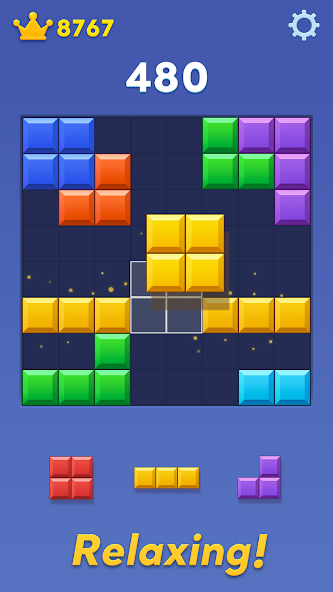
Classic Block Puzzle mode starts on an 8-by-8 board and asks the player to drag shapes onto its cells. Each shape occupies a specific arrangement of squares, so the player is solving a spatial-fit problem rather than matching colors or moving a character through a world. The board is the entire playfield: its filled and empty cells show which placements remain possible. A move is made by positioning a shape on the grid, and each new placement changes the pattern available for the next decision. The compact format makes the rules readable immediately, but it also means every placed block becomes part of the puzzle until a line is completed.
Rows and columns provide the clearing rule. A full horizontal row or vertical column is removed, creating a line clear and changing the occupied pattern. The two directions give placements different functions: a shape can extend a row, extend a column, or align with both. For example, if one placement fills the last missing cells in a row and a crossing column, the move completes two lines at once. That is a geometric consequence of the grid rather than a separate color-match rule. Each clear transforms a particular portion of the board, and the player can use those newly empty cells for later pieces.
The score system rewards combos from clearing multiple lines, so the placement decision has an immediate and a cumulative side. A single completed line yields a clear, while a placement that finishes several lines at once creates the larger combo emphasized by the game. This makes line intersections valuable: two partial lines can share the same future placement, letting one shape resolve more than one unfinished pattern. Players can pursue a direct score gain or hold a setup for a bigger combination. The game does not require a fixed route across the board; each run develops from the particular shape placements and line clears made along the way.
Shape placement also makes arrangement more important than the raw count of empty cells. A broad shape needs a matching footprint, while a narrow arrangement may fit into a smaller region but may not help complete a useful line. Keeping room for upcoming shapes makes the current placement a decision about the next one as well. Eight isolated empty cells, for example, are not equivalent to one open two-by-four rectangle: the same total space accepts different footprints. A useful way to read the board is to track partial rows and columns while preserving areas that can take more than one kind of shape. This is a strategic implication of the placement and clearing rules: a move can earn points now but leave a less flexible pattern for later.
Classic mode frames the board as an open-ended score challenge. The player tries to improve a personal best by sustaining a sequence of placements and clears, rather than defeating an opponent or reaching a story ending. Because there is no rival making moves on the same grid, attention stays on the player’s own decisions and the changing geometry. A stronger score comes from finding placements that create useful clears and combos while continuing the run. The result is a solo puzzle loop with a clear comparison point: the current score can be measured against the player’s previous record, and a new attempt begins with another board puzzle.
Adventure Mode supplies a different kind of progression. Instead of emphasizing one open-ended score run, it moves through progressive levels with unique jigsaw designs and colorful themes. That level-based structure gives players a succession of distinct presentations of the block puzzle and a reason to advance from one stage to the next. The stages replace the continuous record chase with a sequence of separate puzzles. Moving on changes the presentation and arrangement to be considered, giving completion a different role from extending a single Classic run. Classic and Adventure therefore frame the block-placement activity differently: record-building in one and level advancement in the other.
Daily puzzles create a recurring challenge in addition to the Classic record chase and Adventure progression. The daily format refreshes its puzzle goal, and the mobile listing ties those challenges to rewards. Players can also compare or share results with friends, adding a social reference to what remains a single-player board puzzle rather than a live head-to-head match. Offline play is supported for the main puzzle experience, so the placement-and-clearing activity does not depend on a constant connection. The game’s different modes are thus distinguished by their aims: personal scoring, progressive themed levels, and a refreshed daily challenge.
On iOS, the app also supports Game Center achievements. Those sit beside the internal score chase: Classic scores can be compared with the player’s best, while platform achievements supply a separate set of milestones. An attempt can therefore contribute to two kinds of progress, improving a block-puzzle record and unlocking platform achievements. This integration is specific to Apple devices and is not presented as a universal feature across every version.
The rules fit in a sentence and the board does not. Space is the resource, and the pieces that look most useful are often the ones that take it away.
Which Block Blast this is
Block Blast! is a free mobile puzzle game from Hungry Studio, promoted through the developer's own site at blockblast.com alongside its App Store and Google Play listings. Its listing describes a block puzzle on an 8x8 board where you place colourful blocks, clear rows and columns, build combos and chase a personal best, and it notes both ads and in-app purchases.
The name is genuinely crowded: an App Store search for "block blast" turns up other, unrelated games with similar titles alongside this one, which matters if you are looking it up rather than following a link. This page covers the Hungry Studio puzzle with the 8x8 board, and the classic mode within it.
Drag, clear, combo
Play is drag and drop. You take one of the offered shapes, put it on the board, and any row or column you fill completely disappears. Fill more than one line with a single placement and you get a bigger combo, which is where the score comes from and why the game pushes you to look at the whole board rather than the gap in front of you.
Every placement is therefore two decisions rather than one: which shape to spend, and what the remaining empty space looks like afterwards. A shape that clears a line while leaving only narrow strips behind has solved the immediate problem and created the next one, and because the upcoming pieces are already visible, you can plan around the shape you will need rather than the shape you want now.
Why runs end
A run ends when none of the pieces you have been offered fits anywhere on the board, and there are two inputs to that. One is the draw: the game hands you three shapes at a time, and an awkward set in a tightly packed corner can finish a run that you were managing perfectly well. The other is the board state you left behind, and that part is yours.
That mix is the interesting thing about the game, and it is worth being honest about the ratio rather than pretending otherwise. Some endings are the draw refusing to cooperate and some are two placements you would take back; working out which you are looking at is most of the improvement available to you.
Offline, daily and events
The listing is unusually clear about how the game is meant to be played: no connection is required, it is built as a single-player puzzle, and it goes out of its way to describe itself as an offline game. Alongside the endless 8x8 board there are daily puzzle challenges and ongoing goals, and the store page also carries a rotating in-game event banner, so the content cadence is a daily and seasonal layer rather than a story campaign.
Should you play it
Yes, if you want a quiet puzzle with a short feedback loop and no pressure to keep up with anyone. The board works offline, a run is over quickly enough that starting another is easy, and the combo system rewards clearing several lines together.
Two things to weigh. The draw is replaying the same board with a fresh set of pieces, so if you want a game that keeps handing you new levels, look at what the daily challenge and the current event actually offer before committing. And it is a free game with ads and in-app purchases, so if interruptions bother you, check how the app behaves on your device first.
Go deeper with V4mp
- Developer
- Hungry Studio
- Genre
- Puzzle
Explore Block Blast! further
Explore the wiki for detailed reference pages on the game's world, systems, items and locations.