
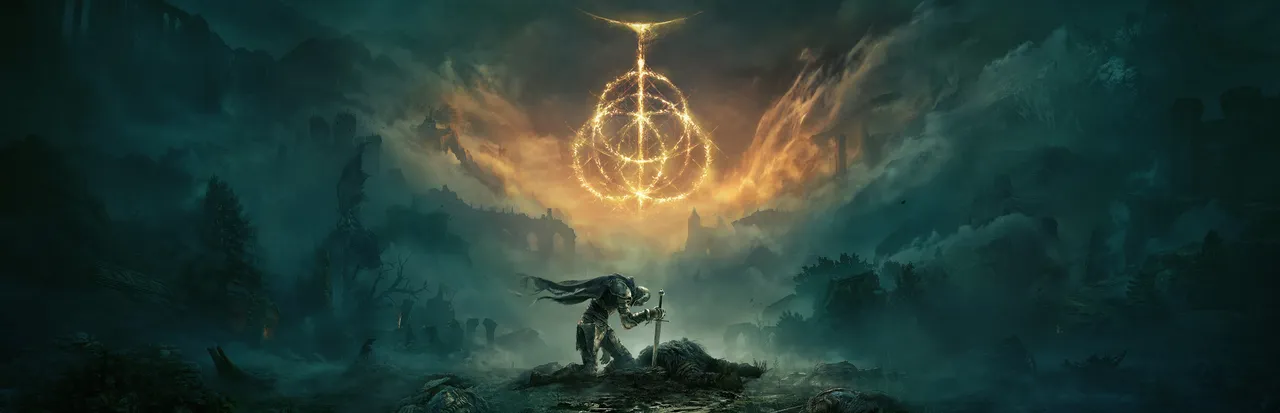
About Elden Ring
ELDEN RING is an open-world action RPG set in the Lands Between, a realm unsettled by the shattering of the Elden Ring. As a Tarnished, explore its fields, caves and legacy dungeons, follow guidance from Sites of Grace, and battle enemies while shaping a character through weapons, magic, equipment and discovered skills.
The Lands Between are ruled by Queen Marika the Eternal, whose demigod offspring claimed the Great Runes after the Elden Ring was shattered. The resulting conflict, known as the Shattering, left the realm damaged and its exiled Tarnished called back by grace. The player creates one of these Tarnished and sets out to pursue the Elden Ring and the title of Elden Lord. This is a broad premise rather than a tightly staged sequence of scenes: much of the world’s history is conveyed through places, conversations and item descriptions encountered along the way. The story’s central figures include Marika, the demigod heirs and the people the Tarnished meets while travelling through their lands.
Exploration ranges from open fields and roads to caves, mines, catacombs and the larger Legacy Dungeons. The map begins obscured; finding area map fragments reveals terrain, and the player can place markers or beacons to remember points of interest. Sites of Grace act as rest points and fast-travel destinations once discovered. Some cast a golden Guidance of Grace toward important places, offering direction without dictating every detour. Smaller locations often contain resources, equipment, characters or a boss encounter, while Legacy Dungeons connect broad landscapes to more intricate routes with locked doors, shortcuts and enemies. The player chooses which leads to follow and can often leave a difficult area to explore elsewhere.
Combat is built around reading opponents and choosing how to spend stamina, position and openings. The Tarnished can fight with melee weapons, shields, bows, sorceries or incantations, and can mix these approaches by changing equipment and attributes. Rolling, blocking, jumping, crouching and mounted movement create different ways to avoid or approach attacks. Weapons carry skills, and the character can find or equip other weapon skills as the adventure progresses. Stealth can help bypass or isolate some enemies. Boss fights are prominent tests, but ordinary groups and roaming threats also make route planning matter; the player may retreat, circle around a strong foe or return after developing the character and equipment.
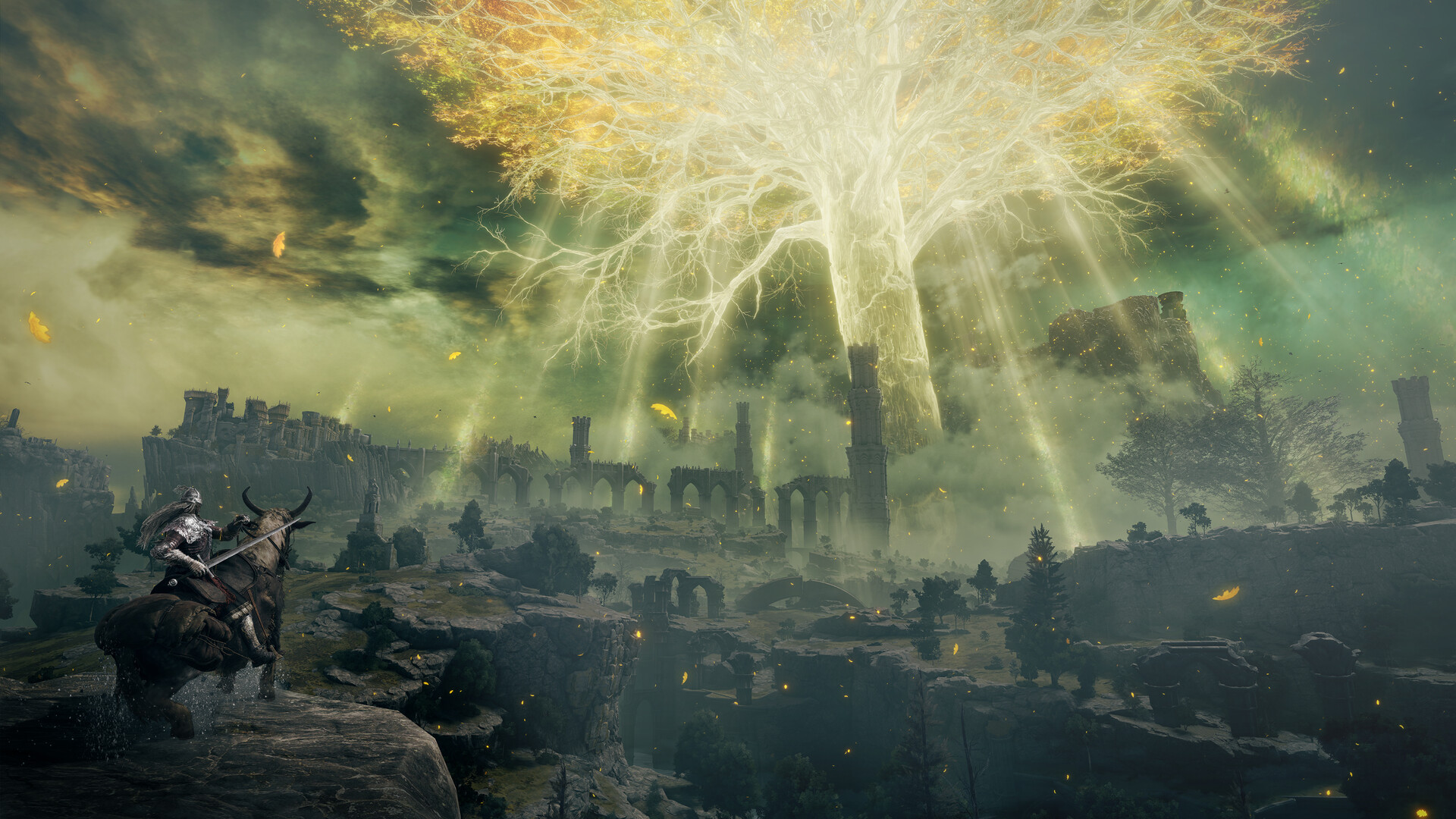
Character development uses Runes, gathered chiefly from defeating enemies and discovered in the world. At Sites of Grace, Runes can be spent to raise attributes such as health, focus, stamina or combat capabilities, while also serving as currency for goods and some improvements. Death causes the Tarnished to drop carried Runes at the place of death, creating a chance to recover them by returning there before another defeat. Weapons can be strengthened with Smithing Stones or Somber Smithing Stones. Armor changes protection and equipment load, but cannot be upgraded through the same process; and a character’s attributes affect which equipment and spells can be used effectively. This lets progression take several forms: improving survivability, leaning into a preferred weapon, building around magic or distributing points across more than one style.
Sites of Grace are also places to manage recovery and prepare for the next stretch. Resting restores health and focus, replenishes sacred flask charges and revives many defeated enemies. The player can allocate flask uses between Crimson Tears, which restore health, and Cerulean Tears, which restore focus. Golden Seeds increase the number of charges, while Sacred Tears improve how much a flask restores. The map’s churches and minor golden trees point toward some of these resources, and smaller dungeons can supply smithing stones or materials for improving spirit allies. Because flask uses are limited between rests, deciding whether to explore another branch or return to a grace is part of the expedition loop.
The spectral steed Torrent opens up the scale of the overworld. Summoned outside certain dungeon spaces, Torrent can cross ground quickly and reach elevated terrain through the world’s vertical routes. The mount also changes combat, letting the Tarnished ride past threats or attack while moving. In dangerous places, spirit ashes can call a companion to fight alongside the player when the local conditions permit; only one spirit type can be active at a time, and the summon is not available during multiplayer. Crafting provides another use for materials gathered during exploration, producing items such as arrows, bombs and consumables. Together, these systems make preparation matter: the player can adjust equipment, flasks and support to suit a route or encounter.
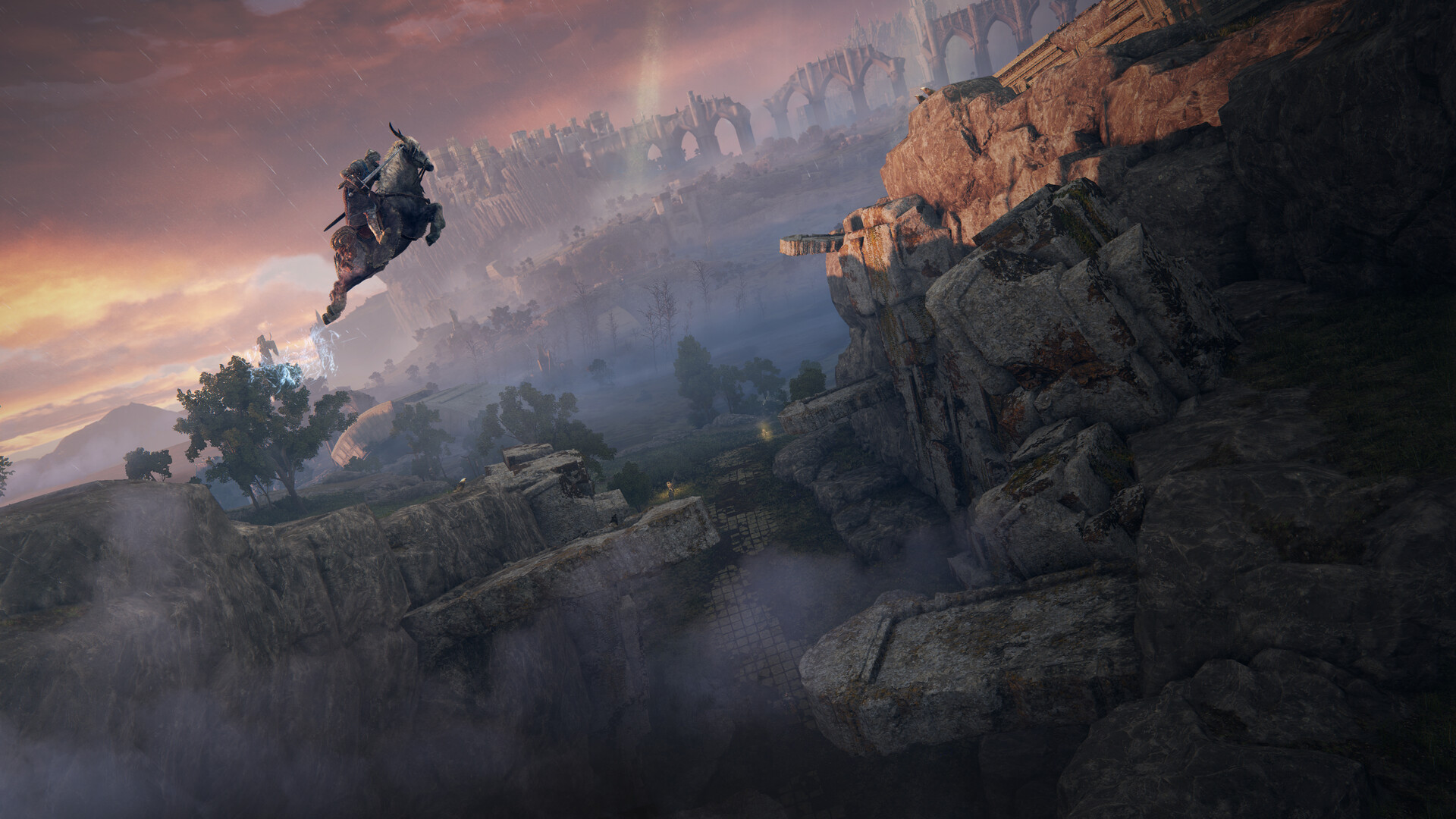
Progress does not depend on defeating every enemy encountered in sequence. The Guidance of Grace points toward key locations, but the open world offers many side paths, optional bosses and character stories. Meeting an NPC can begin a quest whose later steps depend on where the Tarnished travels and what happens in the world. Caves and tunnels reward focused exploration, while catacombs add traps and branching passages; field bosses can appear away from marked dungeon entrances. Online play also allows players from other worlds to join or challenge one another under the game’s multiplayer rules. The result is a journey shaped by exploration, combat and preparation, with the player’s build and chosen route determining much of how each challenge is approached.
FromSoftware's combat didn't change much for Elden Ring. What changed is where it happens, and how much of it you can simply decline to deal with yet.
What you're actually doing
You wake up Tarnished, blessed by grace, and pointed at the Lands Between to become Elden Lord. Nobody explains what either term means. There's no quest log and no markers on the map, so the only record of what you're partway through is your own head. Characters don't flag you down or announce that they have a job for you; they have their own reasons for being where they are, and some of them will watch you walk past without a word.
This is the part of Elden Ring that divides people, and it's worth being precise about why. Nothing in the world feels like a checklist, which is rarer than it should be in a game this size — you find things because you went looking, not because an icon told you to. The cost of that is immediate and real. Leave an area for twenty hours and you can come back to find a storyline closed, with no warning that it had a deadline. The game is not tracking your loose ends for you because it isn't tracking anything.
The tools that keep you moving
The assistance is genuine, and almost every part of it is conditional. Spirit Summons let you call in a temporary ally, but their damage is slight and they only work in certain places, so what they really buy you is a few seconds of breathing room rather than a fight won. Flasks refill after you clear an entire group of enemies, which quietly rewards pushing through a bad situation instead of retreating to reset it.
Stakes of Marika are the most welcome of the lot. Dying to a boss usually puts you back near the boss instead of at the start of the route, which removes the worst chore in this genre — the long, silent walk back. You pay for it by losing access to the setup changes a Site of Grace gives you. Great Runes are the strongest lever and the clumsiest: they need activating through a process the game doesn't spell out, they run on a rare consumable, and the effect lasts only as long as you stay alive. Assistance in Elden Ring is never unconditional, which is a deliberate choice rather than an oversight.
Where it grates
Most of what's irritating here traces back to the same instinct that makes the game good. Withholding information is atmospheric right up until it's a wall, and Elden Ring crosses that line more often than it needs to. The absence of a journal is the clearest example, because it isn't a difficulty setting — it's bookkeeping, and doing it on paper is not more immersive, just more annoying.
The scale has a cost too. Regions are pitched at wildly different levels and little warns you which one you've wandered into, so the early hours can feel directionless if you're expecting the game to set a pace. That's the design working as intended. It's also the reason some players bounce off in the first evening and others don't put it down for a month.
The pulse
The broader reception has been about as unanimous as games get. The worry that dominated the run-up to release — that FromSoftware's formula wouldn't survive being spread across a world this size — mostly didn't happen, and the familiar complaints that did surface are about the late game rather than the early one: repeated boss encounters, a difficulty spike that outpaces the tools you have, and a final stretch that runs longer than it earns. Those are worth weighing, but they're the back half of a very long game, not its character.
Should you play it
Yes, if you want a hard game you can approach at your own pace, and you'd rather assemble a world from fragments than be briefed on it. It's also a reasonable entry point if you've been put off this genre before, because the summon system gives you a way through a wall without a difficulty menu.
Think twice if you need a story told to you directly, or if a quest log isn't optional for you. And if the idea of wandering into content you're badly under-levelled for sounds like a waste of an evening rather than an invitation, the freedom here is the obstacle — it's the same design choice, and it doesn't split neatly into a good half and a bad one.
Go deeper with V4mp
- Developer
- FromSoftware
- Genre
- Open-world action RPG
Explore Elden Ring further
Explore the wiki for detailed reference pages on the game's world, systems, items and locations.