
About Warhammer 40,000: Rogue Trader
Command a dynasty’s voidship through the Koronus Expanse, a poorly charted frontier where Imperial worlds, xenos and rival noble houses compete for power. Recruit a crew of distinctive companions, fight through tactical turn-based battles, and use exploration, trade and political authority to decide what your Rogue Trader’s realm becomes.
Warhammer 40,000: Rogue Trader places the player at the head of a powerful dynasty during the 41st millennium. The inherited Warrant of Trade grants unusual authority to travel beyond the Imperium’s settled borders, and the story begins aboard a vast voidship heading into the Koronus Expanse. This little-charted region contains human worlds, alien powers, warp-tainted dangers and families competing to control resources. As the new Rogue Trader, the player explores systems, investigates planetary crises and makes decisions that can affect the dynasty’s influence. The setting combines the scale of a frontier voyage with the close politics of a crew whose members hold conflicting beliefs and obligations.
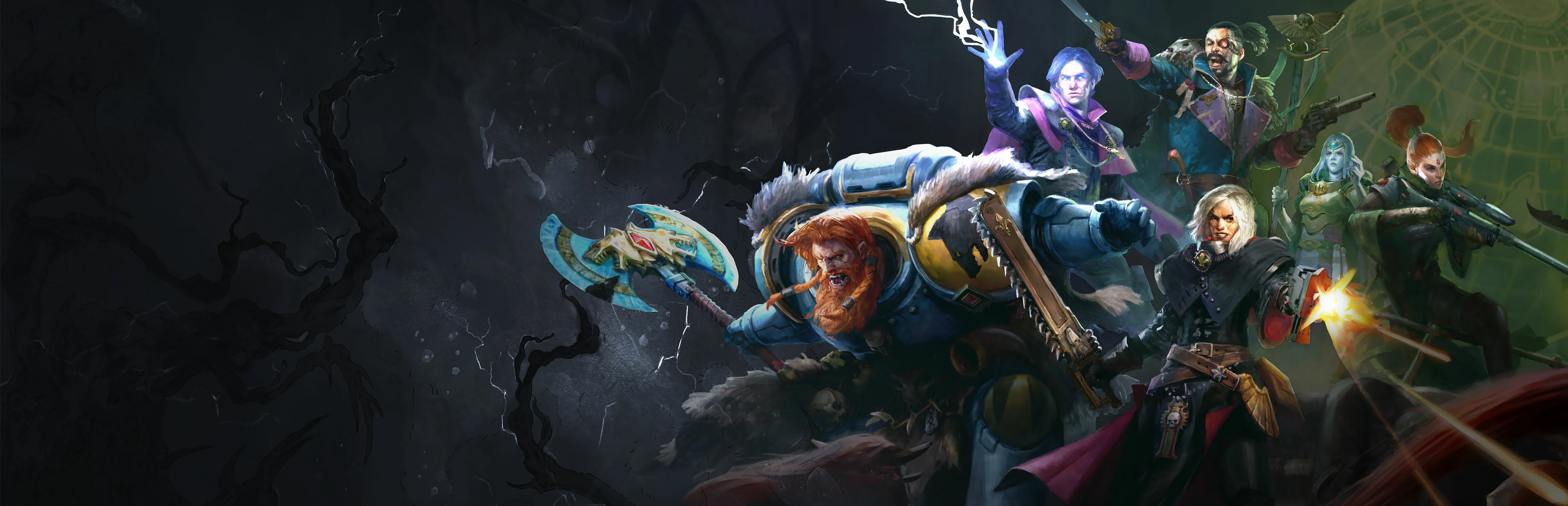
The ship is both a travel hub and the center of the player’s growing domain. From it, the party charts routes through star systems, chooses destinations and encounters Imperial subjects or xenos. Travel through the warp is dangerous, so expeditions can expose the crew to threats beyond ordinary weapons. Among the crew are the stern first officer Abelard Werserian, unsanctioned psyker Idira Tlass, tech-priest Pasqal Haneumann, navigator Cassia Orsellio, Sister Argenta and others recruited as the story expands. Their personal histories bring different perspectives to conversations and crises; Abelard can anchor close combat, while Idira’s visions and psychic attacks add a riskier kind of support.
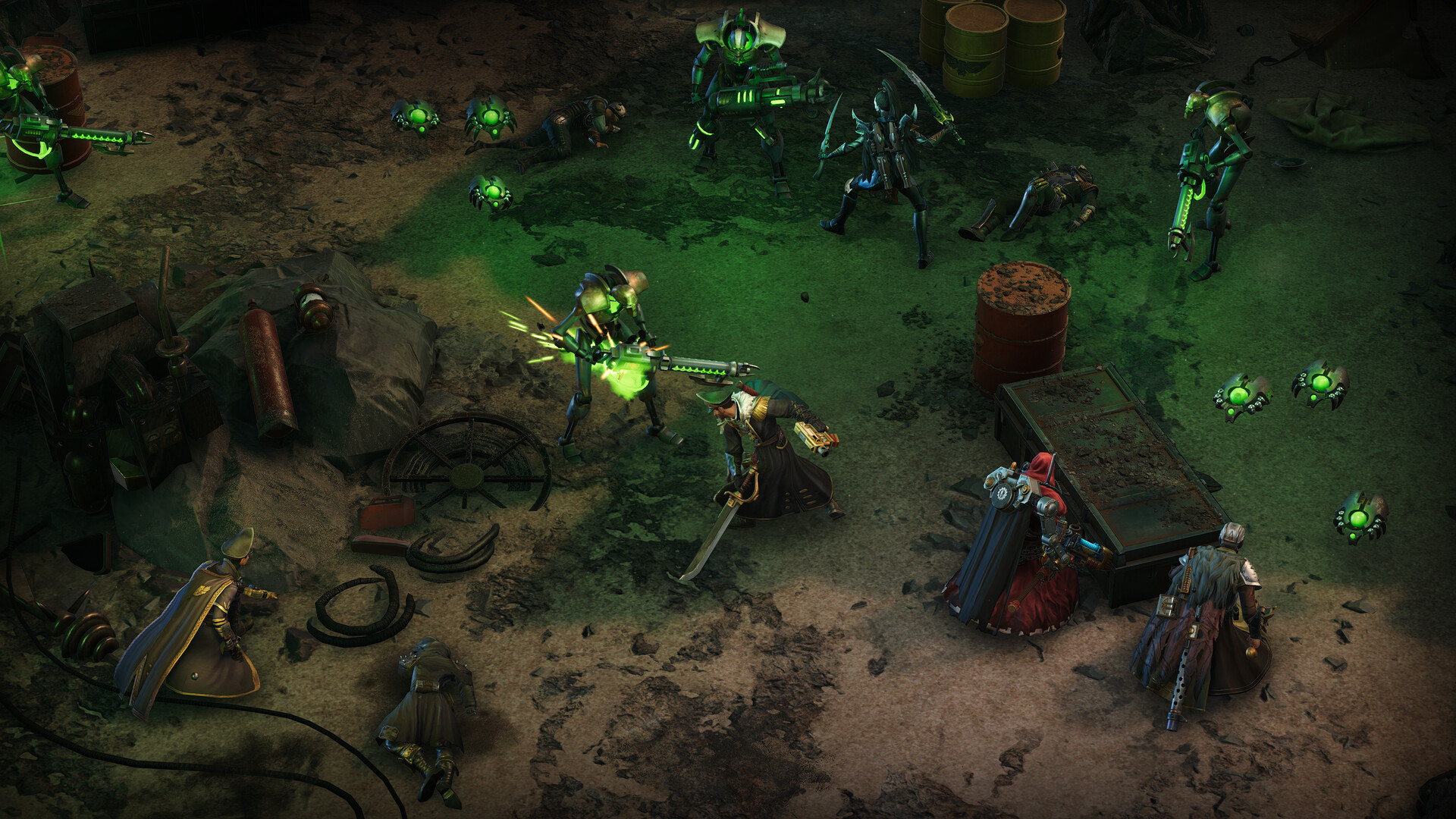
Ground combat is turn-based and built around the position of the party on an isometric battlefield. Cover protects units from incoming fire, line of sight limits who can be targeted, and weapon modes create different tactical patterns. A sniper can line up several targets, while burst fire spreads shots through a cone and can hit allies caught in its path. Melee fighters pressure opponents at close range and can work together to gain an advantage around a target. Armor reduces damage, while penetration helps weapons overcome protection. Each encounter asks the player to consider where companions stand, what threat to remove first and whether an area attack is worth the risk to nearby allies. Cover changes hit chances, while line of sight determines whether a target can be attacked at all; a blocked shot is a terrain problem rather than simply a stronger cover penalty. Burst attacks trace a cone that may strike companions standing between shooter and enemy. Melee attacks can be evaded or parried, and nearby allies can help a fighter pressure a target.
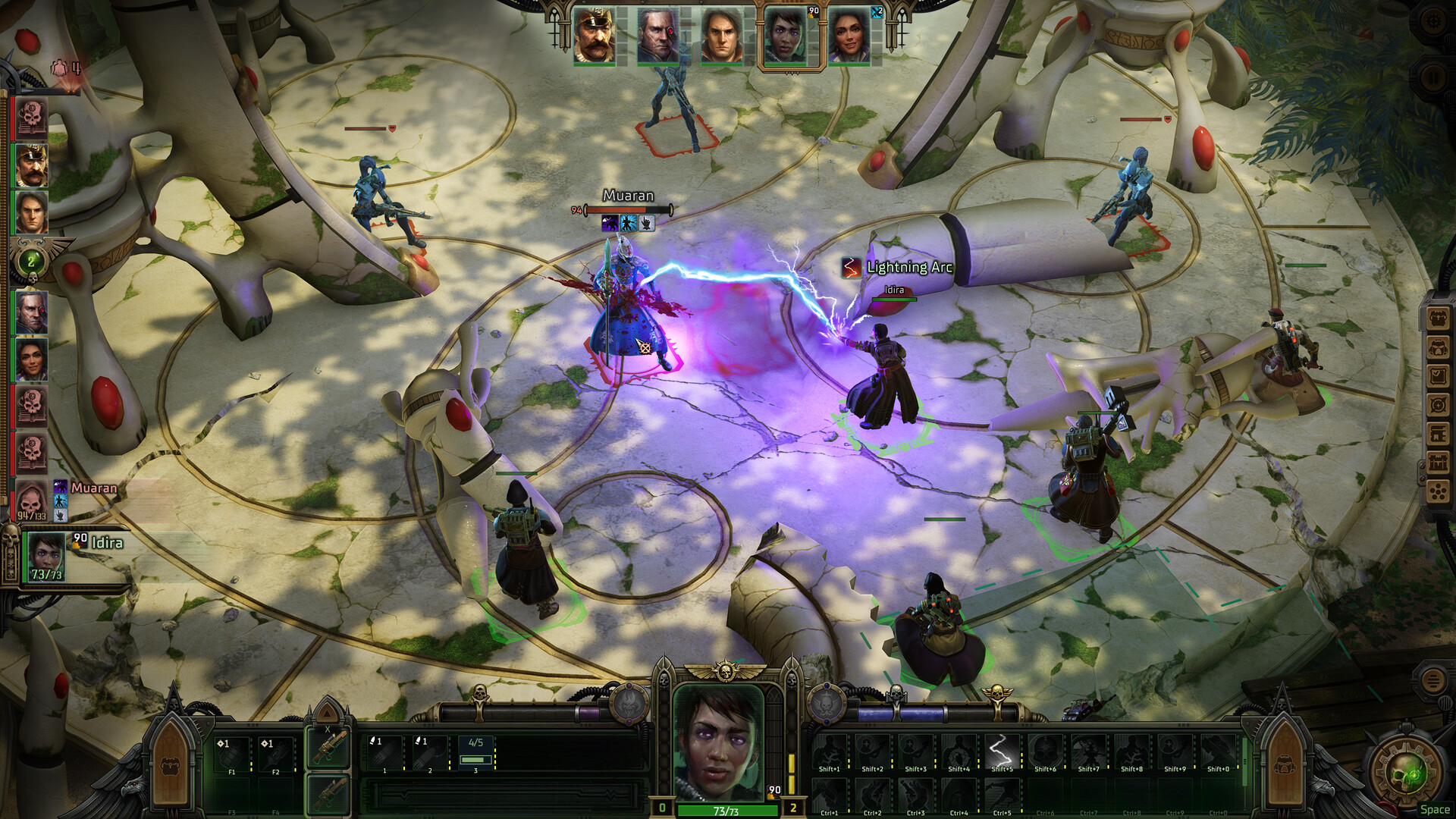
Momentum represents the squad’s morale during a battle. As companions land attacks and defeat enemies, the group can build toward powerful Heroic Acts that let key characters perform extraordinary abilities. If morale collapses, the player can order Desperate Measures, a last-ditch charge with serious consequences. These mechanics give the flow of combat a broader arc than exchanging attacks: a squad can build confidence through effective turns, then spend it to break an enemy position. Individual companions also have archetypes and abilities that specialize them for support, damage, control or resilience, and character development lets the player shape their talents as the opposition grows more dangerous.
Exploration includes more than battles. The Rogue Trader can visit planets, talk with local authorities, discover settlements and decide how the dynasty intervenes in regional disputes. The Expanse contains competing noble houses and privateering families, and the player’s choices influence which groups see the dynasty as a partner or threat. Some decisions involve enforcing Imperial expectations; others concern trade, survival or the treatment of alien populations. Skills and companion expertise can affect dialogue options and discoveries, while quest outcomes may open new opportunities or produce resistance. These encounters make the Rogue Trader’s legal authority a gameplay instrument rather than a title used only in dialogue.
Character creation establishes the protagonist’s origin and role within the dynasty, while leveling develops attributes, skills and archetype abilities. Companions add their own specializations and can be reassigned gear to fill gaps in the party. Equipment ranges from lasguns and bolters to melee weapons and armor, each suited to particular ranges and tactical roles. The game’s percentile-inspired rule structure resolves attacks, skills and defenses through opposed chances, and player-facing abilities modify those chances in specific ways. A specialist can improve accuracy or exploit an enemy’s exposed position, while another companion may absorb pressure or improve the group’s ability to survive a difficult turn.
The journey repeatedly connects a local situation to the dynasty’s larger position. A planet may offer resources or political leverage, but claiming influence can also provoke rivals or change how the crew interprets the Rogue Trader’s priorities. Colony management adds a strategic layer: projects on worlds such as Dargonus or Janus have requirements, costs and rewards, and some resource costs can be paid from Profit Factor when the protectorate lacks the needed cargo. Ship travel determines which systems become accessible, while story quests introduce new allies, enemies and complications tied to the wider Imperium. These decisions make the Lord Captain’s authority tangible both in combat and in the administration of a far-flung domain.
There are three editions of this game and two season passes, and the expansions add companions, systems and stories. Here is what the current purchase actually covers.
Three editions, two passes and the expansions that are out
The editions stack in a straight line. Core is the game plus a unique void ship and a set of exclusive weapons. Deluxe adds a digital artbook, the soundtrack and a wallpaper pack, and those three extras are not available on consoles. Voidfarer contains everything from Deluxe and adds a Cherub pet, a unique Rogue Trader's Throne and a season pass.
Two season passes sit on top of that. The first covers Void Shadows and Lex Imperialis. The second covers The Infinite Museion and a fourth expansion that has not shipped yet, along with an appearance pack. Separately, three story expansions are out so far: Void Shadows, Lex Imperialis and The Infinite Museion, the third of the three. There is also a free add-on, The Shovel DLC, which is a weapon crossover rather than a story.
Platform coverage is PC through Steam, GOG and the Epic Games Store, plus Xbox Series X|S and PlayStation 5. A physical Voidfarer Edition has been announced for PlayStation 5 and Nintendo Switch 2 in October; it is an announcement rather than a shipped product, so check what your store is actually selling before you buy a pass.
The retinue is the real character sheet
You do not travel alone, and the retinue is built from three very different kinds of people: righteous heroes, twisted psykers and what the Imperium would call perfidious xenos. Each companion has a defined combat role as well as a personality. Abelard Werserian is your first officer, a melee specialist who taunts enemies and shields companions, and he knows the local nobility well enough to matter in a conversation. Idira Tlass is an unsanctioned psyker and diviner who supports and buffs the party or throws ranged psychic attacks, and whose own existence is a crime in the eyes of the Imperium.
What makes the group more than a roster is that you can guide each of them through their own story and change where they end up. In a setting where everyone has an agenda, reshaping destinies reads as a warning as much as a feature.
Combat is cover, momentum and the weapon you brought
Fights are a fully-fledged isometric turn-based affair adapted from the classic Rogue Trader ruleset. You think through every action, position the party optimally, and use the environment to take cover. The shooting is where the squad's roles separate: a sniper can pierce several targets in a line, while burst fire is built for groups.
Swinging the momentum of a battle is the other half. Dropping enemies and using your leadership unlocks special abilities called Heroic Acts, and when battle momentum falls low enough you can call Desperate Measures, powerful actions with drawbacks. Between the two, a turn becomes a decision about tempo rather than only about damage.
The Infinite Museion and the body-horror upgrade
The most recent expansion drops you into a vault curated by Trazyn the Infinite, an ancient collector whose interest in your dynasty has its own plans attached. You choose whether to serve his designs or oppose him.
It also adds a companion, Eogunn Februs, a Tech-Priest Manipulus and support specialist with unique buffs, and a compartment on your voidship called Sector Bionica. That unlocks an augmentation system that lets you replace damaged flesh with bionics, improving resilience and opening new tactical options while the more esoteric modifications get steadily more dangerous.
Updates can move the ground under your save
The game is still being reworked under its own expansion line. The sixth major update, 1.6, is the clearest example: it reworked Uralon the Cruel and his daemons, changed how Pasqal and the Forge World origins interact with the augmentation system, improved Operative talent scaling, made grenades count as area attacks that can crit, and rebuilt the talent selection interface with filters and grouping.
The fine print is the part to read before you update. On Steam the previous build stays available through beta branches, for mods or for finishing a run without the changes, but saves made on 1.6 will not load on those legacy branches, The Infinite Museion will not run without the update, and bug reports filed from a legacy branch are not processed. Co-op and mods are not guaranteed to keep working there either.
Should you play it
Yes, if you want a long, talkative role-playing game where your warrant gives you latitude the rest of the sector does not and your crew is the plot. The retinue carries the writing, the turn-based combat rewards planning over reflexes, and the expansions add companions and systems as well as stories.
Go in knowing what you are agreeing to. This is a heavily text-driven game with long combat turns, and the editions and passes are not one product, so check what you are actually buying before you commit to the most expensive one. If you are unsure, the base game is the sensible first step; add an expansion once you know the campaign is for you.
Go deeper with V4mp
- Developer
- Owlcat Games
- Genre
- CRPG
Explore Warhammer 40,000: Rogue Trader further
Explore the wiki for detailed reference pages on the game's world, systems, items and locations.