
About The Elder Scrolls Online
Explore Tamriel in a shared-world RPG whose quests, alliances, guilds and group activities can be approached in a flexible order. Build an adventurer through class, weapon and armor skill lines, craft equipment, join four-player dungeons or twelve-player trials, and fight for an alliance in Cyrodiil.
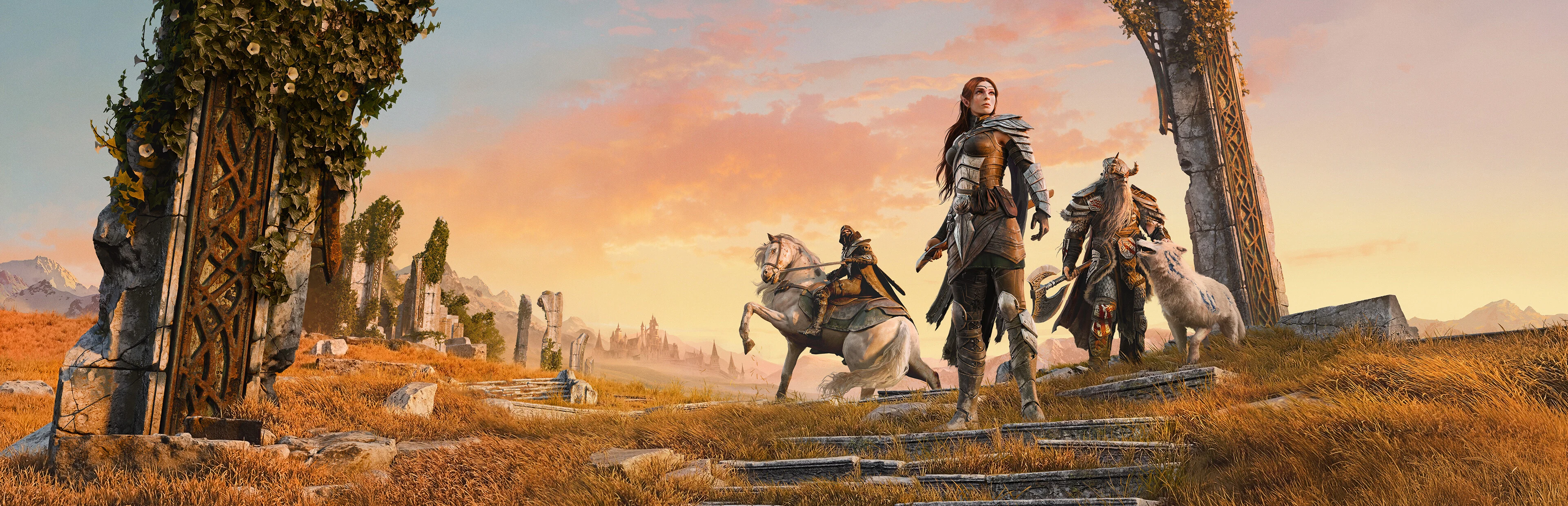
The Elder Scrolls Online turns Tamriel into a shared-world role-playing game where a personal quest can unfold alongside other players' adventures. The base story begins with the loss of the player's soul and a conflict involving the Daedric Prince Molag Bal and the sorcerer Mannimarco. Across the continent, the three alliances—the Aldmeri Dominion, Daggerfall Covenant and Ebonheart Pact—struggle for power, while local communities face threats of their own. The player creates an adventurer by choosing a race and class, then explores regions through quests, delves, world events and faction storylines. The setting draws on Elder Scrolls locations and lore, but its open structure lets players move among areas without following one fixed route.
One Tamriel is the central rule shaping overland exploration. Characters can travel across alliance boundaries and play with friends regardless of level or faction, with level scaling allowing differently leveled characters to tackle overland content together. This allows a new adventurer to follow a local quest, join a guild storyline or visit another alliance's zone without first completing a prescribed sequence. Main quests and regional narratives supply guided objectives, but exploration also reveals side stories, caves, public dungeons, world bosses and Dark Anchors. The result is a world where a map marker may lead to a brief task, a multi-part quest or an open encounter that other travelers are already fighting.
Character identity starts with a class, but the combat build also grows through weapon, armor, guild, racial and world skill lines. The base classes include Sorcerer, Nightblade, Templar, Dragonknight and Warden. Weapon lines such as Two-Handed, Dual Wield, Bow, Destruction Staff and Restoration Staff unlock as the player equips those weapons and fights; armor lines develop by wearing pieces of a given weight. Active abilities are placed on ability bars, and the player combines them with passive effects and an ultimate skill. Progress therefore follows what a character actually uses and which lines are kept active, allowing one class to support several distinct roles over time.
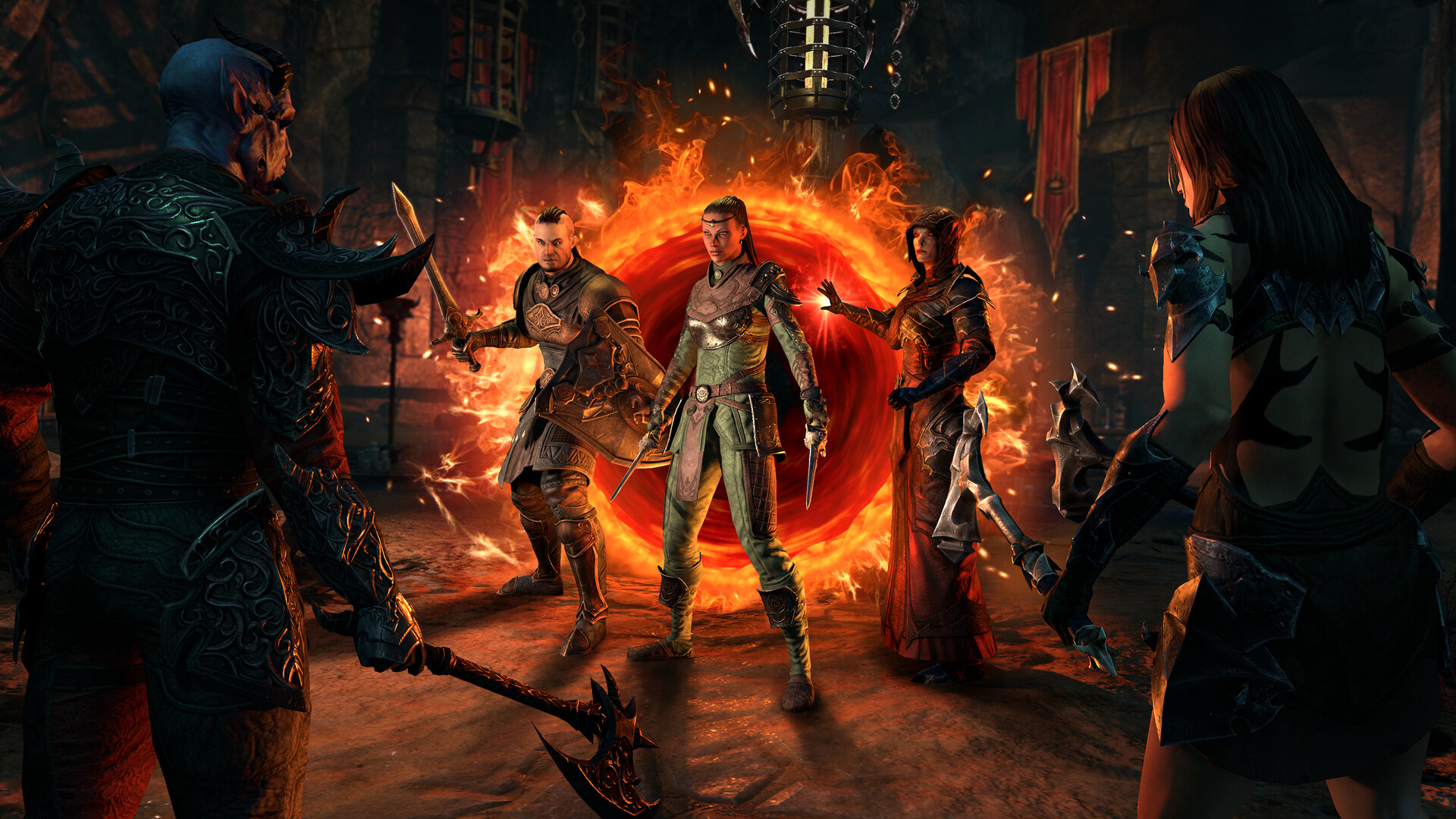
Combat asks players to manage timing and resources while responding to enemy attacks. Light and heavy attacks, blocking, dodging and class abilities form the basic exchange, while weapon choice changes range and function. A two-handed weapon can suit direct pressure, a restoration staff supports healing, and a bow gives a ranged option; armor weight and passives add further build choices. At higher levels, subclassing lets a character train and equip skill lines from other classes after reaching account requirements, creating additional combinations while still preserving at least one native class line. Rather than selecting a permanent job title, the player continually tunes a loadout for solo quests, group dungeons or player-versus-player combat.
Crafting gives exploration a practical reward beyond quest experience. Gathering nodes provide raw materials, while deconstructing equipment recovers materials and researching items teaches traits used in later crafting. Alchemy, Blacksmithing, Clothing, Enchanting, Provisioning and Woodworking each support a different kind of equipment or consumable; visiting the relevant stations begins those lines. Daily crafting writs add a repeatable activity for players who develop their professions. Gear can be replaced, improved or crafted to suit a build, and houses give characters a customizable home. These systems connect roaming through Tamriel to the workbench: resource gathering and careful item management make it possible to shape equipment instead of relying only on random drops.
Group content ranges from public encounters to coordinated instanced challenges. Dark Anchors and world bosses appear in the open world and can draw nearby players together. Four-player dungeons ask a small party to handle tougher enemies and bosses, while twelve-player trials test coordinated groups through larger encounters. The Activity Finder and guilds help assemble teams, and dungeons reward players for learning enemy patterns, role responsibilities and ways to support allies. The Alliance War offers a very different scale: in Cyrodiil, players capture keeps and Elder Scrolls for their alliance during extended campaigns. Battlegrounds provide shorter arena matches, so the same character can move between questing, cooperative play and competitive objectives. Trial groups also need to coordinate sustained damage, healing and protection while learning a boss's signals and the demands of each encounter. Open-world events are less structured: players can arrive in progress, contribute to a shared objective and receive rewards without forming a dedicated team first. This gives solo exploration a natural route into multiplayer play.
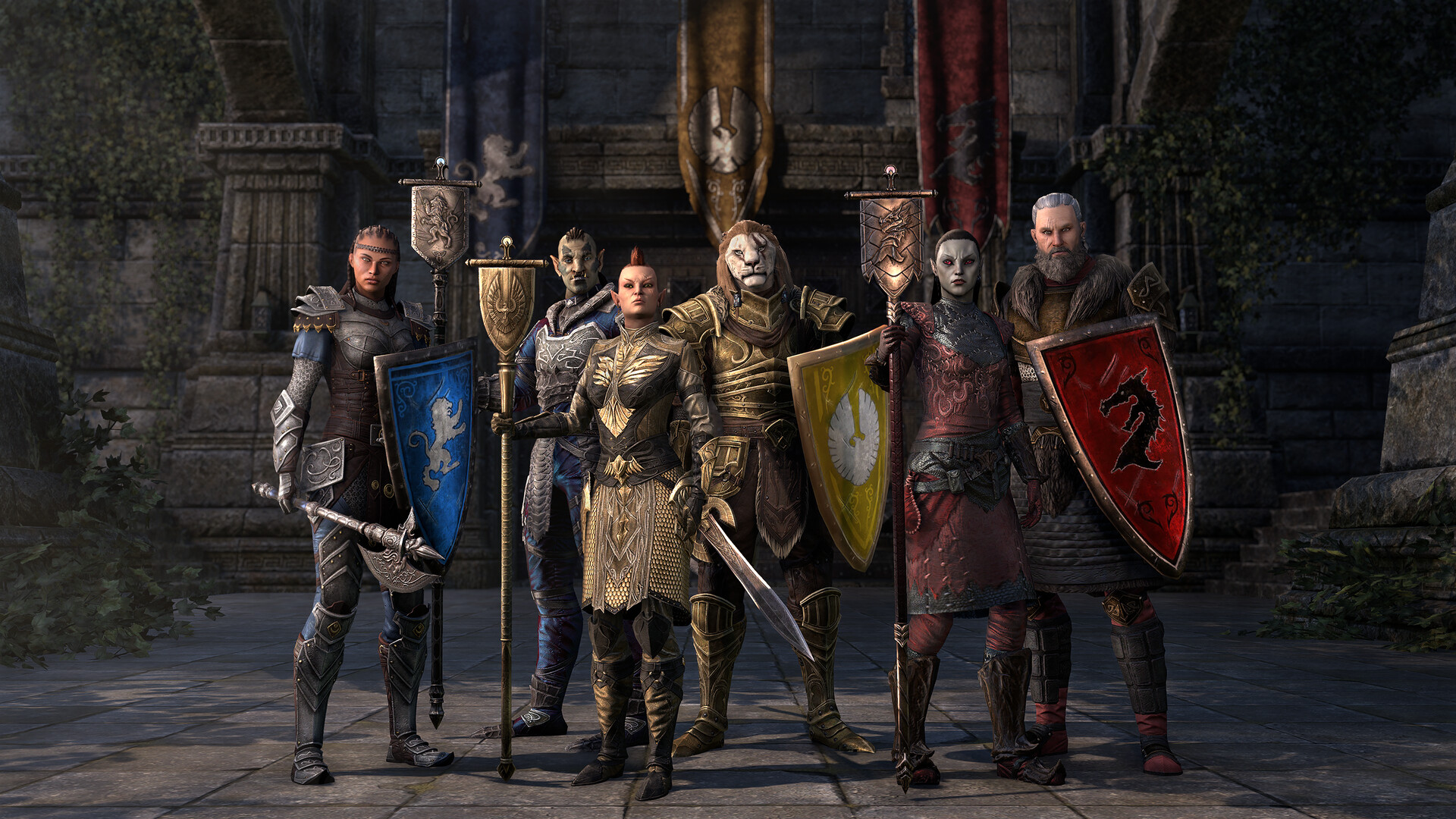
Progress continues through story arcs, equipment, skill mastery and activities chosen by the player. Fighters Guild skills grow through confronting Daedra and undead, Mages Guild progression ties to finding lore books, while other lines are associated with their own quests or activities. Skill points come from character development and exploration, and the player decides which abilities to unlock and slot. The breadth of Tamriel makes the world itself part of advancement: new regions introduce local characters and threats, while guilds and group activities offer systems that are not required for the central Molag Bal storyline. A character can spend a session advancing a quest, gathering materials, joining a spontaneous boss fight or preparing a dungeon build, all within the same persistent online world.
The Seasons model started in 2026. Season One runs from 8 July until 21 October on PC, Mac, Xbox and PlayStation, and the Update that carries the second half of it has been moved to 28 September.
What the base game already contains
You're playing Tamriel about a thousand years before Skyrim, and the base game is not a demo. It includes the Morrowind, Imperial City, Orsinium, Thieves Guild and Dark Brotherhood adventures on top of the launch content, which is several distinct regions and storylines before a season even starts.
Structurally it's an Elder Scrolls game with other people in it. You pick a class and then build on top of it with skill lines and gear, with class and combat refresh work announced for 2027. Questing, dungeons, 12-player trials, crafting, housing and PvP all sit in the same world rather than in separate modes.
Solo play is a supported path rather than a compromise, but it has a shape. Overland questing and the main storylines are entirely soloable. The group content is genuinely group: 12-player trials, group dungeons and the PvP zones want other people. Antiquities is the one to watch, because it is not in the base game today. It is scheduled to become free with Greymoor on 9 November, alongside a Golden Pursuit campaign.
Seasons change what the year looks like
The Seasons structure delivers new stories and experimental content every three months, with the season's gameplay features, systems and improvements included for owners of the game. The Tamriel Tome that runs alongside each one has a free track open to all and two paid tiers, for additional rewards.
Season One is a good example of the shape. It opened with a Thieves Guild storyline in Glenumbra, the Favors daily system and Dynamic Encounters in three zones, then added a Sheogorath questline. Update 51, scheduled for 28 September, carries the Nowhere Vault, a puzzle experience built for solo or group play with changing rooms, and the Rumors system, which turns clues scattered across the world into complete stories.
That update is also the base-game patch, so achievement pinning, the first iteration of a customisable HUD on keyboard platforms, hybridisation work and Antiquities improvements arrive with it. Three-sided Battlegrounds return permanently at the same time. One item has moved: the Crimson Veldt, the 12-player trial that was announced as part of this season, has been pushed to 2027, so that trial is outside the current season.
How a session actually goes
What decides whether you enjoy ESO is less about character power and more about what you decided to do before you logged in. It gives you several different jobs. Follow a story, explore a region for its own sake, take on a group challenge, or fight other players: they want different session lengths and different levels of attention.
That's why picking a purpose matters more here than in a single-player RPG. The Thieves Guild storyline starts from a free quest claimed in the Crown Store, Favors are daily quests posted per Alliance across 20 unique dailies each, and Dynamic Encounters are multi-stage world events that nearby players join. Dungeons and trials are where the group content sits, and Cyrodiil and the Battlegrounds are where the risk profile changes the moment you enter. Naming which one you're doing turns an enormous map into a plan instead of a backlog.
The money question
Buying the game once is enough to play the seasons. On top of that sit three optional layers. ESO Plus is the membership, and it lists full access to the DLC game packs sold in the Crown Store, unlimited crafting storage through the craft bag, 1650 crowns a month, and a Premium Tome Token each month. The Crown Store is the in-game shop, and it is where cosmetics, houses, mounts and various conveniences live. Chapters and older DLC are the third layer, sold as their own purchases.
That third layer is moving in your favour. The group versions of Moon Hunter Keep and March of Sacrifices become free for everyone on 12 October, ahead of Season Two's solo versions of both dungeons on 21 October, and the Greymoor Chapter and the Markarth DLC become free on 9 November. Those are the studio's announced dates rather than completed handovers. If you're buying in now, the Deluxe Edition bundles the base game with the 2025 Content Pass and all eight previous Chapters.
Should you play it
Yes, if you want a very large world you can chip away at at your own pace, with story content you can finish alone and group content waiting for the nights you want it. The Seasons change is the strongest argument for starting now: the season's content comes with the game, the three-month block gives you a natural place to pick up after a break, and no one is asking you to buy a Chapter before you can join in.
What to weigh is the reality of a live game in its second decade. Work that was promised for 2026 has been pushed: the new trial and Update 52 moved into 2027, and the class and combat refresh is targeting 2027. The upcoming dates remain announced plans and can change.
Go deeper with V4mp
- Developer
- ZeniMax Online Studios
- Genre
- Online RPG
Explore The Elder Scrolls Online further
Explore the wiki for detailed reference pages on the game's world, systems, items and locations.