
About SAROS
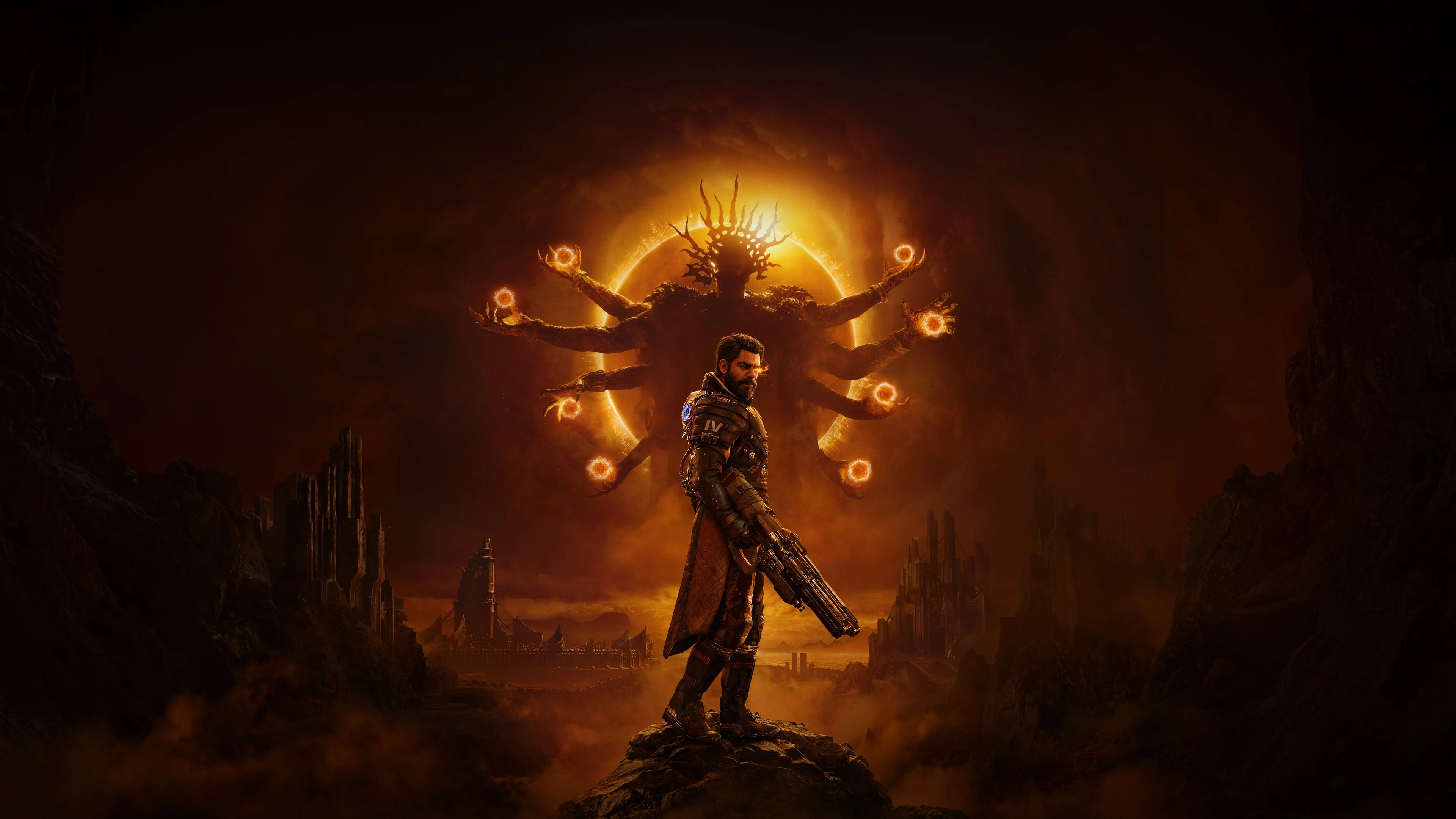
Enforcer Arjun Devraj joins the Echelon IV crew on Carcosa, a hostile planet where an eclipse alters the terrain and the people caught in its reach. Fight through shifting expeditions, combine Soltari weapons with alien power, and return to the Passage to turn gathered resources into lasting upgrades between attempts.
SAROS follows Soltari Enforcer Arjun Devraj as he travels to Carcosa with the Echelon IV rescue crew. Their assignment concerns a lost off-world colony, but the planet itself becomes the central threat: its environments change as expeditions repeat, and an eclipse exposes altered paths and more dangerous conditions. The story unfolds through Arjun’s encounters with the crew and the remnants of the colony, placing a human search for answers inside a shifting science-fiction landscape. The Passage, a temple-like location on Carcosa, is where the crew gathers between journeys and where the expedition’s discoveries become part of Arjun’s longer progression.
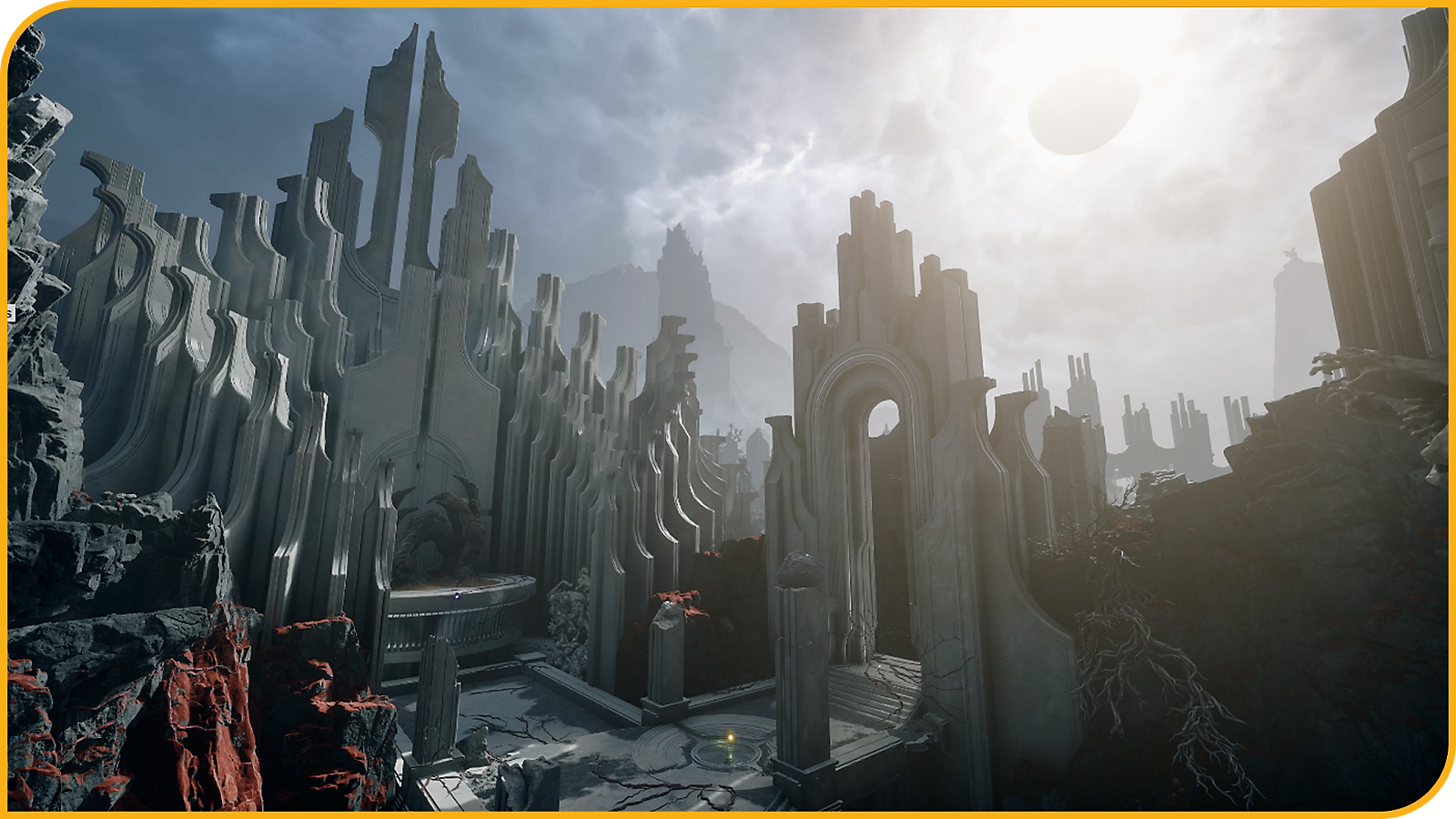
Each expedition sends Arjun through hostile biomes, enemy formations and major encounters before he can push farther into the planet. The layout and weapon drops can differ between cycles, so a route is not simply replayed as a fixed sequence. The world’s eclipse is an escalation that changes properties in particular areas, including hazards and hostile attacks. Its presence also affects the people aboard Echelon IV, giving the repeated journeys a story function as well as a combat one. The crew’s condition and the questions surrounding the missing colony develop in parallel with the player’s growing familiarity with Carcosa.
Combat is a fast exchange of ranged fire, movement and defensive timing. Arjun can dodge, shield and parry hostile attacks while using a high-tech Soltari arsenal. Main weapons include archetypes such as hand cannons, rifles and shotguns, with variants that carry different perks and both primary and alternate fire. Close attention to incoming projectile patterns helps determine when to move and when to raise the shield. Alien Carcosan weapons add a separate power layer: absorbing certain blue projectiles with the shield builds energy that can be spent through a Power Weapon, while yellow corrupted shots can reduce maximum armor integrity until cleansed with that weapon.
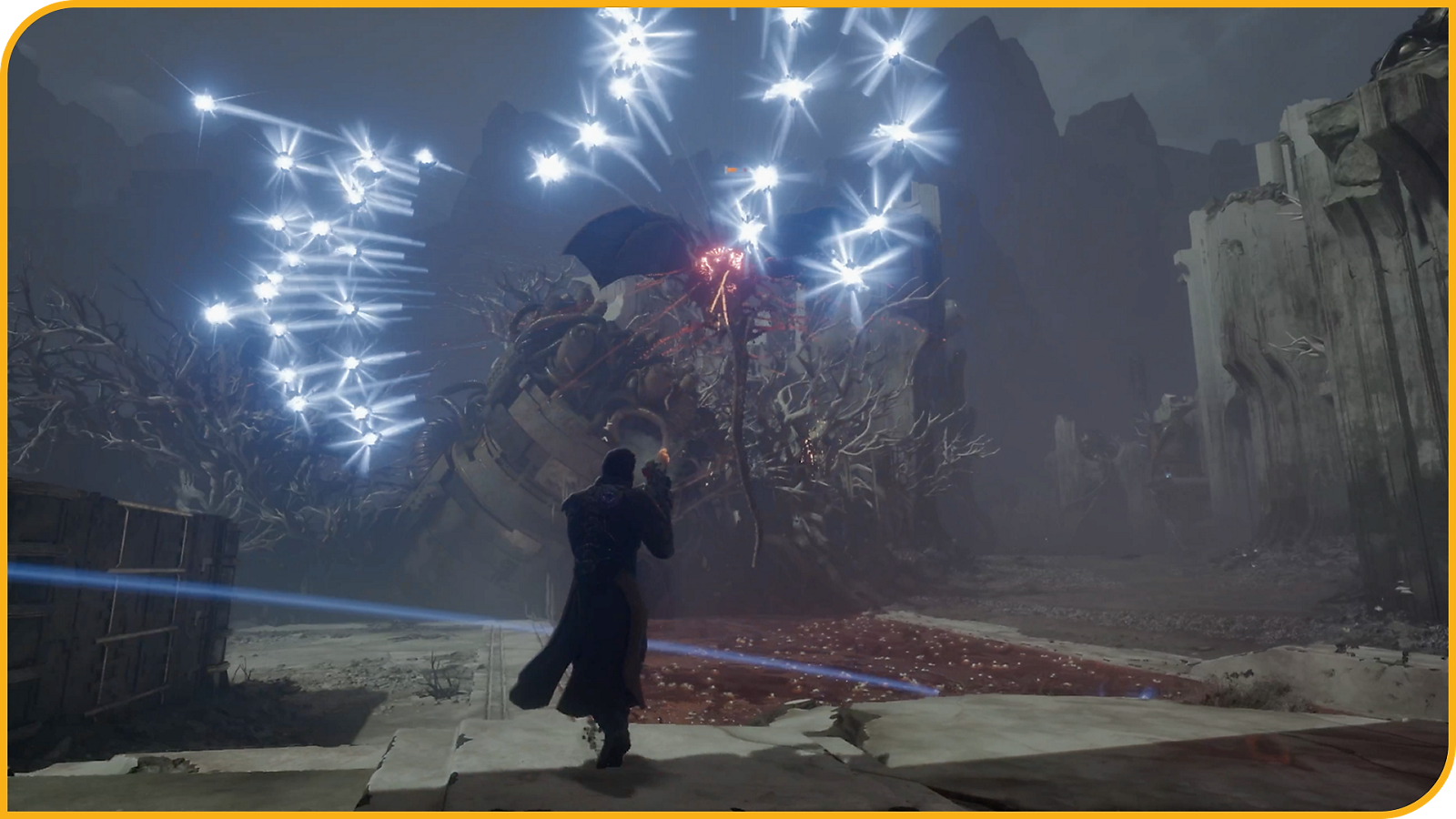
This relationship between defense and offense gives the shield a resource role beyond blocking. Holding it against the right attacks can build the power needed for a wider blast, but sustained use consumes its capacity. The player therefore reads a fight for opportunities to collect energy without remaining exposed, then chooses when a charged shot can interrupt or remove threats. Dash and parry actions provide further ways to cross an attack pattern safely, while enemy wind-ups and projectile types communicate what response is available. Boss fights scale these decisions into longer patterns, asking the player to combine weapon range, movement and shield timing instead of relying on a single attack.
Death returns Arjun to the Passage, but a run still contributes to permanent character growth. Lucenite and Halycon collected on Carcosa can be spent on the Armour Matrix, which develops lasting capabilities such as armor integrity or the shield’s power capacity. The Second Chance ability can be unlocked through this progression, allowing a first fatal mistake in an expedition to be recovered. The result is a loop where each attempt supplies both immediate tactical choices and resources for the next trip. The crew hub also offers conversations and further context, so returning is a pause in the expedition rather than a detached menu screen.
Weapon retention and travel options soften the reset without removing its threat. Main and Power Weapons found during a cycle can be kept after death, giving a promising loadout continuity. The World Dial can teleport Arjun to previously unlocked biomes, including the last biome reached, so a new attempt can resume farther into the planet instead of repeating every earlier stage. These tools make the route through Carcosa more flexible while leaving unopened areas and their encounters ahead. The player can choose a longer run or revisit a known biome start, depending on whether the goal is further exploration or rebuilding a stronger loadout.
Carcosan Modifiers let the player adjust the challenge before an expedition. Protection Modifiers can reduce incoming damage, ease weapon reloads or extend shield use, while Trial Modifiers add pressure through more aggressive enemies or other restrictions. The two types must remain balanced, so reducing one danger may require accepting another constraint. This makes difficulty a configurable system tied to each run rather than a single permanent setting. SAROS is a single-player PS5 action game, and its central progression joins the changing planet, the evolving Echelon IV story and the Armour Matrix into one cycle of exploration, combat and return.
Accessibility options shape how that challenge is presented without changing Carcosa’s core loop. Colour-blindness settings distinguish normal, corrupted and Nova projectiles, useful because projectile type determines whether to dodge, absorb or cleanse an attack. Dialogue focus mode, controller remapping and other adjustments support different ways of following conversations and managing controls. These options sit alongside the Carcosan Modifier system: one changes how information and input are conveyed, while the other adjusts combat pressure. Together they let players tune the demands of repeated expeditions while keeping the central cycle of exploration, battle, return to the Passage and permanent character growth intact.
You are Arjun Devraj, a Soltari enforcer on the colony world of Carcosa, and the planet keeps rearranging itself underneath you. It's a PlayStation 5 exclusive, it has no multiplayer at all, and it released on 30 April.
What you are doing on Carcosa
Arjun arrives with Echelon IV to find out what happened to a colony that stopped answering. Soltari's interest in Carcosa is Lucenite, and securing the mining operation comes before the welfare of the colonists. You spend the game finding out how badly that went.
The reason a run resets is written into the world. Carcosa sits under an Eclipse that repeats on a cycle Soltari can't predict, and during one the native creatures get faster, stronger and more aggressive. Maps stop being accurate afterwards. The territory you cross is genuinely redrawn between attempts, so learning a layout is a temporary advantage rather than a bank you keep.
You move between a handful of named regions: the rocky, hostile Shattered Rise and the subterranean Ancient Depths among them, with The Passage as the hub. The Passage is the one place hostiles will not follow, which makes it the safehouse and staging ground you come back to between runs. You spend what you earned there and go out again.
The shield is the combat system
Most of the depth lives in two inputs. Standard shots, blue with the default colours, feed the Soltari Shield: hold it up as they arrive and the absorption builds Power. The shield also drains Power to stay active, so holding it while nothing is hitting you is a straight loss. Read the incoming fire or don't raise it at all.
Then the left trigger does two jobs. Pull it halfway and you fire your equipped weapon's alternate attack; pull it all the way and you discharge a Power Weapon built from what the shield swallowed. Those Power Weapons are the big damage. The named examples are Prominence, Dispiritor and Illumine, each with a different idea of what killing looks like, and they cost a large amount of armour power for every activation. Their unsettling connection to Carcosa also ties the weapons into the story.
Corruption is the complication the Eclipse keeps adding. Corrupted shots, yellow with the default colours, cut into your maximum armour integrity rather than just your health bar, and the Power Weapon is what scrubs that corruption back off. Nova shots are a third category again, and the colour settings exist so you can tell all three apart on your own display.
Artifacts are the other answer to the same problem. They change what your armour can do, including resisting damage and Corruption, or pulling more from the environment, but the effect holds only for as long as you stay conscious, and some carry adverse side effects. That makes them a resource to spend well inside a run rather than a permanent upgrade.
The fight then comes down to what Power buys you. The shield spends it to stay up and the Power Weapon spends it to fire, so every activation is a trade against the next volley you were hoping to absorb. That tension, more than the size of any damage number, is what the combat is built around.
Second Chance provides a revive when available, but the Trials below include one that removes it outright.
Difficulty you set yourself
Carcosan Modifiers are the reason two people can describe SAROS and both be right about how hard it is. At Primary in The Passage, between runs only, you choose Protections that reduce the challenge or Trials that increase it, and the screen asks for a balanced pair; turn on the Unlimited Protection Modifiers setting and that limit comes off. None of it can be touched mid-expedition, so the decision is deliberate rather than reactive.
The Protections are concrete. Damage Enhancement raises what you deal. Shield Power Enhancement stops the shield consuming Power while active, which effectively hands you more Power Weapon uses. Overlord Restoration puts you at full armour integrity when you walk into a boss. On the other side, Growth Incapacitor I removes Second Chance and Growth Incapacitor II strips out every Armour Matrix upgrade, for the people who want the version of this game that hurts.
Underneath all of it is the Armour Matrix, the permanent progression you feed between runs, plus the Artifacts you pick up along the way. The Matrix is the part that accumulates; an Artifact is a run-scoped change to what your armour can survive and harvest, which makes it part of the build for that attempt rather than permanent progression.
None of this is buried. The modifiers are the game's own difficulty menu rather than a hidden setting, and the launch build ships accessibility options alongside them, including the colour controls that let you tell Normal, Corrupted and Nova projectiles apart.
Playing it on PS5
SAROS is built for one player and it is offline-friendly: single-player, 1 player, Remote Play supported, with no co-op and no competitive mode anywhere in it.
The expensive edition is cosmetic. Digital Deluxe adds three armour sets inspired by Returnal, God of War and Ghost of Yōtei, and the upgrade is sold separately as an add-on. There's no extra region or story behind it, so the standard copy is the game and the Deluxe copy is the game in different clothes.
There is also a way to test it first: PlayStation Plus Premium includes a 2.5-hour full game trial of SAROS. For a run-based game where the loop either grabs you or doesn't, that's worth knowing about before you pay full price.
What is coming, and what you have now
SAROS: Zenith is a free update announced for later in 2026, and it is worth knowing the difference between that and what you can play today. Zenith adds Overlord Rush, a mode for fighting the main Overlords back to back for a high score with worldwide leaderboards, plus Eclipse Layers, a harder new-game-plus that opens after you finish the game. It also brings high-contrast visuals, gyro aiming and a toggleable Slow Game Speed option.
Not all of that is missing today. The colour controls for Normal, Corrupted and Nova projectiles are already in the launch build, and Zenith is the update that adds the further visual and control options on top. Overlord Rush, Eclipse Layers and the leaderboards are announced for 2026 with nothing firmer than that, so don't buy this copy for them. What you're buying today is the loop and the modifier menu, which are already in the box.
Should you play it
Yes, if you want a run-based action game that hands you the difficulty dial along with the shield. The projectile-absorbing Soltari Shield and the left trigger split between alternate fire and Power Weapon give you a real decision in every fight, and the modifier menu means the challenge is something you set rather than something you endure.
Skip it if you want a shared world, because there is no multiplayer here, or if you're not on PS5, because it has not been released anywhere else. The other question is what you want out of a finished run: if you would rather see credits and move on, SAROS asks you to lose, come back and lose again, and the world redrawing itself between attempts is the whole structure rather than a setback on the way to something else.
Go deeper with V4mp
- Developer
- Housemarque
- Genre
- Roguelike action
Explore SAROS further
Explore the wiki for detailed reference pages on the game's world, systems, items and locations.