
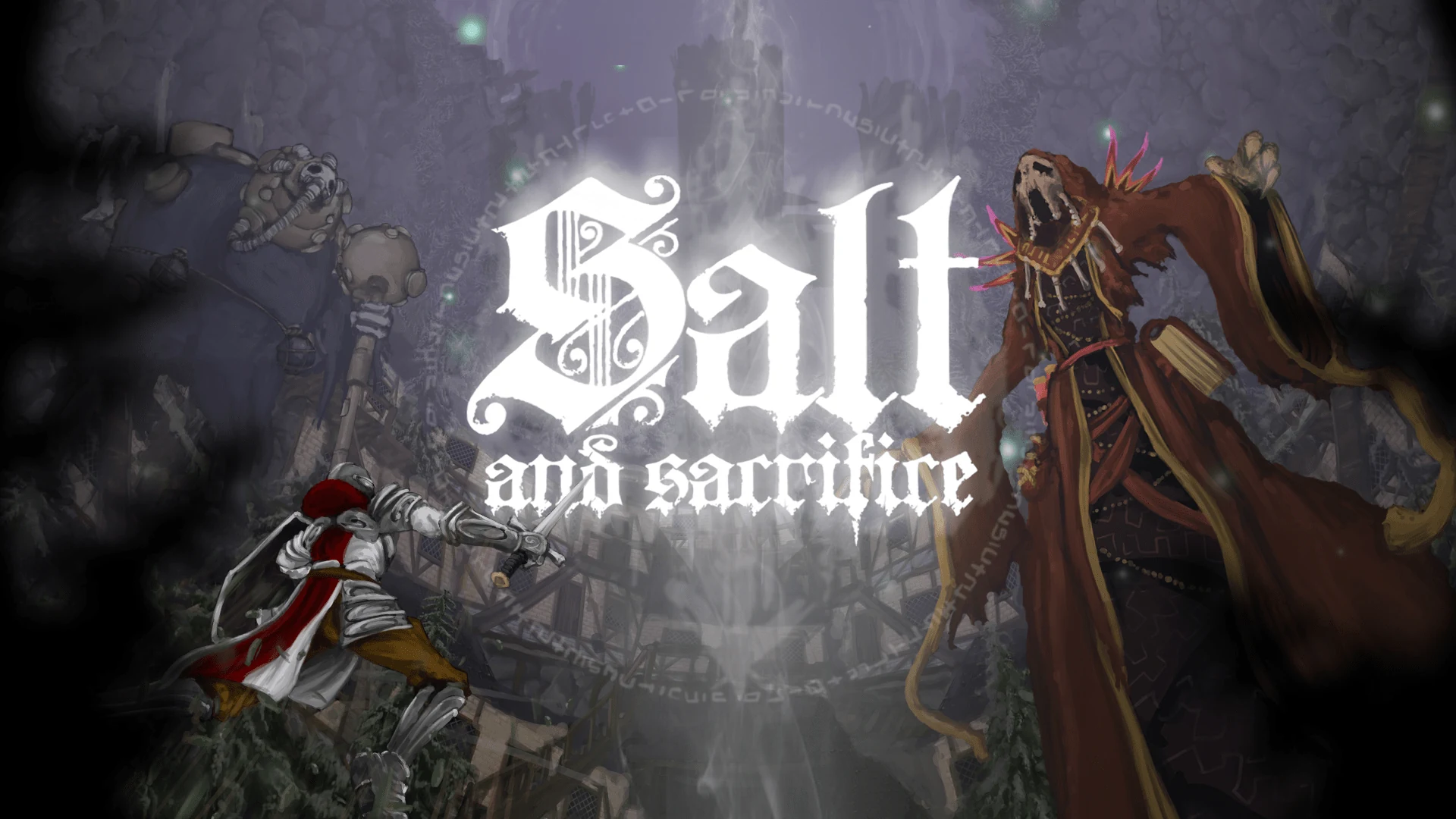
About Salt and Sacrifice
Salt and Sacrifice is a 2D action RPG from Devoured Studios and Ska Studios, the latter known for Salt and Sanctuary, and it is a follow-up rather than a repeat. It came out in 2022 on PlayStation 4, PlayStation 5 and PC through the Epic Games Store, and reached Steam and Nintendo Switch in 2023 next to a free content update, The Traitor's Tomb, that is already inside the copy you would install now. The Traitor's Tomb is included free with the base campaign. This review covers that version.
The hunt starts before the arena
You are a Marked Inquisitor: a condemned criminal given a lifetime of service instead of an execution, sent after Mages warped by elemental magic. A Mage is not a room you walk into. It roams its own part of the zone, and when you find it and start doing real damage, it leaves. It runs deeper into the region, it calls up minions as it goes, and eventually it decides it has had enough of running and turns to face you properly.
Mage hunts use multi-stage pursuits that end in arena battles; other bosses do not all follow that structure. The pursuit is not a cutscene you skip. The Mage is a live enemy in a zone full of other enemies the whole time, so you can start a fight on ground you chose, lose it, and pick it up again with half your flasks gone and a worse position. Add the habit Mages have of only partly recovering when you die or rest, and a failed attempt still leaves a mark on the thing you are chasing.
So don't open a pursuit empty. The chase is cheap; the last phase, where the arena closes and the Mage stops holding back, is where the health and the flasks go. If there is an Obelisk nearby, rest first and walk in full.
Every Mage is a gear set
Beating a Mage lets you devour its heart and take what is left of it, and those remains are the crafting bench. Each named Mage owns a set: armour, a couple of weapon types and a few accessories, and every weapon in that family comes out of the same pile of Mage parts. Once you pick up a single material from a set, the crafting table shows you the whole list, so you can decide whether the armour is worth farming before you spend an evening on it.
Upgrading is a second, stingier gate. Equipment levels up with elemental stones, and the game hands you them by type rather than volume, so a greatsword and a set of light armour can want different stones and only one of them gets fed. You will not max everything, which turns the bench into the real build decision: the Mage you farm is the Mage whose powers you keep.
Salt, silver and what dying costs
Two currencies run the whole game. Salt is experience, and it is spent levelling up. Silver is money, and it buys what merchants sell. Levels are taken at a statue in Pardoner's Vale, and each one also hands you a stone that unlocks a single node in the Tree of Skill, so the level and the unlock are two spends from one act. Level, then look at the tree, then decide whether you wanted health or a skill.
Dying is the usual ritual with one or two sharp edges. You are Obliterated and you wake at the last Obelisk you touched, with your Salt sitting where you fell and one chance to walk back and take it. Fall off something and the Salt drops where you jumped rather than where you landed, which sounds like a small mercy until you have lost a level's worth down a shaft. Resting at an Obelisk also restocks your flasks, your haze decoctions and your ammo, and if you are short on the materials it will bill your silver instead.
Build: eight classes, nine stats, three free nodes
Character creation asks for a class and a crime. There are eight classes — Assassin, Cleric, Fighter, Duelist, Highblade, Paladin, Ranger and Sage — and they share the same starting stat budget. Every class starts on the same five points in each of the nine stats and is then handed three pre-unlocked nodes on the skill tree, so they all add up to the same total. The class decides what you can do in the first hour, not what you are allowed to become.
The crime is the smaller choice and the more fun one, because it drops a single item into your pack that reflects the story you told about yourself: a bag of silver, a forged deed to sell, a censer that turns enemies against invaders. It is a starting bonus, not a build, but it is the kind of detail that makes a first run feel like yours.
Magic lives on your weapons rather than in a separate class. Weapons carry elemental runic arts, and they are paid for in two different ways: some use Focus, which is refilled by drinking haze decoctions, and some use Rage, which fills up as you fight. A caster is therefore a weapon choice plus a resource you have to keep topped up, which keeps the elemental side of the game inside the same loadout decisions as everything else.
Block, parry, and the fight you actually have
Combat is stamina-driven and weight-driven. Attacking, blocking and dodging all eat the same bar, and your roll — how far it goes and how long you are untouchable during it — depends on how much you are carrying. You can also switch loadouts mid-run, so the answer to a heavy fight is usually a lighter second set rather than a respec.
Blocking holds damage off at a stamina cost, and leaning on it with a weak guard will let chip damage through. A perfect block comes from raising your guard just before an attack connects. Repeated well-timed blocks can stagger susceptible enemies and open a counterattack. Alchemy covers the other gap: materials become bombs through the Herbalist, the recipes restock when you rest as long as you have the ingredients, and ranged weapons exist for the parts of a hunt where standing at sword length is a bad idea.
Online: co-op, invaders and the factions around them
Online play runs on a state rather than a menu. You need to be Atoned — a Guiltless Shard clears the Spellmarked condition — and then you can host: a candle or a quickplay search pulls in help, and a password lets you play the campaign with a specific friend. Cooperating no longer makes enemies hit harder, which was a change worth making, and since the 2023 update the multiplayer is cross-play across every platform.
The factions are what make it interesting. Dawnlight Cooperators are summoned to help a host kill Mages. Blueheart Runners invade a stranger's world to harvest the Hazeburnt husks inside it while the host is still trying to play. The Shroud Alliance invades to fight the host, and Oathbound Watchers and Sheriff Inquisitors exist to be summoned and stop them. In practice a session can carry a helper and a problem at the same time, and you cannot be invaded unless you have summoned someone or lit the red candle, which is the game's way of letting you opt in.
Where it grates
The chase is the best idea in the game and it is also where it drags. A Mage that decides to flee across a zone you have already cleared turns a good fight into a sightseeing trip, and because the arena phase is usually a straight brawl, the memorable part of an encounter can end up being the walk rather than the duel.
The other complaint is the one critics have made since launch and it has not gone away: crafting and progression are a grind. Gear is gated behind specific Mages and specific elemental stones, so the set you want usually means re-killing a Mage you have already beaten, sometimes more than twice, and the stone shortage decides for you what actually gets upgraded.
Travel used to be the worst of it. There was no fast travel at all when the game launched, and the walk back through cleared zones was a real tax on a bad fight. That has been softened with beacons that move you around inside a zone, and travelling now brings your allies with you. What has not changed is the difficulty: this is a game that will keep hitting you after you are already on the floor, and it took a balance patch in 2023 to cut the follow-up damage in a monster's juggle combo in half.
What changed after launch
There have been two free content updates rather than one. The first landed at the end of 2022 and added a new merchant with a shelf of utility items, including one that points you at a roaming Mage and another that resets them, which is a quiet win once you are farming a specific set. Nobody calls that an expansion, but it is the difference between hunting and wandering.
The Traitor's Tomb is the big one. It arrived free on every platform in 2023 alongside the Steam and Switch versions, and it adds Heart of Altarstone: an optional zone below the story, with its own bosses, a co-op boss gauntlet called Trials of the Brave, a PvP arena, and beacons for travel inside a zone. Getting there is a small errand rather than a menu. A merchant out in Bol Gerahn hands you a bottle of Altarstone Vintage, and a Runereader back in Pardoner's Vale trades it for the runes that open the way.
A balance patch followed within weeks. Heavy attacks on greathammers, greatblades, greatswords and glaives gained hyper armour so they survive a hit; blocking was buffed across the board; flasks drink faster; staves hit a little harder with runic arts. Being hazeburnt no longer drains your health, and staying guiltless now gives you defence and a better chance at item drops instead. There is also inventory sorting, faster ladder climbing, and a change that matters more than it sounds: beating the final boss no longer drags you into New Game Plus without asking.
New Game Plus and the two endings
The game finishes at the Husk Tree in Elder Copse, after The Undone Sacrifice, and offers you two endings: Climb, or Devour. There is no third path to hunt for, and both of them sit behind the same boss.
What happens next is now your call rather than the game's. Ascending to New Game Plus raises enemy health, damage and Salt, resets the hunts and the bosses, and takes away your keys, runestones and multiplayer tools, so you have to earn the shortcuts and the invasions again. You keep your level, your skill tree, your Salt, your silver and most of your gear. A second run is therefore a power fantasy with the map reset around it: you keep the build, you lose the roads.
The pulse
Critic aggregates land in the low seventies, and the shape of the disagreement is easy to describe. The hunt structure, the combat and the co-op are what people defend. The crafting, the progression gating and the punishing difficulty are what they push back on. Player reviews sit at Mixed, with roughly 62% of about 1,700 store reviews positive, so the split is the same one: the idea is admired, the grind around it is not.
Should you play it
Yes, if the idea of killing a boss so you can wear it sounds like a good evening. Every set is a trophy with stats, the chase gives boss fights a shape most 2D action games never manage, and the co-op and the invasion factions turn a single-player campaign into something you can share or be hunted through. The parry is satisfying, the weapons are varied enough to justify a second run, but getting the equipment you want can mean repeating hunts.
Skip it if you want a big map you can cross quickly, if farming the same Mage for materials sounds like a chore rather than a goal, or if you bounced off Salt and Sanctuary expecting the same game with a bigger world. Salt and Sacrifice is a different shape: a hunt game with a short, punishing campaign, and it will keep the chase in front of you whether you wanted to run it again or not.
Go deeper with V4mp
- Developer
- Ska Studios
- Genre
- Soulslike action RPG
Explore Salt and Sacrifice further
Explore the wiki for detailed reference pages on the game's world, systems, items and locations.