
About Pokémon GO
Pokémon GO brings Pokémon collecting into a location-based mobile world. Trainers explore a map populated by PokéStops, Gyms and wild encounters, then catch, hatch, evolve and power up a collection. Research tasks, Team GO Rocket, raids, buddy activities and player battles provide complementary goals, with Candy and Stardust connecting everyday catches to long-term team building.
Pokémon GO frames the player as a Trainer moving through a map based on the real world. The Map View shows the avatar, nearby Pokémon, PokéStops and Gyms, turning places into points of interaction. Wild Pokémon appear for encounter screens where the player throws Poké Balls, with berries able to influence a catch or reward. PokéStops provide items when their Photo Discs are spun, making walking routes useful for replenishing supplies as well as finding encounters. The central routine is straightforward but connected: notice a Pokémon on the map, catch it, add it to the Pokédex and receive resources that can develop the collection. The location layer gives ordinary travel a changing set of targets and collection opportunities.
Catching is the first step in a resource loop. Each captured species contributes Candy to its evolutionary family, while catches and other activities yield Stardust. Candy and Stardust power up Pokémon, raising Combat Power and Hit Points; the required resources grow as a Pokémon becomes stronger. Candy also enables many evolutions, changing a Pokémon into another species in its line, with some evolutions additionally requiring a special item or other condition. Transferring duplicates can provide more Candy, and hatching Eggs in Incubators adds another way to encounter Pokémon while walking. The player must decide which catches to keep, evolve or invest in, because powering everything equally spreads resources thinly across the collection.
Pokémon have individual battle values and types, so building a useful roster means more than collecting species. Combat Power and Hit Points summarize strength and endurance, while attack types determine whether moves are especially effective against an opponent. Stardust can be used across the collection, but Candy belongs to a species family, making frequent catches of that line valuable for development. At higher Trainer levels, Candy XL supports further power increases. The collection screen and Pokédex organize caught and seen Pokémon, while medals mark achievements. These systems give repeated encounters multiple outcomes: a catch may fill a Pokédex entry, provide evolution material, yield Stardust or become a candidate for raids and competitive battles.
Gyms create shared landmarks for team-based play. Trainers can challenge a Gym controlled by another team, and Pokémon placed to defend a Gym may earn a Defender Bonus when they return. Raid Battles begin when a Boss Pokémon occupies a Gym; nearby Trainers cooperate to defeat it, then successful participants receive items and a chance to catch the boss using Premier Balls. Raid choices reward matching counters to the boss’s type, and dodging charged attacks can reduce damage taken. The mode shifts the scale from an individual encounter to a timed group challenge, asking participants to select a lineup that can deal enough damage before the battle ends.
Several systems give the collection a personal companion and task structure. A Buddy Pokémon can accompany the Trainer and develop through Buddy Adventure, while Poffins and other interactions relate to that system. Research appears in different forms, including Field Research tasks acquired through the play environment and longer special projects. Completing objectives can grant items, encounters or progress toward a stated goal. Team GO Rocket introduces hostile Grunts and named leaders who battle with shadow Pokémon; defeating them provides a different kind of encounter and collection decision. Party Play lets nearby Trainers form a group for shared play, while friend levels and Gifts add a continuing social layer between sessions. Research is divided into Field, Special, Timed and Level-Up tasks. Field Research is collected at PokéStops and can build daily stamps toward a Research Breakthrough; Professor Willow’s Special Research follows a longer multi-part line that cannot be discarded. Timed Research expires after its event window, while Level-Up Research supplies objectives for advancing beyond level 70.
Player-versus-player combat is organized through the GO Battle League and related battle formats. Rather than relying only on the highest Combat Power, players select a team under each format’s eligibility rules and use fast and charged attacks, switching Pokémon and managing shields. Type effectiveness, move coverage and timing can determine whether a team can handle a range of opponents. Battles therefore create demand for Pokémon that might not be the strongest in a raid lineup. The same collection can serve multiple roles: a species may be developed for a Gym or Raid, kept for a limited league, or traded to another Trainer when it has become a duplicate.
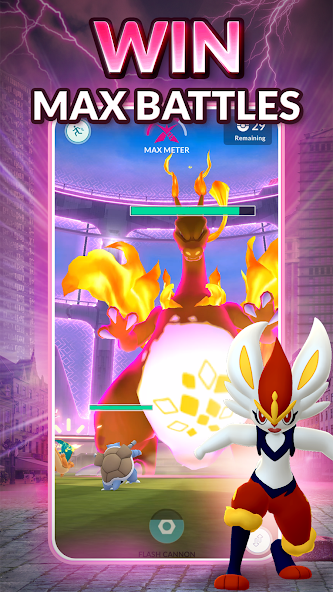
Max Battles add another kind of landmark through Power Spots. These encounters require eligible Dynamax or Gigantamax Pokémon and Max Particles, creating a team-building branch alongside ordinary Gym raids. During combat, attacks fill a Max meter; when it reaches its threshold, a Pokémon can enter its enlarged form for three turns. Energy appearing on the battlefield can help fill that meter, and teammates whose entire party has fainted can still contribute by cheering in eligible battles. A victory offers rewards and a chance to catch the boss, while placing a Pokémon at the Power Spot can help later challengers and earn Candy. This system gives a purpose to maintaining a Max-capable team instead of assuming that a strongest ordinary raid lineup can enter every encounter. Event schedules determine which bosses are available.
The loop is catching and exploring, the fights are Gyms, Raids and Trainer battles, and the appraisal screen is where a collection gets sorted. What that screen is not is the whole answer to what you keep.
Catch, explore, battle
The core of Pokémon GO is encounter-driven. Wild Pokémon appear as you move, your device buzzes to say one is nearby, and what turns up depends on the environment — the help pages name parks and bodies of water as examples, and Incense can pull more into range. Catching combines throw timing with capture odds: the colour of the target ring tells you how hard the Pokémon is to hold, and Berries and better Poké Balls shift the odds.
Battles come in two flavours. Nearby battles need both players in the same place and a Battle Code scan; Friend battles can be sent remotely from the friend list, so the social side is not location-locked. GO Battle League takes the opposite approach and matches you globally from Trainer Level 10 upward. Raids use different passes for different ways of joining. A free Raid Pass from a Gym Photo Disc and Premium Battle Passes cover in-person raids; Remote Raid Passes let you join eligible raids from elsewhere. Availability and event bonuses affect how many raids you can fit into the free route.
The location requirement is a real one rather than a formality. GPS and Location Services appear on the supported-device list, tablets and Wi-Fi-only devices often have no GPS sensor at all, and the help centre says outright that a device meeting the listed criteria is still not guaranteed to work.
What the appraisal screen does and does not decide
Appraise gives you a star rating and a separate reading for Attack, Defense and HP, and you can swipe straight into the next Pokémon to compare without leaving the screen. Two things follow from the help text. Evolving or powering up will not change an appraisal, so there is no point spending Candy in the hope of improving the reading. Purifying a Shadow Pokémon will improve it, which is the exception worth knowing before you transfer a disappointing capture.
What appraisal is not is a keep-or-transfer verdict. GO Battle League runs capped leagues — 1,500 CP in Great League, 2,500 in Ultra, and no ceiling in Master — and each league takes a party of three that cannot include two Pokémon of the same species, so the biggest Pokémon you own is not automatically the right one for the ladder you are playing. Powering up raises CP and HP but is limited by your Trainer level and paid for in Stardust and Candy, and Hyper Training can later lift a Pokémon's stats — though not a four-star or a Shadow one, and the game warns you first when a stat increase would push a Pokémon past a league's limit. Read the appraisal, then read the league rules, then decide.
Favourites and tags: sorting without regret
The star on a Pokémon's profile is the safety catch: a favourite cannot be transferred away, and searching your inventory for favorite brings that protected set back. Tags are the tool for grouping by intent rather than by species, they unlock at Trainer Level 15, a hash in front of the tag name in search filters to that group, and a tag can be removed from a Pokémon's own profile or action menu if it lands somewhere you did not mean.
Buddy hearts run on a daily ceiling
Quick Treat is the low-friction way to feed a buddy without going into augmented reality, and a missed toss costs nothing because the Berry or Poffin is not consumed. The part worth understanding is the meter around it. Today's Activities shows grey hearts for what is still earnable and pink hearts for what you have banked, the cap applies per activity as well as per day, and once the hearts beside a category are all pink you cannot earn more there until the counter resets at midnight local time. Mood sits outside that: an Excited buddy shows double heart icons for the day, which raises the ceiling rather than bypassing it, and the extra unfilled heart slots disappear if the mood drops.
Should you play it
Yes, if you want a collection project that runs alongside time you were going to spend out of the house anyway. I would go in expecting the location to shape the session: in-person raids and nearby battles want you somewhere specific, while Friend challenges and the Battle League work from wherever you are, so an indoor session is possible but a narrower one.
Two things to weigh. This is an app with a device checklist rather than a promise, so check the GPS requirement against the phone in your pocket before committing. And the daily heart and pass ceilings are the design rather than an obstacle to argue with: short frequent check-ins suit the systems better than one long sit-down, and the Premium Battle Pass is there for anyone who wants to raid more often than the free daily pass allows.
Go deeper with V4mp
- Developer
- Niantic
- Genre
- Augmented reality
Explore Pokémon GO further
Explore the wiki for detailed reference pages on the game's world, systems, items and locations.