
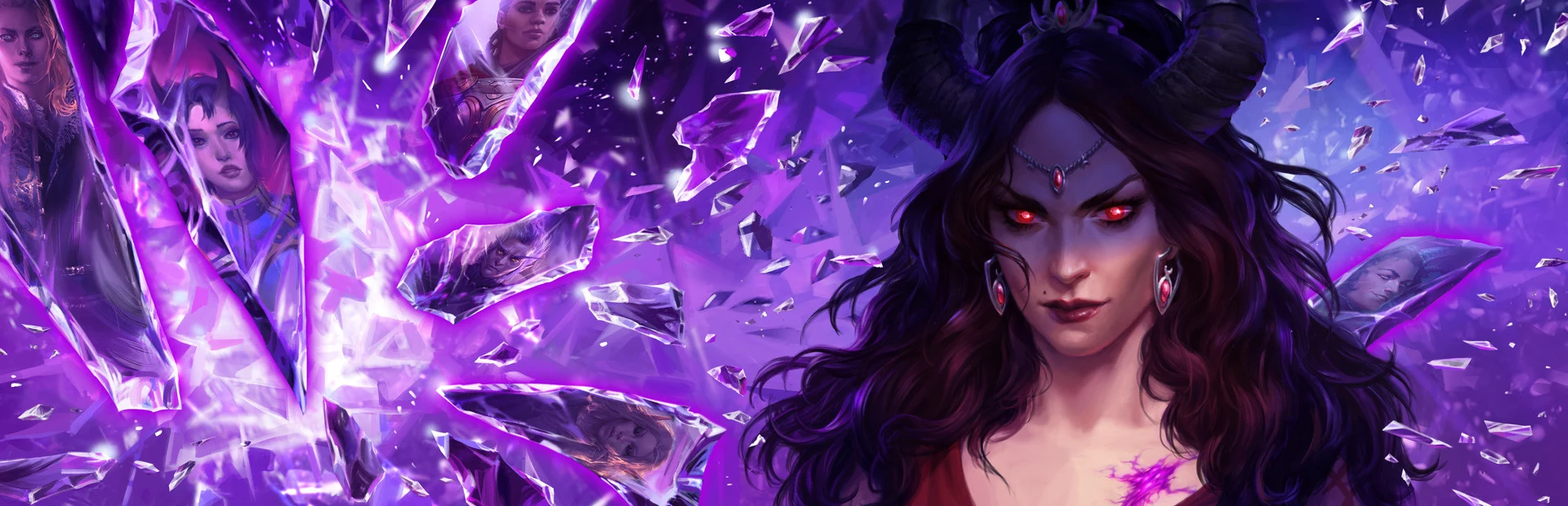
About Pathfinder: Wrath of the Righteous — Enhanced Edition
This is a long game that sells its expansions separately, so the first useful thing we can tell you is which version to buy and what the add-ons actually change.
What you are buying now
The version on sale is the Enhanced Edition, sold alongside two season passes and a stack of content packs. The add-ons include both main-campaign extensions and standalone experiences: there is content you play inside your crusade and content you can start on its own.
There is also a Game of the Year Edition that bundles the game with all of the expansions. It does not include the free Visitors from Morta pack, and that pack can be added at no cost. There are no differences between the Game of the Year Edition and the Enhanced Edition with all the expansions, and both editions receive updates at the same time.
The paid content line currently stops at A Dance of Masks; everything after it has been free packs and patches. So the gap between the cheapest version and the complete one is entirely in the expansions and passes.
The build is the game
The build starts from twenty-five classes and twelve races and runs to more than a thousand spells, feats and abilities. The Pathfinder First Edition ruleset is not a simplified adaptation: it expects you to care about feats, multiclass dips and the difference between a class feature and a capstone, and it rewards reading what each choice grants instead of improvising through the level-up screens.
Mounted combat is part of the ruleset, which quietly changes how a charge works on a large battlefield. That level of specificity is what makes the character sheet part of the game rather than paperwork.
Two combat modes, and you can change your mind
You can fight in real time with pause or in turn-based mode, and switch between them on the fly. Real-time with pause keeps the fight moving and lets you stop the clock to give orders, which suits the smaller encounters between story beats. Turn-based makes every action deliberate, which suits the fights with a dozen moving parts.
Both modes are legitimate ways to play, and the switch stays available mid-encounter, so the choice is per fight rather than per campaign. That flexibility is the quality-of-life decision the length of the game depends on.
The Mythic Path is a second character sheet
Mythic Paths include Angel, Demon, Lich, Trickster, Aeon, Azata, Gold Dragon, Swarm That Walks and Legend. Legend is the path where a hero declines the mythic powers and stays mortal, so it is itself a path choice.
The flavour differences are mechanical. The Lich path leads toward replacing your living companions with undead minions, which is a real decision about the party you have built. The Aeon is a cosmic judge who senses where the balance is broken and corrects it. Each path adds a layer to your hero and to the people around them.
The crusade layer, and the companions who leave
At a set point in the story you are handed command of the Fifth Crusade and the game adds a strategic layer on top of the RPG: recruit troops and their leaders, build up armies, and push back across the Worldwound. You command it twice over — as a strategist looking down at the map and as a field commander in a tactical mode.
This adds army management alongside the party adventure. It is a layer you play through rather than a panel you can ignore, but the game provides difficulty options and an automatic crusade setting, so you can choose how much of it you run yourself.
More than ten companions join along the way, and earning their trust matters: getting on the wrong side of them is a way to lose them. Combined with decisions that kill people off and a world that reacts to how you treat it, the party is not a fixed loadout.
Should you play it
Yes, if you want a CRPG where the character building is the entertainment and you are willing to read. The build depth is enormous, the two combat modes let you choose the pace, and Mythic Paths connect character progression to story choices.
Think twice if you bounce off dense rulesets, or if the crusade layer sounds like a chore rather than a change of pace. Check the edition that suits you before buying, because the expansion line is the whole difference between the cheap version and the complete one.
Go deeper with V4mp
- Developer
- Owlcat Games
- Genre
- CRPG
Explore Pathfinder: Wrath of the Righteous — Enhanced Edition further
Explore the wiki for detailed reference pages on the game's world, systems, items and locations.
Open the Pathfinder: Wrath of the Righteous — Enhanced Edition wiki ↗