
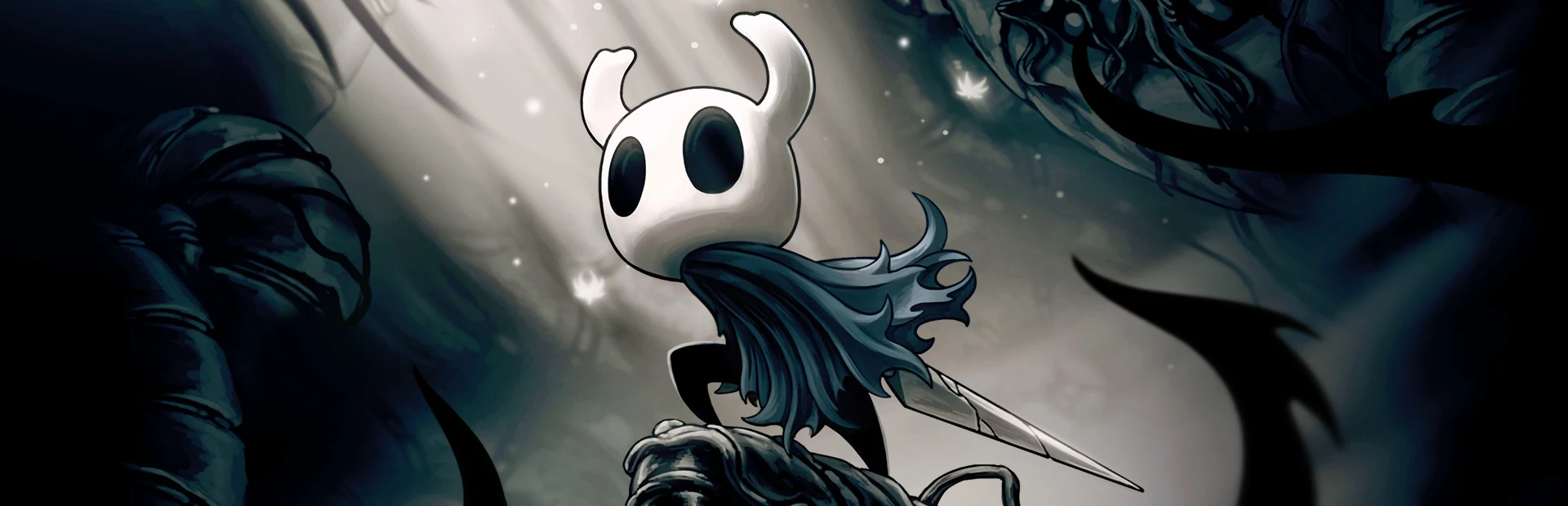
About Hollow Knight
Hollow Knight is a 2D action adventure from Team Cherry, the three-person studio in Adelaide that both developed and published it. It started on Windows in 2017 and spread from there to Mac and Linux, then to Nintendo Switch, and to PlayStation 4 and Xbox One as the Voidheart Edition, which bundled everything that had been added up to that point. The four free content packs — Hidden Dreams, The Grimm Troupe, Lifeblood and Godmaster — are already inside the copy you would install now rather than sitting behind a second purchase, and the only paid add-ons on the store are two soundtrack releases, so there is no story content waiting on a season pass. This review covers the base game with those packs. Hollow Knight: Silksong is a separate sequel set in another kingdom with another protagonist, and it has its own review here.
Soul is the whole economy
Hit an enemy with your nail and Soul fills; Focus spends it to repair masks, while spells draw from the same pool. By default, a heal or spell costs 33 Soul; Charms can change spell costs and healing effects. The main meter holds 99. Three Vessel Fragments form an extra Soul Vessel, which stores another 33, and you can collect three of those reserve vessels.
That shared cost is the design. A full main meter pays for three basic heals or spells, and choosing wrong is how fights slip. The Soul that pays for healing is Soul you did not spend on damage, and the Soul you spend on damage is healing you cannot afford, so the pressure of the game is really about how long you are willing to stay in range.
One detail is easy to miss and worth knowing early: dying cuts the main Soul meter to 66 until you deal with the Shade you left behind. Coming back is not just a walk, it is playing with a smaller tank.
Charms are the build, not the loot
Charms are the relics that actually define how you play, and they are limited by notches rather than by how many you own. You start with three notches out of the eleven that exist in the game, most Charms cost between one and four notches, with exceptions such as the five-notch Kingsoul and the zero-notch Void Heart, and you can only change your set while resting on a bench. Two good Charms being mutually exclusive is normal here, which is why the interesting question is never "what is best" but "what am I leaving out for this area".
There is a way around the limit, and it is priced honestly. If you try to equip a Charm that does not fit, the game refuses; if you keep attempting it five times while at least one notch is free, you become Overcharmed, which lets the extra Charm sit on your bar while you take double damage from everything. That trade is worth it against a boss that would kill you in one hit either way. It is a bad idea in a corridor you have not explored.
The nail is a route, not a weapon choice
You do not pick a weapon class here; you carry one nail and you improve it. The Nailsmith in the City of Tears takes geo and Pale Ore for four upgrades and finishes at the Pure Nail, with the first upgrade costing geo alone and each later one asking for more ore. Pale Ore is the constraint: it is a reward for searching, which quietly makes the best weapon in the game a map reward rather than a purchase.
Nail Arts add charged attacks to the basic swings. Great Slash, Dash Slash and Cyclone Slash are each taught by a Nailmaster, and they are charged attacks with different shapes, so the nail does get variety — just not from a menu. Spells grow the same way: Vengeful Spirit comes from the Snail Shaman at the Ancestral Mound, Desolate Dive from the Soul Master in the City of Tears, and Howling Wraiths from the Overgrown Mound in Fog Canyon. Every one of them has a stronger version hidden deeper — Shade Soul behind a locked door in the Soul Sanctum, Descending Dark in Crystal Peak, and Abyss Shriek down in the Abyss.
Movement follows the same ladder, and this is really the progression system. Mothwing Cloak comes from beating Hornet in Greenpath, Mantis Claw is in Mantis Village, Monarch Wings come from the Broken Vessel in the Ancient Basin, Crystal Heart is at the end of the Crystal Peak platforming section, Isma's Tear is in the Royal Waterways, and the Shade Cloak is deep in the Abyss. Each one rewrites a route you have already walked.
Dying is a detour, and it is priced like one
Lose your last mask and you wake at the last bench you rested on, with a Shade holding every piece of geo you were carrying and your Soul ceiling trimmed until you put it down. Die again before you get there and the first Shade goes, and the currency with it. That is the loop that had reviewers comparing this to the harder end of the action RPG genre, and it is the mechanic that decides whether the game suits you: the punishment is not the fight you lost, it is the walk back and the second mistake.
Steel Soul Mode is the same idea with the safety net removed. Finish the game once and it unlocks, and from then on there is no respawn at all — one death ends the file. The exceptions are worth knowing before you try it: dying to a dream boss or inside Godhome does not end the run, while dying in the White Palace or to the Radiance does. Even here the game is precise about which risks count.
The map is the first boss
Hallownest does not draw itself. You buy the map for each region from the cartographer who turns up somewhere in it, then buy the tools that make it useful — a quill, a compass that marks your position, pins for the points you want to remember. Until you have done that, an area is a shape you carry in your head, and finding the cartographer is often the first real objective when you walk into somewhere new.
This is where the game loses people, and it is worth saying plainly rather than dressing it up. Getting moved back to a bench, losing the geo, and retracing an unmarked stretch you have already cleared is the recurring friction. Playing this well is less about reflexes than about linking benches and Stag Stations into short routes, opening the shortcuts that skip the part you have already survived, and knowing when to stop exploring and spend your geo on a useful upgrade.
Four free packs, and one shelf that is only music
Hidden Dreams added two optional boss fights, new upgrades, new music, a fast travel addition and another Stag Station. The Grimm Troupe added a major quest with its own bosses, Charms, enemies and characters. Lifeblood added a boss and revised others alongside a wide pass of refinements. Godmaster added characters and a quest, more bosses, and Godhome, where the five Pantheons sit as the game's endgame. All four were free, and all four are part of the version you would buy now.
The store still lists paid extras, and it is worth being exact about what they are: an official soundtrack and a second music release. That is the whole list. If you are waiting for a story expansion to justify the purchase, there is not one.
The pulse
Hollow Knight was very well received: aggregate scores land between the mid-80s and 90 depending on the platform, and a recommendation tracker counted 97% of critics as positive. The praise is consistently for the same things, the hand-drawn art and parallax depth, Christopher Larkin's score, the atmosphere of a ruined kingdom, and combat that reviewers repeatedly described as simple to understand and unusually responsive. The Charm system drew specific admiration for the way it refuses to produce a single correct answer.
The disagreement was about difficulty, and it still is. Reviewers called it challenging, with at least one going as far as ruthlessly tough and occasionally unfair, and others admitting the opening hours frustrated them before the systems clicked. The bosses themselves were rarely called unfair — it is the spacing between them, the backtracking and the punishment for a lost fight that split people.
Should you play it
Yes, if you enjoy finding your own way through a world that rewards patience and curiosity. Hollow Knight is generous with content and stingy with explanations, and the four free packs mean the version on sale now is much larger than the one that launched.
Skip it if unmarked space is genuinely unpleasant for you rather than interesting, or if you need the game to meet you halfway with quest markers and a route. A different Charm set or a better shortcut can ease a difficult stretch, but neither replaces learning the fight. The game often leaves you to work out which change you need, and that silence is either part of the appeal or the reason you put it down.
Go deeper with V4mp
- Developer
- Team Cherry
- Genre
- Action adventure
Explore Hollow Knight further
Explore the wiki for detailed reference pages on the game's world, systems, items and locations.