
Current season
About Diablo IV
Diablo IV returns to Sanctuary decades after Diablo III, as Lilith’s arrival draws the Wanderer into a conflict shaped by humanity’s uneasy origins. The action role-playing game pairs a continuous world of quests and regional dangers with character builds, equipment choices, and repeatable dungeons.
Diablo IV is an action role-playing game set in Sanctuary, the world created by the angel Inarius and demon Lilith as a refuge from the Eternal Conflict. The story takes place decades after Diablo III, when Lilith returns and the Wanderer becomes caught in the consequences of her arrival. The campaign follows that central conflict through a world where ordinary communities live under the threat of demons, cults, and other forces drawn toward the struggle. Its focus is a new chapter in Sanctuary rather than a retelling of the earlier games.
Sanctuary is presented as a connected land divided into distinct regions, each with its own terrain, settlements, and dangers. Scosglen’s woodland and coastal spaces, the high-country Fractured Peaks, the Dry Steppes, swampy Hawezar, and the desert kingdom of Kehjistan provide different backdrops for travel and combat. Towns act as service hubs where characters can regroup and continue quests, while the routes between them are part of the world rather than isolated mission selections. Regional stories and encounters make exploration relevant alongside the main campaign, giving the map activity beyond moving directly from one story objective to the next. The contrast is visible in the named regions: Hawezar is defined by wetlands, while Kehjistan’s desert setting reflects a different climate and settlement pattern. Scosglen’s woods and the cold Fractured Peaks likewise give travel a clear regional identity.
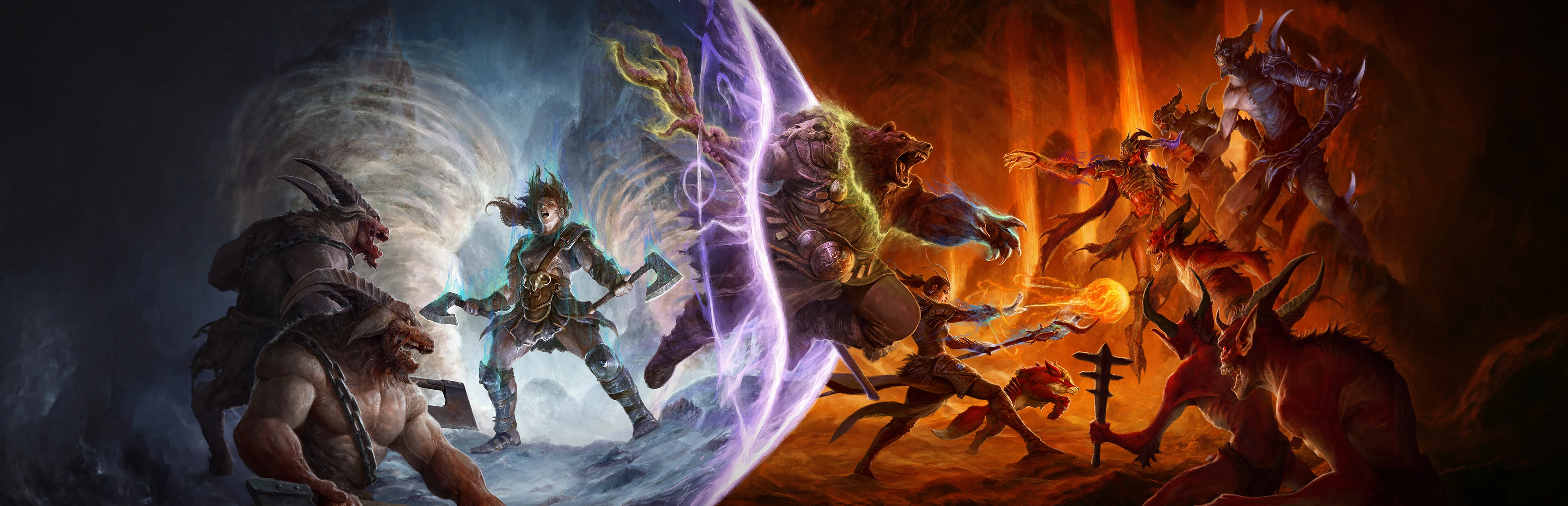
The base game’s original class identities give character creation a concrete starting point: Barbarians fight with a range of weapons, Sorcerers channel fire, cold and lightning, Druids combine shapeshifting with nature magic, Necromancers command the dead, and Rogues bring a mobile weapon-focused style. Each character then develops through skill choices. The current tree uses branches that can change the damage type, reach or function of abilities, so advancing a skill is also a way to define how it behaves. A player can build around a particular attack or connect complementary abilities, producing different responses to packs, distant threats and dangerous elites.
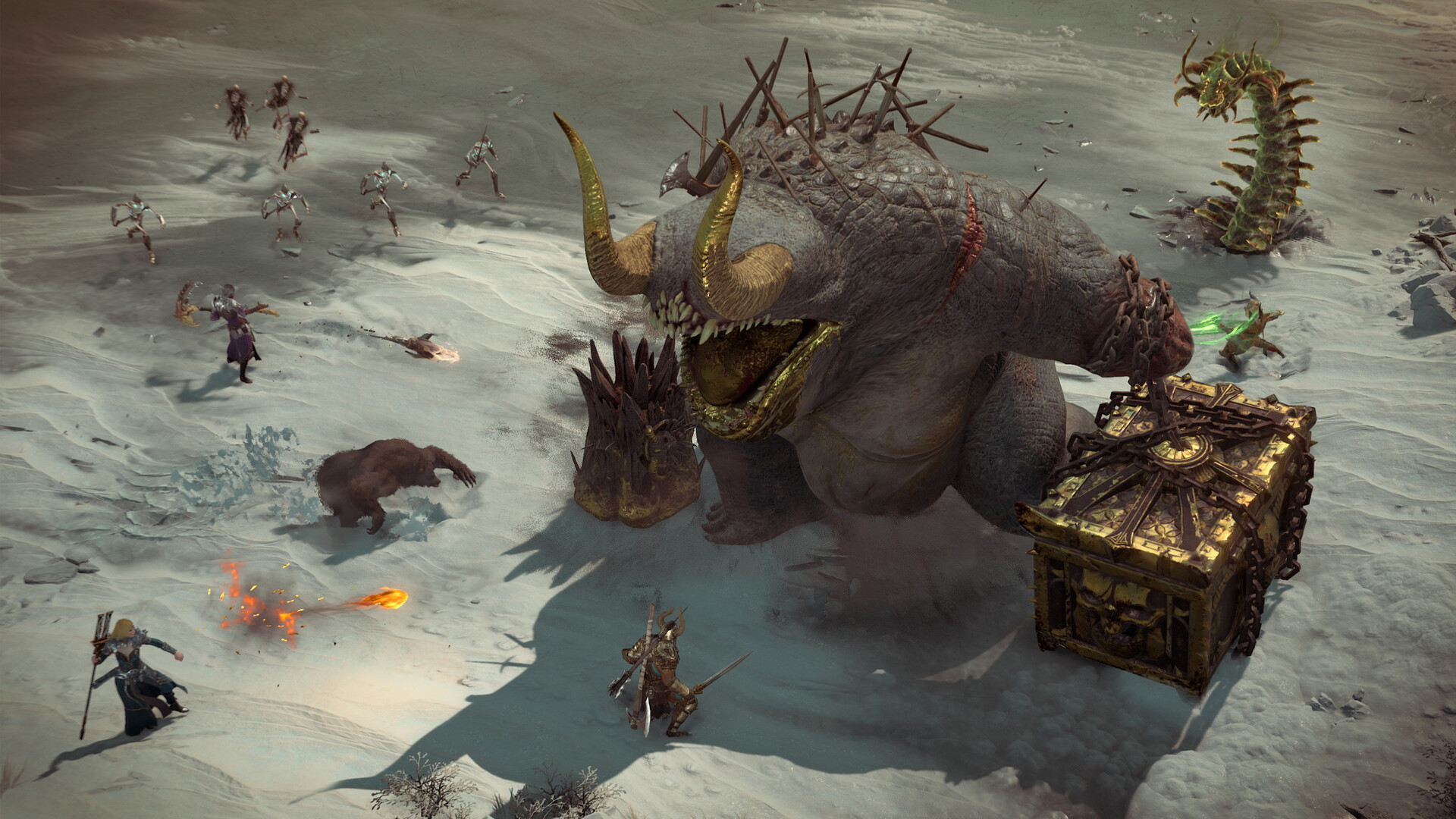
Combat takes place in real time against packs of enemies and larger, more demanding foes. The player moves through attacks, dodges danger, and uses equipped skills as their available resources and cooldowns permit. Enemy groups can pressure a character from several directions, so positioning and choosing when to commit an ability matter alongside the build itself. Boss encounters give those tools a more focused test: recognizing an attack, leaving its danger area, and finding an opening turns the same action system into a pattern-based fight. The emphasis remains on readable attacks and active control rather than issuing commands to a party.
Gear choices affect combat through ordinary attributes and special effects. A Legendary Aspect can change how an ability behaves, making equipment part of the build rather than only a way to raise a number; the Codex of Power is one of the game’s named systems for engaging with these effects. A Barbarian weapon setup, a Sorcerer’s elemental skills or a Druid’s changing forms can therefore be supported by different item powers. The useful question is whether a new weapon or armour piece supports the intended character identity, improves survival, or opens a different skill combination. This layer makes finding and adapting gear a separate decision from spending skill points.
Exploration includes more than following the campaign marker. Strongholds are occupied locations that players clear of demonic forces; reclaiming one changes it, brings non-demonic life back, and can reveal nearby dungeon activity. Regional events and world bosses add public encounters where other adventurers may be present, while the player can still travel through much of the campaign alone. Towns serve as social hubs between expeditions. These activities give the connected map concrete purposes: a player might resolve a local threat, uncover a new route or join a larger fight instead of treating the open world as empty space between story scenes.
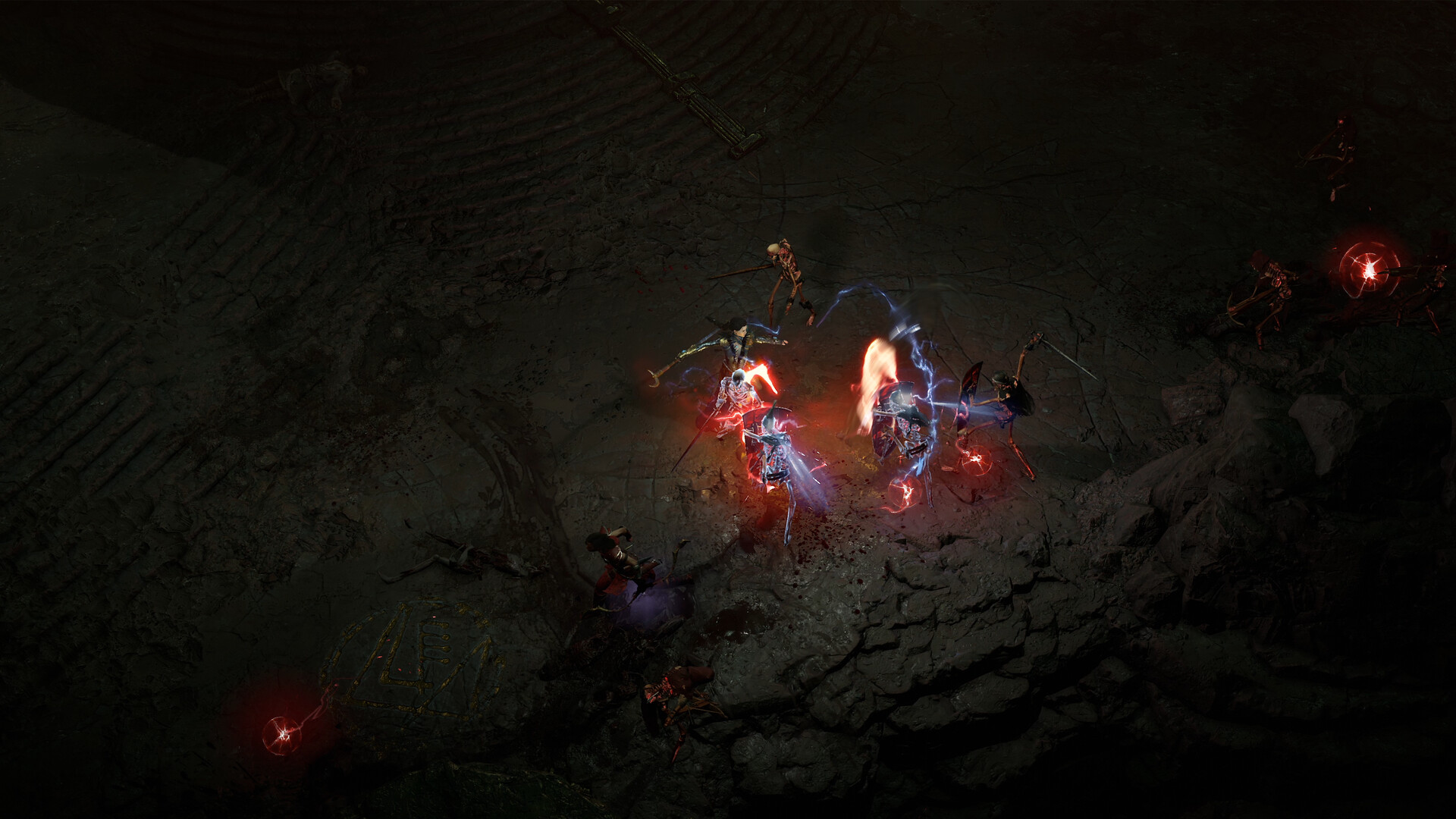
After the main quest, progression broadens into additional challenges rather than ending with the campaign. Nightmare Dungeons alter familiar runs with greater danger and extra objectives, while the Tree of Whispers offers rotating world bounties. Paragon Boards provide a further character-building layer: their paths and nodes extend a hero’s specialization beyond the regular skill tree. This gives the later journey its own progression choices, separate from reclaiming Strongholds or resolving regional events. Players can focus on a dungeon challenge, pursue the next bounty, or decide how to shape a Paragon route for the character they have developed.
Sanctuary’s human communities are caught between supernatural powers and their own beliefs, fears, and rivalries. The Wanderer encounters people whose immediate problems make the broader conflict tangible: a regional settlement may need help with a local threat even as the campaign’s larger danger grows elsewhere. Inarius and Lilith also represent opposing claims over the world and humanity, connecting the personal stories found along the road to Sanctuary’s origins. This tension lets exploration reveal pieces of the setting through characters and places, while the central journey keeps the returning Lilith as the force reshaping the world around them.
It launched in 2023 and the seasons have been turning ever since, with Vessel of Hatred and Lord of Hatred adding three classes, two regions and a rework of the skill trees and the endgame layer in between. The base game is still the foundation all of that stands on.
Choosing a realm is the first real decision
When you create a character you pick between the Seasonal Realm and the Eternal Realm, and both run the same campaigns, the same class list, the same dungeons and the same core endgame. What differs is what happens to your progress.
A season starts with a new character at level one and an empty inventory. In exchange you get that season's theme and mechanics, Season Ranks that pay out cosmetics, currency and Seasonal Blessings as you climb, and features such as the Tower and the leaderboards, which the game still labels as beta. When the season ends, that character and its progress move across to the Eternal Realm, so a season is a restart rather than a deletion.
The Eternal Realm is the persistent half. Characters, gear, stash, Paragon points and gold stay where you left them and nothing resets on a calendar, and it receives the same core game updates the Seasonal Realm does, including balance changes that can move a build you spent months on. Season changes do not delete an Eternal character, but patches can change its equipment and build.
Neither realm makes you replay the story. If you have finished the campaign once you can start a seasonal character straight in endgame content, and an Eternal character can pick up where it stopped or begin the newest campaign right away. Rebirth goes the other way: it converts an Eternal character into a seasonal one, resets it to level one, and keeps the class, the name, the appearance and your transmogs.
Five classes in the base game, eight with the expansions
A base-game copy gives you five classes. The Barbarian is an arsenal and a roar: weapons for every occasion, war cries and ground-shaking slams. The Druid shapeshifts between bear and werewolf and layers earth, wind and storm on top. The Necromancer summons the dead and splits its power between Bone, Blood and Shadow. The Rogue fights at range or in close quarters with imbued weapons, combos and poisons. The Sorcerer throws lightning, ice and meteors and mostly wants to not be touched.
The other three are expansion classes. The Spiritborn arrives with Vessel of Hatred, and the Paladin and the Warlock arrive with Lord of Hatred: a shield-and-hammer holy fighter and a demon-binder. These are full classes with their own skill trees rather than variants, making the roster a clear difference between a base-game copy and a collection.
Lord of Hatred also reworked the skill trees for all eight classes and added bonus skill variants, so a build guide written before it is worth re-reading rather than copying across.
What a character actually does after the campaign
Every edition runs the same core endgame. Helltides turn parts of the open world into a running fight with better drops, the Pit and the Uber bosses offer different progression and reward challenges, and the Forge is where gear gets made and improved. Paragon Boards keep adding power on top of all of it.
Lord of Hatred adds a layer instead of another activity on the same list. War Plans let you pick which activities to run and apply modifiers to the rewards, Echoing Hatred is an endless version for when you want to be overwhelmed on purpose, and fishing exists for the nights you don't. The Horadric Cube is the expansion's crafting bench, and the Talisman carries set bonuses.
Two systems do the quality-of-life work. The Armory gives each character five saved loadout slots, and a saved loadout covers your equipped items, your skills, your class mechanic, your Paragon boards and your glyphs: switching between saved Paragon setups costs no gold, and a missing-item icon warns you when a saved piece has been sold, traded or salvaged since. The loot filter is the other half. You write rules that recolor or hide drops, one filter runs at a time, and a hidden drop cannot be picked up until you turn the rule or the filter off.
What the expansions gate, and what they include
Vessel of Hatred is the first expansion: the Spiritborn, the jungle region of Nahantu, Mercenaries, and the campaign that continues the base story. Lord of Hatred is the second: the Paladin and the Warlock, the Skovos Isles, bonus skill variants across all eight classes, the Horadric Cube, the Talisman, War Plans, Echoing Hatred and fishing.
Any edition of Lord of Hatred unlocks Vessel of Hatred with it, and the expansion adds one extra stash tab and two additional character slots. The Age of Hatred Collection bundles the base game with both expansions for anyone starting now.
The seasons themselves are a smaller gate than the class list. A season's theme, questline and Season Ranks are free to everyone who owns the base game, and only the premium reward track is paid. Even there the requirement is partial: some Season Rank objectives require Lord of Hatred, so access to a season does not necessarily include every objective or reward.
Should you play it
Yes, if you want a dark action RPG with a campaign worth playing once, classes that genuinely play differently, and a post-campaign with more than one thing to do. The realm split is really a question about your habits: Eternal if you want one character you keep polishing, Seasonal if you want a fresh start and the newest mechanics.
What to weigh before buying is the expansion line. Three of the eight classes and two of the regions are paid additions rather than base-game content, and the newest endgame systems sit behind Lord of Hatred while the core endgame does not. If you want the whole class roster and every system, the collection is the version that carries it. If you want the campaign and a character to keep, the base game still stands on its own.
Go deeper with V4mp
- Developer
- Blizzard Entertainment
- Genre
- Action RPG
Explore Diablo IV further
Explore the wiki for detailed reference pages on the game's world, systems, items and locations.
Maps & Tools
Looking for locations and items? Search and filter the places we have mapped.