

About Atelier Yumia: The Alchemist of Memories & the Envisioned Land
Yumia Liessfeldt travels the fallen continent of Aladiss to investigate the cataclysm that destroyed its empire and made alchemy taboo. Gather ingredients, manipulate their mana to synthesize useful items, fight in real time with a changing party, and build comfortable bases and camps that support exploration and character growth.
Atelier Yumia: The Alchemist of Memories & the Envisioned Land follows Yumia Liessfeldt, who discovers after her mother’s death that she comes from a line of alchemists. She ventures onto Aladiss, a continent once shaped by an empire that used alchemy to become powerful before a mysterious cataclysm brought it down. Centuries later, the art is considered dangerous and taboo. Yumia’s expedition asks why the empire fell and whether alchemy itself is truly evil, while she travels with companions through the ruins and landscapes left behind. The story turns alchemy from a craft into the central question of the journey.
Aladiss is explored as a large field rather than a chain of isolated combat screens. Yumia can traverse in multiple directions, search for gathering points and use actions or items to move through the terrain. Materials gathered in the field feed directly into the crafting loop, while exploration tools can open paths and make further areas reachable. Main quests guide the expedition, but location quests appear around landmarks or Shrines of Prayer, and random requests can surface during travel. These different objectives connect the main mystery to smaller encounters and rewards across the continent.
Synthesis uses recipes and the mana contained in their ingredients to create items. The materials chosen affect the resulting item’s power, so gathering is tied to decisions made at the cauldron: a stronger ingredient can improve an item intended for combat or exploration. Crafted items have more than one use in the adventure; some assist with field actions while others provide effects for battle. Simple Synthesis lets Yumia create selected useful items while out in the field, without returning to the main base. The system makes resource collection valuable because each ingredient can become part of a tool, consumable or combat option. Resonance Synthesis places the mana-bearing ingredients into an Alchemy Core, where selecting materials that resonate with one another can strengthen the finished item. Ingredient quality affects how strongly those materials interact, making the choice of gathered components part of the recipe rather than a simple quantity check.
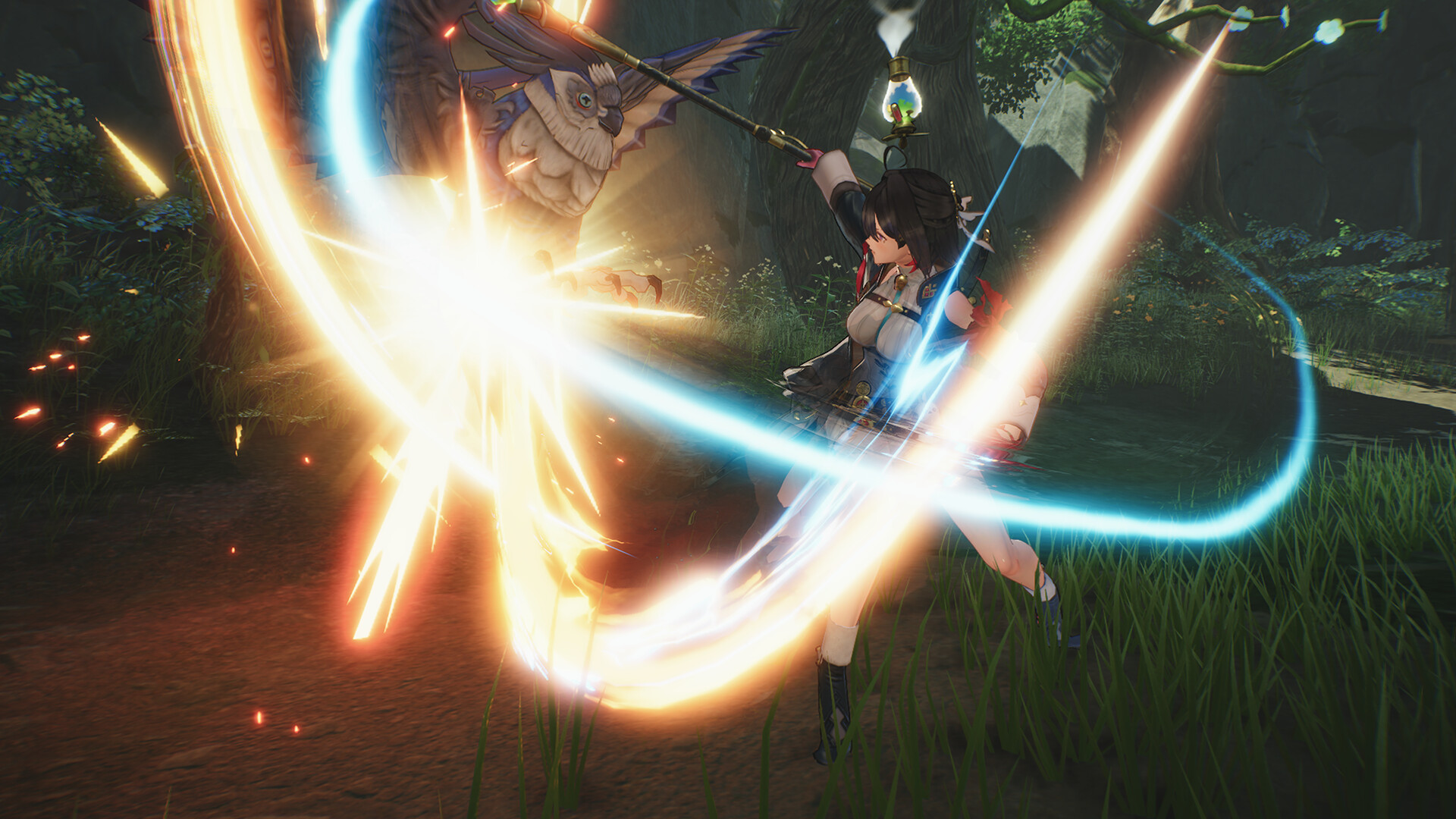
Combat takes place in real time and asks the player to choose attacks according to distance. Characters use different skills at close and ranged positions, and the active party can be moved or switched during a fight. The group uses three front guards and three rear guards, allowing the player to exchange characters as a battle changes. Synthesized items can transform into weapons such as swords or spears, and those items can be reused instead of consumed after one attack. This lets preparation at the alchemy station change what Yumia’s party can do once an enemy encounter begins.
Party actions give the battle system a rhythm beyond basic attacks and skills. Under specific conditions, a Friend Action links characters into a combination attack. Meeting other conditions activates Mana Surge, opening exclusive actions, while each character has an individual Maximize Mana Surge special move. The player can move between party members during combat and adjust who is in the front or rear role. That arrangement matters because attack range changes which skills are available and because different characters contribute their own actions. Synthesized items remain part of the tactical toolkit rather than a separate menu-only reward.
Building gives the expedition places to develop across the field. Players can select a base design from a catalog or build and decorate an atelier with walls, floors, roofs and furniture. Raising its comfort level unlocks development bonuses and can strengthen Yumia and her companions, giving the base a functional role alongside customization. Camps provide a lighter field option when the party does not want to return to its main base: characters can cook or rest, and meals grant benefits for exploration and combat. Certain character events occur at camp, using these pauses to add context to the people travelling with Yumia.
Energy creates another limit on travel and field actions. Manabound areas are covered by mana fog and continuously drain the Energy Core while the party explores them. Finding and activating Mana Circulators clears that fog, changing the area for subsequent travel. Simple Synthesis, falls from high places and riding the Procella also consume energy. At zero, Yumia cannot sprint or wall jump, and entering combat leaves the party weakened. Energy Generators at bases, small shrines and Alstahlia Flowers provide ways to replenish the reserve; the flowers grow in manabound areas and bloom again after use. Outside those dangerous areas, energy also refills naturally over time. Managing that reserve connects movement and environmental exploration to the condition in which the party enters its next fight.
The mysteries of Aladiss also have human and supernatural faces. Yumia’s path is obstructed by figures identified as a Noble in a Black Cloak, a Monocular Werewolf, a Sheep-Eye Witch and a Dragon-Winged Warrior, each described as being obsessed with alchemy. Their presence connects the continent’s old catastrophe to people who still pursue the forbidden art in the present. At the same time, the game’s character quests and camp events provide ways to learn about the companions travelling with Yumia. The result is a story built around two linked questions: what destroyed the old empire, and what the people who inherited its knowledge intend to do with alchemy now.
You play Yumia Liessfeldt, an alchemist travelling a ruined continent where her craft has been declared taboo. Everything you make carries the mana of what went into it, and that is the whole game in one sentence.
Synthesis is a mana problem, not a recipe list
The official description is precise about how crafting works: you manipulate the mana contained within ingredients to create items based on recipes, and the strength of an item's power depends on the ingredients you used. Recipes tell you what you can make; the ingredients decide how good the result is. Learning a recipe and making a good version of it are two separate skills, and the second one is where the hours go.
At the altar, a recipe is built around an Alchemy Core. Adding the core's required ingredients is what makes synthesis possible, and a single activated core is enough, so you can finish a basic item long before you have everything a full arrangement would want. The deeper layer is the Alchemy Slots around it. Each ingredient has a resonance area, and that reach can touch cores, other slots and drifting mana; anything drifting within range is collected when you place that ingredient. Choosing an overlap is the actual decision, and filling a slot without checking what it reaches is how you end up with a perfectly ordinary sword.
Only Effect Alchemy Cores are available at first. Other core types arrive through the Skill Tree, which quietly means your crafting ceiling is a progression unlock rather than a shopping trip.
Item Rebuilding fixes what you left empty, and nothing else
Rebuilding is the second pass on an item you have already made. Learn the skill, open the altar and switch between synthesis and rebuilding, then add ingredients to cores or slots that are still empty. It is a genuinely useful way to rescue a weapon you made early with cheap materials.
The limit is the part that changes how you build. A space that already holds an ingredient cannot be cleared or replaced, whether that ingredient went in during the original synthesis or during an earlier rebuild. If every position you wanted to change is occupied, rebuilding simply cannot help you, and your only answer is a fresh synthesis. The practical habit is to treat the first pass as final for the cores that matter and use rebuilding to top up the gaps, rather than planning to correct a bad ingredient later.
What you make is what you explore with
The field is an open continent, and making things is how you get through it. Simple Synthesis works out in the field rather than only at the atelier, and the store's own description says it produces exploration tools for opening the path forward as well as items for combat and further synthesis. Not every blocked path is an exploration-tool problem, since some of what stands in your way is simply a fight or a story gate, but the loop keeps the same shape: read what is stopping you, work out which item answers it and make that item.
It has one quirk worth knowing before it costs you an evening. Simple Synthesis automatically equips created items into the Exploration Bag when there is space, and if the bag is full they go to the container or basket instead. Quest deliveries will not accept an Exploration Tool that is still equipped in the bag, so a tool you can plainly see in your inventory can be refused until you take it out of the bag and offer it again. If a delivery is refused, check the bag first.
Combat keeps synthesis in the middle of the fight
Battles are real-time, and the system is built on two attack ranges that change your available skills as you switch between them, so the fights turn on how quickly you read which range you want to be in. The reason synthesis matters here is that synthesised items transform into weapons like swords and spears, and the store's own line is that items can be reused any number of times, so a crafted blade is part of your moveset rather than a consumable you are rationing.
There is also a building side, where you construct bases and furnish them. Both the Dressing Room used for costumes and Photo Mode arrive once base building is unlocked, which is the point where most of the cosmetic side of the game opens up.
Should you play it
Yes, if the crafting is what you came for. This is an Atelier game that put its deepest decisions in the synthesis screen, and the open-field structure suits a player who would rather work out what to make than follow an arrow. Choose equipment and synthesised items to support the characters you take into battle.
Two practical notes before you buy. It is sold across PlayStation, Xbox, Switch and Steam with real differences between them, and those differences are regional as well as platform-specific. The publisher's UK and European page lists the Switch, Xbox One and Steam versions as digital only, but the same publisher's Japanese page sells a Switch physical edition and includes Switch in its physical box sets, so the European note is not a worldwide rule. The developer also warns that some downloadable content might be restricted to certain platforms in future. Buying the base game and then the season pass is a real alternative to the bigger editions: the additional maps in that pass want you to reach certain points in the game before you can explore them, and the publisher's own repeated warning about duplicate purchases is worth taking seriously here.
Go deeper with V4mp
- Developer
- Gust
- Genre
- RPG
Explore Atelier Yumia: The Alchemist of Memories & the Envisioned Land further
Explore the wiki for detailed reference pages on the game's world, systems, items and locations.
Open the Atelier Yumia: The Alchemist of Memories & the Envisioned Land wiki ↗