
About Absolver
In the fallen Adal Empire, you begin as a masked Prospect placed under the Guides’ authority. You explore a compact world, learn attacks by surviving opponents’ moves, and build a personal Combat Deck from four directional stances. Training, PvE encounters and multiplayer trials all feed a journey toward proving yourself worthy of becoming an Absolver.
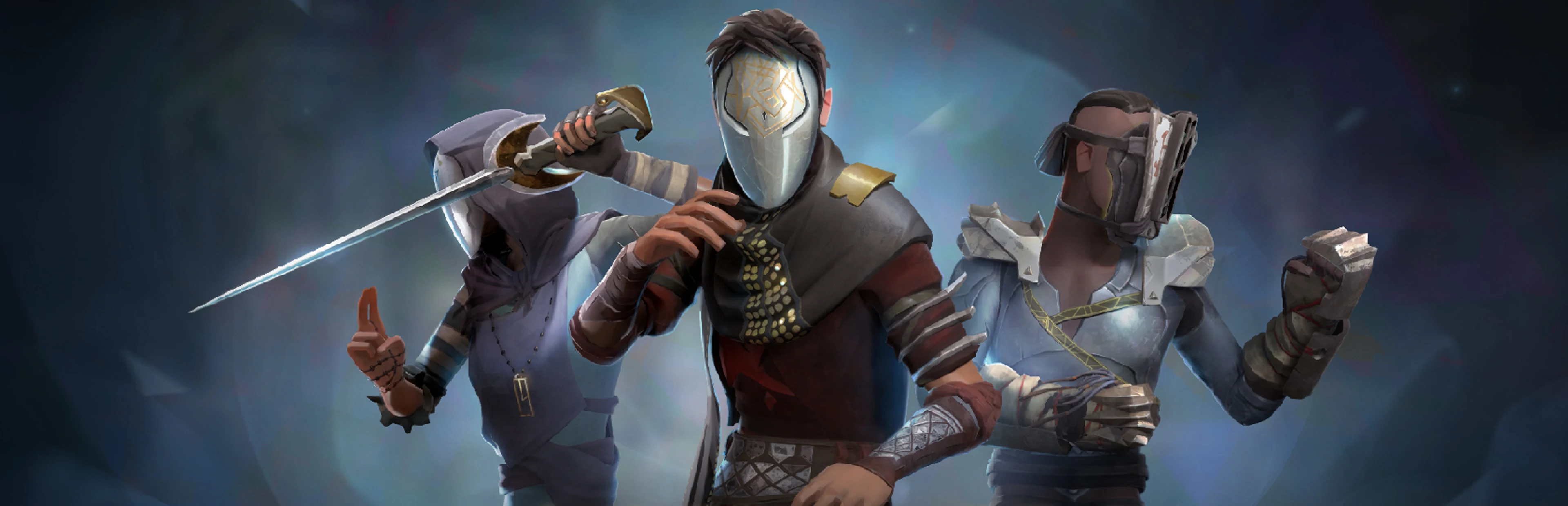
Absolver begins with the player as a Prospect, an untested fighter wearing a mask created by the Guides, rulers of the fallen Adal Empire. The mask frees its wearer from ordinary needs such as hunger and thirst, and the Guides use Prospects’ journeys to judge who may join the Absolvers. The setting is a small open world of ruins and paths where the people encountered are part of the progression rather than scenery alone. You move through Adal, fight key non-player characters and other Prospects, and work toward the tower at the end of the initiation. The premise keeps the goal clear—earn the title—while leaving how to fight and whom to learn from largely in the player’s hands.
Movement and orientation shape every exchange. Combat tracks four stances around an opponent—front left, front right, back left and back right—and an attack can carry the fighter from one stance into another. A deck gives each stance a sequence of attacks and an alternate move, so the player plans how one string leads into the next instead of selecting a fixed combo. Attacks differ in speed, range, damage and special properties; a deck can be built to maintain pressure, change direction or introduce a slower move after a quick entry. The camera and footwork matter because the stance system is relative to the opponent. A change in distance or angle can affect which attack path is available.
Moves are learned in combat by defending against attacks that the Prospect has not yet mastered. Blocking, avoiding or parrying a move contributes learning progress; winning the encounter secures the accumulated attack experience. This makes an unfamiliar opponent a source of new material as well as a threat. The player can use those attacks later in the Combat Deck, testing how they connect from different stances. Combat is therefore also a curriculum: observe the opening and recovery of enemy moves, survive long enough to learn them, then decide whether they fit the deck. Training and encounters build a vocabulary of attacks, while the deck editor lets the player arrange that vocabulary into sequences with an intended tactical flow.
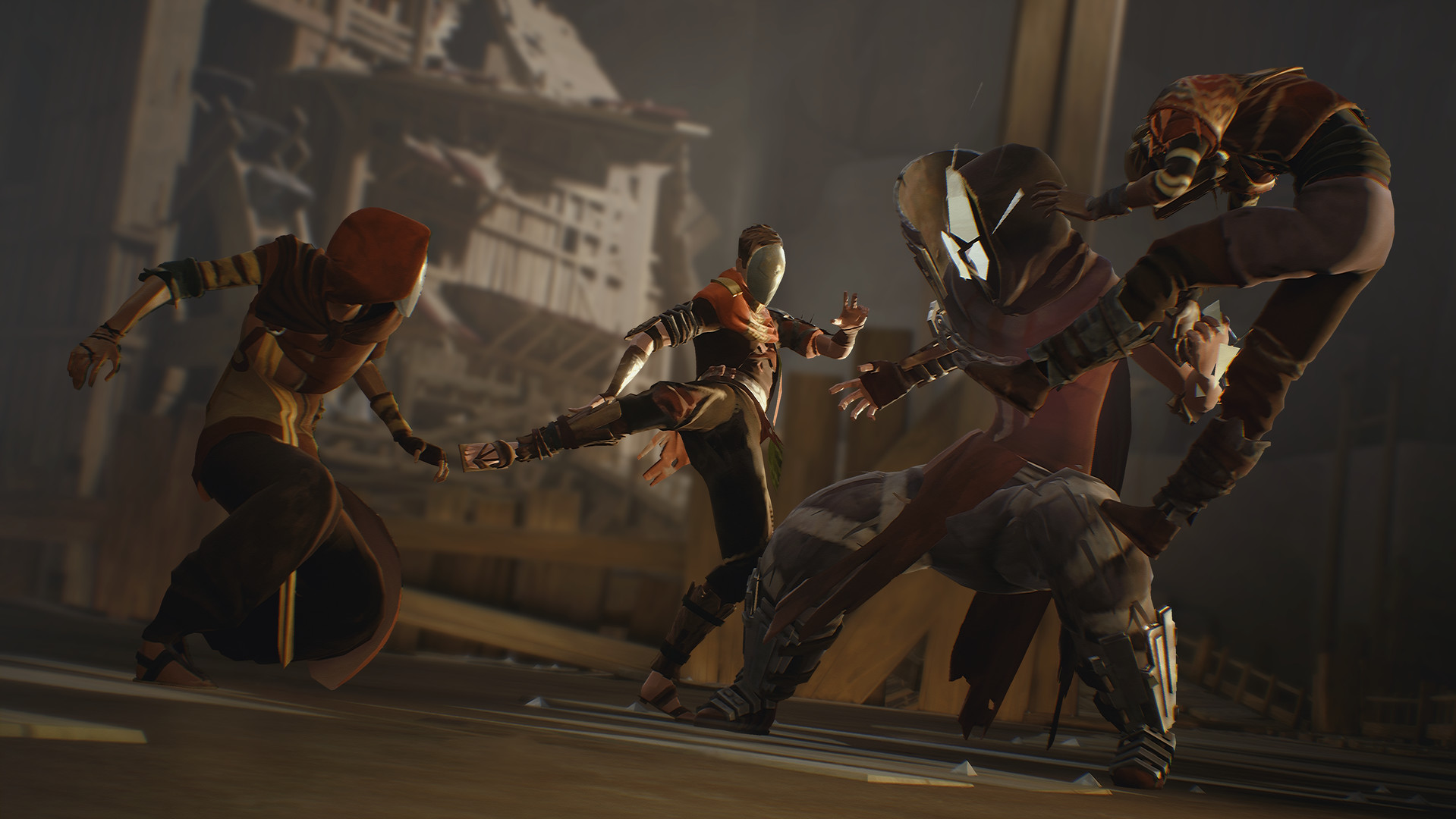
A Combat Style determines a defensive ability and adjusts the character’s strengths. The starting choices include Windfall, which avoids attacks with directional movement; Forsaken, which parries; and Kahlt Method, which absorbs a hit. Other styles can be learned through progression and student or mentor relationships. The style is only one layer of a build: the deck determines attack sequences, while equipment changes protection, mobility and other attributes. Separate bare-handed and weapon decks allow a sword or other weapon to alter the pattern of available moves. Tension Shards accumulate during combat and can power special abilities or bring a weapon into the fight. These systems reward deliberate timing, but they also make the player’s preparation visible in the move flow.
Adal supports both the structured path of the Prospect and encounters shaped by other players. The world can be traversed to fight NPCs, meet fellow fighters, teach or learn a style, and form relationships with mentors and disciples. Combat Trials provide dedicated arenas for competitive fights, while cooperative PvE lets players tackle the ruins together. Arena success advances the broader ranking and progression framework. The game can also be completed offline, though its social systems are a central part of its design; the world and combat deck remain meaningful even when approached without relying on other players. The online encounters are built around uncertainty: another masked fighter may become an opponent, an ally or a teacher.
Progression also includes attributes, equipment and the organization of a school. Victories provide experience for attributes such as strength, dexterity, vitality, endurance and will, while Tension Shards feed combat powers. Gear obtained through PvE or PvP changes protection, speed and stamina-related values, creating a trade-off between defense and movement. Joining a school can expose the Prospect to another player’s combat style and deck, and eventually lets experienced players share their own approach as mentors. These systems give advancement several tracks: gain moves through observation, shape a deck, refine attributes and equipment, and learn from another fighter. The result is a character whose identity is expressed through the way attacks are chained as much as through a stat spread.
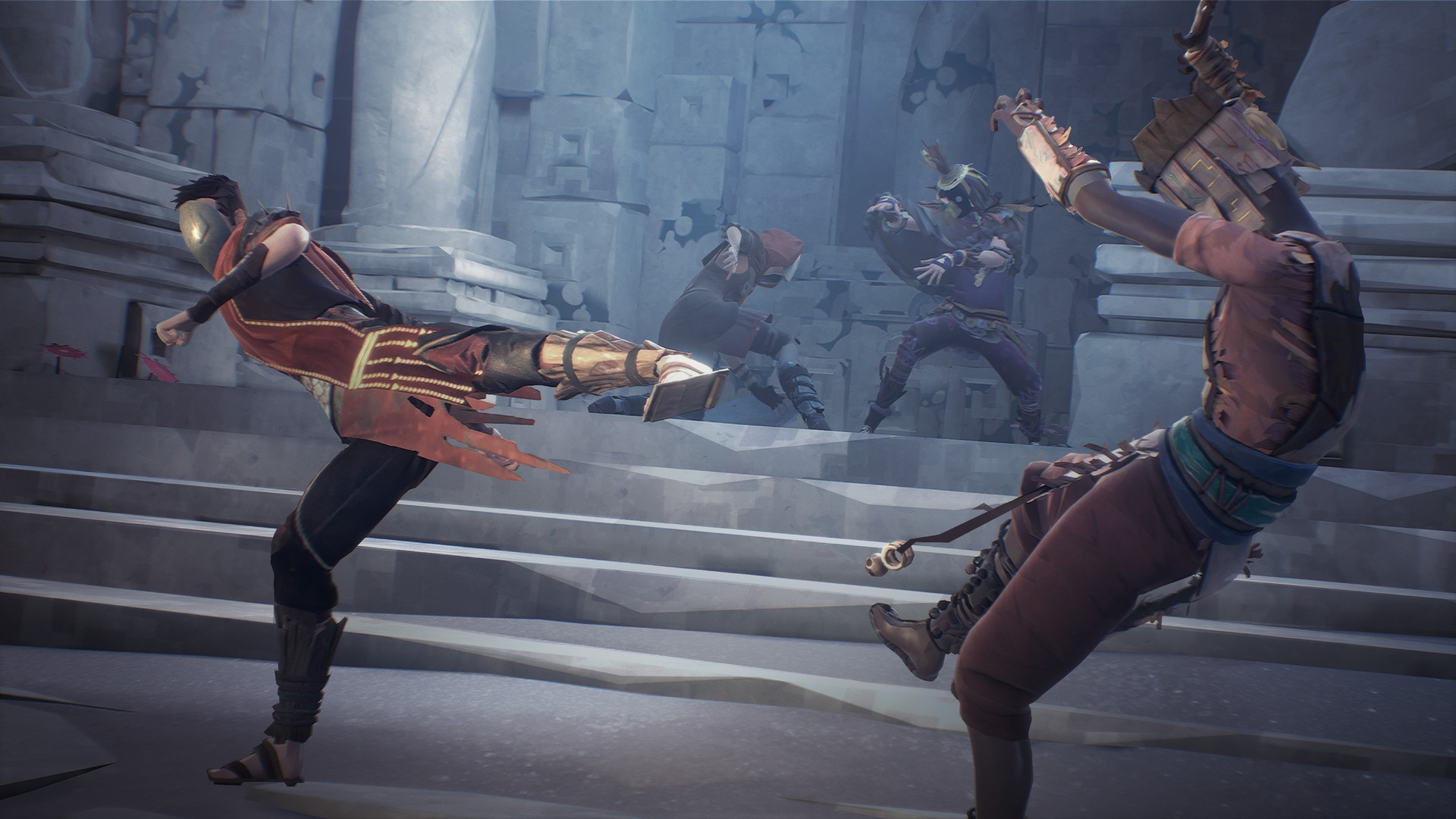
The route toward becoming an Absolver culminates in a final tower fight after the Prospect has trained and defeated important figures in the world. That goal gives exploration a direction without turning the campaign into a linear mission list: movement through Adal leaves room for duels, cooperative battles and lessons from other players along the way. The deck’s stance transitions remain the central skill test in every setting, whether against an NPC or a human opponent. Learning a new attack can alter a familiar sequence, and changing a style or weapon shifts the defensive and offensive options around it. Absolver’s progress is consequently both outward—through the ruins and toward the tower—and inward, through an evolving understanding of the combat system.
Sloclap's martial-arts brawler is one of the few fighting games where the most important decisions happen before the fight, in a menu that is really a character sheet. It is also compact, online and a little rough around the edges, and it is worth knowing which of those you are buying.
What you are actually playing
Absolver is a third-person martial-arts brawler from Sloclap, published by Devolver Digital, and it is a fighting game with a walk in front of it. You wake in the ruins of the Adal Empire wearing a mask, cross open ground, meet other Prospects, and pick fights to earn moves and gear. The fighting is where the game lives: four stances, a deck of attacks you assemble yourself, and a single defensive ability that quietly decides which exchanges you are good at.
The fighting comes in two halves. The campaign is yours to work through against offline opponents, with nobody else needed online, and that is where you can learn new attacks and hunt gear on your own. The open world is also shared, and other players walk into it: you cannot tell from a distance whether they want to spar, duel or simply pass through, which is most of the tension the shared map has. The structured play is the Combat Trials: 1v1 duels, plus a 3v3 Overtake mode that shipped a few months after launch, all fought for rank and rewards.
The deck is the character
There is no class and no fixed moveset. Your deck is a list of attacks you arrange yourself, and each of the four stances holds its own set. You begin with almost nothing, and every move you want has to be earned, either by defending against it in a fight or by learning it from someone who already knows it. Then you decide where it goes.
That is the whole game in one idea: what you can do in a fight is something you built. A deck that flows is one where each attack leaves you in the stance that holds the next one, so a good sequence plays as a route rather than a list. You can change stance on the fly mid-fight, and this is where decks are won and lost. A careless arrangement leaves you standing in the wrong guard with the wrong move loaded, which is not where you want to be while someone swings at you.
The cost is that Absolver is often at its most interesting before the fight starts. If the best weapon in a fighting game being a menu sounds like the appeal, it is. If you want to pick a character and learn their buttons, this is a lot of homework bolted to a fighting game.
You are not guessing at any of it, either. Open an attack in the list and it shows its own numbers: range, stamina cost, impact on a raised guard and the advantage frames it leaves you on a hit. Absolver is a fighting game that hands you the frame data, and decks get sharper the moment you start reading it.
Styles decide what defence means
Every character picks a Combat Style, and the style changes what defending actually does. Kahlt Method absorbs hits without being stunned or pushed back, and returns some of the health you lose when the counter that follows lands. Forsaken parries and briefly stuns. Windfall avoids the strike and slows the attacker for a moment, which opens a counter window rather than a free hit. Stagger, the fourth style, is a drunken-boxing variation that fights to its own rhythm, and Downfall added Faejin, drawn from Bruce Lee's Jeet Kune Do, which changes its defensive ability depending on your input and the stance you are in.
Defence is not only the style ability. Guarding, feinting and manual dodging are all still there, and Downfall added Resilience: when your Resilience is at least as high as an attack's power level, that hit will not interrupt you. Two players in the same arena can hold completely different ideas about which exchange they want to be in.
So the same fight plays out differently depending on which answer you own. A Windfall player is waiting for the strike to slip past. A Kahlt player is looking to eat it and hit back. Two characters in identical gear can approach one exchange in completely different ways, and that is the reason Absolver's fights stay interesting well past the first few hours.
Schools, and the people you learn from
The social side is not a lobby bolted on afterwards. You can join a School, learn from a mentor, and eventually run one yourself with students of your own. A school lends its deck and its powers to its members while they are in it, and using that deck against enemies is how its moves become yours. School Challenges then turn that into a season: reach Disciple rank, take your school's loadout into 1v1 Combat Trials, and the wins your school racks up pay out rewards on a three-week cycle.
That is a better reason to care who is on the other side of the arena than a friends list. It is also the part of the game with the sharpest edges, because learning from people depends on people being there to learn from, and a school's rewards only matter if you keep turning up to defend them.
Downfall, and what came free
Absolver got one expansion, and Sloclap gave it away. Downfall arrived in 2018 as a free update and added a dedicated PvE dungeon mode: a run through the Adalian Mines, alone or in online co-op, against upgraded enemies and three boss fights, with the Gleam you collect feeding upgrades and eventually unlocking the Faejin style. The base game's shared world already had its own PvE fights, so treat the mines as the focused dungeon run rather than the only place to test yourself offline. Downfall also added School Challenges and rewrote how every enemy in the game fights, which changed the original world fights too.
The paid extras stay small. The Adalian Forest Pack is cosmetic gear with the same stats as pieces you can already earn, so it buys a look rather than an advantage. The rest of the money goes on the soundtrack and a Deluxe edition that bundles it with a digital artbook. Nothing essential sits behind a paywall.
Powers, gear and the long game
Beyond the deck, every fighter carries a few Powers. Downfall's set is a good sample of what they do: a burst of cut damage on bare hands, a shield that stops your own attacks being interrupted, a stun that disarms the opponent and drags their weapon towards you, and a short window where you slip every incoming hit. They unlock in the Essence Shop once your Gleam level is high enough, which ties the mines back into the rest of the game.
Gear runs a similar long game. Weapons and armour drop from fights and from Rift Disks, the loot boxes you buy with crystals. Crystals come with prestige levels past level 60, and they also pay for attribute resets and appearance changes. Spare pieces break down into fragments, and those fragments turn an aged piece back into a new one. It is a lot of systems for a game about punching people, and all of them feed the two things that matter: your look and your deck.
What it costs you
The first cost is the connection. The shared world and online Combat Trials need a stable connection; the campaign can also be played offline.
The other cost is scale. Absolver is a compact game: the open world is a route between fights rather than a place to live, and the long tail is duels, schools and the mines rather than new regions to roam.
One practical note: the store page's own system requirements recommend a gamepad. Absolver's defence is built on direction and timing, and the fighting is laid out with a controller in mind.
Should you play it
Yes, if the idea of assembling your own martial art sounds better than picking one off a list. Absolver's fights are still unlike anything else in the genre: the stances, the deck and the style abilities all point at the same question, which is what you actually know how to do when the pressure arrives.
Skip it if you want a large world, a long campaign or a fighting game you can play next to someone on the same couch. Absolver is an online brawler with a small map, a high skill ceiling and no local co-op, and the people who stay with it stay for the deck.
Go deeper with V4mp
- Developer
- Sloclap
- Genre
- Action RPG
Explore Absolver further
Explore the wiki for detailed reference pages on the game's world, systems, items and locations.