
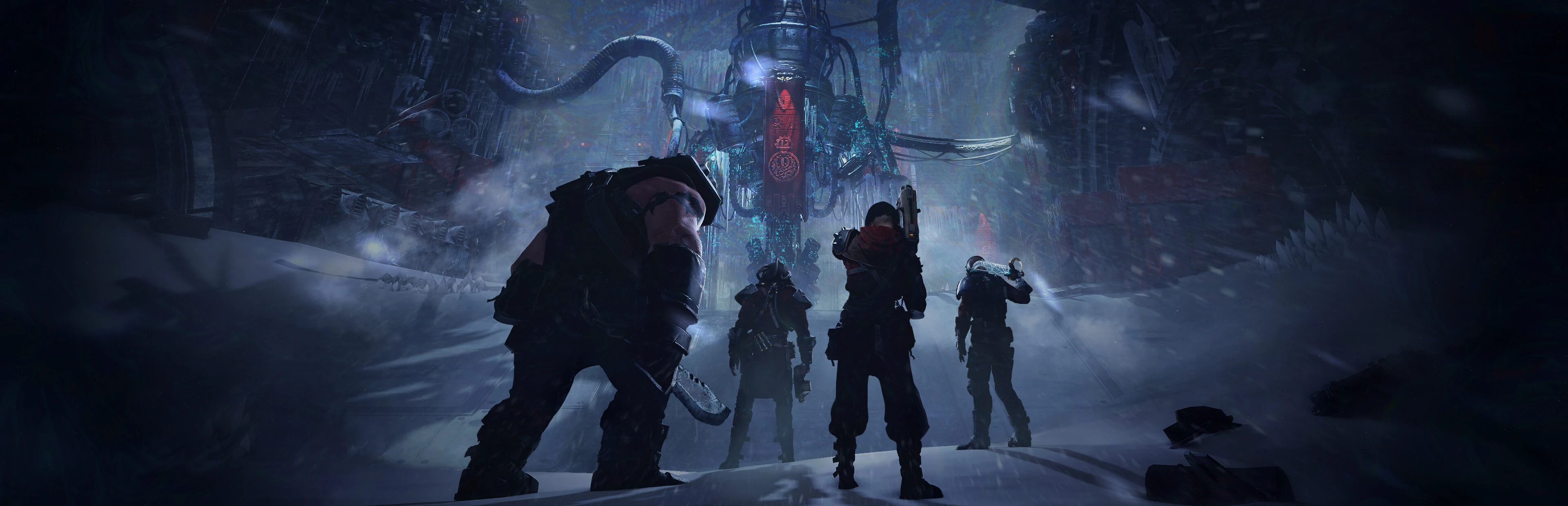
About Warhammer 40,000: Darktide
Join a four-player strike team of rejects fighting the Nurgle-corrupted forces of the Moebian 6th in Hive Tertium. Switch between melee and ranged combat, build a Veteran, Ogryn, Zealot or Psyker, complete cooperative missions and return to the Mourningstar to improve gear and prepare for harder operations.
Warhammer 40,000: Darktide sends a squad of prisoners and other condemned recruits into Hive Tertium, a vast Imperial city threatened by the forces of Nurgle and the Moebian 6th. The player creates a reject, choosing a background and personality that shape dialogue, then joins up to three other operatives for missions under the direction of Inquisitorial agents. Rather than following one hero through a solitary campaign, the game builds its story through briefings, mission events and conversations in the Mourningstar hub. Tertium's manufactoria, transit stations and sealed districts become battlefields where an ordinary task can expose the squad to a sudden surge of enemies or a larger operation.
Missions are four-player cooperative operations with objectives that vary by location. A team may need to cross a hostile district, restore machinery, carry an item through an exposed area or survive a timed holdout while an objective completes. The mission board offers locations, difficulties and special conditions, and players choose the operation before deploying. Enemy composition and combat pressure can shift as the squad advances, so the route from entry point to extraction is a sequence of fights and tasks rather than a clear corridor. Completing a mission earns resources and character progress; failure can still teach the group where coordination broke down, but it does not complete the objective or guarantee its rewards.
Combat depends on moving between melee and ranged attacks. Hordes can crowd a narrow passage, making a block, shove or sweeping strike necessary to create breathing room before a player can aim again. Ranged enemies punish a squad that stays exposed, while armored specialists and disablers can interrupt a careless push. Toughness provides protection against incoming ranged fire and recovers through close team proximity and combat actions, giving coherency a tactical purpose. Dodging, sprinting, sliding and weapon choice all affect whether a player can cross fire safely. Ammunition is shared as a limited resource in the environment, so squads need to prioritize threats and avoid wasting shots into a dense horde when melee can control it.
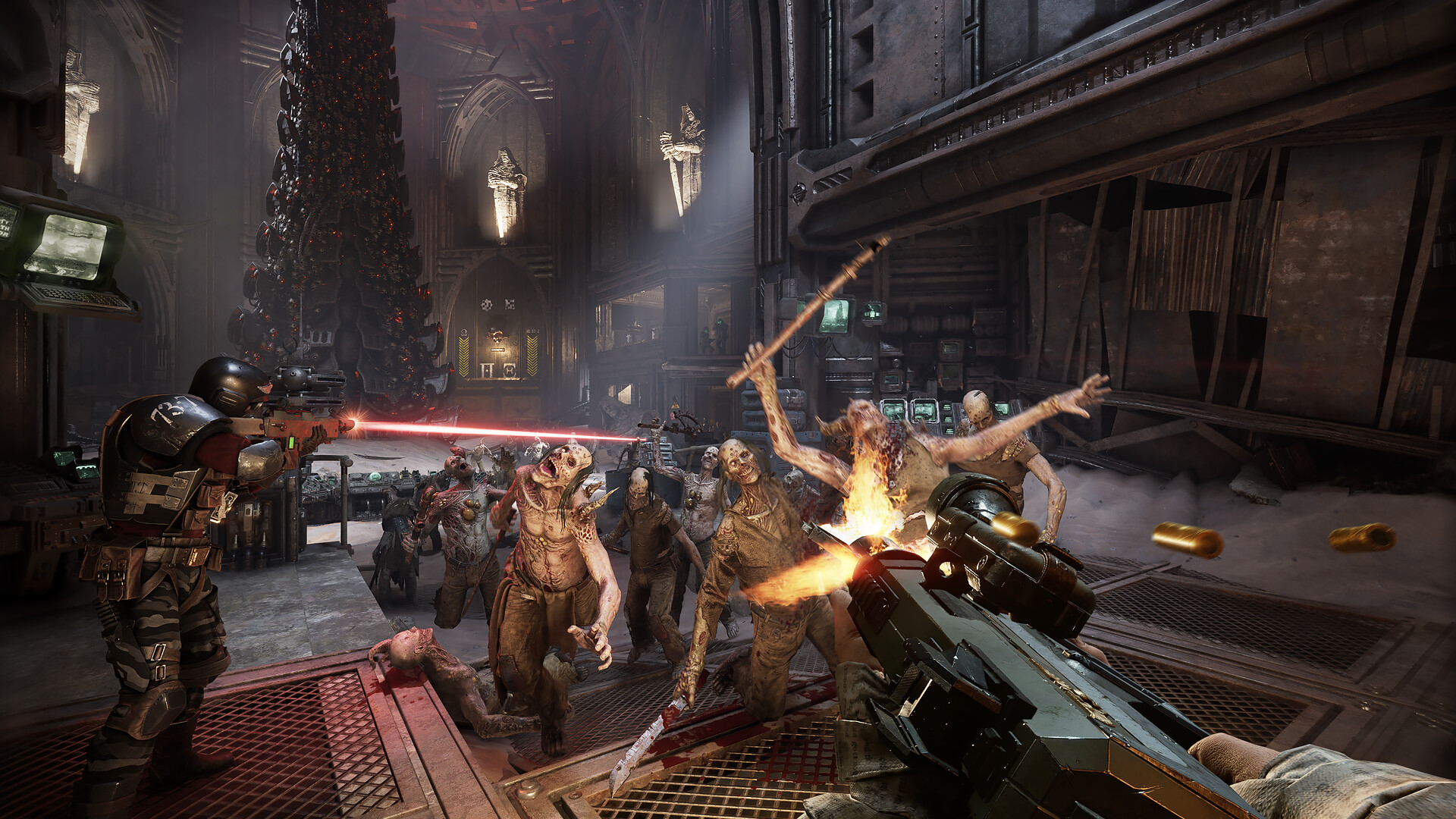
The four core archetypes provide different foundations: Veteran, Ogryn, Zealot and Psyker. A Veteran can specialize toward ranged precision or support; the large Ogryn can control space with heavy weapons; a Zealot can commit to close-range aggression or team protection; and a Psyker draws on peril-generating psychic powers. Each talent tree includes combat abilities, grenade-like blitz options, passive talents, auras and keystone choices. Talent points let a player assemble a build around a preferred weapon and role, while loadouts combine primary and secondary weapons, curios and cosmetics. Changing a build can shift how the character handles a mission without changing the squad's need to cover different threats.
Weapons have distinct attack patterns, ranges and target matchups. A firearm may clear distant shooters but leave a player vulnerable when surrounded; a force sword or heavy melee weapon can control close enemies while demanding careful timing. Weapon marks and variants give players alternate combinations of attack chains and statistics, and equipment upgrades let a preferred item keep pace with tougher missions. The hub's training areas help players test weapons and abilities against practice targets before deployment. Learning a weapon's crowd-control swings, armor performance and defensive action matters as much as its listed damage, because a team survives by staggering or eliminating the right enemy before it disrupts an objective.
The Mourningstar connects deployments to longer progression. Mission completion grants experience and currencies, while stores and crafting services let players acquire, improve or adjust equipment. The talent tree is a major source of build identity, and the combination of talents, weapons and curios changes how a reject contributes to the team. Character levels unlock more options, while higher mission difficulties test whether those choices work under greater pressure. A squad can coordinate complementary abilities—one player suppressing ranged fire, another holding a chokepoint, and another removing a dangerous specialist—rather than treating each build as a self-contained damage race. The hub's conversations also add fragments of the setting between sorties.
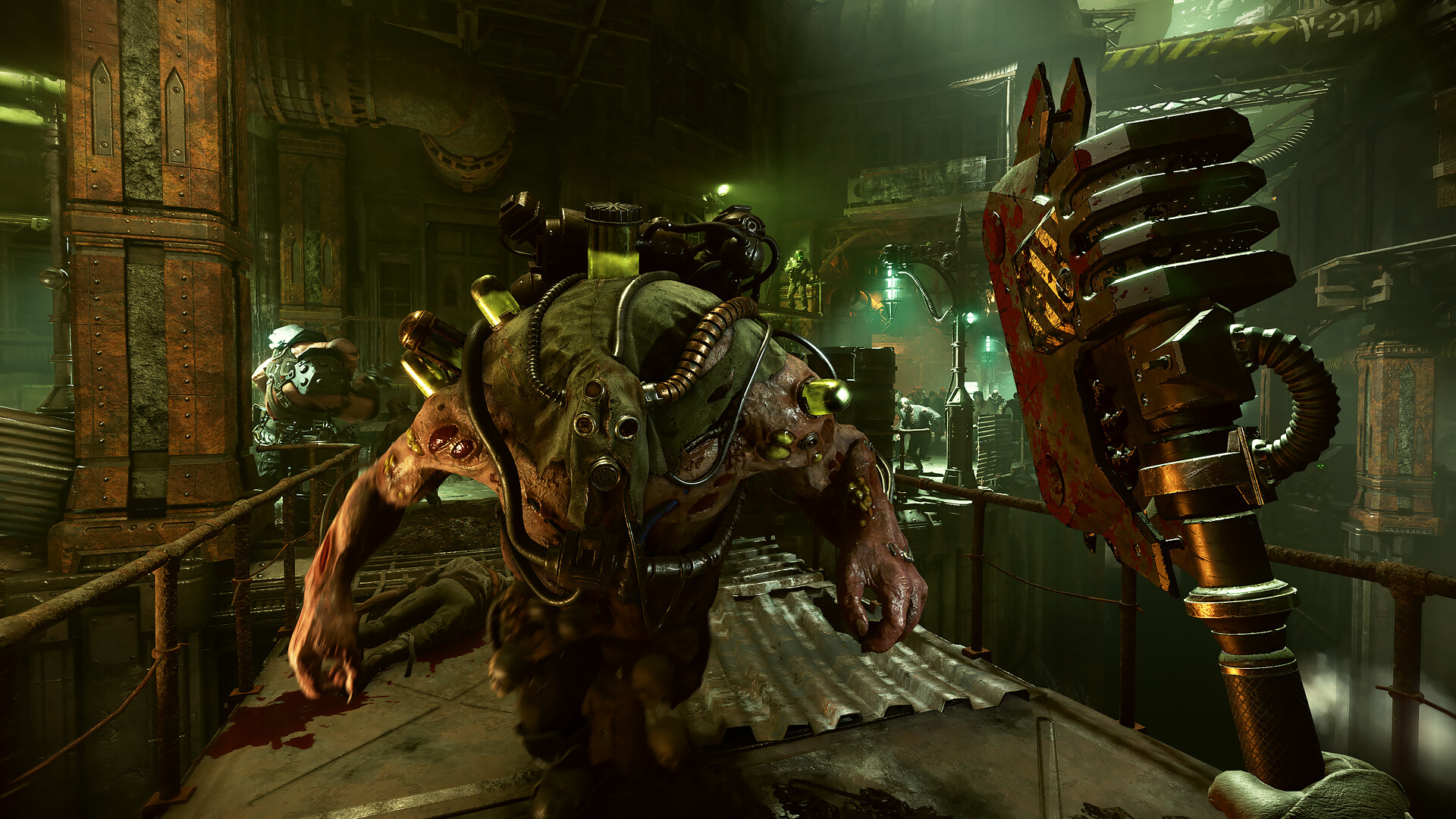
Enemy pressure is organized around recognizable threats. Poxwalkers and other infected bodies fill space in numbers; traitor guardsmen attack from range; armored foes can resist casual fire; and specialists such as trappers or bombers force immediate responses. A sound cue or a teammate's callout can matter more than the enemy's health bar when a disabling attack risks separating the squad. Coherency and rescue mechanics make position important: players who drift too far lose team support and can be isolated, while reviving a downed ally may require suppressing or controlling the surrounding enemies first. These moments turn team communication into a practical combat tool.
The ongoing campaign of missions lets players revisit Tertium's districts as the situation changes through updates and new operations. Each sortie asks the squad to balance pace, resource use and formation: rushing may bypass some threats but leave a player out of position, while taking every fight can exhaust ammunition and health before the objective is complete. After extraction, the group returns to the Mourningstar to spend earned materials, adjust talents or test a different weapon setup. Repetition is part of the structure, but each deployment combines a selected map and mission with enemy pressure and team choices that make the same fundamentals—protect the group, control the horde and complete the task—play out differently.
Warhammer 40,000: Darktide launched at the end of 2022 and Fatshark has kept feeding it since. Four classes come with the game and three more are sold separately, gear has been rebuilt around a weapon Mastery track, and there are three different endgames depending on whether you want ranks, extraction runs or wave arenas. This review covers the base game and the free updates that arrive with it.
The fight is two halves
Darktide is built on the melee system from Vermintide 2 and adds Warhammer 40,000 gunplay on top of it, and it wants both halves used. Mastering the balance between ranged and melee is the skill it keeps testing, and that sounds like a slogan until a horde is inside your lasgun's range and you are still aiming down the sight.
Each half covers what the other cannot reach. A chainsword answers anything that closes the distance; a lasgun answers the shooters holding the far end of the corridor you need to cross. The interesting decisions sit in the switch, and they are usually made a second late. If you are being hit while you are still aiming, you waited too long to draw.
Read the melee set for whichever class you pick early, because that is the half that saves you when the fight closes. Darktide punishes players who treat the gun as the main weapon and the blade as a panic button.
Toughness rewards staying close
Your toughness, the buffer sitting over your health, regenerates on its own while you are in coherency with the rest of your strike team. That is the route that shapes the game more than any weapon. Push ahead alone and you are spending a resource that has stopped trickling back, so isolation is a real risk rather than a single mistake.
It is not the only route, though. Class abilities restore toughness outright, whether that is a shout, a dash or a drop into stealth, and talents across the trees hand toughness back for melee strikes, kills, elite kills and critical hits. Coherency is one source rather than the whole system, so a player who breaks away is giving up the passive trickle, not all of it.
The punishment for straying is specific. The Chaos Hound and the Moebian Trapper are the enemies that immobilise or capture players who wander, and once you are caught, getting free is normally a job for somebody else. Being hog-tied takes you out of the fight and hands the rest of the team a rescue, and the hive will happily arrange that while they are busy.
Four is the number you are building around: when a full team extracts in Expeditions, the Tech-Remnants everyone gathered on the run go into the shared pool at once. Cross-play is supported across the platforms Darktide shipped on, so the strike team does not have to be four people on the same machine.
Four classes you own, three you buy
Your class decides your traits and skill set, and the four that come with the game are the Veteran, the Zealot, the Ogryn and the Psyker. All four had their talent trees reworked through 2025, and the balance preview for the Depths of the Damned update is set to go back over the original four again, cutting the number of plain stat nodes so the trees read as build choices rather than a toll you pay on the way to the good parts.
Three more classes are sold separately, and they are real classes rather than skins. The Arbites arrived in 2025 with a Cyber-Mastiff and its own weaponry, the Hive Scum followed at the end of that year with a mixable Stimm, and the Skitarii Alpha Primus landed in 2026. Each one also ships as a deluxe edition with cosmetics, plus a cheaper cosmetic-only upgrade for players who already own the class.
Starting with the base four costs you nothing extra and is genuinely enough for a long time. The paid classes change what a team can do rather than unlocking the game, and reading their talent trees before buying is the same exercise you would do on a free one.
Gear is a track, not a lottery
Darktide rebuilt its itemisation in the Unlocked and Loaded update, and the shape of it is worth understanding before you start breaking weapons down. Weapons belong to families. Using a family earns progress on that family's Mastery track, Mastery pays out Blessing Points, and those points unlock the Blessings you actually want instead of hoping a drop rolls one.
Power is the second half of the same idea. Every weapon has a Power cap tied to how far you have taken its Mastery, and you spend materials at the Shrine of the Omnissiah, the game's crafting station, to Empower a weapon up towards that cap. Empowering lifts all five of the weapon's stats together rather than letting you pick one, but it only raises them towards that weapon's own potential, and weapons still drop with different stat distributions and different ceilings. A weak profile stays a weak profile, so the search for the right roll is not over.
Perks unlock through the Mastery track as well, and either of a weapon's two perk slots can be changed at the same Shrine for a cost. Spare weapons can be handed over as Sacrifice for extra progress on a family you want to learn, which turns the pile of guns you would never use into something useful. Favourites never appear in bulk actions or the Sacrifice list, so mark the weapon you are keeping before you start clearing space.
Two details save you time later. Blessings and Mastery progress belong to the account rather than the character, so work banked on a weapon family carries across to the classes that share it, and what a new class actually repeats is the level climb that unlocks its own weapon families. Currency stays simple across all of it: Ordo Dockets, Plasteel and Diamantine, spent at the Shrine and in the shops, with the Armoury Exchange splitting its stock into ranged, melee and curio sections.
Mission, condition, difficulty
The mission board lets you choose the mission and the difficulty separately, which sounds like a small thing and is not. You can chase a specific map, or take whatever is up at the difficulty you want. Auric is its own difficulty now rather than a modifier stacked on Damnation, so the top of the ladder is a separate choice from the map you are running.
Conditions are the per-mission twist. Mutators get layered onto a run, and the point of them is that the team has to read the situation, change tactics and change loadouts in response. In practice the briefing screen is real information: build against what this mission is doing rather than repeating what worked last time.
Between the conditions, the class mix and the enemy roster there is enough moving that a mission you have run before can still surprise you. That variety is the reason Darktide holds up to repetition better than most games in its lane.
The endgame is three different games
Havoc is the ranked one. It is aimed at players who have finished the level climb, and it stacks negative modifiers on top of each other as the ranks go up. Fatshark overhauled how the ranks work and added campaigns and new modifiers during 2025, and the mode has kept changing since.
Expeditions is the newest and the most different. The team leaves Hive Tertium to recover Tech-Remnants from outside the walls, which means radiation, a limit on how long you can stay, and one decision repeated all run: extract in the Valkyrie with what you have, or push further for more. Run out of time and die and you keep nothing, and what you do bring back unlocks more of the mode's map.
Mortis Trials is the arcade one. Unlocked from Trust Level 13, it puts you in psychic arenas for twelve waves with roguelike elements and wave compositions you will not meet anywhere else. It is the mode for when you want the fight without the mission around it.
On top of those, the game runs timed live events through the year, each with its own rewards and its own twist on how missions work; eleven ran in 2025. The Depths of the Damned update, with a new mini campaign, a new level and six new weapons, is scheduled for the end of September.
What you are paying for
The free updates carry most of the game. New modes, new enemies, new missions and plenty of new weapons have arrived without anyone opening a wallet, which is unusual for a game this far past launch.
The three extra classes are the exception, and so are cosmetics. Classes are sold individually with a deluxe version and a cosmetic-only upgrade for people who already own one, and the cosmetic store trades in Aquilas with a rotating selection. Those classes bring their own weapons and gear, so a free update is not a promise that every future addition lands for nothing; the paid content is the part of the game you decide you want after you know how you play.
Where it is rough
Darktide has been reworked in public more than once, and your build can move with it. The balance preview for Depths of the Damned is set to rewrite talent tree layouts for the original four classes, which means saved loadouts may need rebuilding rather than a light tuning pass.
Golden Toughness is the ability effect that let a sliver of toughness absorb a hit that would otherwise have spilled through into health, and the preview for that same update removes the soak so toughness follows the same damage rules however you get it. The same pass tunes the enemies it was best at smothering, Poxburster explosions and Sniper shots among them. Building around whichever mechanic is strongest this month is a plan with an expiry date.
Some systems are also denser than the game explains. Mastery, Power, Perks, Blessings and Marks all live in menus that assume you already know the difference between owning a Blessing and being able to put it on a weapon. You learn that by wasting materials once. Reading first is cheaper.
The early hours are the weakest version of it. A character that has not filled out a talent tree yet plays nothing like the one the endgame modes are designed around, and low difficulty Darktide is a thinner game than the one waiting past the climb.
Should you play it
Play it if you want a co-op game where the team is a mechanic rather than a suggestion, and you like the idea of a fight you keep swapping weapons inside of. The melee is the reason to be here, and the update record is the reason there keeps being more of the game to come back to.
Skip it if you want the game to hold still, or if you would rather be the whole plan. Darktide is at its best with people you can talk to, and the systems around the fight are heavy enough to feel like homework when you were hoping for a corridor and a shotgun.
Go deeper with V4mp
- Developer
- Fatshark
- Genre
- Co-op action shooter
Explore Warhammer 40,000: Darktide further
Explore the wiki for detailed reference pages on the game's world, systems, items and locations.