
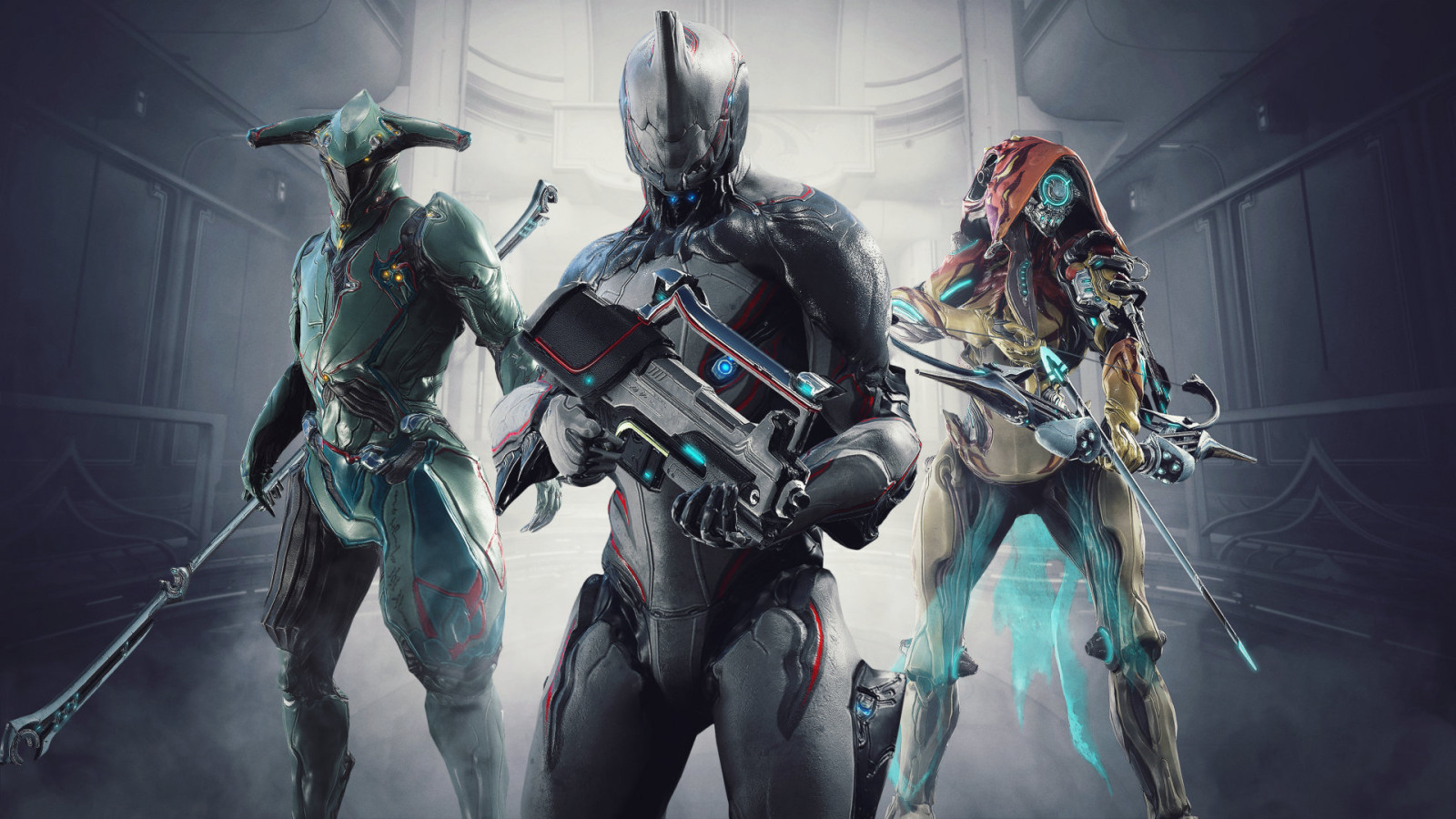
About Warframe
As a Tenno awakened in a fractured Origin System, you pilot Warframes through missions shaped by rival factions and an unfolding science-fiction story. Agile movement and ability-driven combat meet a long progression loop of unlocking Star Chart nodes, collecting blueprints, crafting equipment and tuning it with Mods.
Warframe begins with the Tenno waking from a long period adrift, guided by the Lotus into a solar system still marked by the Old War. The Tenno are ancient warriors who wield Warframes, biomechanical suits that combine protection with distinctive powers. The Origin System is not a settled frontier: rival groups compete for territory, resources and influence while the Lotus directs the Tenno toward missions across its planets and vessels. Early objectives introduce that relationship through the introductory quest Vor’s Prize, but the larger narrative gradually reveals more about the system’s past and the Tenno’s place in it. The story unfolds alongside a broad collection of repeatable missions, so campaign discoveries and ongoing equipment growth coexist.
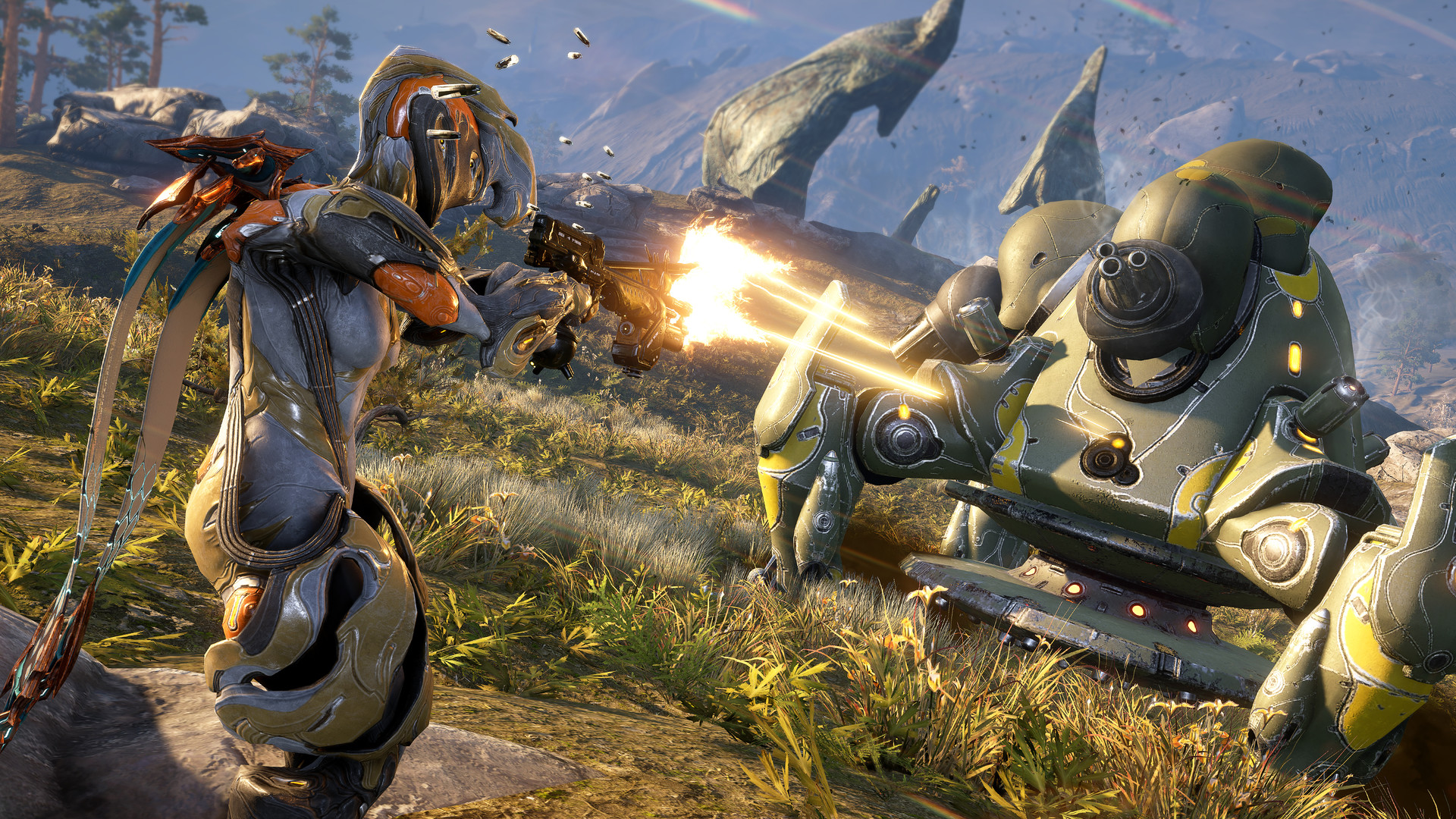
The Grineer and Corpus give the conflict two sharply different faces. The Grineer are a militarized clone civilization whose industrial machinery reflects their pursuit of territorial control. The Corpus are a profit-driven conglomerate with sleek technology and a corporate leadership structure. Their units, weapons and battlefield arrangements create different opposition across missions, while the Infested present a separate biological danger within the system. The Lotus’ guidance places the Tenno between these powers rather than making them a conventional soldier for one empire. At times, a mission’s faction and objective determine what the squad must prioritize, whether that means eliminating a hostile force, reaching a secured area or interacting with a facility under attack.
A Warframe determines more than appearance. Each suit has its own set of abilities, and those powers shape how a player can approach a fight: Excalibur emphasizes sword combat, Volt channels electricity, and Mag manipulates magnetic forces to control enemies and strip defenses. The selected frame is only one part of the loadout, since primary weapons, sidearms and melee weapons can be combined around different ranges and roles. That flexibility means a frame’s powers can support gunfire, close combat, crowd control or other tactical needs. As players obtain additional frames, they can switch between them in the Arsenal and build a roster for different mission demands instead of permanently committing to the initial choice.
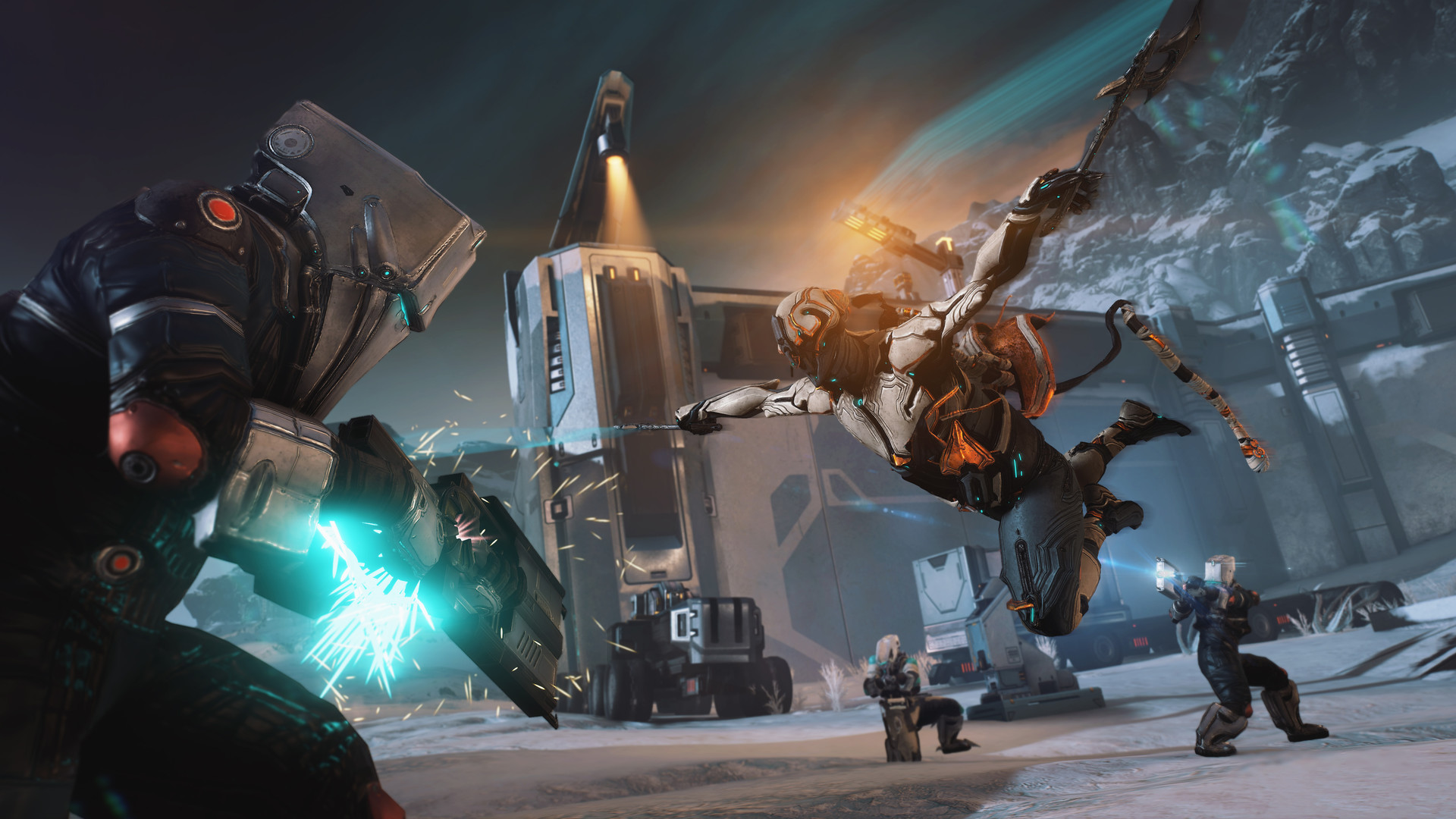
Movement is a defining part of how missions play. Tenno can sprint, slide, double-jump, bullet-jump in a chosen direction, aim-glide through the air and run or latch along walls. These actions help cross large rooms and gaps quickly, but also affect combat positioning: a player can move above a crowd, redirect toward a new target or keep firing while controlling a descent. Melee weapons add their own role, including special attacks against enemies who have not detected the Tenno. Not every objective is solved by damage, either; security terminals may require a tile-based hack, and a stealthy approach can prevent enemies from raising an alarm. The result is a mission rhythm that shifts between traversal, combat and interaction.
The Star Chart is the system map and the main structure for opening new missions. The Orbiter’s Navigation console presents available nodes, enemy faction and approximate threat level, and completing unlocked missions reveals further parts of the chart. Each mission sends the squad into an environment with a defined objective, while pickups can provide resources, Credits, ammunition, health, energy or Mods. The mission reward and the materials found along the way serve different purposes: one advances access through the system, another helps build or improve equipment. Story quests add authored chapters and new systems as prerequisites are met, giving players a path through major narrative events while the node network remains a dependable way to gather resources and develop the arsenal.
The Foundry aboard the Orbiter turns blueprints and collected materials into usable equipment. A blueprint specifies the parts needed to construct an item; after collecting the required resources, the player starts construction and waits for the build to finish. Resources come from missions, so the crafting loop naturally sends players back into the Star Chart to gather particular materials while continuing to level weapons and frames. This produces a long-term collection system built around experimentation: weapons and Warframes can be acquired, crafted and ranked through use, then placed in different loadouts. The market also contains blueprints for Credits alongside other items, but many pieces of equipment can be pursued through the in-game crafting route rather than being direct purchases.
Mods determine how equipment performs once it has been built. A weapon or Warframe has an Upgrade Capacity, and each equipped Mod consumes part of that budget; ranking an item increases its capacity over time. Mods can be fused at the Orbiter’s Mod station to improve their effects, while matching the polarity symbol of a slot reduces the capacity cost. Forma can change a slot’s polarity, but resets the item’s rank, making it a deliberate step in specializing a favorite piece of equipment. Stance Mods alter melee weapon combos, while Aura Mods provide a squad-wide benefit. This system connects ordinary mission pickups with deeper buildcraft: the same frame or weapon can be tuned around different abilities, damage, utility or team support.
The Syndicates provide a reputation track separate from equipment ranks. The major faction Syndicates include Steel Meridian, Arbiters of Hexis, Cephalon Suda, the Perrin Sequence, Red Veil and New Loka; each has its own values and rewards, and the groups maintain allied, opposed or hostile relationships. Pledging to one earns Standing through mission activity, while rival affiliations can lose it. Neutral organizations such as the Ostrons and Solaris United are not affected by those faction rivalries and offer their own Standing activities. Increasing rank unlocks rewards such as weapons and Warframe Augment Mods, which can then be purchased with Standing. Choosing where to build a reputation therefore becomes another persistent decision, tied to rewards and the political connections between groups across the Origin System.
Free covers the missions, the Star Chart and the frames you build from blueprints. Expensive is measured in time, because capacity, Endo and Forma decide what your equipment can actually do once it is built.
What the free download actually covers
You start with Vor's Prize, a Warframe, a sidearm and a melee weapon, then unlock the Star Chart node by node. The Teacher follows and walks through Mods, polarity, Endo and Fusion, which is the closest thing the game has to a tutorial for its own upgrade system. Junctions between planets hand you a short task list, and finishing those tasks opens the next region instead of gating it behind a purchase. The open worlds, the Orbiter consoles and the free Nightwave objectives all sit inside that same free structure.
Warframe is available on PC, PlayStation, Xbox, Nintendo Switch and mobile, and Digital Extremes runs cross platform play across those platforms. Account linking is handled by Cross Platform Save, which turns a PC account into the account that other platforms link into, so one set of quests and ranks follows you between them. The details are where people get surprised: TennoGen bought on Steam stays on PC while console-bought TennoGen stays on the console side, and Platinum cannot be traded between Nintendo Switch and other platforms. If either matters to you, read the official cross platform guide before linking rather than after.
Capacity is the system that shapes everything
Every Mod you equip spends capacity, and capacity grows as the item levels up. Matching a Mod's polarity to its slot halves the cost, so the same Mod can be affordable in one build and impossible in another. Catalysts double a weapon's capacity and Reactors do the same for a Warframe, which raises the ceiling on what a build can fit. More capacity lets you equip additional or higher-ranked Mods, alongside the other choices that shape a build.
Forma is the long-term tool and the honest catch. Applying one changes a slot's polarity, and it also resets that item to unranked, so you re-level it before the new build comes online. The Forma itself cannot be removed. That reset does not take your account Mastery with it: re-earning already credited ranks on the same item does not award those points twice, so a Forma pass costs time rather than progress.
Endo is the other half. Raising a Mod's rank with Fusion costs both Endo and Credits, and duplicate Mods are a reliable early source of Endo. The upgrade screen is worth reading slowly the first time, because the Mods worth ranking are the ones you will still be using next month rather than everything you happen to own.
Blueprints, build timers and the Platinum question
Most equipment arrives as a blueprint. Many Market listings sell the blueprint for Credits and the finished item for Platinum, and those are two different purchases with two different prices. Once you own a blueprint and its materials, the Foundry builds the item over a displayed timer, and rushing that timer spends Platinum. Reusable blueprints carry an infinity symbol instead of being consumed.
The friction is storage rather than access. A new account starts with a small allotment of Warframe and weapon slots, and those fill faster than most players expect, because Mastery rewards you for levelling unfamiliar gear. Slots can be earned as well as bought — recruiting a friend pays out weapon slots and a Warframe slot — so this is a slow grind rather than a wall. Selling a weapon to free a slot is still a decision with a cost, and a favourite you have already invested Forma into is usually the wrong candidate.
Platinum is the premium currency, and Prime Access is the headline purchase: instant access to a new Prime Warframe and its weapons, sold alongside accessory packs. The counterweight is real and worth stating plainly. Digital Extremes lays out both routes on the same page — buy the pack, or earn Void Relics, crack them, craft the parts and assemble the Prime for free — so the paid route buys time rather than a stronger version of the frame. Prime Resurgence is the other gear route, rotating previously released Prime Warframes and weapons back through Varzia's wares, while Heirloom collections and Supporter Packs are the cosmetic end of the store.
What a returning player walks back into
Warframe is an update-driven game, and the releases keep arriving. Iceblade of Narin is announced for September 23, 2026, adding Narin as the 66th Warframe along with a six-player mode called Glacial Defiance, Entropic Eximus enemies aboard the Zariman, and a long-requested Banshee rework. Banshee arrives as a free login reward during the update's launch window, and Citrine Prime Access opens alongside it — check the in-game announcement for the exact launch and reward availability.
Beyond that, Digital Extremes has announced Epoch Operation: Taubound as a month-long, one-off in-game event, with the publisher stating plainly that there will be no reruns, plus a journey toward Tau later in the year. For a game this old, that rhythm matters more than any single patch: content arrives on a schedule, and the guides you read have a shelf life. Treat any Warframe build advice as belonging to a particular update, including ours.
Should you play it
Yes, if you like the idea of a shooter where the interesting decisions happen in a menu rather than in a shop. The opening is a starter frame, a handful of Mods and a Junction list, and the game becomes itself once you have a blueprint you want, the materials to build it and a reason to spend Endo on the right Mod instead of every Mod you own.
Two things to know before you commit. The core missions and earnable Warframes can be reached through play, while some accessories and other items have separate purchase restrictions, but the wait is real: build timers, Endo costs and slots are what decide how fast a new account moves, and the paid route exists to buy time rather than power. And the systems stack up over a decade of updates, so start with the introductory quest, the first Junction and your Mod screen, and let the rest arrive in the order the game offers it.
Go deeper with V4mp
- Developer
- Digital Extremes
- Genre
- Co-op action
Explore Warframe further
Explore the wiki for detailed reference pages on the game's world, systems, items and locations.