

About Pillars of Eternity II: Deadfire
Follow the Watcher into the Deadfire Archipelago after the god Eothas awakens beneath a titanic statue and tears through Caed Nua. Sail the Defiant between island settlements, navigate competing Huana, Vailian and Royal Deadfire interests, and shape a party through class abilities, real-time tactical combat or optional turn-based play.
Pillars of Eternity II: Deadfire continues the story of the Watcher, whose stronghold at Caed Nua is destroyed when the god Eothas returns in the form of a colossal statue. The Watcher survives but must follow the god across the Deadfire Archipelago, a chain of islands at the edge of Eora’s known world. The region includes crowded ports, volcanic slopes, reefs and remote settlements, each connected to the sea and to competing claims over the land. The pursuit of Eothas sets the main direction, but the Watcher can decide which local powers to support, undermine or avoid as the journey unfolds.
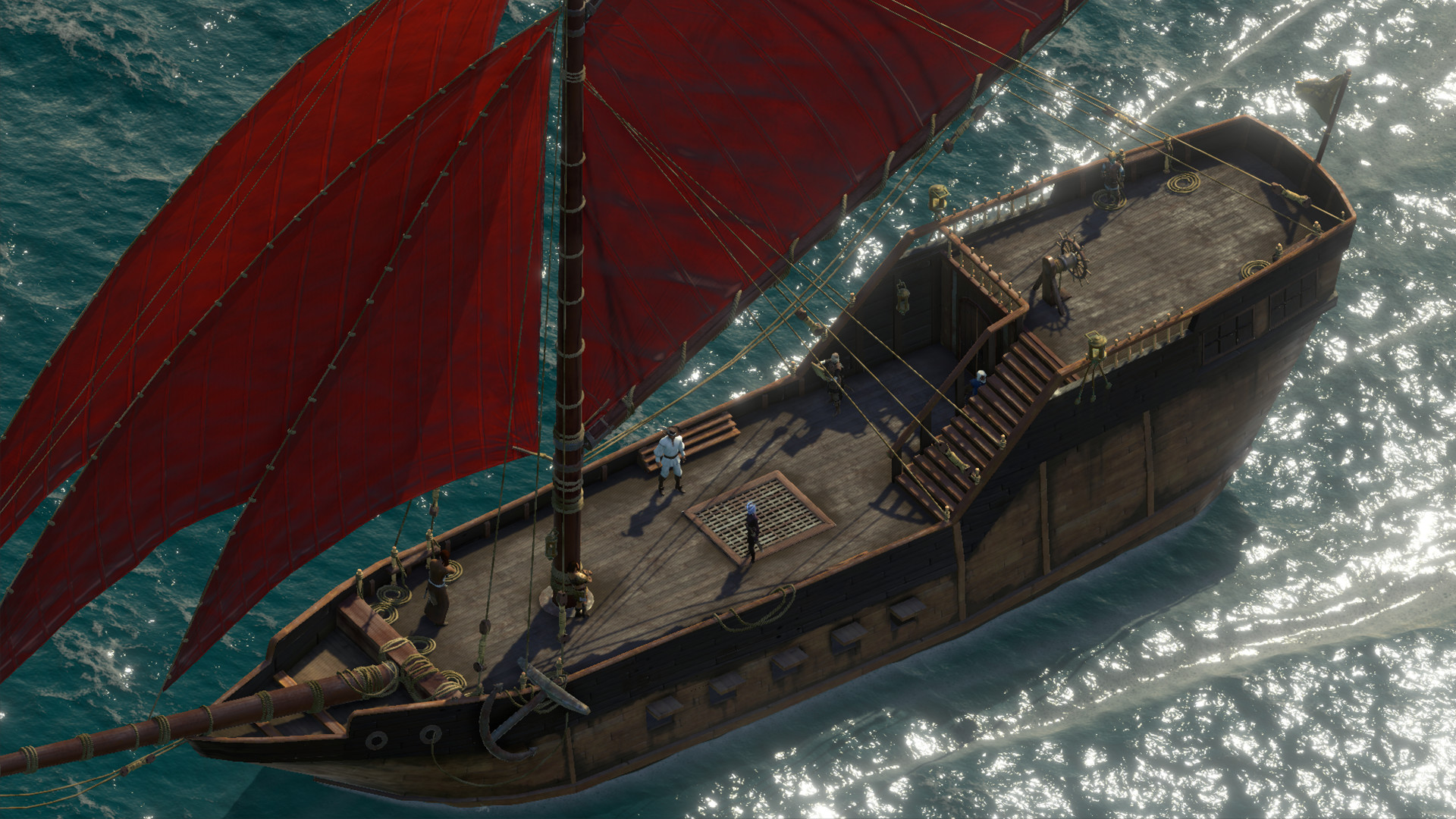
The Defiant is the party’s ship and mobile base. It carries companions and crew between islands, and its stores, supplies and condition become part of longer voyages. The player can recruit crew, assign them to ship duties, upgrade the vessel and eventually acquire different ships. Sailing uses an open regional map where discovery points, weather and encounters can interrupt a route. Hostile vessels can lead to ship-to-ship combat, which is represented through a dedicated exchange of positioning, shots and crew actions; players may also seek other ways through an encounter. Landing at an island returns the game to its exploration and party-RPG structure, with conversations, quests and tactical fights.
The Deadfire’s political map is defined by several powers with different interests. The Huana are the archipelago’s native people, whose tribal leaders and Queen Onekaza seek to preserve their society. The Vailian Trading Company pursues commerce and extraction, while the Royal Deadfire Company represents Rauataian expansion and military order. The Principi sen Patrena operate as pirates and privateers. These groups appear in quests, ports and sea encounters, and their rivalries make the Watcher’s decisions consequential. Helping one group may alter access, reputation and the assistance available later, while independent choices can keep the Watcher from becoming a formal agent of any faction.
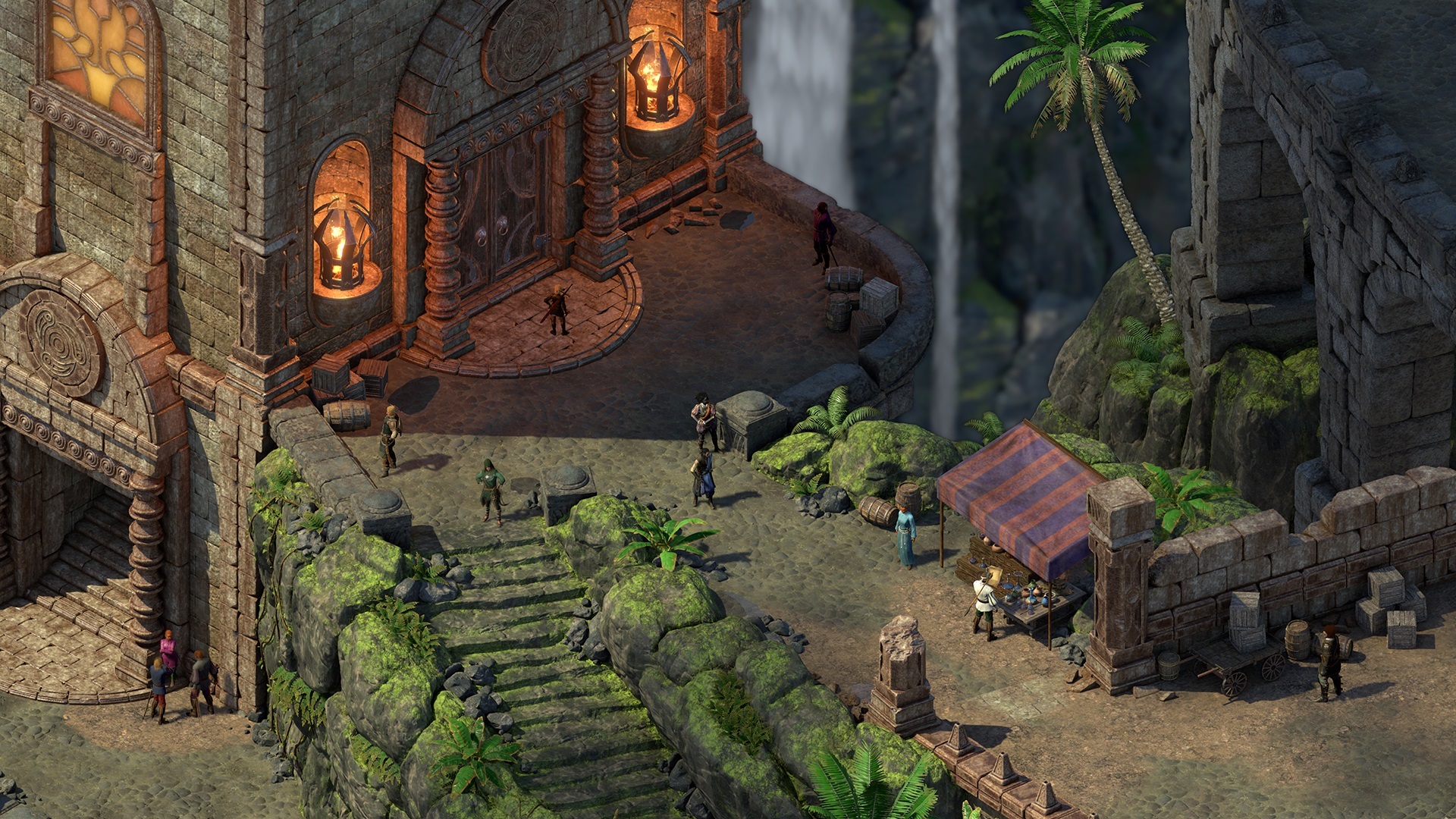
The Watcher travels with a compact adventuring party, selecting up to four companions alongside the protagonist. Returning faces such as Edér accompany newcomers including Serafen, and each brings personal quests, dialogue and opinions that can change with events. Companions may relate to one another as well as to the Watcher, so conversations on the ship reflect choices made ashore. Character creation draws from Eora’s ancestries, cultures and classes; subclasses specialize a class, while multiclassing combines two class progressions. A single-class character reaches higher-level abilities in one discipline sooner, whereas a multiclass character spreads options across two toolkits. For example, a Cipher/Fighter can pair focus-building weapon attacks with durable frontline talents, while a single-class Cipher can reach its strongest class abilities sooner. These choices shape the party’s available skills and roles rather than locking the player into one prescribed formation.
Combat can run in real time with pause or in a turn-based mode. In the real-time system, recovery time determines how quickly a character can act again after an attack or ability, while armor and weapon choices affect that cadence. Characters build resources through class-specific activities: a Cipher accumulates focus through weapon attacks, a Monk builds wounds by taking damage, and a Chanter builds phrases over time to power invocations. Abilities target defenses and can apply afflictions or inspirations, so a front line might pin enemies while ranged characters exploit weakened defenses. Each character has an Empower action: self-empowering restores half of that character’s class resources, while empowering a selected ability improves its effect. This makes Empower a personal reserve to time around a difficult fight, not a shared party pool.
Exploration blends story quests with practical choices about how to travel. The party can land at named ports and remote islands, search ruins or caves, pursue leads from factions, and speak with people whose reactions depend on reputation and prior decisions. Skills such as Mechanics, Survival, Athletics and Insight contribute to checks beyond combat; companions can lend their strengths in dialogue or exploration. Resting and supplies matter during long routes, and food or equipment can support the group before a difficult encounter. The ship’s crew and upgrades turn wealth from quests into improved travel capacity, while the world map presents decisions about what to visit and which risks to accept.
Progression ties the Watcher’s pursuit to both class development and the political future of the archipelago. Each level offers new abilities or passive improvements, and equipment can add properties that reinforce a character’s role. Companion relationships respond to their experiences, while faction standing can change how leaders and crews treat the party. As Eothas advances, the Watcher must weigh personal convictions against the consequences for the people of the Deadfire. The game therefore alternates between intimate party scenes aboard the Defiant, tactical encounters on land and a broad voyage through contested waters, giving the player several ways to shape a journey that began with the destruction of Caed Nua.
Two combat systems, a ship you upgrade like a character sheet, and seven companions to draw a party from. Here is what you are choosing between, and what the add-ons add on top.
You pick a combat system, and it is final
Deadfire gives you two ways to fight. One is classic real-time with pause, where you slow the fight down and issue orders; the other is turn-based, added after launch as a free update and finished out of beta with Patch 5.0. You choose between them when you start a new campaign, and there is no changing the mode once you have begun. If you want to see both, that is two campaigns rather than two settings.
That makes the choice worth thinking about for thirty seconds rather than clicking through. Turn-based suits players who would rather read a fight one step at a time and plan a whole round; real-time with pause suits players who want the same tactical options delivered continuously. Everything else in the game, including the party you build, sits on top of whichever you pick.
The ship is both transport and base
You captain your own ship, and it is a way of getting between quest markers as well as your stronghold on the seas. You upgrade the ship and the crew and choose which skills to improve so you can survive the dangerous encounters on the way, so the ship is where a lot of the planning for a voyage happens.
Ports are where the campaign branches. You plot your own course across the archipelago, discover islands, meet the people living there and take on quests at the docks, which means the order you do things in is yours rather than a chapter list's. The Deadfire is also where the world changes: this is an island setting rather than the forests and castles the first game traded in, and the difference runs through the quests as well as the scenery.
A roster of seven, four in the party at a time
The party is the other place your choices compound. There are seven companions to recruit, and each one offers a choice of class options with deeper abilities rather than a single fixed build, so the same person can be pointed in a different direction on a second run. You do not field all seven at once: the party you take with you is five, your Watcher and four companions. The companion system also carries personal relationships and interactions, so how you treat someone is a decision with a result attached.
With four companions in the party and a choice of class options for each of them, who covers what when a fight turns matters more than filling every slot, and that is true in both combat systems.
What the add-ons add
Three post-launch expansions are sold as an Expansion Pass, and they are also bundled into the Obsidian Edition alongside the base game, a soundtrack, a digital pen-and-paper rules set, a high-resolution map and a guidebook. Beast of Winter takes the party into the Beyond after an ancient feud between eldritch powers; Seeker, Slayer, Survivor is the combat-focused one, built around an arena on a new island; The Forgotten Sanctum is an endgame chase into a dungeon and a set of wizards with plans of their own.
Patch 5.0 also added The Ultimate, a challenge run that stacks the game's God Challenges, Trial of Iron, Path of the Damned and Solo mode into one campaign.
Should you play it
Yes, if you want a party role-playing game where the world is a set of routes you chose rather than a map you cleared, and where a companion is worth a second look before you commit them to a role. The combat choice at the start is the one decision that cannot be revisited, so make it deliberately, and consider turn-based if you have bounced off pausable real-time before.
Two things to know before you buy. This review covers the release sold on Steam, which is the PC version for Windows, Mac and Linux; console copies are packaged differently, so the add-on question depends on where you are buying. And the expansions are not part of the base game, so if you want all three, the Expansion Pass or the Obsidian Edition brings them together in one purchase.
Go deeper with V4mp
- Developer
- Obsidian Entertainment
- Genre
- RPG
Explore Pillars of Eternity II: Deadfire further
Explore the wiki for detailed reference pages on the game's world, systems, items and locations.