
About Fallout 76
Free updates and seasons are one half of the deal and Fallout 1st is the other. Here is what each one actually changes about a session, and where the C.A.M.P. fits into both.
A shared map, not a private save
Fallout 76 is described as an open-world multiplayer addition to the Fallout story, and you emerge from Vault 76 twenty-five years after the bombs fell alongside other Vault Dwellers. The store says you can play solo or co-op, so company is your choice; what is not a choice is the world itself, because a public server is shared with other players whether or not you team up with them.
Character building runs on the familiar S.P.E.C.I.A.L. system, and the store frames the goal as forging your own survivor, whether that is a Power Armor tank, a stealth sniper, a gunslinging cowboy or a melee brawler. Perk cards sit on top of those stats, and the modern game also keeps swappable special loadouts, so a build is something you store and switch between rather than a decision you are stuck with.
The paid part is the base game
This is the part that decides the review, so it is worth being exact: Fallout 76 is a paid game, not a free-to-play one. What has been free is everything since, and the store says so plainly, advertising years of free updates and map expansions plus an extensive calendar of in-game events. Recent free additions have brought new regions and new kinds of activity rather than cosmetics, including the Burning Springs area and the mystery-driven The Slasher update.
The expansion list is where that promise cashes out, and it is long. It includes Wastelanders, Steel Dawn and Steel Reign, Expeditions: The Pitt, Atlantic City, and Skyline Valley with its Vault 63 and its ghoul dwellers. None of that sits behind a season pass, and the only add-ons the store currently sells are bundles of Atoms and cosmetics rather than story chapters, so a player who buys the base game and never spends again still gets the map.
Seasons give the open world a deadline
Seasons run alongside the quests, and they are free to participate in. You earn S.C.O.R.E. just by playing, ranking it up earns Tickets, and the Tickets are spent in the Seasons menu on that season's rewards, which is what makes a season a clock rather than a shop: the work worth doing now is not the work that will still be there next month.
A season that has finished can also come back. The game now runs a Legacy Season alongside the current one, and both draw on the same ticket pool, so a reward you missed gets a second window. Fallout 1st members pick up bonus rewards during a season as well, including a S.C.O.R.E. boost and exclusive items.
What Fallout 1st actually buys
Fallout 1st is a premium membership, and it buys private space rather than content. Members get access to their own Private Adventure and Custom Worlds servers, a monthly gift of Atoms to spend in the Atomic Shop, and a set of exclusive cosmetics on top of the bonus season rewards.
The storage perks are what a long-running character actually feels. A Scrapbox gives members unlimited storage for crafting supplies, and a Survival Tent can be pitched on the road as a place to rest and fast travel from. That eases the squeeze that a stash limit creates for a hoarder, though it is relief for the storage problem rather than a solution to every capacity limit in the game.
The membership is a subscription, and it can be sampled rather than guessed at: the game periodically runs a Fallout 1st preview trial that hands the perks to everyone for a week.
The C.A.M.P. is where a session settles
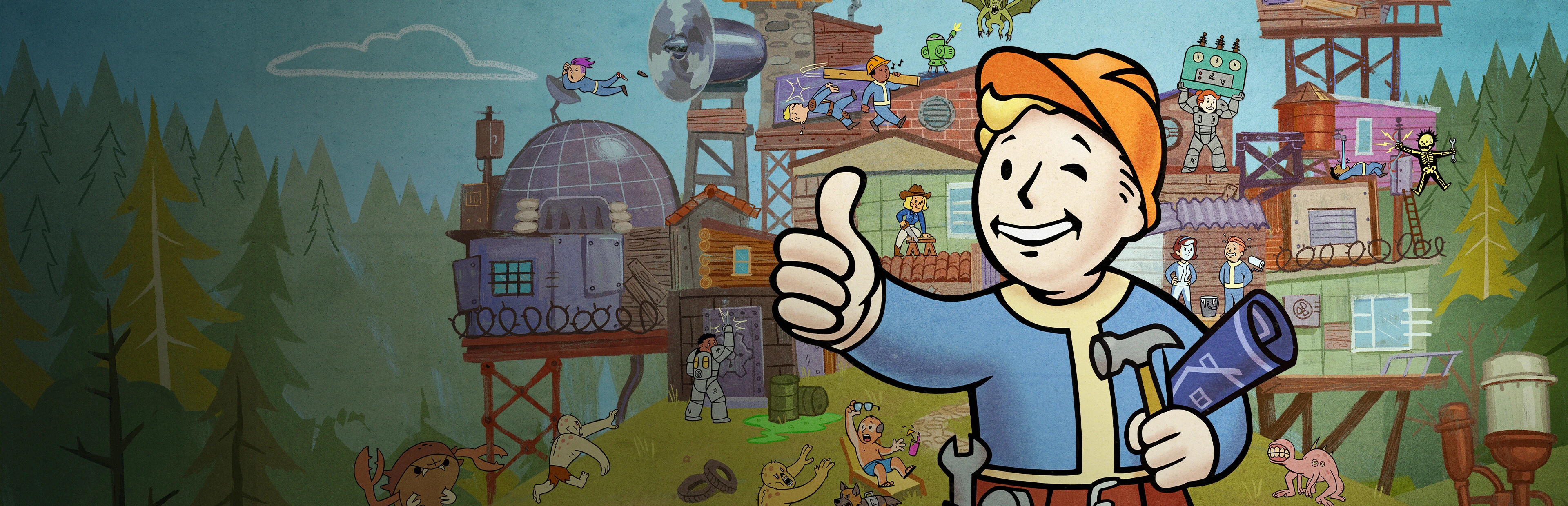
The Construction and Assembly Mobile Platform is the system that ties the free game and the membership together. You pick a spot in the world and then design and expand the C.A.M.P. there, so it is a base you choose rather than a shelter the game hands you. Because a build can be saved as a blueprint and placed again later, it is also a base that can travel with you when you want it to, even though it stays put the rest of the time.
It can also be set up as a shop to trade with other survivors, and that is the part that makes it public. Your C.A.M.P. is not just your address in Appalachia, it is a reason for someone else to walk over and knock.
Should you play it
Yes, if you want a Fallout where the wasteland is a place other people are also living in, and you are comfortable with a persistent online world. The free update history is the strongest argument for the game, because the world you buy into keeps changing without asking again.
Two things to weigh first. Decide whether the storage problem matters to you, because Fallout 1st is really a storage and privacy subscription and nothing in the story sits behind it. And go in expecting to share the map: solo play is supported, but a public world is public unless you are paying for a private one.
Go deeper with V4mp
- Developer
- Bethesda Game Studios
- Genre
- RPG
Explore Fallout 76 further
Explore the wiki for detailed reference pages on the game's world, systems, items and locations.