
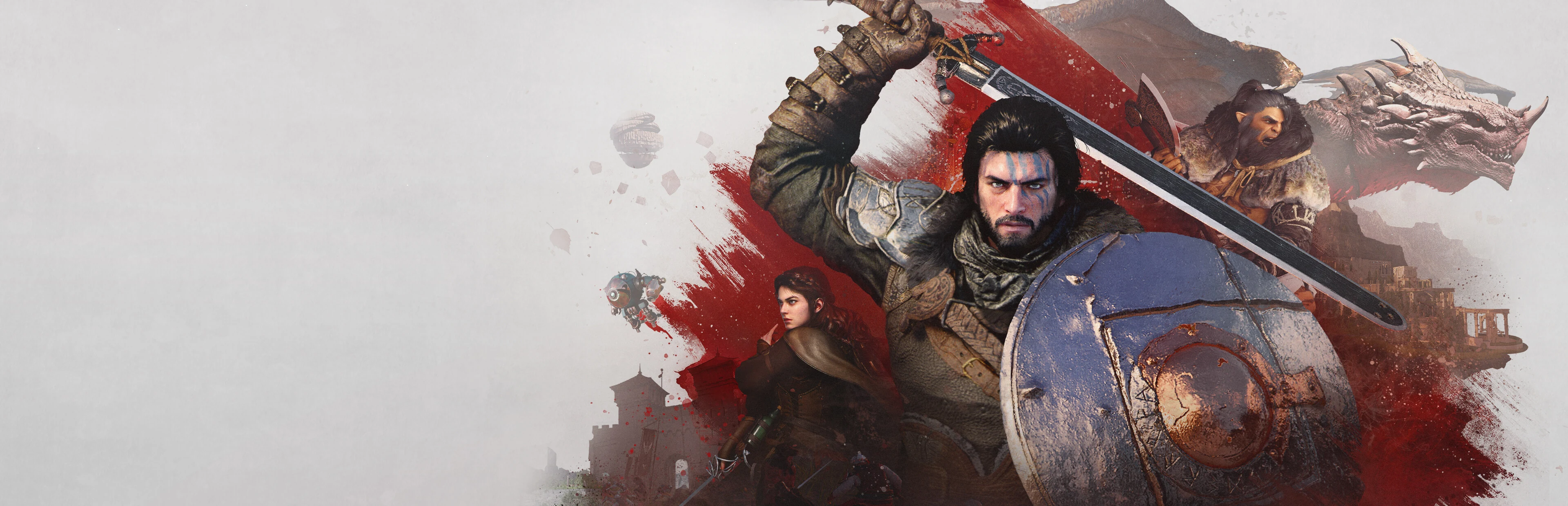
About Crimson Desert
Crimson Desert follows Kliff, a Greymane mercenary caught in a conflict that scatters his comrades across Pywel. This open-world action adventure combines close-quarters combat, exploration and a rebuilding cause, as Kliff searches for survivors and confronts the forces destabilizing the continent.
Kliff begins as a member of the Greymanes, a mercenary band from Pailune whose uneasy balance with rival forces is shattered by an attack from the Black Bears. The assault leaves Kliff separated from companions including Oongka, Yann and Naira, and puts Myurdin, the Black Bears’ leader, at the center of the immediate conflict. Kliff’s journey is framed around finding the scattered Greymanes and rebuilding the group, while the situation in Pailune points toward a wider threat to Pywel. The story follows one central protagonist through a land where local struggles and a larger mystery converge.
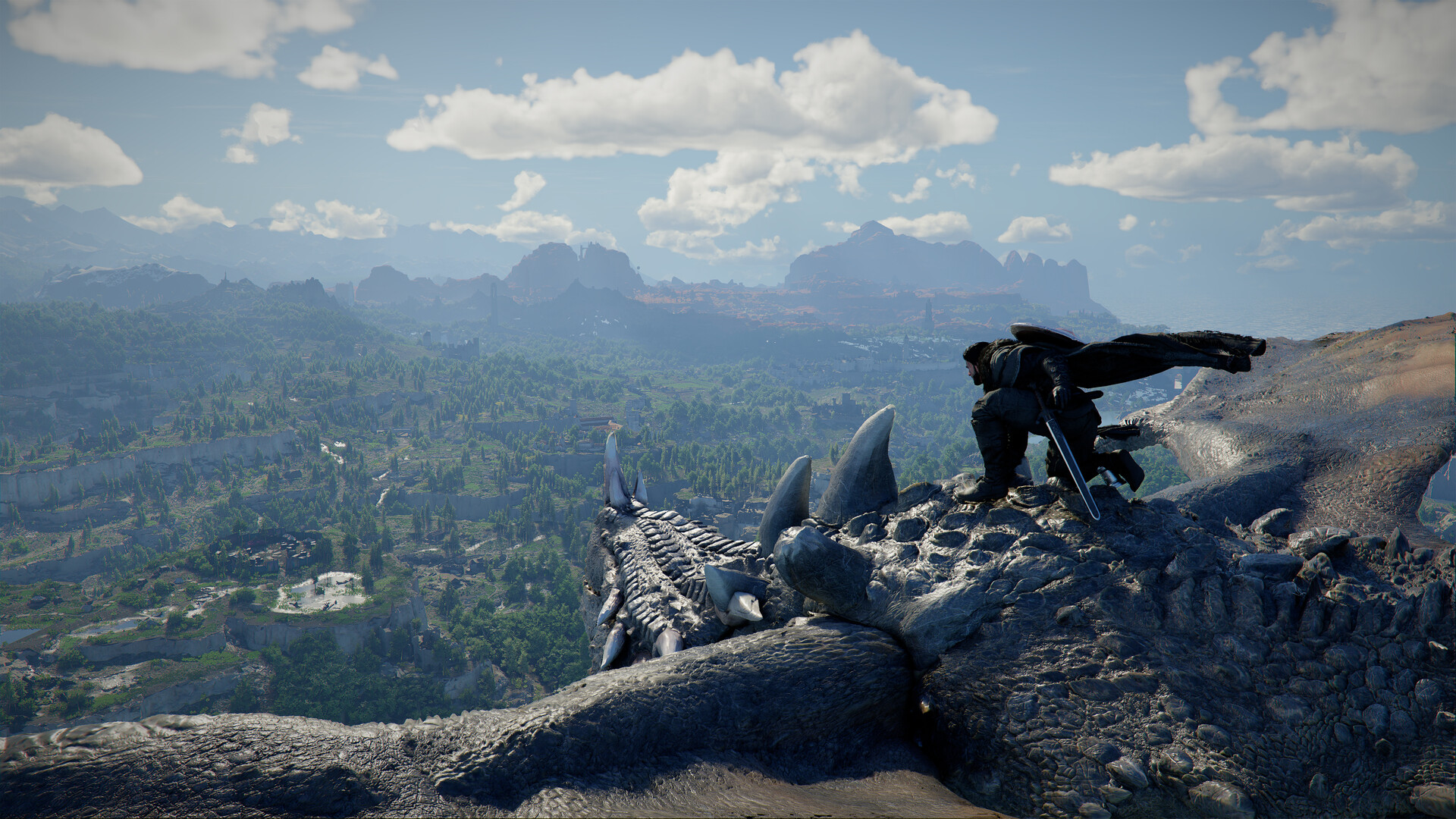
Pywel is a large, seamless continent of wilderness, settlements, ruins and the mysterious Abyss. Its scale makes travel and observation part of play: Kliff rides across the landscape, climbs through vertical spaces and uses a focus action to target people, objects, enemies or even a particular part of a tree. The world is populated with people, animals and harvestable plants, and ordinary requests can lead into more consequential encounters. The result is a setting that supports both directed story missions and unscripted detours, with the conflict among the Greymanes and Black Bears providing a clear thread through otherwise varied terrain.
Exploration relies on reading the environment and using movement abilities to reach places that are not on the direct path. Aerial islands appear early, and later gliding and hovering provide ways to cross gaps and survey terrain; gliding consumes stamina while hovering does not. Abyss Nexuses function as discoverable fast-travel links, often concealed among unusual ruins and activated by a pressure plate. Inventory capacity is expanded through specific missions that grant permanent slots, rather than through a weight limit. These systems give exploration practical rewards while making navigation a combination of riding, climbing, gliding and uncovering shortcuts.
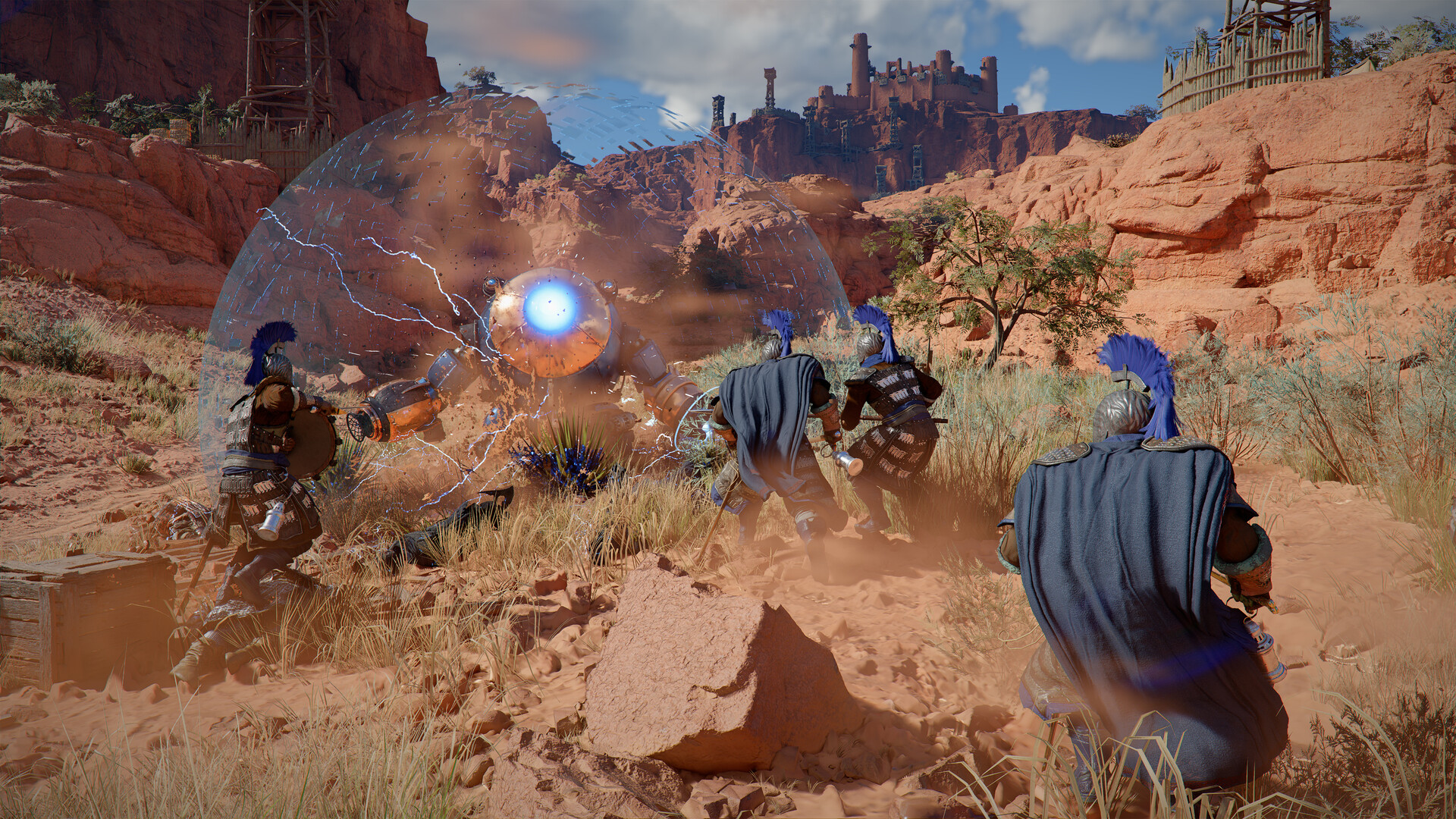
Combat is built around a responsive character-action moveset rather than a single weapon rhythm. Kliff can combine swords, spears, bows, guards and special abilities, while stamina and other resources shape how long he can sustain defensive or movement actions. The skill system is presented in colored branches, but a line between abilities does not always mean one must be purchased first; selecting an ability reveals its actual prerequisites. Health and stamina improvements can support survival, while movement skills such as Double Jump and Axiom Force’s aerial techniques broaden both traversal and fight positioning. Encounters can therefore reward unlocking a new attack, improving a core attribute or learning how to use the existing controls more precisely.
Pywel is divided into five regions: Hernand, Pailune, Demeniss, Delesyia and the Crimson Desert. Kliff’s search therefore moves through named territories with their own settlements and faction stories, not simply across a succession of anonymous wilderness areas. Requests from inhabitants range from small deliveries to helping liberate strongholds, with resources and other rewards connecting local work to the wider journey. The floating Abyss provides a different setting above the continent, where ancient constructions, puzzles and immense power are tied to an effort to restore balance and prevent that power from being misused. Travel can also extend beyond ordinary riding and gliding to a missile-firing mech, giving the land and its dangers another scale. In towns, smithies and tailors sit alongside shops and other daily services. Fishing, mining and gathering supply materials for cooking and improving equipment, while dyes, hairstyles, tattoos and clothing let the player change Kliff’s appearance. He remains a defined protagonist rather than a blank character built from scratch, so this customization changes how the Greymane looks while preserving his place in the story.
Interactions with towns add social consequences to the open-world routine. The game tracks reputation numerically, and taking property marked as belonging to someone else requires Kliff to wear a mask; theft harms local standing even if nobody witnesses it. Greeting residents can help repair that standing, giving ordinary street interactions a practical role. Elsewhere, travel may lead from a settlement to a ruin, a quest, or an encounter with a stranger whose request changes the route ahead. These local activities sit alongside the Greymanes’ rebuilding goal, connecting Kliff’s personal search for his scattered companions to a continent whose factions and everyday inhabitants are all affected by the upheaval.
The Greymane Camp also develops as a working base between journeys. Its housing and camp-management options let Kliff organize supplies, while Kuku Coolers can preserve food and ingredients for later cooking. Gatherable-resource chests store materials that remain available for crafting and refinement, linking the act of collecting plants or minerals in Pywel to equipment preparation back at camp. The settlement can be improved through its own activities, including cookery, livestock and dispatching Greymanes on missions. These systems give the scattered band a practical rebuilding dimension: resources found during travel feed camp services, and camp work supports later expeditions without reducing the story to a sequence of fights. The camp is where the Greymanes’ recovery is visible in the tools, stores and routines they establish.
It launched in March and has been patched steadily since. The Enhanced edition arrived in August as a free update, the first paid expansion lands in October, and there is no multiplayer here at all.
What you are doing on Pywel
The setup is revenge by rebuilding. Kliff's Greymane comrades are ambushed in the night by the Black Bears, leaving the faction dead or scattered across the continent, and his job is to pull it back together. What that becomes in play is a continent to cross: green plains and woods, arid deserts, rugged mountains, busy cities, quiet hamlets, landmarks, ancient ruins and hidden treasures.
The world also goes up. Climbing cliffs and gliding opens the vertical layer, mounts run from horses to wyverns and mechs, and the story keeps pointing you at the Abyss, a realm above the world where a mystical imbalance has to be put right. Two more playable characters, Oongka and Damiane, join Kliff along the way, each with their own path and their own skills to spend.
The structure is deliberately loose. Landmarks, ruins and points of interest pull you off the road constantly, quests and encounters carry the smaller stories, and the map is generous about letting you take the long way. Exploration gives you reasons to leave the main quest and investigate those locations.
Fights without a script
Combat is not a rotation handed to you. You assemble a set from a wide pool of skills, weapons and equipment, then decide how to use them, and the result is fast and physical: dodges, grapples, mounted charges, and enemies that will absolutely interrupt a plan rather than politely trading hits.
Post-launch patches cleaned up the parts that grate over a long campaign. The game now has difficulty settings, keyboard and mouse or controller presets, and better inventory handling, all added after release. Skills were reworked as well: progression can be reset per character, and a new Abyss Link resource means the other two playable characters learn the same skill whenever one of them spends an Abyss Artifact on it, which turns a three-character story into a shared build rather than three separate grinds.
Bosses got a second life out of the same patch cycle. Rematch fights arrived for a first set of them and then for more, so the big encounters are not one-and-done. Those rematches give you a way to revisit completed encounters.
Where it lands depends on what you want from combat. There is no single weapon tree you are meant to complete and no rotation the game grades you on. You find the skills you like, you build the character around them, and the fights get solved by combining things rather than by executing a memorised sequence. That freedom is the selling point and also the reason the early hours can feel formless until you have enough tools to make a plan.
Life between the fights
The camp is where the campaign starts and where the daily loop lives: gather resources, cook fish, hunt, brew dyes, and manage storage you will never have quite enough of. Upgrading the Greymane camp gives gathering and storage a purpose alongside the main story.
The updates spent most of their effort on exactly that layer. Seventeen patches have added more than twenty features, around 120 new mounts and pets, and 70 outfits, equipment and items, and the list is dominated by quality-of-life rather than new weapons: private storage, housing additions with outdoor customisation, a pond for keeping fish, trading improvements, cross-save between PC and console, and a run of minigames that goes from a claw machine to pinball and orb rolling. There are legendary animal pets and a baby wyvern in there too, which tells you what kind of game this turned into.
Housing deserves its own mention, because it stopped being decoration. The upgraded mode lets you build an actual home with outdoor space, and the expansion pushes it further by letting you rent and manage facilities as a source of income. For a game whose main quest is about rebuilding a faction, it is fitting that housing offers the same rebuilding theme at a smaller scale.
What is free and what you pay for
Crimson Desert Enhanced is a free update. If you already own the game, the current version adds new cutscenes and story moments across the main quest line, five new voice languages in German, French, Spanish, Brazilian Portuguese and Japanese, Arabic interface and subtitle support, and every post-launch update to date. The main story itself was tightened in the same release, with knowledge, memory fragments and extra boss dialogue added to hold the narrative together.
The paid part is Charting the Unknown, the first expansion, dated for 15 October. It takes the game to sea: you take command of a ship, explore islands off Pywel's coast, and dive beneath the waves for sunken ruins and underwater treasure. On land it adds new threats, the ability to rent and manage facilities for income, and an upgraded Housing mode with deeper relationships with the people of Pywel. Pre-ordering adds diving outfits for Kliff and Oongka and a lighter set for Damiane. It will not be on the Mac App Store at launch.
The base game comes in Standard, Deluxe and Collector's editions alongside a physical release, and it is sold on Steam, the Epic Games Store, PlayStation and Xbox. Cross-save moves a single save between PC and console, which matters if you split your time between a desk and a couch, and the first official discount ran in August, so waiting for a sale is a reasonable plan if the October expansion is not calling you.
Should you play it
If you want a huge single-player action game where the map is the point and combat is something you assemble rather than learn off a list, this is built for that. Pywel is genuinely varied, the world rewards the detour as much as the destination, and the free Enhanced update adds story refinements and features to existing copies without another purchase.
Skip it if you want multiplayer, because there is none, or if you need an action game with a fixed combat language to master and a ladder at the end of it. This is a game about wandering a continent, and it expects you to enjoy the wandering.
One practical note if you are buying in October. The expansion is the headline of the month, but the base game is the complete thing that has been patched for six months. Start there, and add Charting the Unknown when you have run out of coast.
Go deeper with V4mp
- Developer
- Pearl Abyss
- Genre
- Action
Explore Crimson Desert further
Explore the wiki for detailed reference pages on the game's world, systems, items and locations.