
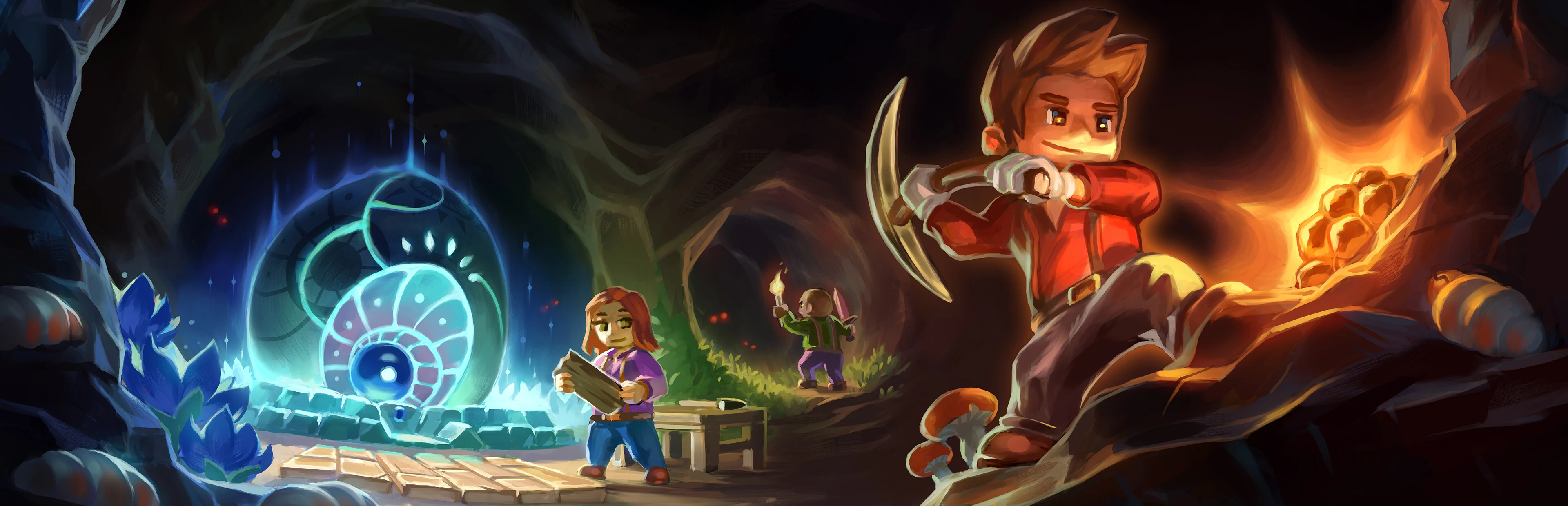
About Core Keeper
Repairs cost Scrap Parts, a cooked meal can carry several different effects at once, and the free 1.3 update added mounts. Here is what those choices actually mean.
One world, one to eight players
The official description calls it a mining sandbox adventure for 1-8 players, with 2-8 player drop-in/drop-out online co-op on top of solo play. You can also run your own dedicated server, which the studio updated to work across the different PC storefronts, though someone still has to keep the machine hosting it running.
Solo play is fully supported, and co-op runs the same world with the same biomes and the same Titan gates. What a crew buys you is the division of labour: one person mining, one farming, one keeping the base supplied, where a solo explorer is all three jobs at once.
Skills and talents are the long progression
Progress beyond your tools comes from levelling skills and spending talent points, and the store description frames the whole loop around powering up the Core. That shapes a run more than any single weapon does: mining faster, fighting better and automating more all come from the same character, and the points are finite. Base building sits in that economy too, because automated mining, smelting and storage are how a large operation stays manageable.
The biomes are distinct enough that routes matter. Clay Caves, the crystal caverns of the Shimmering Frontier, the Sunken Sea you cross by boat and the Desert of Beginnings. They are separate trips rather than a single descent, and each one wants gear you probably did not build yet.
Repair runs on Scrap Parts
Worn equipment loses durability, and the Salvage and Repair Station is where that becomes a decision. The blue repair control restores an item by spending Scrap Parts, and the cost rises with the amount of durability the item has lost, so one scrap is not enough for a badly beaten pickaxe. The other half of the station breaks equipment down: dismantling a spare returns Scrap Parts, and the items you feed it are destroyed, so that slot is for gear you have finished with rather than gear you are saving.
Keeping the blue repair control and the yellow reinforcement control apart matters, because they sit next to each other and only the blue one is the repair. Either way, read the durability bar once the job is done rather than assuming the click did what you wanted.
Food and crops are a small system with sharp edges
A Cooking Pot has two ingredient slots, and cooking starts on its own once both are filled. Different effects from a meal can be running at the same time; what will not stack is the same effect, which is applied at its stronger value rather than added on top. So a dish built from two plants can carry more than one kind of bonus, and the point of testing combinations is finding a set you want rather than stacking a single effect three times over. Cooked effects also differ from the raw ingredients, so it is worth keeping a dish you like on the hotbar instead of eating the ingredients as you find them.
Growing the ingredients has its own rules. Seeds need specific ground, so Heart Berry and Bomb Pepper want Dirt while Carrock needs Stone Block and Puffungi needs Mold Block, and tilling is a separate step again. Early on, a harvest does not guarantee a replacement seed, so a patch can run down if you plant everything and keep nothing back.
What the 1.3 update added
Riders of the Underground brought mounts. Place a Saddle on any cattle and it becomes a rideable mount with its own UI for renaming and for setting whether it stays put, follows you or roams; take the saddle off and it goes back to being cattle. Hookshots are a new off-hand item that latch onto solid surfaces like walls and pull you across pits and water. There is also a new Moss sub-biome inside the Forgotten Ruins, which the studio describes as a cozy spot with no natural predators, plus a new weapon family of Scepters for the Warlock play style.
Minions now persist indefinitely instead of expiring, you can dismiss them on purpose, and the patch removed the cooldown for spawning them. Smaller things matter more than they sound: you can compare gear, cycle loadouts with a bound key, and if you die in a boat, minecart or go-kart the vehicle now drops and returns to your inventory rather than following you to your grave.
Should you play it
Yes, if you want a sandbox that keeps handing you a reason to dig. On the PC release the two paid items listed are an Explorer's Guide and a soundtrack, so the biomes and the updates arrive with the base game rather than behind a second purchase; console stores run their own listings, so check those separately if you are buying there.
Two things to sort out first. Decide who hosts before you build anything serious: a dedicated server keeps the world available without the original host sitting in the game, but it still runs on a machine somebody has to leave on. And keep a stock of Scrap Parts before you need them, because a long trip with worn gear is a long walk back to the station.
Go deeper with V4mp
- Developer
- Pugstorm
- Genre
- Survival crafting
Explore Core Keeper further
Explore the wiki for detailed reference pages on the game's world, systems, items and locations.