

About Borderlands 4
Borderlands 4 sends four new Vault Hunters to Kairos, a planet controlled by the Timekeeper and his Order. The campaign combines first-person gunplay, character-specific Action Skills, weapon hunting, faction alliances and free-form traversal as the Hunters become part of a rebellion against the planet’s ruler.
Borderlands 4 moves the series’ Vault Hunters to Kairos, a world that remained hidden behind a protective veil until a rogue moon tore through it. The resulting upheaval leaves the planet exposed and destabilizes the Timekeeper’s rule. His cybernetic Bolts control inhabitants, while synthetic soldiers called the Order enforce his authority. A resistance begins to form among people who have lived under that system, and the four Hunters arrive in the middle of the unrest. The campaign centers on gathering allies and challenging the Timekeeper, with old faces such as Claptrap, Moxxi and Zane appearing alongside new characters. The setup gives the usual search for alien Vaults a political dimension: the Hunters are not simply exploring a frontier but intervening in a planet-wide revolt.
Kairos is divided into four connected regions, each with its own terrain, factions and dangers. The Terminus Range is a cold mountainous area where one of the Timekeeper’s generals, Vile Lictor, conducts experiments at a blacksite. Elsewhere, the Rippers form a violent horde under Queen Callis, while the Order patrols territory and local groups seek a way out of the ruler’s control. These communities are not only scenery: the Hunters recruit factions to their cause, and their campaign crosses settlements, hostile installations and wilderness where fauna and roaming enemies create encounters away from the main missions. The planet’s spaces are designed for movement in several directions. Gliding, dashing, double-jumping and point-grappling help cross gaps and reach elevated routes, while a Digirunner can be summoned to cover the open ground.
Players choose one of four Vault Hunters, each with a distinctive kit rather than a generic skill list. Vex is a Siren who draws on phase energy, conjures shades and can summon Trouble, a spectral feline familiar. Her unique Trait changes with the element of her equipped weapon, making the current arsenal relevant to her Action Skills. Rafa is a former Tediore soldier whose experimental exo-suit digistructs weapons for different engagements. Amon and Harlowe bring their own combat identities, so selecting a character determines the tools available before gear is considered. Each Hunter has three signature Action Skills to choose among, supported by branching passive trees, augments and capstone abilities. Abilities, passive choices and equipment work together to control fights, creating room to shift a build’s emphasis without erasing its core character.
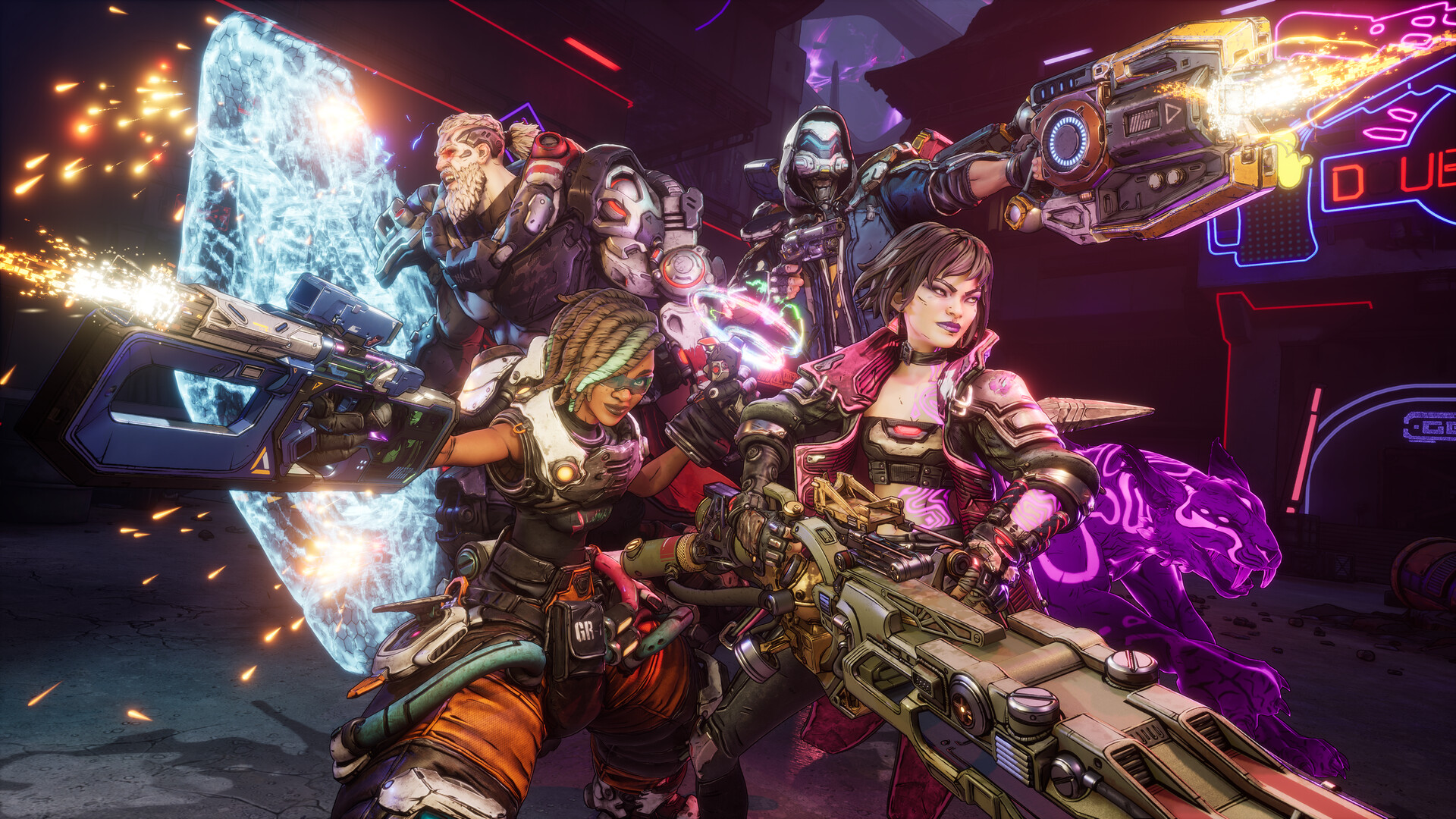
The combat loop remains centered on shooting, enemy drops and continual equipment decisions, but weapon identity is built around eight manufacturers. Order favors precise bursts, Ripper weapons charge into automatic fire, and Daedalus models can use multiple ammunition types. Tediore guns are thrown as explosive reloads; Maliwan specializes in elemental effects; Jakobs rounds can ricochet after critical hits; Vladof brings high rates of fire and large magazines; and Torgue offers explosive or sticky projectiles. Licensed Parts can combine characteristics from more than one manufacturer in a single firearm, so a gun’s behavior can be less predictable than its brand alone suggests. Enhancements improve weapons based on manufacturer, while Rep Kits provide healing or temporary buffs. Ordnance groups grenades and heavy weapons in a cooldown-based slot, making powerful bursts part of a timed combat choice.
Exploration connects combat to a larger sequence of regional objectives. World events and hidden discoveries appear alongside missions, while Echo-4, the Hunters’ robotic companion, can provide guidance across the landscape. Reclaiming a Silo gives the Crimson Resistance control of old Order technology and reveals an approximate Vault Key Fragment location. Gathering enough fragments opens a hidden Vault, a high-level dungeon with tougher combat and valuable loot. A reclaimed Silo also becomes a fast-travel point, and its communications balloon can launch a glide toward another objective. Mission replay and Moxxi’s Big Encore Machine allow players to revisit fights while pursuing specific gear. Kairos also contains world bosses and short activities that automatically become tracked missions when discovered. Legendary guns have unique effects, so collecting them is a separate goal from combining familiar manufacturer traits through Licensed Parts and Enhancements. Optional fights and activities can therefore appear on routes that would otherwise be followed only for campaign missions.
Group play is structured to keep the campaign moving even when party members progress at different rates. Online parties can drop players in or out, and a player may fast-travel directly to another member instead of having everyone retrace the route. Loot is instanced, so each Hunter receives personal drops rather than competing over one shared pile. Dynamic level scaling and individual difficulty options let friends cooperate without requiring identical character levels or challenge settings. Local split-screen supports two players, while online sessions can host up to four and include crossplay. These options change how the campaign’s missions and world events can be approached: a player can join a friend’s activity, keep personal equipment rewards, and still develop their own Hunter through the same story.
It arrived in 2025 and the free Version 1.10 update pushed the level cap to 70, so a base copy is not a stale one. New Vault Hunters and new map regions have come as paid packs since, while the Takedown raid, Circle of Slaughter and the weekly activities have been free.
A planet worth riding across
Kairos is a faction-run world you cross rather than a menu of levels. Your Vault Hunter double jumps, glides, dashes and grapples, and the hover bike covers ground between the fights, so the trip to an objective is part of how a fight opens rather than dead time before it.
It's also set up for company. Four-player online co-op runs on every platform, with two-player splitscreen on PlayStation 5 and Xbox Series X|S, and the design detail that matters is level scaling with individual difficulty, so a party at mixed levels can stay in the same fight. Everything can be played alone as well; co-op is an option rather than a requirement.
The damage types do the teaching
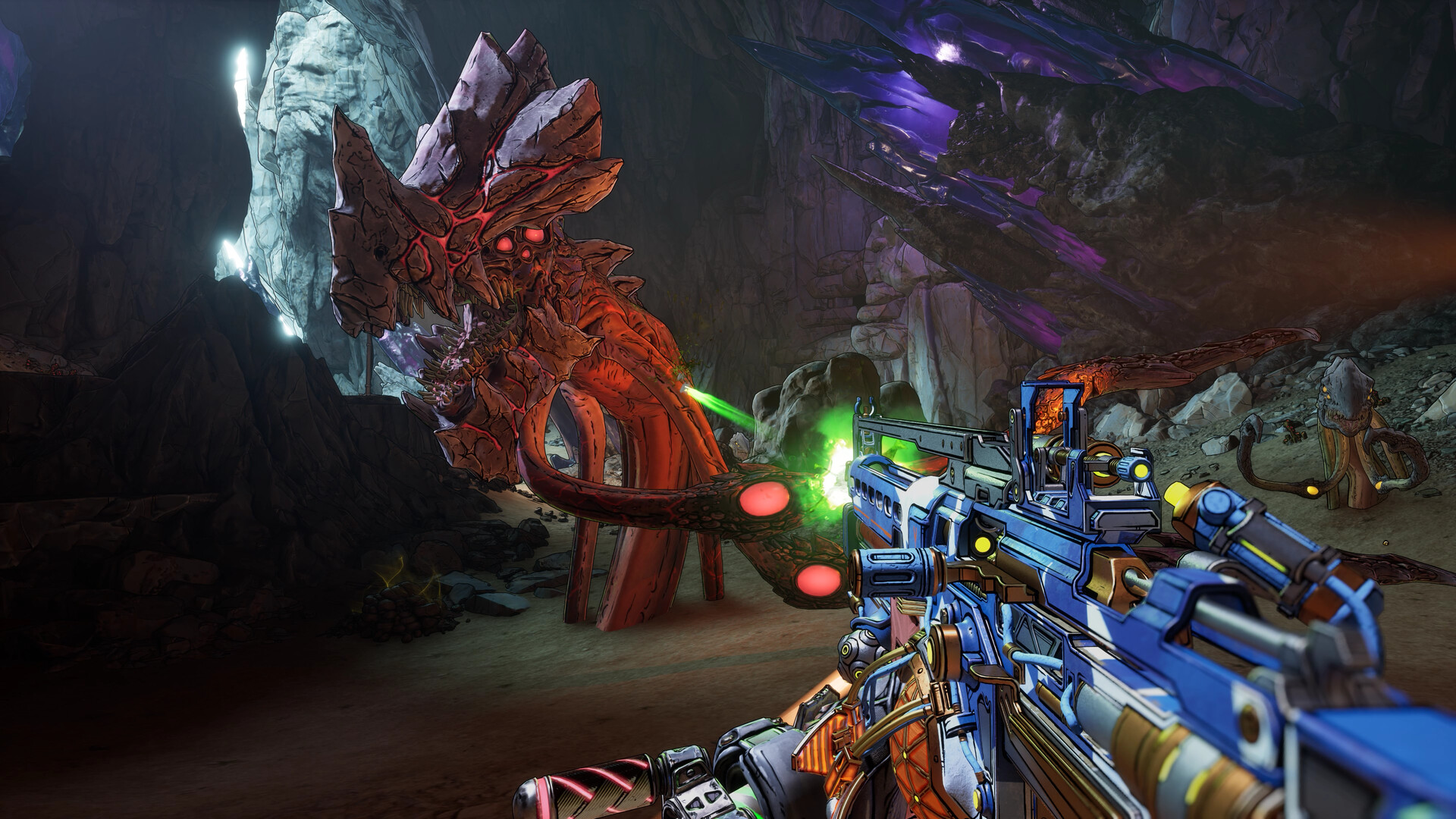
Six damage types matter: Kinetic, Incendiary, Shock, Corrosive, Cryo and Radiation. Kinetic is the non-elemental baseline, which is why the elemental guns are the ones worth thinking about. Against the standard health layers, three matches are the place to start: red Bio bars want Incendiary, blue Shield bars want Shock, and yellow Armor bars want Corrosive.
That three-colour shortcut is useful, but incomplete. Radiation also hurts shields and explodes groups, Cryo also hurts armour and is the better answer when you want a target slowed, and both are slightly weaker than the specialist element for the same bar. Enemies stack those layers, so the bar actually draining is the one to read, and when it breaks you read the next one and switch. Hard difficulty, which is the default in the endgame's Ultimate Vault Hunter Mode, makes resistances bite harder, and named traits can override the match outright — Elemental Eater heavily reduces elemental hit damage. A slot you can swap into is worth more than one gun that looks optimal in a menu.
Underneath that sits a branching tree per Vault Hunter and an Action Skill that changes how a fight starts.
After the credits, Kairos keeps a schedule
The weekly rotation is one strand of the endgame rather than the whole of it, and the game tells you that plainly. Once you've finished the main campaign, the Weekly Big Encore Boss and the Weekly Wildcard Mission appear on the Map tab of your ECHO menu, alongside the relocated Maurice's Black Market vending machine.
The rotation arrives as a server-side update, so the week's set changes without a download; your copy of the game still has to be on a version that supports the content. The two missions behave differently. The Wildcard Mission hands out a guaranteed Legendary for completing a run under a rotating set of enemy traits, and the Big Encore boss is a tougher variant of one of Kairos' own big threats, fought through Moxxi's Big Encore Machine. Maurice's machine is the interesting one: the location is the same for everyone each week, but the inventory is rolled per player, so players can find different items at the same location.
Around the weeklies sit the rest of the post-campaign. Ultimate Vault Hunter Mode adds five difficulty levels, Firmware adds set bonuses that only roll on Repkits, Ordnance, Class Mods, Shields and Enhancements, and the Specialization tree starts levelling account-wide once the campaign is done. The raid and the Circle of Slaughter mode are free additions rather than pack content. That's a reason to log in without a season pass, and it's also the limit of the weeklies themselves: if you don't care about refighting bosses you have already learned, the rotation won't invent new content for you.
What is free and what you pay for
Version 1.10 was free for every owner, and it was not a small patch. It raised the level cap by ten to 70 and handed out the skill points that go with it, and it ran a balance pass across the base game's Vault Hunters, including a large damage increase for Rafa the Exo-Soldier's APOPHIS Lance. Nothing about that requires a purchase.
The paid side is a menu of separate pieces, and it's optional rather than required. Loveless the Hacker adds a new playable Vault Hunter who works across the whole game. Story Pack 2: FL4K and the Last Resort adds the island region of Providence with new missions and activities, eight story bosses including a new major one, thirteen minibosses, and new Pearlescent and Legendary gear with new class mods. Bounty Pack 5: Amara and the Vile Shadows adds narrative content, gear and the Vile Test Chamber, a repeatable boss-rush activity, and the Vault Card sold alongside it unlocks cosmetics and gear through play with no time limit on the rewards. Earlier packs and hunters follow the same shape: a Vault Card plus mission content for the Bounty Packs, a hunter plus a new region for the Story Packs.
If you want the packs in one go, the edition that matters is Super Deluxe, because it bundles both tracks: the Bounty Pack Bundle, which is Bounty Packs 2 through 5, and the Vault Hunter Pack, which is Story Packs 1 and 2. Deluxe gets you the Bounty Pack Bundle only. The pieces are also sold separately, at $9.99 USD for a new Vault Hunter, $19.99 USD for a Story Pack and $5.99 USD for a Bounty Pack or its Vault Card, with regional pricing set by each storefront.
How I'd buy it
If you are unsure whether you want a loot chase at all, the standard edition includes the campaign: play the campaign, and the free level cap and class buffs apply to you either way.
If you already know you keep playing after the credits, the packs are still optional, and the useful question is which one. A new Vault Hunter changes every run you make from that point on; a Story Pack is a region, a storyline and the gear that comes with it; a Bounty Pack is a smaller piece of narrative plus its Vault Card. I'd pick the one I actually wanted rather than collecting them, because each is priced separately and none of them fix a campaign you didn't enjoy.
Should you play it
Yes, if you want a looter shooter with a big planet to cross and a loot chase that keeps going after the credits. Kairos is big enough to wander, the movement options are generous, and the level scaling keeps a mixed group in the same fight rather than splitting it. A weekly rotation and a free raid give you somewhere to point a group without anyone needing a season pass first.
Where it lands is mostly about the loop rather than the company. Everything here can be played solo, so a lack of friends isn't what decides it; what decides it is whether a weekly reason to refight a boss you've already learned sounds like an invitation or a chore, and whether being sold new characters and regions after the credits sits well with you. If neither of those is a problem, the base game is a complete one.
Go deeper with V4mp
- Developer
- Gearbox Software
- Genre
- Action RPG
Explore Borderlands 4 further
Explore the wiki for detailed reference pages on the game's world, systems, items and locations.