
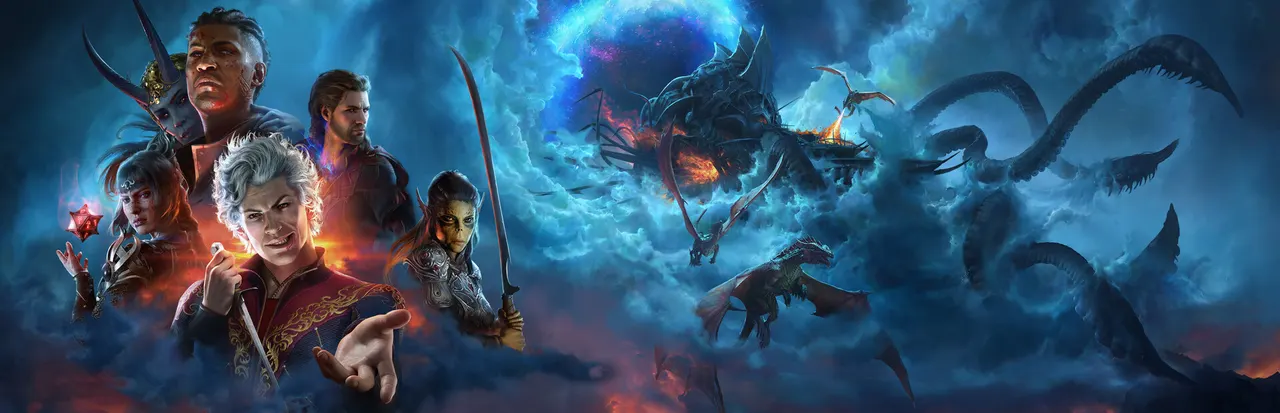
About Baldur’s Gate 3
Larian Studios developed and published it, and it left early access in August 2023. It hands you an extraordinary set of tools and then trusts you to work out what they do — which is where its reputation comes from, in both directions.
The scale is the point
If you have played Larian's Divinity: Original Sin games, the vocabulary will be familiar: species and classes at character creation, initiative rolls, movement, long and short rests, death saves, proficiencies. What changes is how much of the world is built to react to what you do with them. You can talk your way past fights, take a side in someone else's argument, or set fire to the room and accept the consequences. Very little of it is staged for your benefit, and the game rarely stops to tell you which choice was the interesting one.
Combat is most of what you do — turn-based, tactical, and genuinely fiddly. One bad move can undo several good ones, though there is usually a way back out if you are willing to resurrect a party member at camp. You field four, and a workable mix matters more than any individual being brilliant: something to hold the line, something casting, something doing damage. It is dense enough that we would genuinely recommend the lower difficulty on a first run. Not because the game is unfair, but because it will not teach you the vocabulary you need to make informed decisions, and the lower setting still pushes back without punishing you for not yet knowing what a spell slot is.
Why the fights are worth the effort
What carries the combat is how many systems interlock. Your stats, the elements in the world and the equipment you have picked up all change what is possible, and the landscape matters as much as the enemy list — the same encounter plays differently in a corridor than on a ledge. Our favourite example is still a barrel of oil. Throwing one and setting it alight is not a hidden trick, it is a supported answer to a hard fight, and the game never says so. Not realising that sort of thing was available is, we suspect, what makes the early hours feel unfair to some players and brilliant to others.
The camp is where the game actually lives
The fighting is half the game at most. The rest is the camp, where you rest, recover, and settle the business of being a group of people nobody asked to trust each other. It is staged to suit whoever is in it — one companion's corner says more about them than a paragraph of dialogue would — and it moves with you, so it never stops feeling like yours.
You take three companions with you, and the game makes choosing between them genuinely difficult. Damage output is only half the decision; someone whose agenda grates on you is better left behind, and the game is happy to let you learn that the hard way. That is most of the reason we keep coming back. The question it opens on — who are you — gets answered over dozens of hours, badly, by a character you invented.
The pulse
The reception has been almost embarrassingly uniform. It is widely treated as the high-water mark for the genre and the best Dungeons & Dragons game anyone has managed to make, which is a strong claim for a licence with that many failed attempts behind it. Where the conversation gets interesting is the opening: the recurring criticism is not about the game at all, it is about how thin the onboarding is and how much of the first stretch you spend confused. Worth knowing before you start, especially if you are new to the genre rather than merely new to this one.
Should you play it
Yes, if you like reading, if you will happily give one fight an evening, and if you would rather be handed a set of tools than a set of instructions. The generosity is the whole character of the thing, and it is the closest anything has come to putting a tabletop campaign on a screen without sanding the edges off it.
Leave it if you want a brisk campaign, if turn-based combat bores you, or if you know you will resent the hours it takes to learn its language. That is the real warning here, and it is the only thing about this game worth arguing over.
Go deeper with V4mp
- Developer
- Larian Studios
- Genre
- Party-based role-playing game
Explore Baldur’s Gate 3 further
Explore the wiki for detailed reference pages on the game's world, systems, items and locations.