
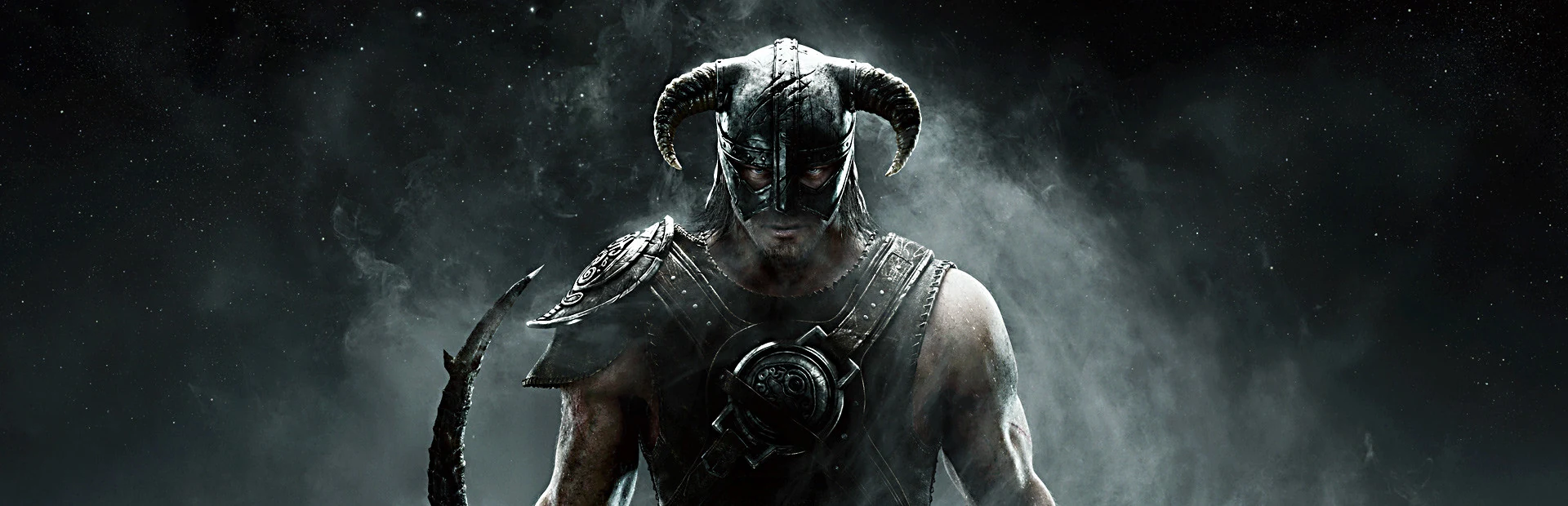
About The Elder Scrolls V: Skyrim
Arrested amid Skyrim’s civil conflict, the player character escapes a sudden crisis and discovers a connection to the dragons returning to the province. As the Dragonborn, you travel across a northern region shaped by rival political powers, ancient ruins, local communities, and choices about how to develop your character.
The Elder Scrolls V: Skyrim opens with its protagonist in Imperial custody, caught up in a civil conflict between the Empire and the Stormcloaks. An interruption at the execution site gives the prisoner a chance to escape, after which the player is free to decide which thread to follow first. The character is Dragonborn, and the opening leads into both that discovery and the warring factions threatening to divide Skyrim. The main quest concerns the return of dragons and the danger surrounding them, while the political conflict and local stories continue alongside it.
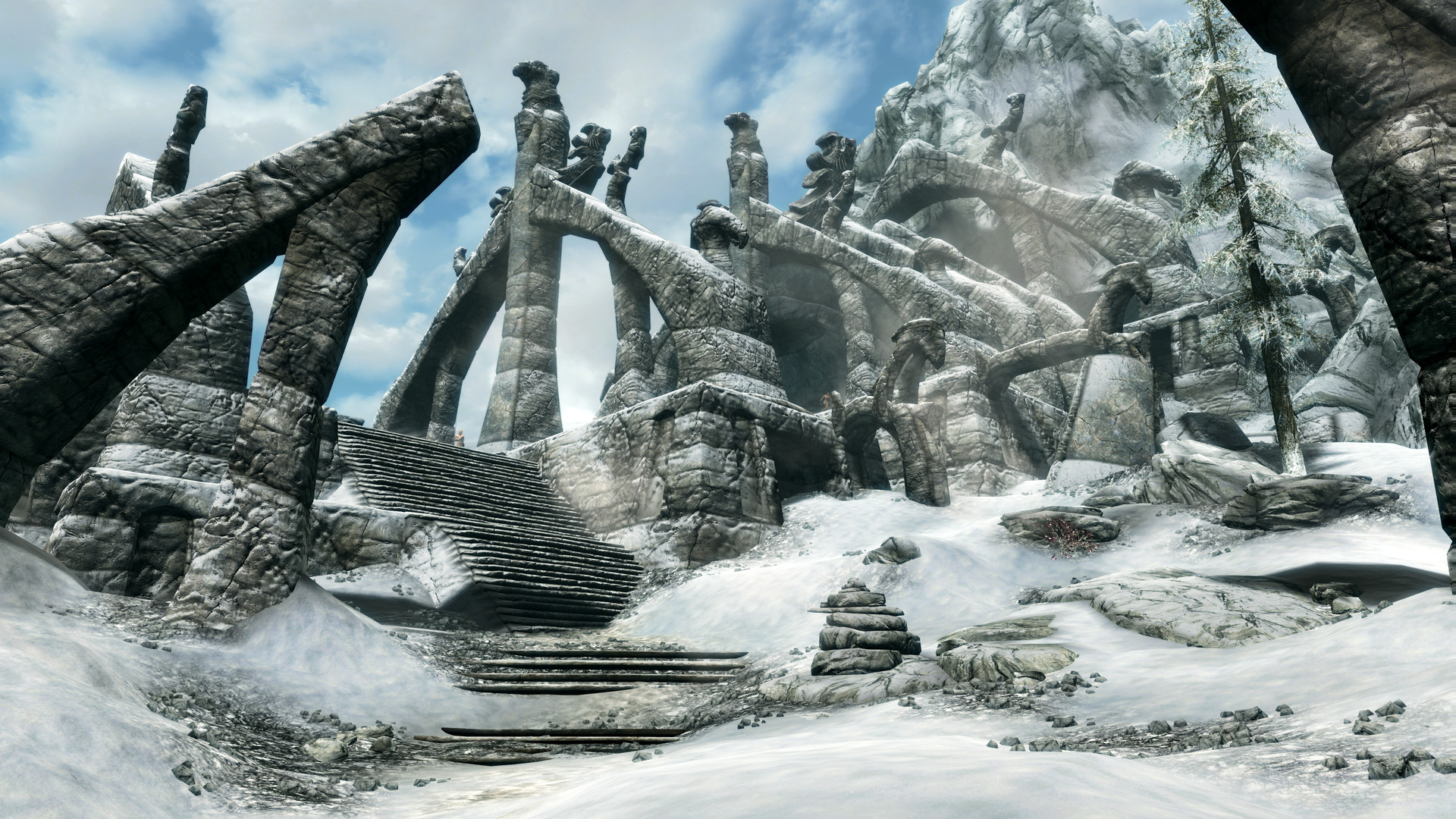
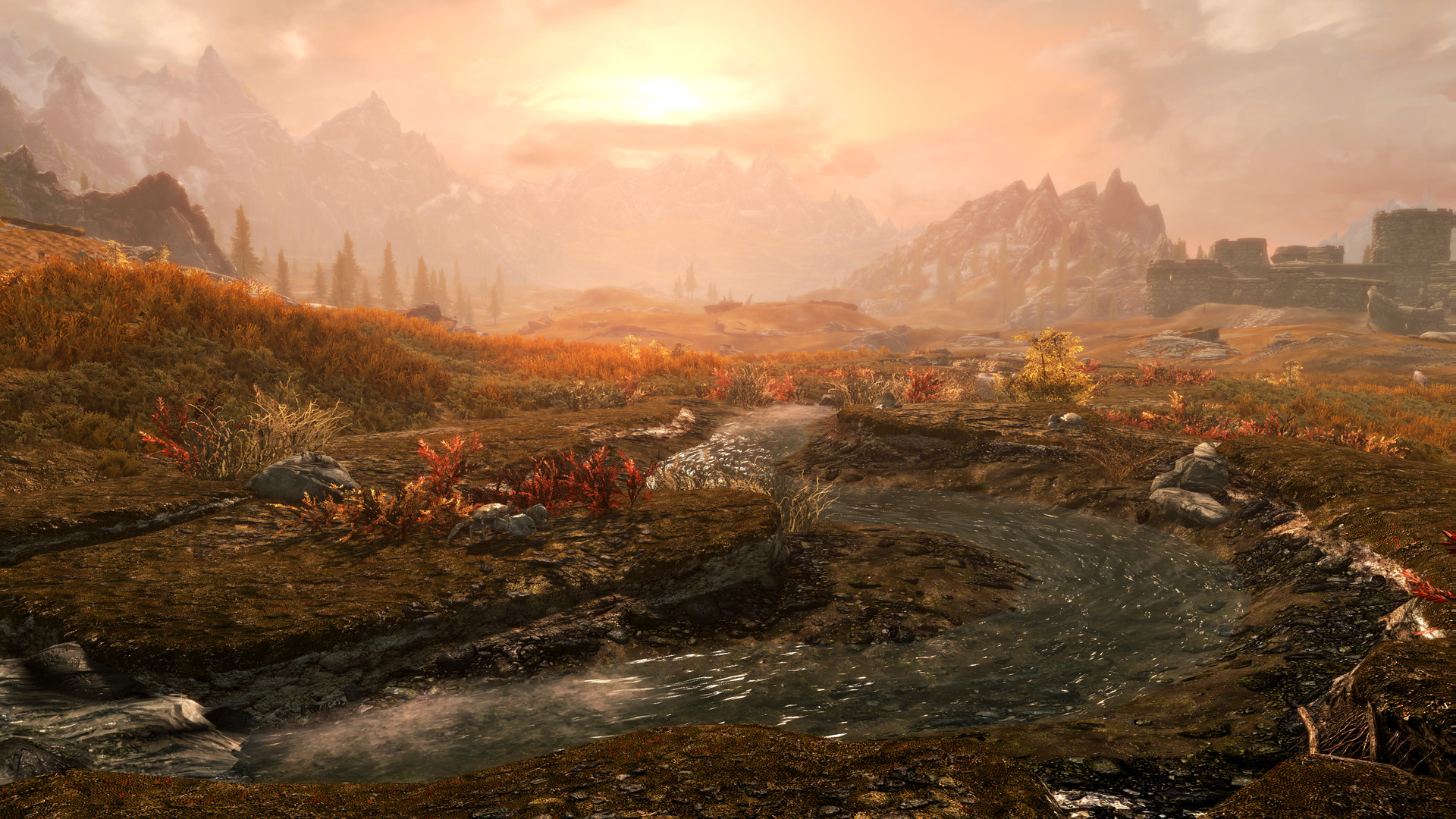
Skyrim is a mountainous northern province of Tamriel, with settlements, wilderness, forts, caves, tombs and other ruins connected by roads and trails. The player can pursue the main quest or leave the route to explore, where side quests and encounters can redirect the journey. Cities and villages provide characters with ongoing concerns; smaller discoveries may lead to a dungeon, a new task or another contact. The world map is not merely a menu of missions: travel itself exposes the player to environmental hazards, hostile creatures, bandits and unexpected encounters that can shift the immediate goal.
Character creation begins without a fixed class. The player chooses a race and appearance, then builds capability through skills rather than selecting a permanent combat role. Skills include weapon disciplines such as Archery, armour, stealth, Speech and schools of magic including Destruction. Using a skill contributes to its development, and advancing character levels provides opportunities to improve attributes and unlock perks in skill trees. This means a character’s progression reflects chosen activities: using bows, crafting, sneaking, bargaining or casting can each shape the build. The system allows specialisation while leaving room to broaden into other approaches during the adventure.
Combat can be approached with melee weapons, bows, spells or stealth, and the player can mix these methods instead of committing to only one. Weapons and magic have distinct skill tracks; armour choices affect protection, while blocking and movement help manage incoming attacks. Bows reward distance and aim, whereas close-range weapons make positioning and timing more immediate. Sneaking can help avoid detection or create an opening before a fight begins. The Dragonborn’s Shouts add another ability layer: these are powerful words of the dragon language, unlocked by learning words and absorbing dragon souls, and are separate from ordinary spell skills.
Dragons are a recurring threat and a defining part of the main story. Encounters with them connect combat to the protagonist’s identity, since defeating a dragon can grant a soul used to unlock a known Shout. The game also sends the player through ancient sites to learn more about the dragon crisis and the history behind the Dragonborn. This main-quest thread can be advanced between other activities, so a player might spend time helping a town, exploring a ruin or joining a faction before returning to the central threat. These paths contribute to the same character’s experience and accumulated resources.
Skyrim’s civil war gives the province a second major source of conflict. The Imperials and Stormcloaks have competing claims about Skyrim’s future, and the player can become involved in their struggle while encountering local rulers and residents whose loyalties are shaped by the dispute. These factions frame the protagonist’s arrest and the early story. Faction questlines introduce distinct duties and relationships, while many side quests focus on individual communities rather than the fate of the province. The player’s chosen order changes which concerns dominate the next stretch of play.
Exploration supports several practical ways to prepare and progress. Dungeons may contain enemies, treasure, notes or quest objectives; returning to settlements lets the player sell unwanted equipment, acquire supplies and speak with people who offer further work. Smithing, enchanting and alchemy support equipment and consumable preparation, while looting and rewards provide new weapons, armour and ingredients. The game’s open structure lets a player move between these loops at their own pace. A detour can improve a skill or provide equipment before the next main encounter, and discoveries can add new objectives without forcing a single route through the province.
A separate progression thread comes from learning the Thu’um. Word walls reveal individual words of power, and dragon souls allow the Dragonborn to unlock Shouts that can change how an encounter unfolds. Some Shouts create space or disrupt opponents; others provide movement or support, depending on the words learned. Because they recharge over time, they complement rather than replace weapons and spells. Finding a wall often means travelling to a remote location or clearing a ruin first, tying character growth to exploration. It gives the player a reason to investigate landmarks even when the main quest is elsewhere. This links knowledge with practical use: discovering a word is only the first step, and the Dragonborn still needs the relevant soul to make it available. This creates a reward loop in which story encounters, optional exploration and character growth meet in one system.
Special Edition, the Anniversary Upgrade, the free console upgrade, the 2011 original and Skyrim VR sit on different storefronts as separate things. Here is what each one gets you, and what the Creations menu inside the game does.
Which Skyrim you are actually buying
The version to start with is The Elder Scrolls V: Skyrim Special Edition. It is the 2011 game carrying its three add-ons, Dawnguard, Hearthfire and Dragonborn, with remastered art and effects laid over the original build, including volumetric god rays, dynamic depth of field and screen-space reflections. There is no separate decision about the add-ons on this version, because they are already in it.
The 2011 original is a different listing, and it carries a notice that it is unlisted on the Steam store at the publisher's request, so it will not appear in a store search even though its own page still opens. Treat it as the pre-remaster route rather than the place to start.
Skyrim VR is the third option and it is not one platform. As a purchase it includes the core game and the same three add-ons, and it is sold for Windows headsets on Steam and for PlayStation VR, where the PlayStation Store says it plays natively on a PlayStation 4 and on a PlayStation 5 through backwards compatibility. The Anniversary Upgrade does not apply to either version, because that add-on requires Special Edition.
The Anniversary Upgrade is content, not a better remaster
On PC the paid route is The Elder Scrolls V: Skyrim Anniversary Upgrade, an add-on that requires Special Edition and covers the Creation Club content released up to the game's tenth anniversary. The edition was described at launch as Special Edition plus 74 creations, and the upgrade's own listing keeps that scope, so the figure is a record of what the edition shipped with rather than a count of what has arrived since.
That means Anniversary is not a tier above Special Edition in the way a remaster sits above an original release. It is the same remaster with a large archive of add-on content unlocked, sold either as the upgrade on top of Special Edition or bundled with it.
Console owners have a second thing to check. The publisher says that owners of Special Edition or the Anniversary Edition on PlayStation 5 and Xbox Series X|S receive a next-generation upgrade for the game, and that this upgrade is free. The Anniversary Edition has since been released on Nintendo Switch 2 as well, sold either as a full copy or as an upgrade for players who already own Skyrim on the earlier Nintendo Switch.
Creations, credits and storage
The Creations menu is an in-game store, and credits for it are sold as a separate add-on. Creations released through the Verified Creators programme are achievement-friendly on Xbox and trophy-friendly on PlayStation, so they no longer block achievements, and a creation you already had only picks that up in a new game.
Storage is the practical ceiling, and it has moved. A recent Skyrim update raised mod storage to 15 GB on both PlayStation 5 and Xbox, and expanded PlayStation 4 creation storage to about 16 GB, with an explicit warning that download size may not match space used there and that the console's storage partitions can put a practical limit on how many large creations you keep installed at once.
What you are actually playing once you have picked
The base game is the 2011 sandbox. You do not choose a class at the start; you are told to play any type of character you can imagine and to define yourself through your actions, with hundreds of weapons, spells and abilities to do it with. Skills grow from use, so your build becomes a record of what you actually did rather than a plan you locked in at the menu.
The three add-ons are inside every modern copy, which is what makes the version question the interesting one. Dawnguard, Hearthfire and Dragonborn are each their own long detour, and on the Anniversary Edition they arrive alongside a large library of creation content that adds quests, dungeons, weapons and spells.
Dragons are the spine of the plot rather than its finale. The fights recur, and being Dragonborn is the plot's gift rather than a class choice, so the encounters matter for more than the loot they drop. An open character sheet and an open map are what still make Skyrim worth planning for, and what punishes a plan made too early.
Should you play it
Yes, and the order to buy it in is straightforward. Start with Special Edition. Add the Anniversary Upgrade only if you want that archive of Creation Club content rather than the base game, and take the free console upgrade if you are on PlayStation 5 or Xbox Series X|S. Only pick up Skyrim VR if you already have a headset and want the same world inside it, and only buy the unlisted 2011 release if the old build is the point.
One thing to know before you install anything large: creation storage is finite on console, so check what your platform allows before you build a large collection. Recent Skyrim updates have changed creation storage and the Creations menu itself, so if you keep a lot of creations installed, it is worth re-checking those limits after an update rather than assuming nothing moved.
Go deeper with V4mp
- Developer
- Bethesda Game Studios
- Genre
- RPG
Explore The Elder Scrolls V: Skyrim further
Explore the wiki for detailed reference pages on the game's world, systems, items and locations.