

About Persona 5 Royal
Persona 5 Royal follows Joker, a Tokyo student who becomes part of the Phantom Thieves after awakening to his Persona. By day, he balances school and relationships; in the Metaverse, the group infiltrates Palaces and Mementos to confront distorted desires through stealth and turn-based combat.
Persona 5 Royal begins when a high-school student known as Joker transfers to Tokyo after an incident leads to probation. He stays at Café Leblanc with Sojiro Sakura and enrolls at Shujin Academy, where he gradually meets other young people who have their own reasons to resist adults abusing power. A mysterious app called the Metaverse Navigator leads the group into a supernatural reflection of people’s distorted desires. There, Joker and his allies become the Phantom Thieves, using code names and masks as they investigate targets whose actions have harmed others. The premise moves between everyday school life and psychological fantasy, with the group trying to change the hearts of people who believe themselves untouchable. Royal expands the original Persona 5 story with additional characters, Confidants, locations and a new story arc.
Palaces are distorted environments shaped by a target’s view of the world. The Thieves infiltrate these spaces, avoid Shadows where possible and fight when they are discovered. Each Palace has its own imagery and obstacles, with stealth routes, hidden passages and the grappling hook giving Joker new ways to move through some areas. At its deepest point lies a Treasure, a physical manifestation of the target’s heart. The Thieves’ objective is to reach it and steal it, which sets a time-sensitive mission against the calendar of ordinary life. Mementos serves a different role: it is a sprawling dungeon associated with the public’s shared desires, where the group can pursue requests outside the main Palace stories. Its layout changes between visits, so it functions as an ongoing place for side missions and combat.
Combat is turn-based and revolves around identifying enemy weaknesses. Joker can use weapons, guns and Personas, supernatural beings that grant skills and elemental attacks. Hitting an exposed weakness can knock an enemy down and grant another action through the One More system. When several foes are vulnerable, the Thieves can press the advantage with an All-Out Attack. Allies have their own Personas and specialties, so the party can combine healing, elemental damage, buffs and physical attacks. Baton Pass lets a character hand an extra action to a teammate after exploiting a weakness, creating a chain across the party. The player also negotiates with certain Shadows to obtain new Personas, making some encounters opportunities to expand Joker’s toolkit rather than simply defeat every opponent.
The Velvet Room provides a way to reshape Joker’s Persona collection. By fusing two Personas, the player can create a different one with inherited abilities, allowing the roster to be tailored toward upcoming challenges. Persona choice influences which skills Joker can access and can support varied combat approaches. Outside battle, Confidants represent people Joker spends time with around Tokyo. Strengthening these relationships improves his effectiveness as a Phantom Thief and can unlock practical abilities. Their stories reveal pressures affecting students, workers and adults across the city. The social layer is not only character flavor: time spent with one person uses an opportunity that could have gone to studying, working, training or another relationship.
Each day divides into limited activities, and the player chooses how to use after-school and evening time. School obligations, part-time work, cafés and hangouts can raise social attributes or advance Confidant relationships, while Palace and Mementos visits use another portion of the schedule. Deadlines give the Thieves a reason to balance preparation against social development instead of postponing every dungeon. Royal’s added characters and scenes broaden this calendar and introduce further relationships, but its central rhythm remains the interaction between the real city and the Metaverse. A day spent strengthening a bond can improve a later infiltration, while time spent exploring can earn money, experience and Persona materials. The player gradually builds both a capable team and a network of people whose lives intersect with Joker’s double identity.
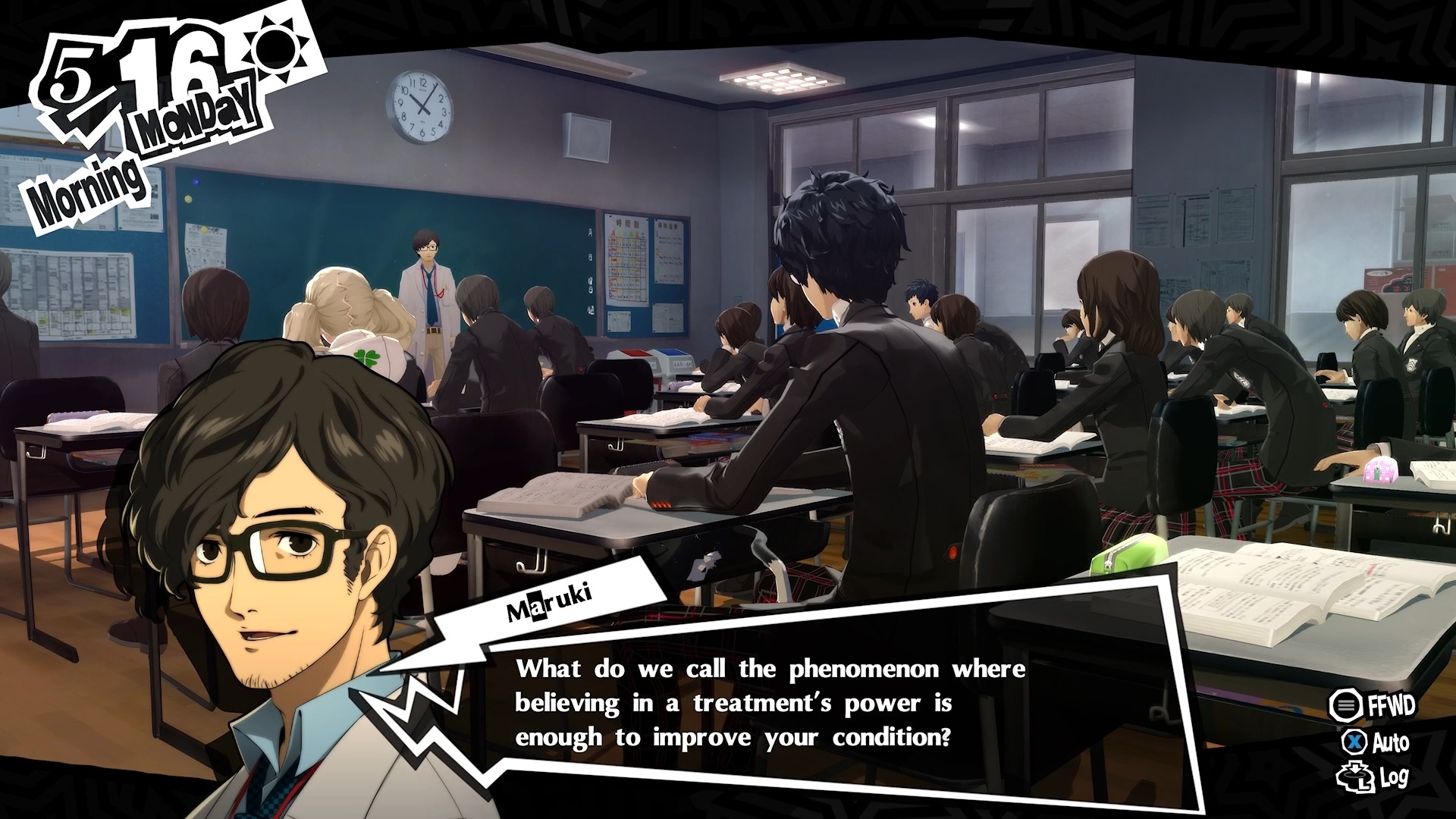
Royal adds activities that connect Tokyo’s social life to the Phantom Thieves’ combat tools. In Kichijoji, Joker can visit a jazz club, play billiards or darts, and spend time with teammates in a district that was not part of the original release. Darts can improve a party member’s Baton Pass rank, strengthening the handoff that follows a weakness hit in battle. Palace exploration also gains a grappling hook, which opens new routes and leads to hidden Will Seeds; collecting these in a Palace restores SP and can produce a further reward when all three are found. Showtime attacks give certain pairs of Thieves a coordinated move, while eligible party members can develop third-tier Personas as another stage of combat growth. The Thieves Den provides a separate customizable hub for viewing collected art, scenes and music, with decorations and awards tied to its own activities. These additions add tactical and collection goals beyond the main calendar loop. Royal's additional relationships include Kasumi Yoshizawa, a transfer student and gymnast, and Takuto Maruki, the school counselor. They introduce different perspectives on Joker's school life and form part of the expanded narrative, alongside the returning Phantom Thieves and their existing connections.

ATLUS rebuilt the game around new characters, new confidants and a chapter of story the original never told. The catch is that the new chapter is not handed to you.
What Royal adds to Persona 5
The publisher's own description of Royal is a massively expanded and reworked version of the original, and the additions are specific rather than cosmetic. There are new characters, new confidants, new story and new locations. There is a grappling hook, which opens stealth routes into places the original version did not let you reach. And there is a new chapter that runs past where the original story ended and carries its own ending. That chapter is not automatic. The guides we read are clear that it only opens if the school counsellor's confidant, the Councillor, reaches rank nine before the story's mid-November cut-off, with two other bonds, Faith and Justice, deciding how much of the new material you see. Miss the deadline and the game ends the way the original did.
Two new confidants are the headline addition, because confidants are how this series turns the people around you into systems. In the Japanese product page for Royal's original release, ATLUS also advertises a new area of Tokyo and a fully reproduced darts machine as part of the expanded school life, alongside a larger set of daily-life options. Royal is a re-release that keeps adding things to do between the fights, and the calendar is where the real decisions live.
Dungeons, stealth and the hook
The core loop is unchanged: you are a transfer student in Tokyo who spends part of the day living a normal school life and the rest of it infiltrating the distorted spaces where the game's villains hide, stealing their hearts as a Phantom Thief. Persona 5 Royal retains the visual style of the original, and the grappling hook is a new traversal option rather than a rewrite of how the dungeons work. Stealth still comes down to how you approach a shadow and where you start the fight.
What makes the re-release interesting is that the additions were tuned for people who already knew the original. Royal includes gameplay and dungeon refinements rather than only new content, which matters more for a long RPG than any single new area. There are also alternate endings to find, which is the series being explicit that the extra material is meant to change what the ending means.
The layer around the fights
Fights in Persona are a collection problem as much as a tactics problem, and the rules are worth knowing before you spend a night on them. Hitting an enemy's elemental weakness or landing a critical hit downs it and buys you another turn, which is the whole basis of the pressure: find the weakness, then keep the chain going. Downing an enemy also unlocks a Baton Pass, where you hand that extra turn to another party member for a boosted attack. Fusing Personas in the Velvet Room is the other half. Two or more are combined into a new one that inherits abilities from its ingredients, so the roster you carry is something you build rather than only recruit. Confidants are not all fighters, either. Some of the people you spend time with are your party, and several of the most useful never enter a dungeon at all: a counsellor, a teacher, a doctor and a journalist all trade their time for advantages outside the field.
There is a collector's layer on top of all of it. The Thieves Den is a personal space where you display rewards and collectibles, and the PC version ships with more than 40 items of previously released downloadable content included, so the costume and music packs that used to be separate purchases are part of the package. You can also choose between Japanese and English voice tracks, which is the sort of option an RPG this long should always offer.
The useful thing about the publisher's own summary of Royal is that it lists categories rather than boasting: two new confidants, gameplay and dungeon refinements, a new chapter, and the Thieves Den. The refinements are the part that applies to every hour rather than only to the new ones, and the extra confidants are the part that changes how a run is planned. If you are weighing up the expanded version, those two items are the argument, not the cosmetics.
Versions and platforms
The PC release on the store entry used here is a Windows build asking for a modest 8GB of RAM and around 41GB of storage, and it is single-player with full controller support. ATLUS lists the game across PlayStation 5, Nintendo Switch, the Xbox consoles and Windows, so the platform choice is wider than the PC listing alone suggests.
One honest note about maintenance: Royal has received a handful of small version updates since its PC release, which is the shape of support you expect from a finished, single-player game rather than a live one. If you are choosing between this and a newer, shorter RPG, the deciding factor is whether you want to live a year of someone's life.
Should you play it
Yes, if you have not played Persona 5 and want the expanded version, or if you loved the original and want the chapter it withheld. Royal is the base game plus another semester, two more confidants and the traversal tool, and the new material is gated behind a bond you have to build long before it arrives.
Skip it if a calendar-driven RPG is not the shape of game you can finish, or if you want the combat to be the whole game rather than half of a routine. Time is the resource this one actually asks you to manage.