
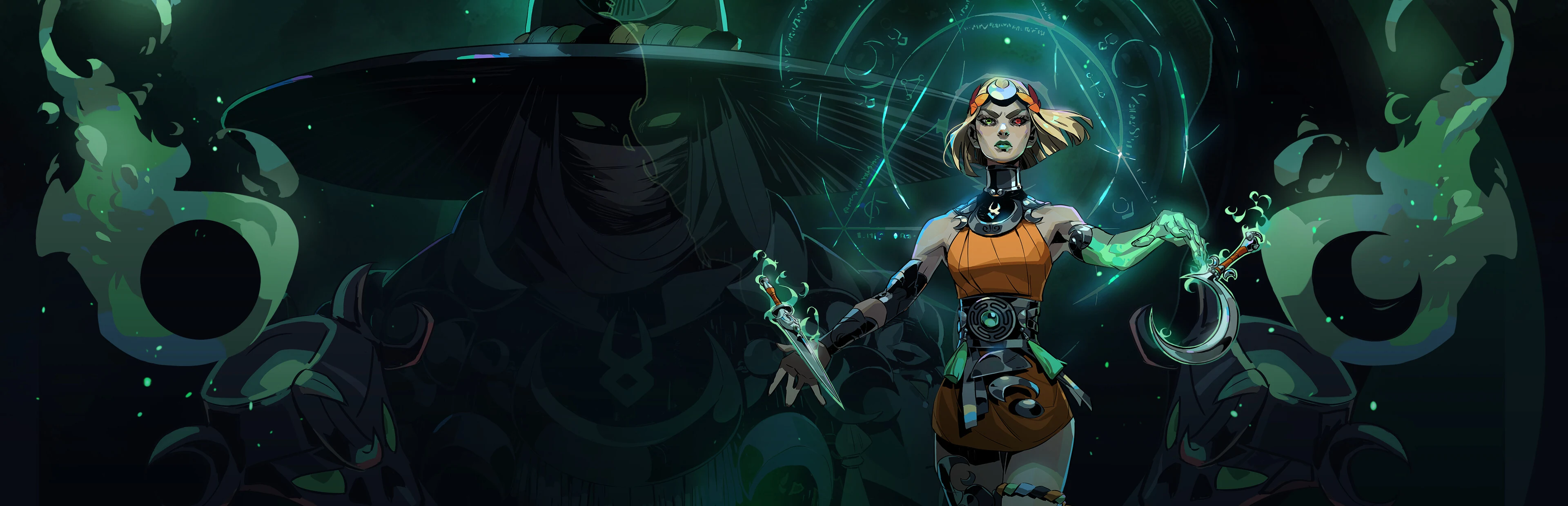
About Hades II
Hades II is Supergiant's first sequel, and it does not pretend the first game never happened. You play Melinoë, Princess of the Underworld, an immortal witch sent after the Titan of Time. It spent about a year and a half in early access from 2024, then launched properly in 2025 on PC and Nintendo Switch before reaching PlayStation 5 and Xbox in 2026. It is a single-player game from top to bottom. This review covers that finished version and the free patches around it, and the soundtrack is sold alongside it rather than folded into the game.
Two directions, one night
Once you have opened the surface route, the Crossroads offers a choice the original never had: down or up. Down runs through Erebus, Oceanus, the Fields of Mourning and into Tartarus, where Chronos waits at the end. Up runs through the ruined City of Ephyra, the Rift of Thessaly and on to Mount Olympus, finishing at the Summit. Two routes, two Titans, two sets of enemies and materials, and a story that keeps moving whichever way you go.
They are not the same run with a different backdrop. The regions are built around the route you picked, the Guardians are different people with different rules, and the rewards you are fishing for change with them. Swapping direction is how you keep the game from going stale, and it is also how you unstick progression when one route keeps killing you.
Before most Guardians the game hands you a breather in the form of Charon's shop or a fountain. That room is where a run gets fixed: top the health up, buy a Death Defiance, or grab one more upgrade for the fight ahead. Skipping it to save gold is a decision you make with your eyes open.
One warning worth having before you commit: the story takes more than one clean descent. The route ends are milestones, not the ending, and the game gates the true ending behind repeated clears. The first big post-launch patch actually raised the number of Underworld clears it asks for, then added a way to step back to earlier story beats if you want to revisit them.
What Melinoë does that Zagreus could not
Combat looks familiar and then quietly rewrites itself. Each weapon has an Omega version of its attack, special and cast: hold the button instead of tapping it and the move comes out heavier, paid for with Magick. Magick does not trickle back while you are trading blows, so this is a resource you plan rather than a free upgrade. Magick normally refills when you move to another location; boons and upgrades can also restore it during combat.
The cast is the clearest break with the first game. Instead of a stone you throw and collect, you drop a binding circle on the ground that holds enemies where it lands. That turns the cast into crowd control first and damage second, and it is the reason a room full of fast enemies can be handled on your terms. There is a sprint on top of the dash as well, which changes how you cross an arena under fire.
The old call-the-god super is gone, replaced by Hexes. Selene is the one who hands them out, each Hex charges as you spend Magick, and the Path of Stars spends your progress on upgrading them. It means your big button is something you build toward instead of something you wait for.
Six weapons, and the Aspects behind them
You start with the Witch's Staff and unlock the rest as you gather materials: the Sister Blades, the Umbral Flames, the Moonstone Axe, the Argent Skull and the Black Coat. That is six Nocturnal Arms, and they are genuinely different games. The Blades want you in close and moving, the Axe wants space and timing, the Skull throws ammunition you then have to go and fetch.
On top of that sit Aspects, which are not small stat bumps. An Aspect rewrites how a weapon's moves behave, and the interesting ones push you into a style you would not have chosen. Unlock costs vary by Aspect and can require different reagents. Nightmare is important for upgrading alternate Aspects, while Melinoë's starting Aspects use other materials. Each weapon also hides one more Aspect that has to be earned rather than simply bought.
The Altar of Ashes is the character sheet
Between runs, the Altar of Ashes holds a board of Arcana cards, and this is where the original's mirror went. There are two separate steps and they trip people up. Ash unlocks a card, then you spend Grasp capacity to keep it active. Grasp is not a currency you spend down, it is a ceiling: it limits how many cards you can run at once, and Psyche is what raises it.
Unlocking cards costs materials, while activating them uses your available Grasp capacity, so an early board is a puzzle. You will own a card you do not have the Grasp to activate, and the answer is to go and find more Psyche rather than to sell anything. Later on, Moon Dust upgrades the cards themselves, and an incantation lets you save several arrangements so you are not rebuilding the board night after night.
Keepsakes, gifts and the rule that bites
Keepsakes come from characters you get close to, and you carry one at a time. Clear encounters while one is equipped and it ranks up on its own, which turns a favourite Keepsake into a long-term investment rather than a starting bonus. If ranking a specific one is the goal, keep it on: encounters you clear with a different Keepsake feed that one instead.
The exception is worth knowing before it costs you a run. After you have cast Kindred Keepsakes, a case appears in the room past most Guardians and you can swap to another Keepsake you own. You get that swap once per region, and a Keepsake you trade out cannot come back for the rest of the night. Decide before you close the case, because it does not reopen.
Gifts run on the same social logic as the first game, just longer. Nectar is what earns you a Keepsake in the first place, and once a bond is forged the Crossroads cast keeps accepting Bath Salts, Twin Lures and Ambrosia, which is a much better reason to keep talking to everyone than a one-off reward.
What you spend, and what it buys
Hades II is generous with materials and strict about what each one is for. Ash feeds the Arcana board, Psyche raises its ceiling, Moon Dust upgrades the cards; Aspect recipes use different reagents, with Nightmare funding many alternate-Aspect upgrades. Bones are the broker's currency between runs. Star Dust, reagents and incantation ingredients are the slow lane: they unlock familiars, tools and permanent conveniences, and they arrive a few at a time.
Gold pays for supplies and upgrades during a run. It normally does not carry back to the Crossroads, so save it for a useful purchase rather than treating it like Bones. A build can still give you reasons to hold some in reserve.
Tools, familiars and the Cauldron
Four gathering tools open up the resource economy: a pick for mineral deposits, a spade for digging, the Rod of Fishing for water, and the Tablet of Peace for lone shades. Early access made you choose one to carry. The finished game lets you carry the whole set, which removes a decision that punished you for guessing wrong.
You can also bond with familiars, a small cast of animals who travel with you and chip in. One comes along at a time, they level up with treats you brew, and each of them has a different specialty: combat, blocking, gathering, or fishing when you would rather not stop. A later patch added an alternate look for each one, which is the sort of thing you do not need and will still unlock.
The Cauldron is where the permanent scaffolding lives. Incantations unlock the tools, the familiar treats, saved Arcana sets, the upgrades that make the Crossroads itself more useful, and eventually a way to go back and watch story moments you have already passed. It is the reason a failed run still feels like progress.
God Mode, Vows and Fear
God Mode is back for anyone who wants the story more than the punishment. It cuts the damage you take, it keeps easing the pressure as runs end badly, and you can dial its strength back down if it overshoots. It is a comfort setting with a growth curve rather than a switch, and it does not take the game away from you.
For everyone else, the real difficulty dial arrives after your first win over Chronos. A pillar appears in the training grounds and the Oath of the Unseen opens: you swear Vows, each Vow raises your Fear, and the Oath hands you a Testament that names a Guardian, a weapon you have to use and a minimum Fear to attempt it. Clear the assignment and the payout is Nightmare, which is exactly what you need for weapon Aspects. The punishment and the reward are the same system, which is why the endgame loop holds up.
Fear doubles as the scoreboard. How far you push it on a clear is what the game's titles and reward tracks are measured against, so the honest way to play the late game is to keep raising the number until the fights stop being comfortable.
What changed after launch
The launch came with the usual round of hotfixes, and then the studio did something more interesting. The first big patch in late 2025 reworked the true ending: new scenes before and after it, a higher number of Underworld clears needed to reach it, and a Cauldron incantation that lets you return to an earlier point if you want to see those scenes again. It also cut the cost of Crossroads decorations and refunded what players had already spent on them.
The second patch landed in 2026 alongside the PlayStation 5 and Xbox versions. It added narrated conclusions to a pile of character prophecies, an open-ended gifting loop, a new alternate form for each familiar, more decorations, and a mode that the notes deliberately left for players to find. Further hotfixes followed through the middle of the year.
The pulse
Hades II earned a very warm reception for its combat, characters and expanded progression. Its larger scope gives returning players plenty to work through, though the extra systems also make it a more demanding game to learn.
That reception is easy to explain. This is a sequel that kept the loop people loved and doubled the surface area around it: more weapons, more permanent systems, a second route, and a story with more characters in it. The trade is that there is far more to grind. If the original's tight, focused climb was the part you liked most, the sequel's extra layers take some getting used to.
Should you play it
Yes, if you liked Hades and want more room inside the same idea. The two-route structure is the best addition, the build layer is deep enough to plan around rather than just react to, and the permanent upgrades at the Crossroads mean a bad run still moves the account forward. The combat keeps the speed of the original while adding a resource to think about, and the cast finally does something interesting.
Skip it if you want a short roguelike. A full clear is a long project, the true ending wants repeat victories rather than one good night, and the endgame difficulty is built out of modifiers you opt into and then have to respect. Hades II is the bigger game in both directions, and that is the whole pitch.
Go deeper with V4mp
- Developer
- Supergiant Games
- Genre
- Action roguelike
Explore Hades II further
Explore the wiki for detailed reference pages on the game's world, systems, items and locations.