
About Factorio
Stranded on an alien planet after a crash, an engineer must build an industrial network capable of launching a rocket. Factorio turns mining, processing and crafting into connected production lines, then adds research, power management, expanding logistics and defense against native creatures as the factory spreads.
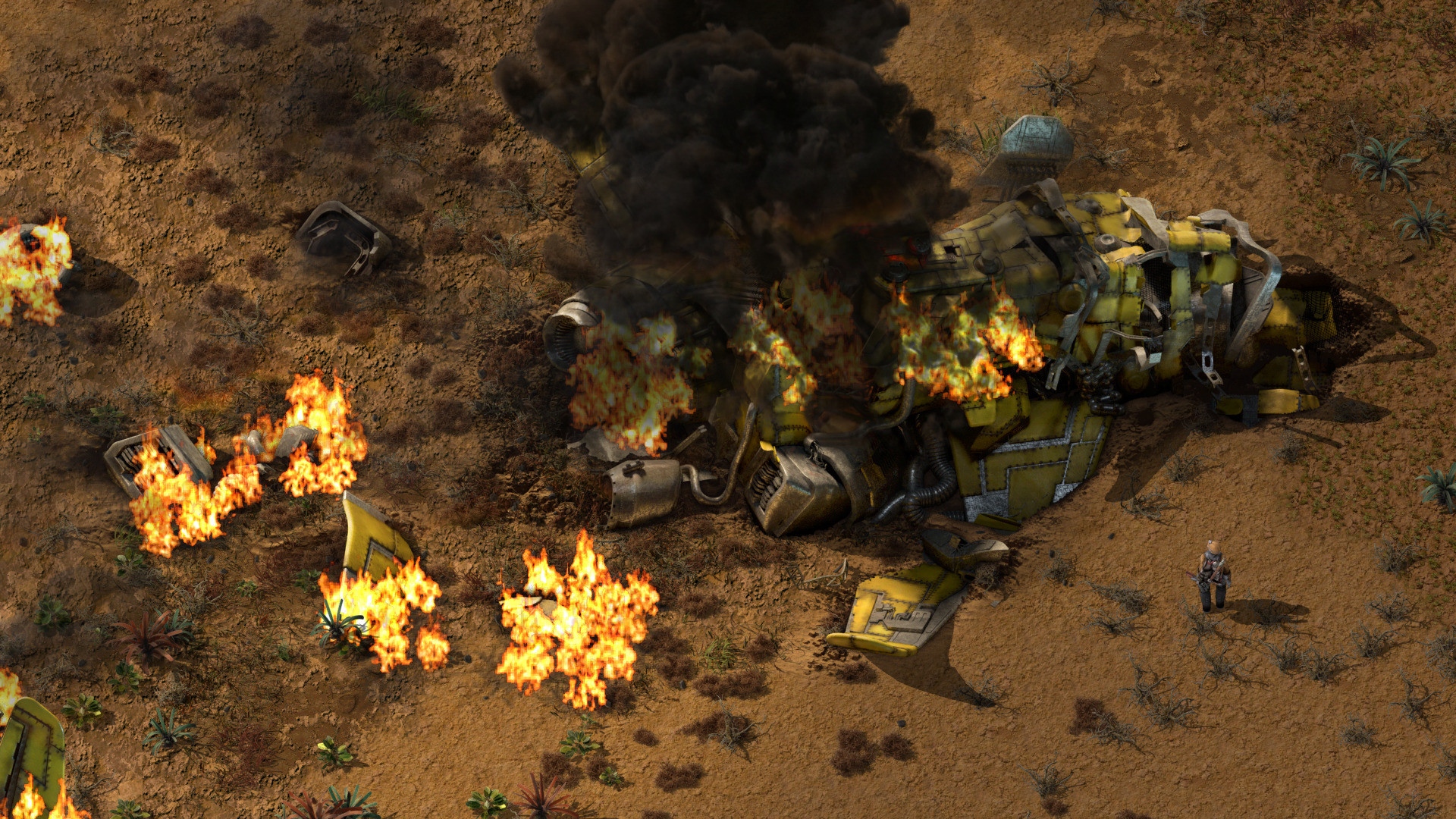
Factorio begins with an engineer stranded on an alien world after a crash. The single-player Freeplay objective is to research and construct a rocket silo, then launch a rocket, but reaching that point requires an industry capable of building its own tools and infrastructure. The player starts with basic access to local resources and gradually converts a small work site into an automated system. Each new product depends on earlier materials, machines and power, so the practical challenge is not only deciding what to build, but arranging the supply chain that makes further construction possible.
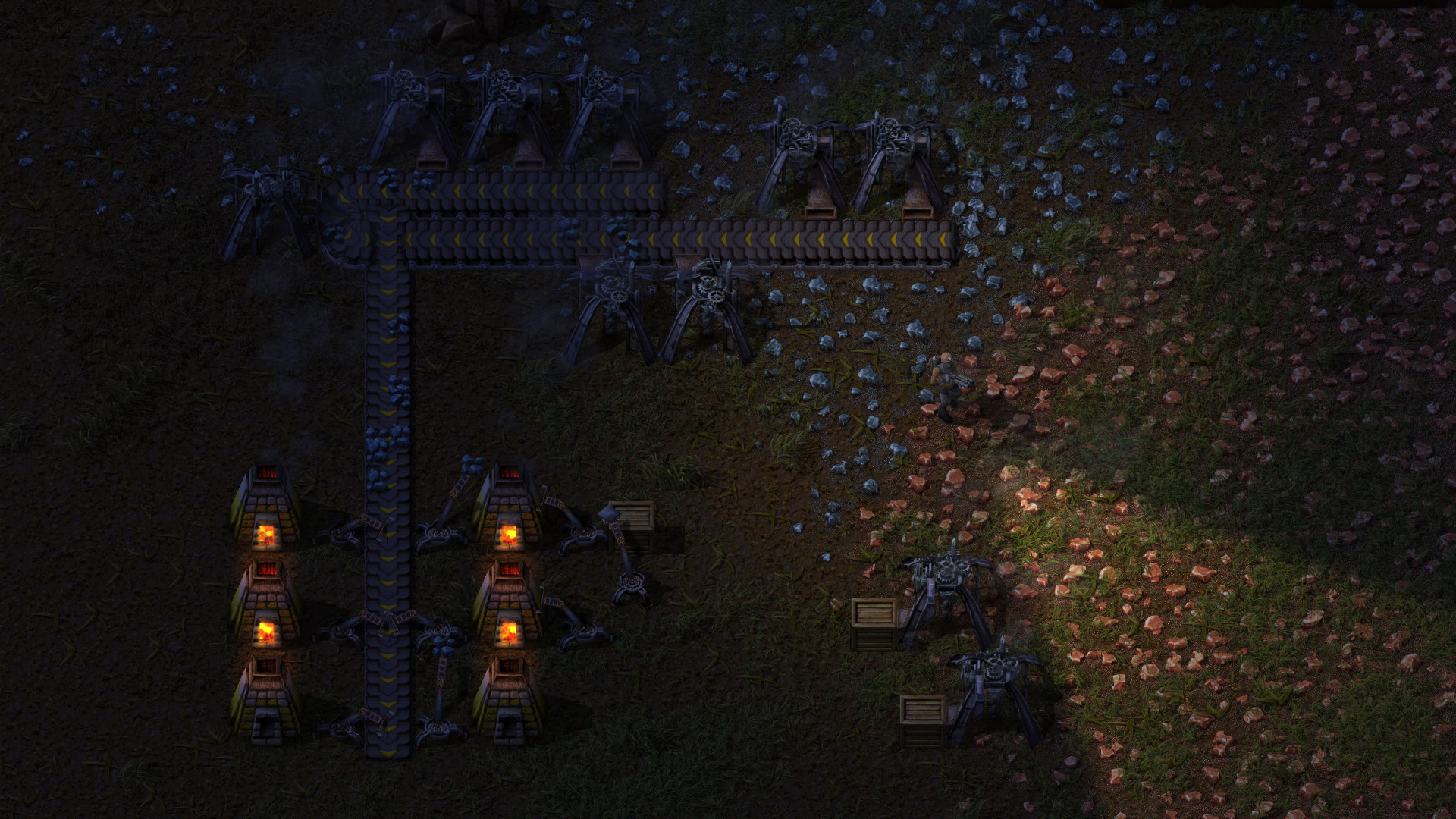
The basic production loop begins with mining drills, furnaces, transport belts, inserters and assembling machines. Drills extract ore, furnaces turn it into plates, and belts carry ingredients between production areas. Inserters move items between belts, machines and containers, while assemblers follow recipes to create components and equipment. A hand-crafted item may be useful early, but scaling requires machines to reproduce it reliably. The player designs these links directly, deciding whether to dedicate a line to one product or distribute shared materials through a wider network that several production chains can draw from.
Research converts produced science packs into new technology. A laboratory consumes the required packs, and each completed technology opens further equipment, recipes or capabilities. That creates a feedback loop: research expands the factory’s options, while the factory must supply the materials needed to keep research moving. Early steps teach mining and basic assembly; later progression reaches more demanding processes such as oil refining and advanced power. The technology tree gives the rocket objective a clear direction, but progress depends on building enough capacity to manufacture both science and the hardware that science unlocks.
Electricity can halt production when the supply cannot meet demand. One early generation chain uses an offshore pump to supply water to a boiler; the boiler burns fuel to heat that water into steam, and a steam engine consumes the steam to generate electricity. Water and fuel therefore enter the boiler, while steam is piped onward to the engine. The player extends the electric network with poles so machines can draw from generators, then adds generation as more of the factory joins the grid. A new production area may need both a fluid route and electrical coverage before it can run.
As the factory grows, the player must move materials across increasing distances. Belts are suited to continuous local flows, while train tracks connect distant resource patches and outposts. The map’s deposits are finite, so a factory that consumes heavily must eventually reach new veins and plan how to bring their output home. Oil adds fluid logistics: crude oil must be pumped, refined into products and distributed through pipes to chemical plants or other consumers. Each transport method brings a different layout problem, making logistics an expanding layer of the factory rather than a one-time setup.
The planet’s native biters respond to the industrial activity taking place around them. Mining, combustion and production create pollution that can provoke attacks, turning growth into a defensive concern as well as a supply problem. Walls, turrets and ammunition can be manufactured and positioned to protect vulnerable areas; weapons and other military technology allow the engineer to clear nearby nests and open space for expansion. A defensive system itself has a production chain, so ammunition and repairs must be supplied. The player balances additional output against the exposure and maintenance that come with a larger industrial footprint.
Later systems extend how much of the factory can be managed automatically. Logistic robots can move items according to conditions set by the player, while construction robots can reproduce a saved blueprint when given the materials. Circuit networks allow signals from machines and sensors to control parts of a production line, enabling conditional behavior such as limiting a buffer. Modules can tune machine output or efficiency as demand changes. Uranium processing later opens nuclear power as another generation route, adding a fuel and infrastructure chain for the expanding factory.
Factorio’s moment-to-moment work alternates between building, observing and revising. The player checks which inputs a recipe requires, traces where those ingredients come from and decides how to route them without starving other machines. A new technology may solve one shortage while creating demand for more components, power or transport. Combat can interrupt that planning when biters attack, and exploration may be needed to reach fresh ore or oil. The rocket remains a concrete end goal for Freeplay, but each step toward it is a chain of smaller engineering problems solved through machinery and logistics. Map generation creates a different challenge each run, so the location and distribution of resources also shape how the factory expands. The resulting layout encourages different decisions about production sites and routes to remote patches. Scouting and adapting routes remain part of the engineering loop rather than a task solved once at the starting site.
One copy of the base game gets you the whole loop on a map that is very large rather than endless. Space Age is an expansion that requires that copy, adds four planets and space platforms, and rewrites the pacing of a run if you start with it enabled.
What the base game already is
You crash on a planet and work outward from a stone furnace. Mining drills feed belts, belts feed assembling machines, power comes from an offshore pump, a boiler and steam engines, and every finished product becomes an ingredient for something more complicated. The loop holds because it never lies to you: a starved assembler has a visible cause, and finding it is the game.
The 2.0 update that shipped alongside Space Age belongs to the base game rather than the expansion, and it brought broad changes to production, quality-of-life and performance. Buying only Factorio still gets you that technology tree and those changes. The map is finite but very large — a maximum of two million tiles on each side — so a long-running save is not going to run out of room. The base game runs on Windows, macOS and Linux, and it supports cooperative play, LAN co-op and cross-platform multiplayer between those versions. There is also a console release, and the expansion's own purchase page lists the supported platforms for anyone checking their machine first.
What Space Age adds, and what it costs you
Space Age continues the run after rockets, and it ships as a set of four mods: Space Age itself, Quality, Elevated Rails and Recycler. Those mods are packaged so you can enable some without the others: Recycler and Elevated Rails are dependencies of Space Age but can be switched on separately, and Quality is recommended rather than required. Space Age adds four planets you travel to with space platforms, each with its own resource problem, and it moves the victory condition from launching a rocket to building a platform that can reach the solar system edge. The scale is deliberate: new science packs, new buildings, new intermediate products and two new enemy types, with planet-specific mechanics that each break a habit the starting planet taught you.
Quality is the one worth understanding before you start. It introduces higher tiers for items, structures and equipment, created by chance through quality modules, and it is the game's answer to growing upward instead of outward. It is recommended rather than required, and the two highest tiers need technology from two of the later planets. Elevated Rails adds a second layer of track that lets you build intersections and cross terrain and oceans. Recycler turns items back into ingredients at a loss, which is the exchange rate you accept when a factory produces the wrong thing by the thousand.
The honest cost is time. Space Age changes progression and pacing enough that Wube's own advice is to start a fresh save with it enabled rather than adding it to a finished base-game factory, and that advice applies to a first run too. The two modes are really two different campaigns, and a player who bounces off the expansion's opening may still enjoy the base game more.
Space Age availability, plainly
The expansion requires ownership of the base game and is sold directly by Wube, with Steam and Humble listed as the partner storefronts. Buying from Wube upgrades your account on the site, which is what unlocks the direct downloads, and that same account can then redeem a free Steam key — so buying straight from the developer is not a lock-in either. The expansion page lists system requirements as well, and its recommended specification is a clear step up from the minimum.
One platform exception is worth knowing before you buy. Space Age is not available on the original Nintendo Switch release of the game, for space and memory reasons; the Nintendo Switch 2 edition is where the expansion lives, and that edition is out now. Nothing here touches the PC versions, where the expansion is business as usual.
How it plays once you are inside
The pleasure is diagnostic rather than dramatic. A transport belt moves fifteen items a second across two lanes, so each lane carries half of that, and a full lane beside an empty one is not a full belt. Inserters take from behind and drop in front, priorities hide in splitter settings, and a single furnace produces plates at a slower rate than most new players assume. Once you can read a stalled line, the game turns into a series of small, satisfying repairs.
Combat is the other half of the promise. Biters that find themselves in a polluted area try to reach whatever is producing it, and spawners absorb that pollution to muster attack waves, which pushes you to automate defences and walls rather than treat them as a separate game mode. Space Age's platforms then carry that same pressure into orbit, where a platform that cannot handle what meets it is a design problem rather than a bad roll.
Should you play it
Yes. If you are new, buy the base game and play the free 2.0 content first, because the opening hours teach the same skills either way and the base run is the cheaper way to find out whether belts and ratios are your idea of a good evening. If you already know the loop and want more of it, Space Age is a genuine second campaign with new logistics, new hazards and a much larger victory condition.
Two practical notes. Start a new save for Space Age instead of extending an old factory, and check the platform list before you buy, because the expansion is not available on every version of the game. Both are much cheaper to get right on the first evening than to correct a hundred hours later.
Go deeper with V4mp
- Developer
- Wube Software
- Genre
- Factory building
Explore Factorio further
Explore the wiki for detailed reference pages on the game's world, systems, items and locations.