
Automate Red and Green Science at 30 Packs per Minute
On this page
Five assembling machine 1s making red science and six making green science can supply 30 packs per minute of each colour. Their ingredient chains need attention too: belts, inserters and circuits compete for iron, and one shared gear assembler cannot sustain this target.
Start with handcrafting, then research Automation
Smelt 50 iron plates for Steam power and 10 copper plates for Electronics. After both triggers, craft a lab to unlock Automation science packs. Handcraft 10 red packs and research Automation in a powered lab; this unlocks assembling machine 1.
Automate red packs next. Research Logistics for underground belts and splitters at a cost of 20 red packs, and Logistic science pack for the green recipe at a cost of 75 red packs. Logistics helps arrange the factory; it is not a prerequisite for green science. Fast inserters have a separate technology. These are the default 2.0.77 research requirements.
Keep the recipe outputs straight
Recipe times below are measured at crafting speed 1. Assembling machine 1 runs at speed 0.5, so its actual cycles take twice as long.
| Product | Ingredients | Output per craft | Recipe time |
|---|---|---|---|
| Red science | 1 copper plate + 1 iron gear | 1 pack | 5 s |
| Green science | 1 ordinary inserter + 1 yellow belt | 1 pack | 6 s |
| Iron gear | 2 iron plates | 1 gear | 0.5 s |
| Yellow belt | 1 iron plate + 1 gear | 2 belt items | 0.5 s |
| Copper cable | 1 copper plate | 2 cables | 0.5 s |
| Electronic circuit | 1 iron plate + 3 cables | 1 circuit | 0.5 s |
| Ordinary inserter | 1 circuit + 1 gear + 1 iron plate | 1 inserter | 0.5 s |
Use the ordinary yellow electric inserter in green science. Burner, long-handed and fast inserters cannot substitute. The belt recipe’s double output also matters: 30 belt items require 15 crafts.
Build each ingredient chain
First, make gears from iron plates. Route some gears and copper plates into a red-science assembler, then remove finished packs onto a lab belt.
For green science, build copper cable production beside electronic-circuit production. Feed cable plus iron plates into circuits. Feed circuits, gears and another iron-plate input into the inserter assembler. Make yellow belts on a separate branch using gears and iron plates. Finally, supply the finished inserters and belt items to green-science assemblers; those are consumed as ingredients, not placed as machines.
Start with one assembler per final pack recipe and confirm every transfer before extending the rows. Use the power guide if a new group has no electricity, and leave space to add arms where a fast intermediate recipe needs them.
Expand to 30 packs of each colour per minute
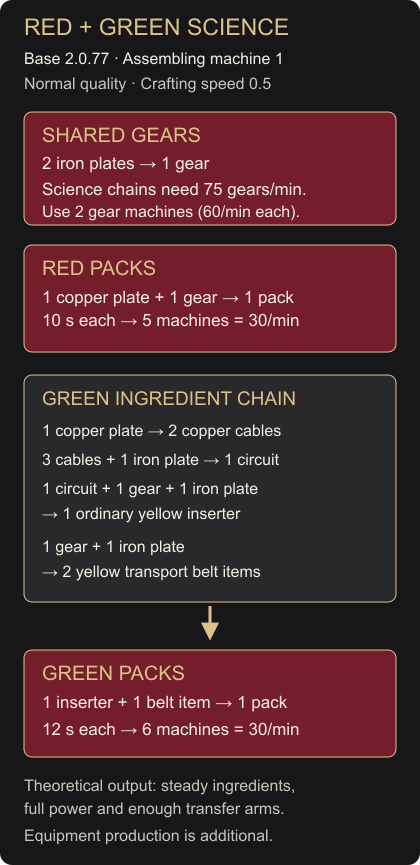
At assembling machine 1’s speed of 0.5, a red pack takes 10 seconds and a green pack takes 12. That gives 6 red or 5 green packs per machine per minute: five red machines and six green machines balance at 30 each. The 5:6 ratio assumes matching machine speeds.
Both chains together need 75 gears per minute: 30 for red packs, 30 for the inserters, and 15 for the belt crafts. One gear assembler produces 60 per minute, so provide two. The green chain needs 30 circuits and 90 cable per minute. One assembler each for cable, circuits, inserters and belts has enough recipe capacity for that demand.
These counts assume continuous ingredients, full power and sufficient transfer. They exclude supplies diverted into equipment crafting. In particular, leave room for extra cable-transfer arms: a single ordinary inserter may throttle the required 90 cable per minute. Inserter mechanics.
Keep the labs working
Feed both colours into powered labs and select research that uses them. Green does not replace red. A lab’s pack demand depends on the selected technology’s unit time and research bonuses, so no single lab count fits every research project. Lab mechanics.
When research pauses, open a lab and identify the missing colour. Follow that pack backward through its assembler to the missing ingredient. Check output space, inserter direction, filters and power before adding more machines. If ingredients are produced but fail to arrive, use the belt throughput checks. More labs help only when enough packs reach them.