
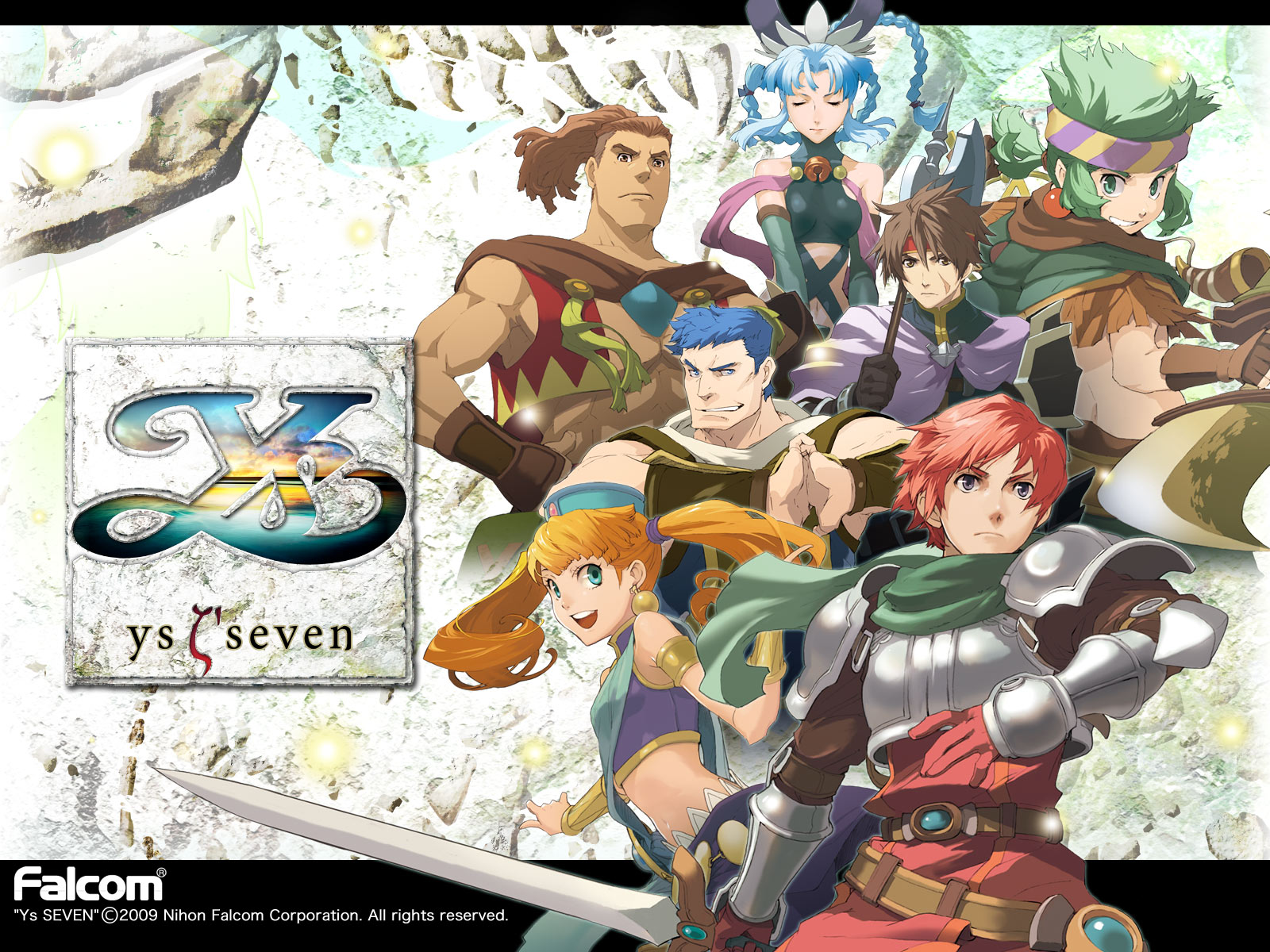
About Ys SEVEN
Adol Christin and Dogi arrive in Altago after a fragile ceasefire opens the island kingdom to foreign visitors. A royal request draws them into an investigation of earthquakes, dangerous creatures and the Five Great Dragons, while a three-person party system reshapes Ys combat around weapon types, learned skills and timed guards.
Adol Christin and Dogi reach Altago by relying on contacts made during earlier adventures. The island kingdom had once been a busy trading centre, but a war with the Romun Empire restricted visits from abroad; the conflict has only recently reached a ceasefire when the two adventurers arrive. The port’s renewed access does not mean its people welcome outsiders. Suspicion of foreigners shapes Adol’s first dealings with the authorities, and a clash with a military officer leads to the pair being taken into custody before the king releases them. That encounter gives the monarch an opportunity to ask for their help: reports point to unusual trouble across the island, including increasingly aggressive monsters and a run of earthquakes. Altago’s creatures also present a practical problem. Adol’s familiar steel weapons cannot deal with them, so he must start again with new equipment and learn how this country’s threats behave. The king’s request begins as an investigation of nearby ruins, but the disturbance reaches into the history and survival of the whole kingdom.
The mystery centres on the Five Great Dragons and the five tribes that serve them. The dragons are treated as divine guardians, and their relationship with Altago’s peoples gives the crisis both a spiritual and political dimension: the tribes have become estranged, while signs of disorder appear in the land they are meant to protect. The story follows Adol and Dogi as visitors caught between those communities, rather than as rulers with authority over them. They encounter local figures including Tia and her adopted sister Maya, the dragon knight Scias, and members of the tribes’ leadership. These characters connect the immediate troubles in Altago’s settlements to its older traditions without requiring the player to know earlier Ys stories first. The travelling group also grows through companions who take part directly in combat. Geis, a mercenary Adol met in Ys VI: The Ark of Napishtim, is one returning ally; other recruits bring their own weapons and combat role. The focus stays on how an outsider’s request opens into a larger investigation, with the dragon mystery and recent earthquakes serving as the visible threads that pull the party through the island.
Altago’s port is the starting point for travel through towns, outdoor routes and ruins. The island’s large overworld connects the places where the party meets residents, follows regional mysteries and encounters monsters. People around Altago can ask for deliveries, searches for harvest points, or help defeating particular enemies. Other requests ask the group to untangle a local problem. Many of these side quests have a story deadline: they must be accepted and completed before the adventure passes a certain point, so visiting towns and speaking with their residents matters as the journey proceeds. Exploration also supplies the materials that support equipment growth. Some materials come from harvest points and others from defeated monsters; both can be taken to shops for synthesis. The routes therefore serve several purposes at once, linking story progress to optional errands, supplies and the next encounter. As the party moves through a region, combat can begin directly in the field. The controlled fighter can dodge an incoming strike, then switch to a companion whose attack type fits that enemy.
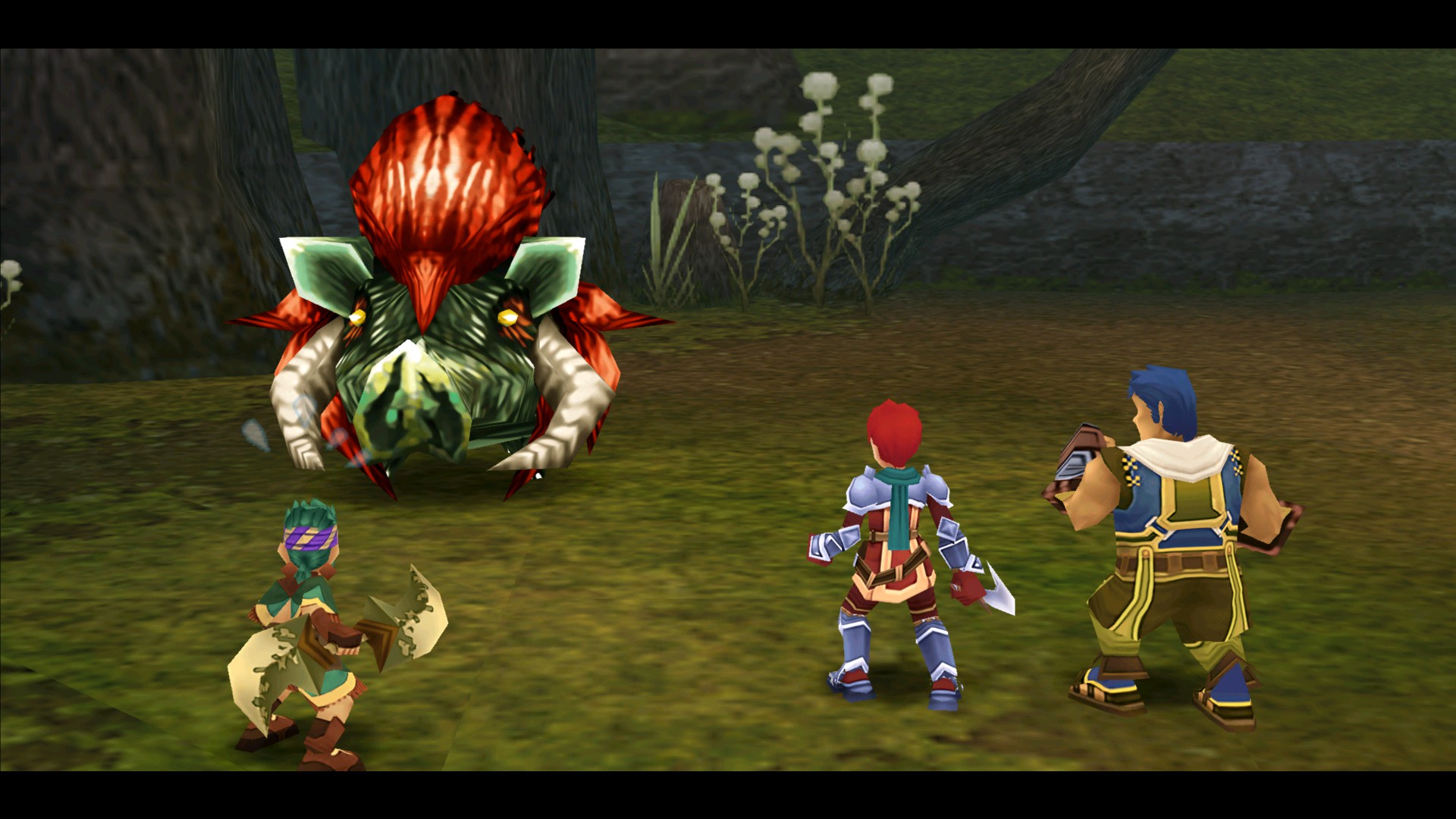
Combat unfolds in real time with a party of up to three characters on the field. The player can switch control among the active members while the others fight alongside them, and the roster expands as the story introduces new companions. Those allies carry different weapons and combat styles, so building the trio determines which options are immediately available. A quick switch can put a different fighter under direct control when an enemy’s defense makes another attack type a better choice, or when the player wants to continue pressure with a fresh set of skills. The party’s three fighters also let attacks overlap: one can keep an enemy occupied while another closes in with a skill, and each character brings a distinct EXTRA attack for a heavier burst of damage. Large bosses are a major part of the adventure, and their scale makes the group’s combined tools useful across a longer fight.
The three attack types give that party choice a clear purpose. Slash attacks are effective against plants and enemies with soft, fleshy bodies; Strike attacks are suited to creatures with hard outer shells; Pierce attacks work well against agile or flying foes. Matching a weapon to a target’s weakness changes which member is useful in the encounter. Adol can change his attack type through different swords, while other companions have their own weapon category and style. That lets the party cover more than one kind of foe without treating every character as interchangeable. Quick dodging helps the fighter under direct control move clear of an incoming attack. Flash Guard rewards a guard timed for the instant a strike lands: a successful guard prevents damage, rapidly fills the Skill and EXTRA gauges, and makes the next attack a critical hit. Each character also has a distinct EXTRA Skill. Its gauge fills over time and more quickly when attacks connect, so these powerful attacks can be held for a boss or used to clear a crowd. Read together, the systems create a loop of identifying the enemy’s type, choosing a suitable fighter, dodging or guarding a counterattack, and spending the resources earned through continued pressure.
Skills and equipment develop together. Weapons carry special Skills that consume a combat resource, and repeatedly using one raises its proficiency until the character learns it. Once learned, a skill remains available after changing weapons, and further use raises its level. The PC version lets a character equip learned Skills to four attack buttons; using one spends the Skill Gauge, which fills as attacks land. Charged attacks and building an enemy’s stun gauge also help replenish the resource. When that stun gauge fills, the target is incapacitated for a short time, creating an opening for the whole group to attack. This gives the player more to consider than replacing old equipment with a higher attack value. A new weapon may provide access to an unfamiliar skill; practice can make that skill permanent; and continued use can strengthen it after the weapon is no longer needed.
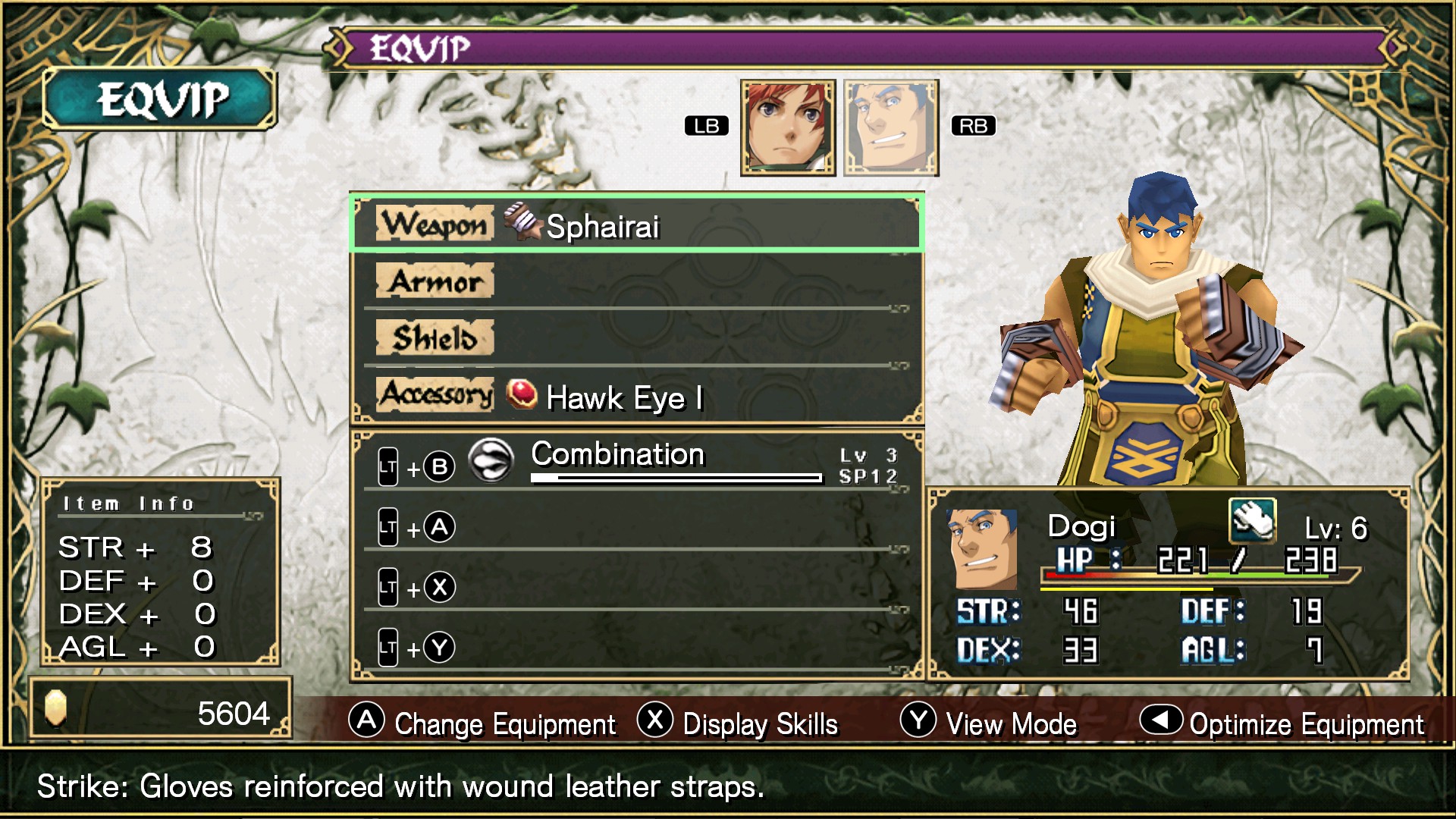
Shops make equipment growth depend on both currency and materials. The party can buy and sell items, then use synthesis to turn materials from monsters and harvest points into stronger equipment. Some items are available only through synthesis, and rare materials make the choice of what to create more deliberate than simply buying every new item on offer. Story progress also unlocks a Support Ability for each character. This passive benefit applies to the whole party and improves as its owner levels up. Adol’s ability improves hit rate, Dogi’s increases the chance of stunning enemies, and Elk’s raises the gold found after battle, so the active group’s members contribute even when the player is controlling someone else. Ys SEVEN first appeared as a PSP game; the Windows release is its PC port, with an HD update, 60-frame-per-second presentation, resolution options and revised localization. The PC edition also adds Steam achievements and cloud support. Its three-dimensional character and environment presentation carries into the port. Falcom Sound Team jdk is credited for the game’s rock soundtrack.
- Developer
- Nihon Falcom Corporation
- Genre
- Action RPG