
About Ys: Memories of Celceta
Adol Christin wakes in Casnan with no memory beyond his name, then joins the thief Duren on a mission into Celceta’s Great Forest. Map the dangerous wilderness, fight in a switchable party, meet people tied to Adol’s past, and search for clues that may explain how he reached the frontier town.
Adol Christin arrives in Casnan, a frontier settlement beside the Great Forest of Celceta, without knowing how he got there or remembering anything beyond his own name. A thief called Duren says he has spent the preceding weeks with Adol, but the missing adventurer cannot confirm that account. Their first joint task takes them into a local mine to deal with monsters and rescue miners in danger. Adol’s instincts as a swordsman return during the crisis, and their actions attract the attention of a Romun Army general stationed in Casnan. She gives the pair a larger assignment: chart the forest, a vast region from which earlier expeditions have not returned. This practical mission sits beside Adol’s personal search for his lost past. On the road he encounters people who claim to have met him before, while Duren’s familiarity with him offers only part of the picture. The story makes uncertainty about memory and trust part of the expedition itself: the pair must travel through a dangerous frontier while judging what they learn about Adol and the people who recognize him.
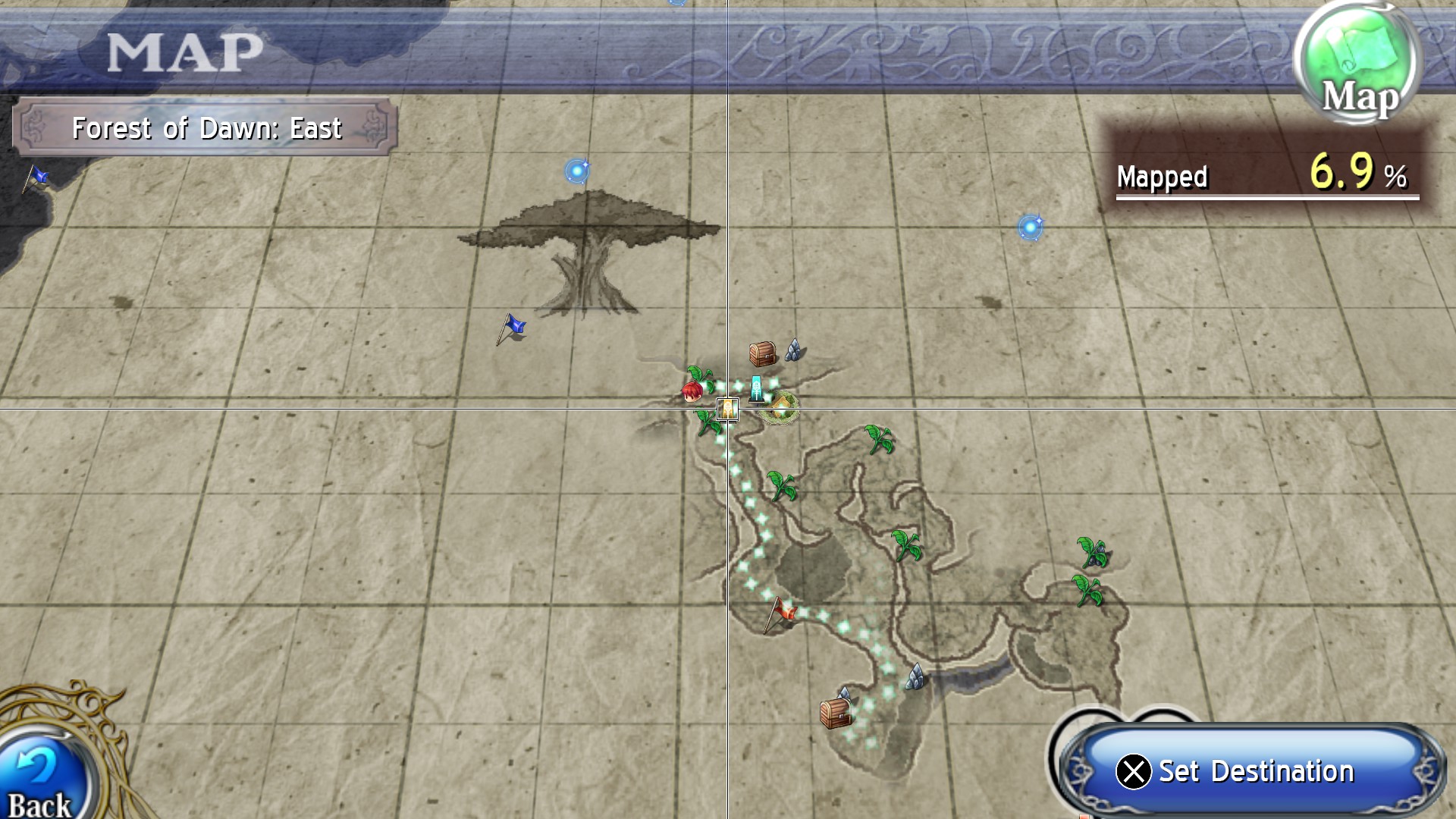
Mapping the Great Forest is the expedition’s central activity. Celceta is presented as an extensive overworld of connected wilderness rather than a chain of isolated battle rooms; the party pushes outward from routes they already know, finds new paths and landmarks, and fills in the map as it goes. The map is a working instrument: detailed icons mark discoveries and destinations, while customizable waypoints let the player direct attention toward a chosen point. Its markers include treasure, memory fragments, quests and collection points, and the map also makes unexplored areas visible. Forest tracks lead into varied terrain, with obstacles and secrets interrupting travel and battles occurring along the way, so charting and fighting share the same space. Not every route is immediately open. Some areas wait behind key items, giving a newly found object a later use as an access condition and making return journeys meaningful. Special stone monuments provide fast travel between visited parts of the forest; their network opens gradually, so early trips still depend more on traversing the land. At first, monument connections are limited; later, the map makes revisits among discovered stones more direct. This creates a rhythm of scouting, marking progress, reaching a barrier, and extending the route after the party has found what it needs.
The journey also asks the player to manage how the party moves through Celceta. Adol does not travel alone for long: Duren and other characters join as the story develops, and their abilities matter beyond damage output. Allies have individual abilities used in exploration as well as combat, while the original handheld design used Vita touch controls for some environmental puzzles and map functions. On the Windows release those interactions can be handled by controller or mouse, rather than requiring the Vita screen or rear touch panel. The route therefore combines ordinary traversal with observation: the party examines its surroundings, uses the available character or interface actions where the terrain calls for them, and returns to earlier spaces when a new route condition is met. Teleport monuments later reduce the distance between known regions. These conveniences support the map-making loop without removing the need to explore the forest and discover its paths. They also make the PC version’s control conversion relevant to play: its mouse support carries over functions originally designed around touch, including puzzles and map adjustment.
Encounters use real-time party combat. Up to three characters take part, with the player directly controlling one and switching among active members during a fight. Their weapon classes answer different enemy defenses: Adol’s slashing attacks suit unarmored targets, while Duren’s striking attacks are effective against armored foes; other recruited fighters bring additional attack types. Choosing the right character changes how quickly an enemy can be pressured, so a mixed party can respond to different opponents without leaving the battle screen. Ordinary attacks build toward character skills, which vary in range, speed and strength, while the rarer Extra attacks deliver a more concentrated burst. Defense also has a timing element. A precisely timed block triggers Flash Guard, and a well-timed evasive move triggers Flash Move; both can negate danger and create an opening, with Flash Guard also supporting a short period of critical attacks. These actions matter particularly against bosses, whose attacks make reading a pattern and responding at the right moment part of dealing damage. The party’s non-controlled members act under configurable behavior, so the active character’s positioning and timing remain the player’s direct focus while allies continue attacking.
Progress comes from combat, exploration and the gradual expansion of Adol’s companions. Characters gain levels and learn combat skills, and experience also reaches members who are not currently in the active group, reducing the need to keep every recruit in the field just to maintain basic growth. Equipment and skills let each character develop around the role implied by their weapon type, while enemy weaknesses make party composition useful in encounters rather than merely cosmetic. Defeating an opponent with an effective attack type can improve the rewards it yields, joining tactical play to the collection of materials and equipment used on the journey. The map records discoveries such as treasure, quests and memory fragments, giving the player several kinds of progress to pursue in the same region. Adol’s recollections add a narrative thread to that exploration: clues found across the forest help restore pieces of his history and connect the present expedition to people and events he does not remember. The entries also reveal information about his earlier travels, so a detour toward a fragment can expand the story as well as the map. Karna is another supporting character Adol encounters as his past connections emerge, broadening the group beyond Duren and the people who only claim to remember him. The central campaign keeps these systems connected: exploration reveals destinations and memories, battles supply resources, and newly strengthened characters are ready for the next section of wilderness.
The PC release on Steam is Nihon Falcom’s Windows adaptation published by XSEED Games and Marvelous USA, following the PlayStation Vita version. Its edition-specific changes concern presentation and control: selectable HD resolutions, fixed frame-rate options up to 120 frames per second or an unlocked rate, configurable keyboard, mouse and controller bindings, and mouse support for the former touchscreen functions. Its graphics options include smoothing, dynamic lighting and shadows, with resolutions extending to 4K or higher on supported hardware. The PC version adds fast cutscene forwarding, saving anywhere, 300 save slots and in-game adjustment for controller input, alongside options to rebind the controls. It supports DirectInput and XInput controllers and can adjust the button prompts to match the connected setup. The Steam edition also integrates leaderboards for Time Attack and Boss Rush, optional challenges built around defeating bosses under time pressure. These modes become available after completing the campaign once and can be entered from the menu; after a challenge, the main campaign resumes where it was left. Boss Rush can be attempted with Adol alone or with a full party, changing whether the challenge centers on one character or the team’s weapon matchups and skills. The game’s release history includes PlayStation Vita in 2013, Windows PC in 2018 and PlayStation 4 in 2020; the controls and integrated Steam leaderboards described here are specific to the PC edition.
- Developer
- Nihon Falcom
- Genre
- Action RPG