
About XCOM: Chimera Squad
XCOM: Chimera Squad is a standalone turn-based tactics game set in City 31, five years after XCOM 2. You lead a fixed cast of human, hybrid and alien agents through connected encounters, planning breaches and reading an alternating initiative timeline while directing investigations and assignments to keep a fragile post-invasion city from descending into unrest.
XCOM: Chimera Squad takes place after humanity has ended the alien occupation of Earth. Five years after XCOM 2, the former invaders’ soldiers remain among the population, and humans, hybrids and aliens are trying to build a shared civic life. City 31 is presented as a model of that coexistence, but underground groups oppose the alliance and threaten to turn its districts against one another. The player directs Chimera Squad, an elite unit made up of human and alien agents, as it investigates those threats. This is a standalone story in the XCOM universe, with its own City 31 crisis and cast, rather than an expansion to XCOM 2 or a continuation of Enemy Unknown’s global defence command.
The strategic layer centres on a high-tech headquarters and the order in which its work gets done. Investigations, other tasks and agent assignments compete for attention while unrest rises in the city’s districts. The player chooses which threat or responsibility to address next and deploys agents suited to the situation; allowing pressure to grow can move City 31 closer to anarchy. That creates a shorter, more focused campaign rhythm than Enemy Unknown’s worldwide satellite coverage, Council funding and expanding subterranean base. Chimera Squad’s command decisions are tied to districts in one postwar city, so assigning people and prioritising investigations form a direct part of keeping the alliance intact.
Missions are built from discrete Encounters rather than one uninterrupted battlefield. Before an Encounter, Breach Mode presents entry points with different tactical advantages and disadvantages. The player chooses which agents use each point and in what order, then launches the team into the room to take opening actions and establish its position. The entry choice and the agents’ order matter because the Breach creates the first opportunity to engage the opposition and set up the fight that follows. Once the current Encounter is cleared, the squad moves to another room or area and breaches again. A mission therefore asks the player to make several small assault plans, not only a single deployment decision at the start.
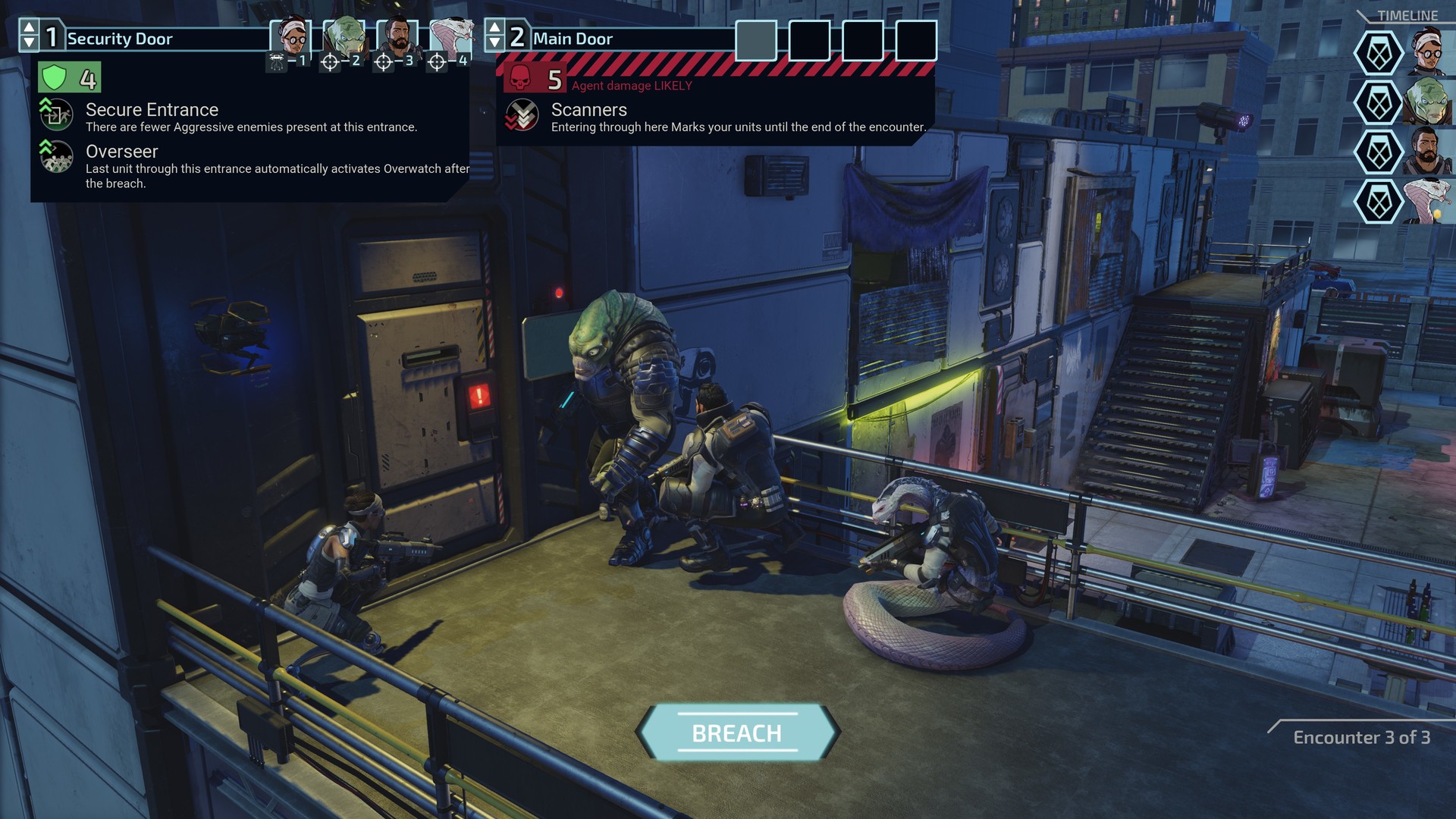
After the opening Breach round, combat uses interleaved turns. Instead of every agent acting and then every enemy taking a separate full turn, individual agents and opponents alternate according to an automatic initiative order. The Timeline shows which unit is due to act next, turning the order itself into a tactical problem: a dangerous enemy near the front may need to be controlled before it attacks, while an agent in immediate danger may need support first. Agent abilities can interact with this sequence, and species-specific skills add options that fit particular characters; the Viper’s tongue pull, for example, can draw a target toward the squad. The player manages the risks visible in the upcoming order rather than planning an entire squad turn before the opposition responds.
The agents are named characters with distinct personalities, motivations and tactical abilities. Chimera Squad includes eleven human and alien agents, grouped into specialised and complementary classes whose skills can combine in coordinated attacks. Choosing who enters at each Breach point and who accompanies the squad into later Encounters makes team composition part of mission planning. The Viper’s biology provides a clear example of how a species-specific action differs from a general weapon command, while cooperative class skills create opportunities to link one agent’s setup to another’s attack. Because the cast is individually defined, progression and tactics revolve around developing and deploying these operatives rather than generating a replaceable roster of soldiers as in Enemy Unknown.
City 31’s Field Teams operate outside the firefights. From headquarters, the player can spend Intel to place one in a district and later spend more to upgrade it. Each team receives a specialty when deployed: Finance brings Credits, Security brings Intel and Technology brings Elerium, with additional benefits tied to missions or situations in that district. Some specialties also help reduce unrest or expose a hidden target sooner. Unlike Chimera Squad’s named combat members, Field Teams do not enter tactical encounters. Deploying and upgrading them opens citywide abilities that can be triggered when an immediate district problem needs attention. This gives Intel a use beyond the next mission and makes the district map a continuing part of the campaign.
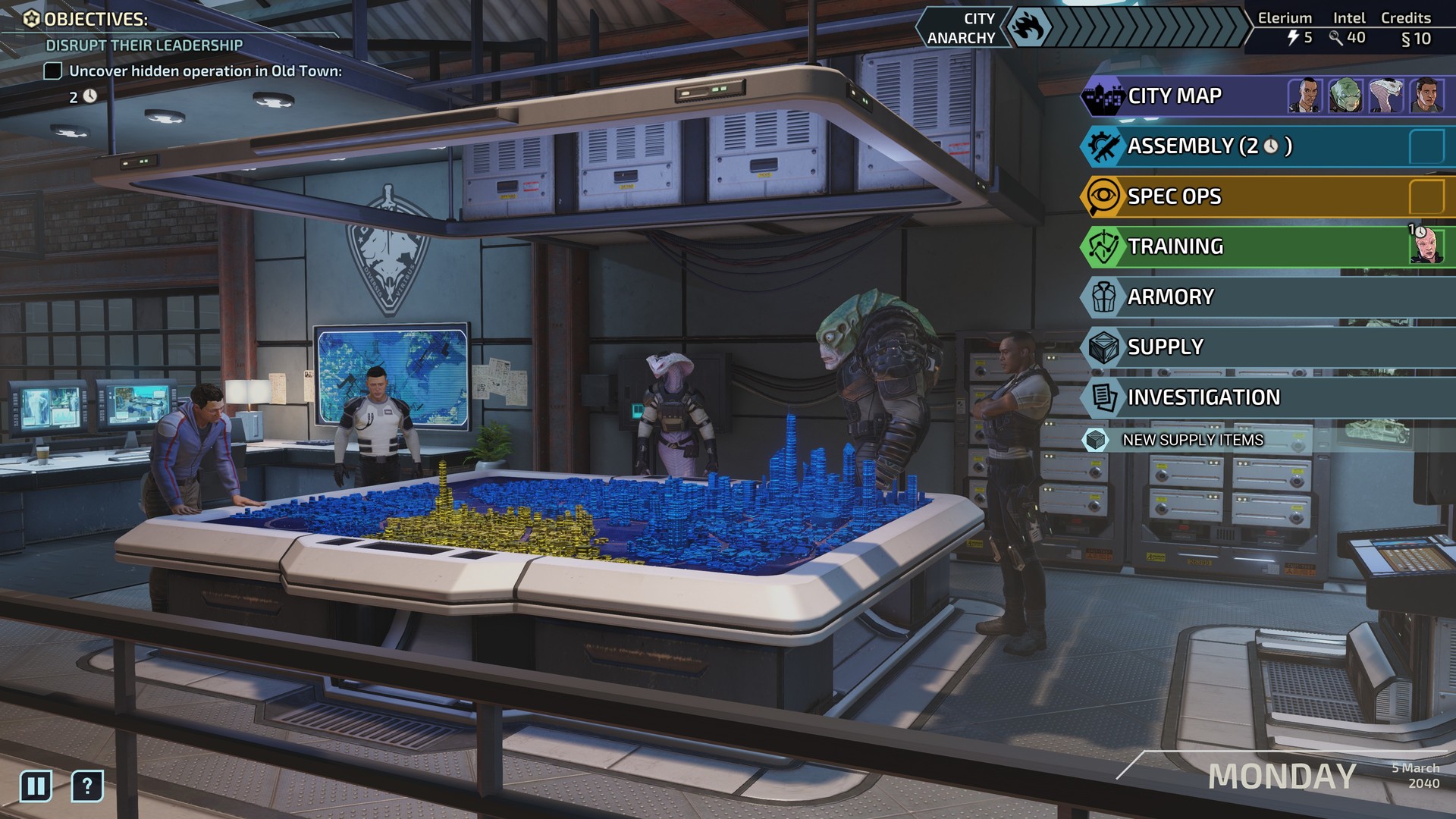
Injury can carry consequences between encounters even though the cast remains fixed. An agent reduced to a Bleeding Out state can acquire a Scar, weakening one of their statistics for later missions. A second collapse may deepen an existing Scar or create another, so keeping a damaged squad member active has a cost beyond the current room. Training can mend these penalties, but sending someone there also takes them away from other assignments while they recover. A Scar that reduces maximum health is not ordinary damage and cannot be removed by a combat heal. The player therefore considers readiness at headquarters as well as the next Breach: the agent with the ideal power for a mission may need recovery while other members carry the investigation forward.
- Developer
- Firaxis Games
- Genre
- Turn-based tactical strategy