
About WRATH: Aeon of Ruin
As the Outlander, you arrive on a dying world and accept the Shepherd of Wayward Souls’ charge to hunt the remaining Guardians of the Old World. This first-person shooter sends you through dark hubs and interconnected maps, where weapons, artifacts, movement and careful exploration carry you past monsters toward the forces sustaining the world’s ruin.
WRATH: Aeon of Ruin casts the player as the Outlander, a figure who has drifted across the Ageless Sea before washing ashore in a world already succumbing to darkness. A pale guide known as the Shepherd of Wayward Souls gives the Outlander a purpose: seek the Guardians of the Old World and confront the power behind their corruption. The story is delivered through this spare mythic frame rather than a crowded cast of companions or lengthy conversations. Its setting supplies the context instead: ancient ruins, drowned places, forests and temples show a civilisation that has been left to decay. The journey is about crossing that hostile world, uncovering fragments of its past and reaching the beings whose presence gives the land its direction.
The campaign is arranged around three distinct hubs, each connecting to a set of maps rather than sending the player down a single chain of corridors. The hubs give the world a sense of geography: after reaching a new region, the Outlander can enter its surrounding locations and work through their different routes. The official release describes fifteen maps in total, with environments including crypts, sunken ruins, corrupted temples and forests. These spaces mix enclosed passageways with larger chambers and outdoor stretches. A door, switch, key or raised ledge can redirect the route, and a return path may bring the player back to a familiar space from another angle. Exploration therefore works alongside combat: moving forward means reading architecture, checking side passages and noticing how separate parts of a level connect.
Combat draws on the fast first-person action associated with older shooters, while the Outlander’s arsenal adds several ways to handle a room. A wrist blade provides a close-range option, and firearms cover enemies at a distance; the publisher highlights that weapons have multiple firing modes, so choosing when to use each attack matters as much as aiming. Ammunition, health and armour are found in the environment, often beside the main route or in spaces reached by exploring. The levels also place enemies in groups and in varied terrain, making movement part of the fight. A narrow walkway, flooded corridor or open arena changes how much room is available to dodge and reposition. The practical rhythm is to keep moving, select a suitable weapon and use the shape of the room to avoid being surrounded.
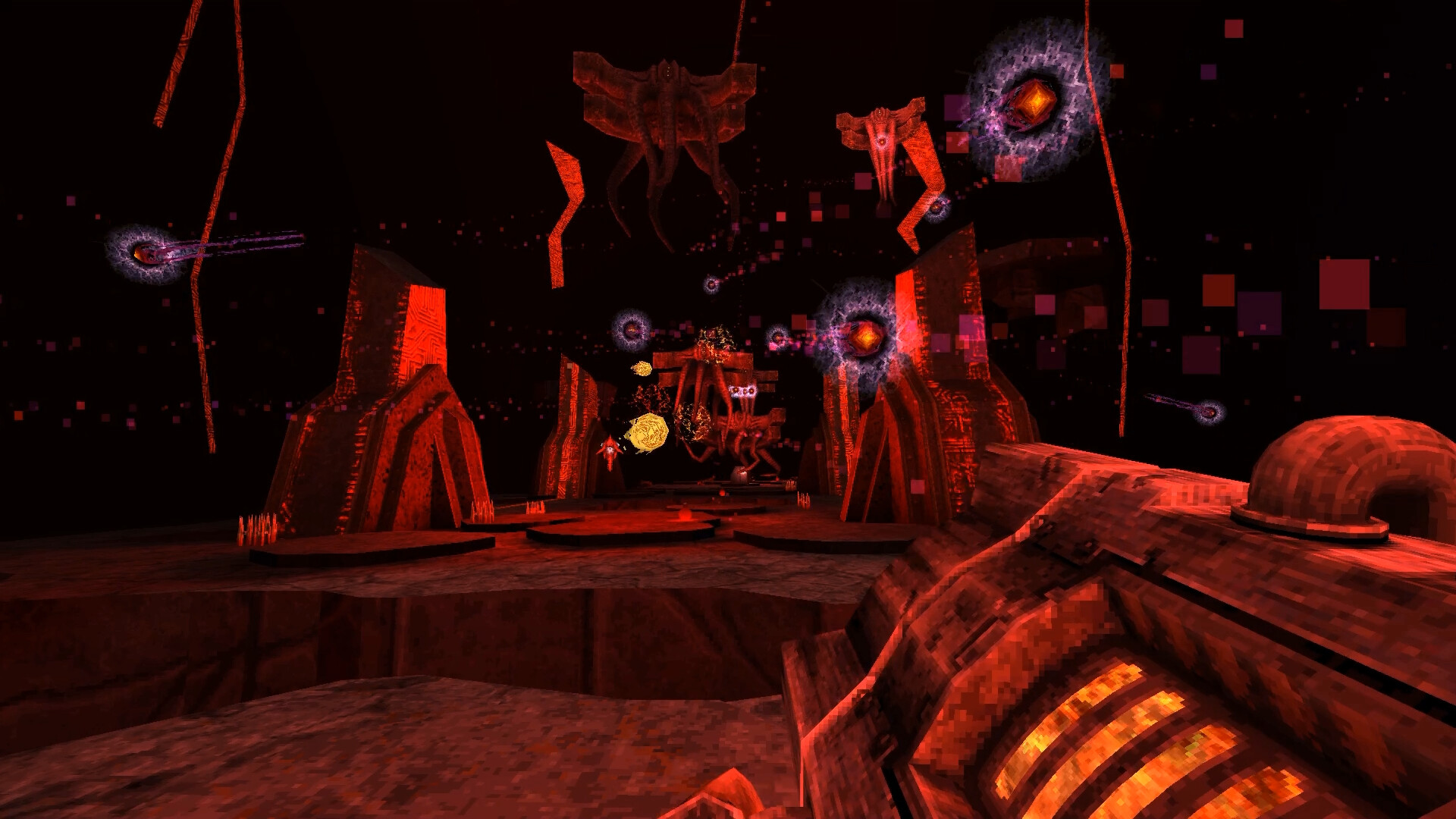
The creatures of the dying world are not simply background obstacles. Steam describes fifteen enemy types and three powerful Guardians, while the official page stresses that the Outlander faces foes in great numbers as well as in strength. A new encounter can therefore ask for a different distance or approach: some spaces are easier to cross after clearing ranged threats, while a close group makes room for a faster weapon or a retreat through a side route. The maps use levers, doors and keys to divide progress into readable stages. In The Mire, for example, switches open onward passages while a red key is initially inaccessible; exploring another branch reveals the route to lower it. This kind of environmental sequence gives combat a larger context, because defeating enemies is only part of getting through the level.
Artifacts provide a second layer to the Outlander’s toolkit. These are powerful objects hidden across the world, and the release materials describe ten distinct artifacts that can influence a fight. Some are useful for survival, while others change the pressure on enemies; the publisher’s update for the Trinket of Deflection, for instance, describes a shield that can ward off incoming projectiles and then turn them back toward attackers. Finding such objects rewards curiosity and gives the player options beyond the weapon currently in hand. They sit alongside ammunition, armour and other supplies in optional rooms, coffers and secret areas. Since a side passage may contain a useful item or may demand a detour through more danger, exploring is a choice about preparation as well as completion.
Movement and navigation reward attention to vertical space. Levels can conceal supplies above the obvious route, behind a breakable or blocked section, or across water and gaps that require a jump or the blade’s lunge. In The Mire, the path to the main red door loops through a flooded route, raised planks, switches and a relic near the exit. The example shows how a map can make the player revisit a large chamber after opening a new route, then use the new connection to reach an earlier landmark. Keys and switches provide clear progress markers, while the details between them are left for the player to read. Looking up, checking the edge of a platform or inspecting a room beyond its first entrance can uncover a shortcut or useful cache without turning the campaign into a checklist of mandatory pickups.
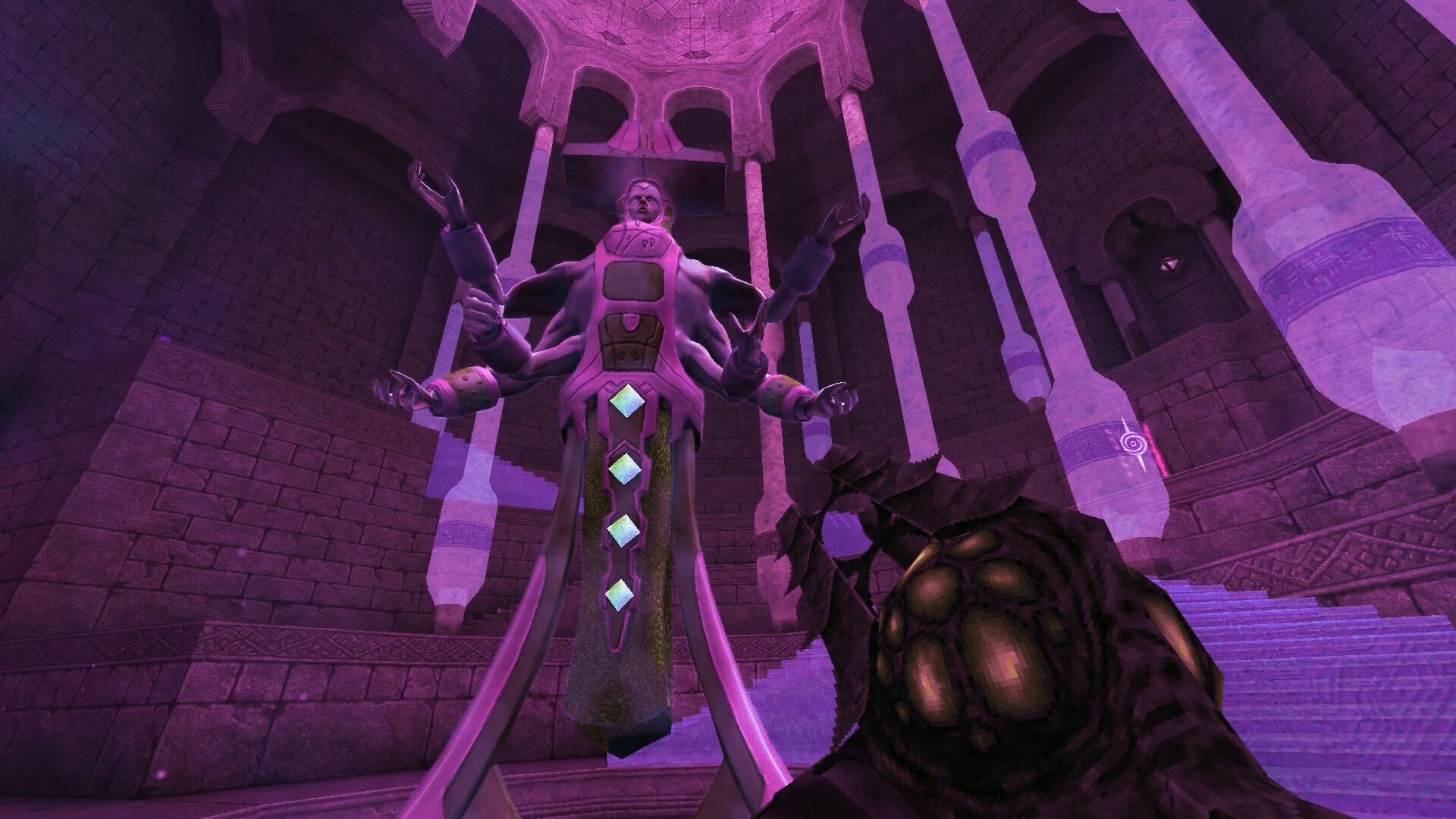
The larger objective remains visible even as individual maps focus on local problems: the Outlander is travelling with the Shepherd toward the Guardians of the Old World. The official structure sets three Guardians against the three-hub campaign and gives each region its own collection of enemies, environments and secrets. Scrolls, relics and environmental details add fragments of lore to the action, allowing the setting to emerge through things encountered on the way. The player’s immediate tasks are concrete—survive a fight, find a key, pull a switch, reach a relic or open the next route—while the recurring imagery of decay and ancient power connects them to the wider quest. Progress comes from learning how each place is laid out and carrying that knowledge into the next stretch of the Outlander’s hunt.
- Developer
- KillPixel Games and Slipgate Ironworks
- Genre
- Single-player first-person action shooter