
About WORLD OF HORROR
In WORLD OF HORROR, a cosmic threat gathers over Shiokawa, Japan, as residents encounter impossible events and the Old Gods stir. Choose an investigator, pursue randomized mysteries, collect clues and tools, and face turn-based battles. Your route through cases and the choices made under pressure determine how each investigation ends.
WORLD OF HORROR sets its investigations in Shiokawa, a Japanese seaside town where ordinary places become sites of inexplicable events. Hospitals, classrooms, apartments and forests all hold disturbances linked to the reawakening of the Old Gods. The player takes the role of an investigator trying to understand the local horrors and confront the threat gathering over the town. Its story arrives through cases, each a smaller thread in a larger cosmic crisis. The people, clues and dangers encountered on the way can differ between runs. Its 1-bit images and chiptune sound give this setting a stark, limited palette that makes strange details stand out.
A run places an investigator in Shiokawa as the Old Gods reawaken and the town moves toward catastrophe. You take on investigations drawn from a pool of mysteries, moving through locations and events to uncover what is happening. These cases can be approached in different orders, and their events are randomized, so a remembered solution does not guarantee that the same obstacles will appear in the same sequence. You examine clues, solve puzzles, meet people and decide how much risk to take before continuing. Most mysteries have more than one ending. Your choices and survival affect what you discover, while the larger task is to confront the terror behind the apocalypse. The structure makes each run a connected set of short investigations rather than a single linear case.
Exploration is presented through a point-and-click style interface. You select places and interact with objects or people, then respond to the encounter that follows. A clue may reveal new information, an item may provide a way past a problem, and a conversation can introduce another complication. Mysteries ask you to read details, use objects, perform rituals or work through puzzles, with combat adding another kind of threat. Because the event pool is randomized, it helps to look closely at what a particular scene offers instead of assuming that a previous run’s sequence will repeat. Your investigator’s health and sanity are finite, so investigation itself carries a cost even before a monster appears.
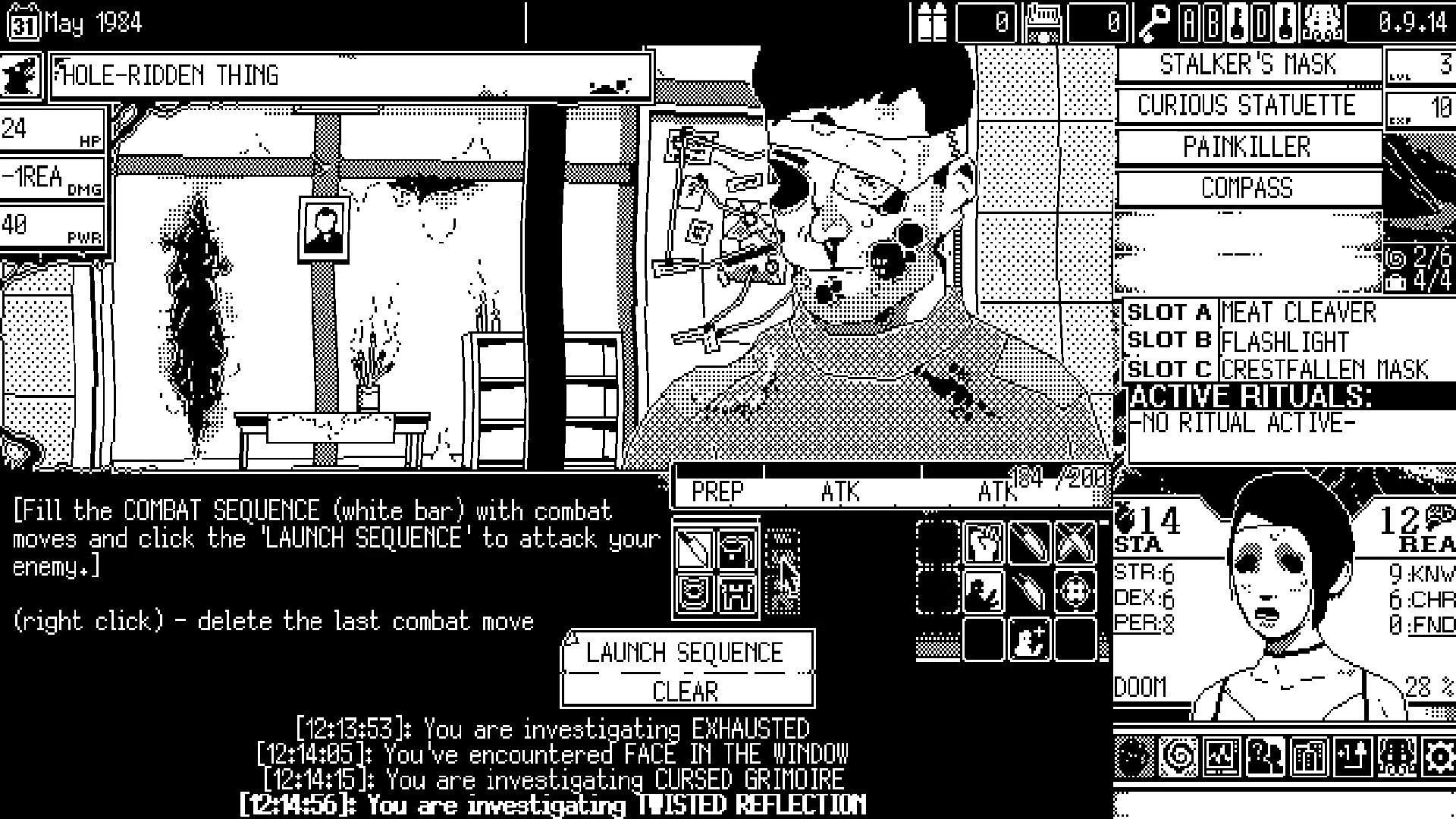
When a hostile encounter begins, combat proceeds in turns. You choose actions while watching your remaining health, sanity and available resources, then the enemy responds. A deck of event cards shapes the encounters you can face, so preparation includes deciding which tools or effects to use and when to take a risk. Wounds and loss of composure can accumulate across events, leaving fewer options for a later confrontation. Items, allies and spells can change the balance of an encounter, while the need to judge threats remains. This repeated pressure between exploring another scene and preserving the investigator makes route planning part of survival.
The character roster changes the starting perspective on a mystery. The game includes fourteen playable characters, each with a distinct fate to uncover across the investigations. Choosing who to take into a run changes which investigator is at the center of the events, while the selected Old God gives the attempt its larger antagonist. You still visit the town’s locations and face randomized encounters, but a different run can reveal another character’s story or another possible outcome in a case. This variety is tied to replaying investigations, not to a promise that every character has a separate long campaign. Their routes sit within the shared crisis in Shiokawa, where individual encounters and their endings add pieces to a broader picture of what is happening.
WORLD OF HORROR draws on cosmic horror and Japanese horror imagery, with Junji Ito and H. P. Lovecraft among its stated inspirations. The monochrome, one-bit art gives people, rooms and monsters a consistent visual language, while its chiptune soundtrack supports the retro computer presentation. These choices affect how scenes are read: a small change in a mostly empty image can carry as much weight as a dramatic animation. The player reads text, scans the frame and chooses actions through an interface rather than steering a character through a continuous 3D space. The resulting pace leaves room to interpret a scene before committing to its next step, and the randomized events ensure that familiar visual style can frame unfamiliar combinations of clues and threats.
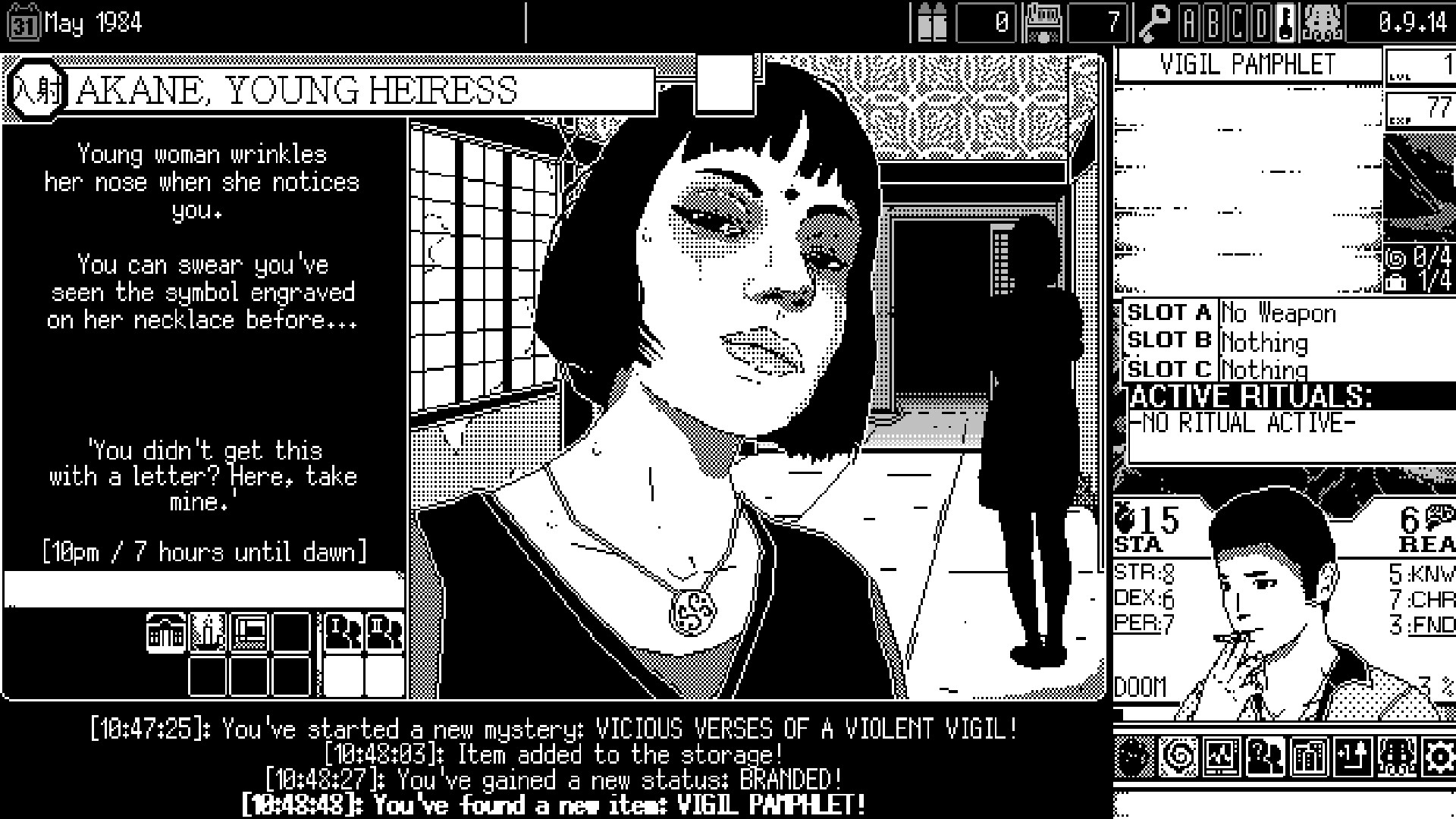
A complete run brings together case resolution and the pressure of the larger apocalypse. Investigations can end in different ways, and outcomes may require different routes through events. As you uncover clues, find allies or spells, and survive encounters, you build a better understanding of both the current mystery and its place in Shiokawa’s crisis. The risks persist across the run, so an apparent shortcut can cost health or sanity that will be needed later. Learning its systems and recognizing how event choices affect a case can help, while randomized sequences keep attempts from following identical scripts. Its core task is investigation: follow an uncertain trail through a town under supernatural pressure and confront the force behind it.
- Developer
- panstasz
- Genre
- Cosmic horror role-playing game with roguelite investigations and turn-based combat