
About Wolfenstein: The Old Blood
In an alternate 1946, B.J. Blazkowicz and fellow operative Richard Wesley infiltrate Castle Wolfenstein to obtain intelligence on General Deathshead. Their search leads into a second Bavarian operation involving an archaeological dig, while stealth, gunfights and the game’s paired steel pipes shape the campaign.
Wolfenstein: The Old Blood is a standalone prequel to Wolfenstein: The New Order, set in an alternate 1946 in which Nazi Germany is close to winning the Second World War. B.J. Blazkowicz and British operative Richard Wesley, using the codename One, begin a two-part operation in Bavaria: enter Castle Wolfenstein and obtain information that can locate General Deathshead’s compound. The assignment draws B.J. into a conflict with Rudi Jäger, the castle’s prison warden, and then into Wulfburg, where Nazi archaeologist Helga von Schabbs is investigating mysterious artefacts. These linked episodes take the story from a military intelligence mission toward a supernatural threat without changing the game’s central perspective: the player remains in control of B.J. as he crosses guarded spaces, gathers weapons and fights occupying forces. It is a complete campaign that stands on its own, while its prequel position explains how its wartime events precede The New Order.
The castle operation is built around infiltration as well as direct combat. Nazi commanders can signal an alarm and bring in reinforcements if they detect B.J.; the HUD indicates when a commander is nearby and when an alarm is being broadcast. Moving quietly, using cover and taking out a commander before the signal goes through can prevent that reinforcement wave. The player can crouch, lean around cover and switch between single and dual wielding when duplicate firearms are available. This creates a practical rhythm of checking sightlines, identifying the officer who can raise the alarm, and deciding whether to clear a route quietly or fight through it. The campaign supports both approaches, but an alarm changes the immediate encounter by adding opposition rather than acting as a purely narrative warning. Health, armour and ammunition pickups are placed through levels, so the player also has to manage the supplies collected along each route.
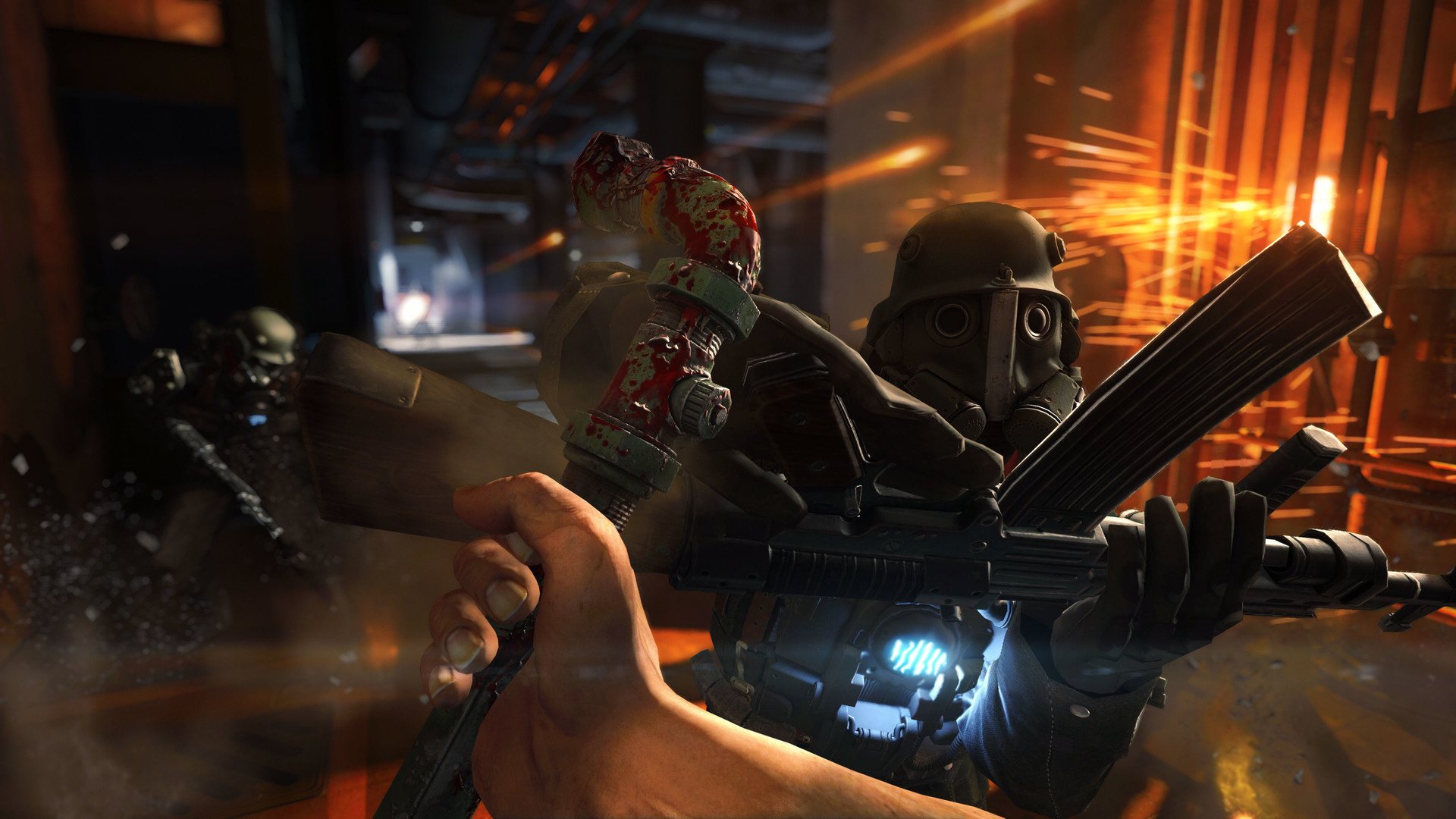
The paired steel pipes are the defining new tool in this prequel. B.J. can use a pipe as a close-range weapon or for a silent takedown, and combine the two shorter pieces into a stronger joined pipe. The joined form is used against certain weak barriers; the separate pipes also let him climb marked walls, making the tool part of navigation as well as combat. These actions are contextual: a climbable surface or breakable obstacle presents a route that ordinary jumping and gunfire cannot provide. Pipe traversal connects spaces above or beyond the immediate corridor, while pipe takedowns let the player remove a guard without firing and risking an alarm. The pipes therefore sit alongside the game’s firearms as a resource for deciding how to enter a room, move through the environment and deal with an isolated enemy, rather than as a cosmetic melee animation.
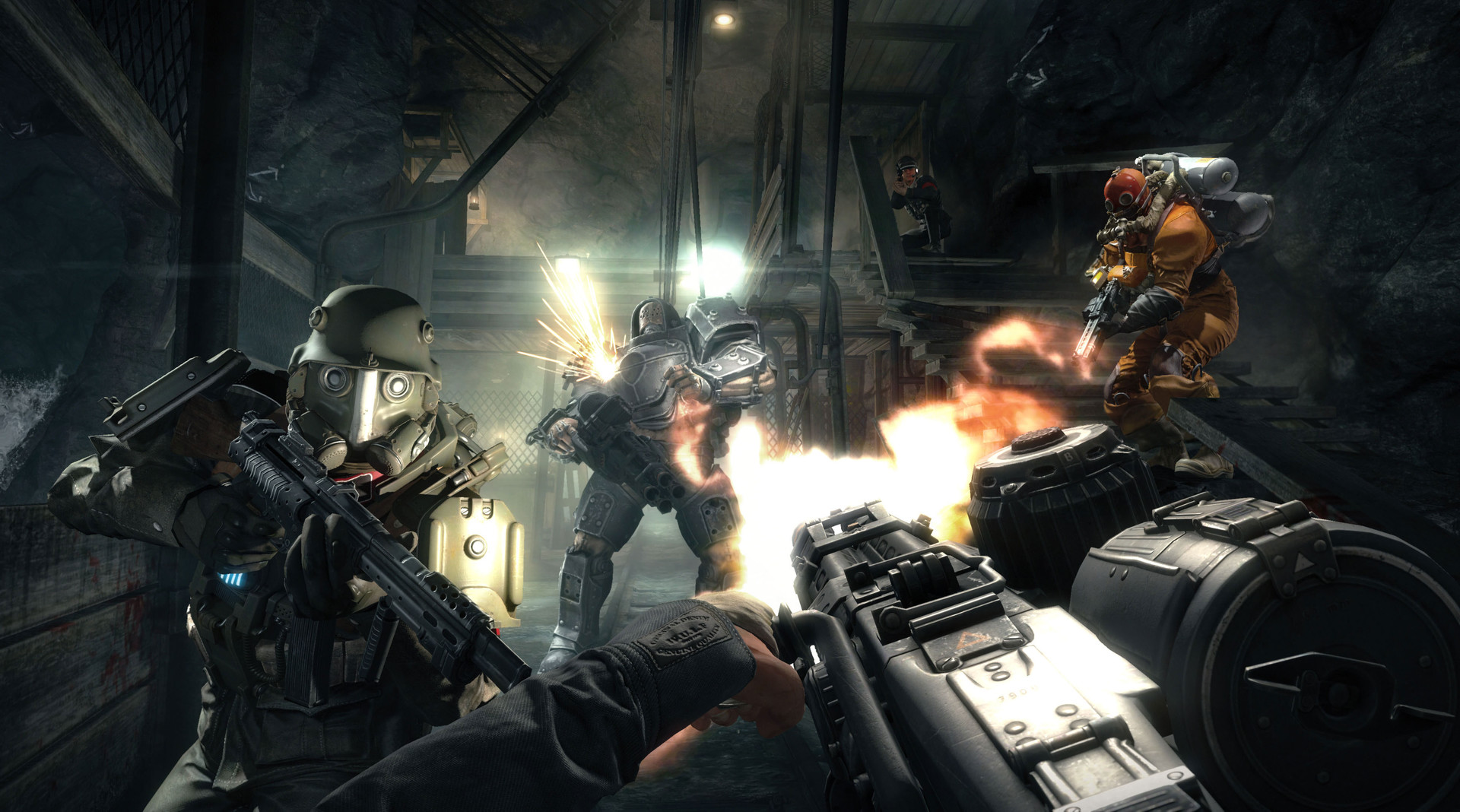
The arsenal mixes familiar firearms with weapons suited to the 1946 setting. The handgun can be fitted with a silencer, the Bombenschuss is a bolt-action carbine for medium or long range, and the Assault Rifle 46-T can switch between semi-automatic and burst fire. Close encounters can be met with the short-range sawed-off shotgun or the Shockhammer, while the single-shot Kampfpistole launches high-explosive ammunition useful against large targets or groups. When the player collects another copy of a compatible weapon, the weapon selector makes dual wielding available; the mode can then be toggled while that weapon is equipped. The game places this firepower beside stealth tools instead of requiring one fixed combat style. A suppressed handgun, pipe takedown or carefully aimed rifle shot can keep an approach quiet, while a shotgun, explosives or two weapons can answer a fight that has already opened up.
Progress is tied to the actions performed during play. The Journal lists perks and their unlock conditions, which reward things such as particular combat behaviours with improved capabilities. This gives repeated use of stealth takedowns, weapons or other actions a longer-term effect beyond simply clearing the current room. Health gradually regenerates after damage, while collected health can temporarily raise it above its normal maximum; armour and ammunition come from pickups, and an armour overcharge requires the relevant perk. The result is a loop of searching the level for useful supplies, choosing a route through guarded rooms, and adjusting weapon use to the threats ahead. The Journal also holds objectives, tutorials and records of found collectibles, giving the player a place to check campaign information without interrupting the action for an external menu or guide.
The second part takes the operation from Castle Wolfenstein into Wulfburg and the excavation led by Helga von Schabbs. The setting broadens from prison cells and military fortifications to rural Germanic streets, valleys crossed by bridges and cable cars, and underground catacombs. Nazi forces include elite troops, drones and hulking Super Soldiers, while the archaeology plot introduces the campaign’s occult atmosphere. These environments provide a change in the kinds of spaces B.J. must traverse but keep the same first-person combination of exploration, stealth and firefights. The main campaign is divided into eight chapters, and completed chapters can be replayed from the menu. Challenge Mode is a separate arena-shooting option built around notable gunfights from the campaign, so it offers a way to revisit combat encounters without presenting itself as another story chapter.
- Developer
- MachineGames (Steam credits identify development in association with MachineGames; GameSpot calls it the developer of The New Order).
- Genre
- Single-player first-person shooter/action-adventure.