
About Wolfenstein: The New Order
In an alternate history where Nazi Germany won the Second World War, war veteran B.J. Blazkowicz awakens after a long coma to a world ruled by the regime. He joins a small resistance network and carries its fight across occupied Europe, using stealth, firearms and advanced weapons in a story-led first-person campaign.
Wolfenstein: The New Order opens amid the final battles of the Second World War and then jumps forward into an alternate 1960s shaped by a Nazi victory. The regime has turned its military advantage into a global system of occupation, backed by advanced machines, weapons and industrial power. William “B.J.” Blazkowicz, a veteran soldier who has spent years unconscious, wakes into a world where the conflict has already been lost. MachineGames frames the campaign as a personal return to the fight: B.J. must understand the new order around him, find people willing to resist, and strike at the institutions that keep the regime in control. The setting spans familiar European cities recast by the alternate timeline as well as military installations and other heavily guarded locations.
B.J. is the player character throughout the first-person campaign, but the story gives space to the people who make up the resistance and the communities caught under occupation. Anya, a nurse who helps him after his awakening, becomes an important ally as the plot develops. The resistance is small and exposed, relying on secrecy and coordination rather than a conventional army. Its members provide contacts, context and objectives between combat operations, while the Nazi command structure supplies the immediate opposition. The game alternates action with story scenes and time spent among allies, so its narrative follows relationships and the cost of continued resistance alongside the mission to weaken the regime. The full campaign is single-player and organized into story chapters, which can be replayed after completion.
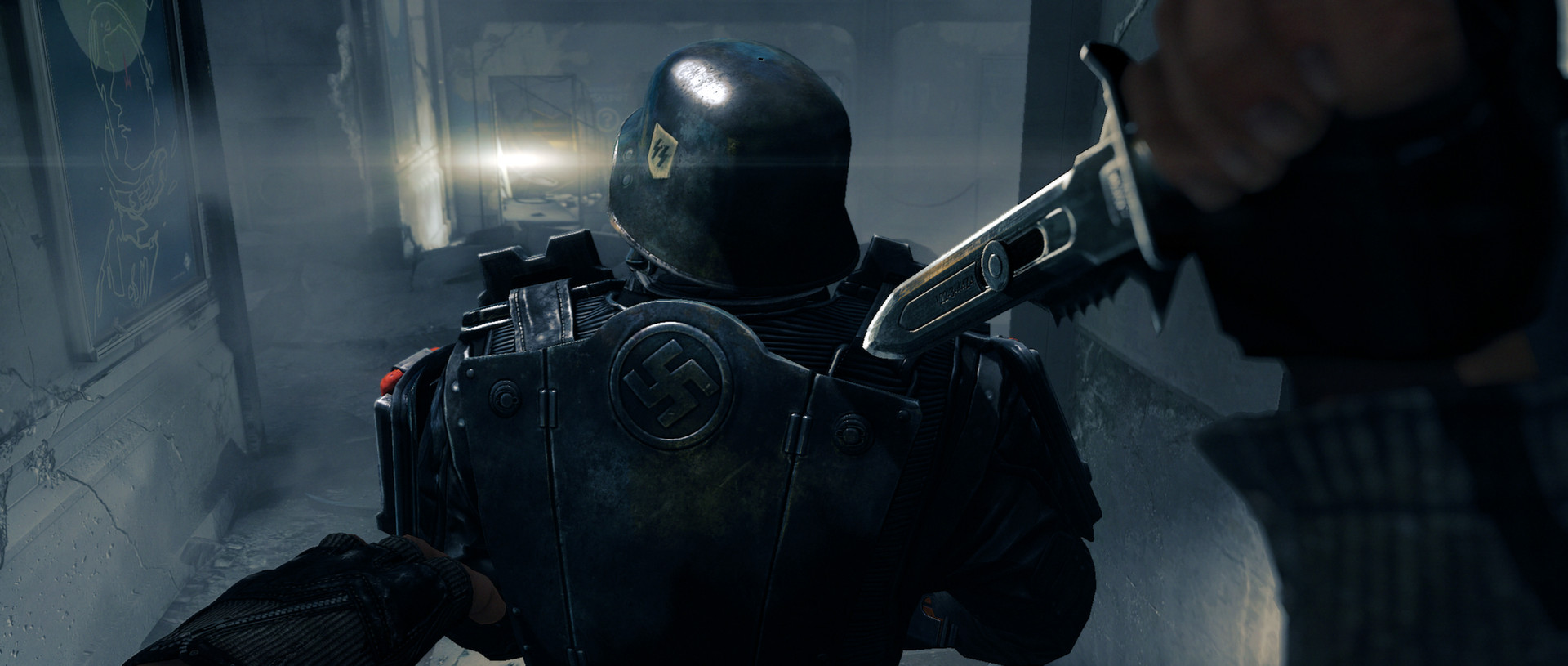
At mission scale, play moves between exploration, stealth and open combat. B.J. can crouch, sprint, use cover and lean around it, making position relevant when enemies patrol a room or fire from protected angles. Commanders are especially important in guarded areas because an alerted commander can sound an alarm and call in reinforcements. Approaching such an area quietly and taking the commander out before detection can prevent that call; once the alarm is raised, the encounter becomes a larger fight. The Scout perk adds on-screen information about nearby commanders and their alarm status. This creates a clear tactical objective within some combat spaces, while other sections focus on a direct assault, traversal or a story event rather than offering the same stealth setup.
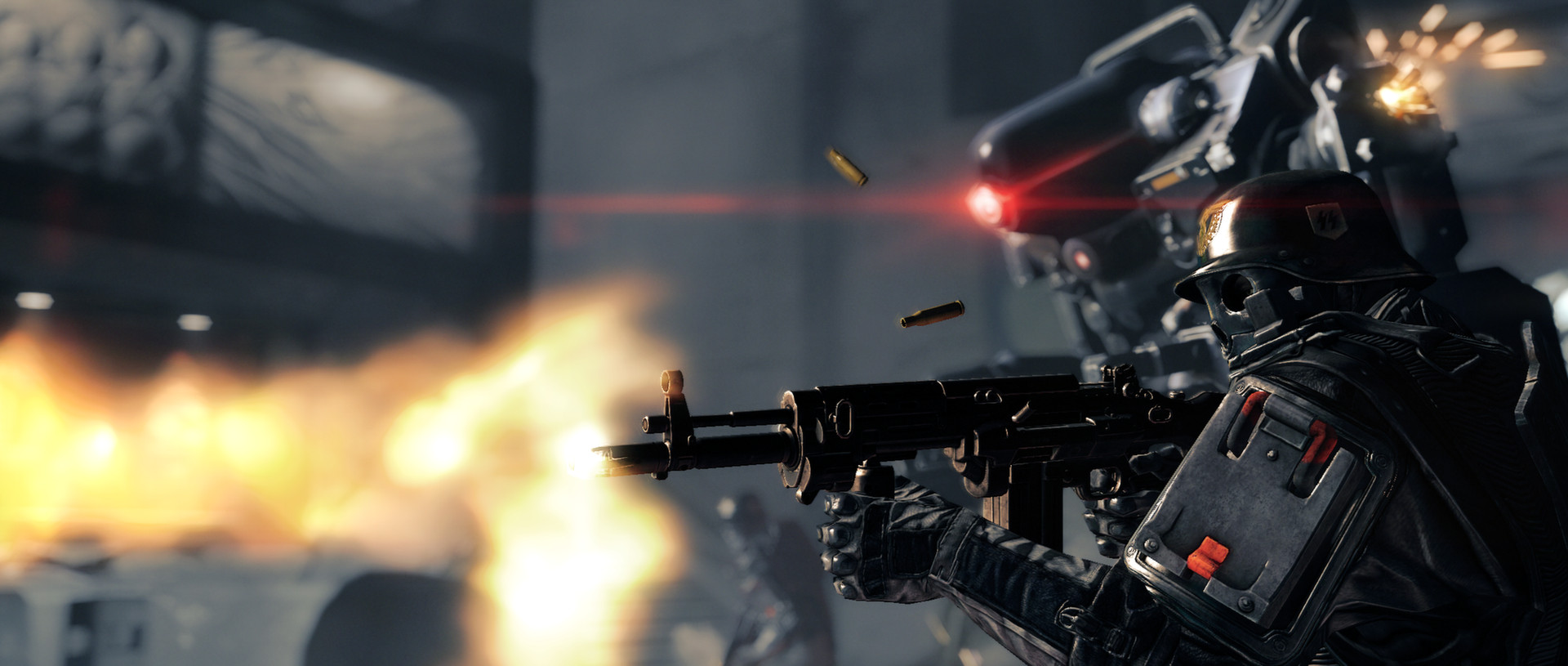
The arsenal covers knives, handguns, submachine guns, assault rifles, shotguns, grenades and advanced weapons. Some firearms can be used in either hand, and the player can switch fire modes on weapons that support them. A silenced handgun and knife can support quiet takedowns, while heavier weapons and dual wielding suit a louder approach. Enemies drop ammunition and other supplies, and levels also contain health, armor and ammunition pickups. Health regenerates gradually to the next increment of twenty after damage, while extra health pickups can temporarily raise it above its normal maximum. Armor does not follow that same health rule: both are replenished from objects found in the level. The player therefore scans combat spaces for resources as well as threats, and chooses when to use ammunition or grenades.
Perks grow from actions performed during play and are grouped into four tracks: Stealth, Tactical, Assault and Demolition. Stealth rewards actions such as silent takedowns with abilities that include throwing knives, faster crouched movement and improved stealth weapons. Tactical centers on small and medium firearms, with benefits to reloads, weapon switching and selected weapons. Assault improves dual wielding and heavy-weapon use, along with ammunition collection and storage; Demolition develops grenade and explosive play, including the ability to throw grenades back. The system links repeated combat behaviors to persistent improvements, allowing a campaign to build strengths around the methods used most often. Its perks also support mixed approaches, since the four categories address different parts of movement and combat rather than defining separate character classes.
Searching levels is part of the action loop because useful items and secrets are placed away from the main route. The journal collects objective notes, tutorials, perk information and a record of discovered collectibles, giving the player a place to review what has already been found. Commanders add another incentive to observe the space: silent elimination prevents reinforcements, and stealth progression can reveal their presence through signal indicators. Once an alarm is active, enemies can arrive in waves, turning a previously quiet route into a sustained exchange of fire. These connected systems make awareness valuable whether B.J. is moving through a patrol unnoticed or fighting through a room; listening for threats, using cover and checking supplies all affect the immediate encounter.
The main menu also supports replaying chapters that have already been completed, letting the player revisit earlier sections of the campaign. A separate Extras area uses Enigma Codes found during the game: solving them there unlocks bonus game modes. The same menu provides access to collected-item records, game statistics and credits, while the journal keeps objective notes and previously encountered tutorials available during play. These features give discoveries a second function beyond immediate supplies: codes can open additional ways to play, and chapter selection offers a route back into finished story segments without restarting the entire campaign. The game therefore tracks both forward campaign progress and selected rewards from exploration.
- Developer
- MachineGames
- Genre
- Action-adventure; story-driven first-person shooter