
About Wolfenstein II: The New Colossus
In 1961, B.J. Blazkowicz returns to Nazi-occupied America with the Kreisau Circle and works to unite local resistance groups. Missions across the country combine stealth and open combat, while weapon upgrades, an early timeline choice and three distinct contraptions shape how he approaches each fight.
Wolfenstein II: The New Colossus is a sequel to The New Order, continuing B.J. Blazkowicz’s fight in an alternate 1961 where Nazi Germany controls much of the world and has occupied the United States for fourteen years. Badly injured after the previous conflict, B.J. returns to America with the Kreisau Circle, the resistance group he joined in the earlier game. His objective is to rebuild the fight against the occupation and bring local groups into a broader revolution. The story includes familiar allies such as Anya, Set Roth, Max Hass and Bombate, while introducing American resistance leaders including Grace Walker and Horton Boone. The game presents the occupation through both its military forces and the communities living under it, giving the campaign a national setting that stretches beyond a single base or front line.
The U-boat Eva’s Hammer functions as the resistance’s base and the campaign’s hub. Between major operations, B.J. can walk its decks, speak with the crew and coordinate the next mission; the submarine also provides access to side activities and later assignments. From there, the resistance travels to places including Manhattan, Roswell and New Orleans, each depicted as part of the occupied United States rather than as interchangeable combat arenas. Bethesda’s account describes a devastated Manhattan, a small-town Roswell and New Orleans bayous, while its story places local groups at the center of the broader campaign. Grace leads the Manhattan-based Black Revolutionary Front, and Horton heads the New Orleans Resistance. These are separate communities with their own history and distrust, so the player’s progress involves entering new territories and confronting the forces that control them as B.J. attempts to bring the resistance together.
Combat supports stealth, deliberate tactical movement and direct assaults. B.J. can crouch, lean around corners, move between cover and silently remove enemies before they raise an alarm; once detected, he can switch to louder fire and use heavier weapons. The opening offers a choice between the Fergus and Wyatt timelines, which changes a signature energy weapon: the Laserkraftwerk or the sticky-canister Dieselkraftwerk. The choice therefore changes the tools available for combat as well as parts of the character story. The game also allows free dual-wielding, including combinations such as a suppressed weapon in one hand and an assault rifle in the other. A second Shockhammer can be carried for a paired heavy shotgun setup. Encounters can then be approached with different weapon combinations, and the player can change tactics as the immediate situation shifts rather than committing to stealth or open combat for an entire mission.
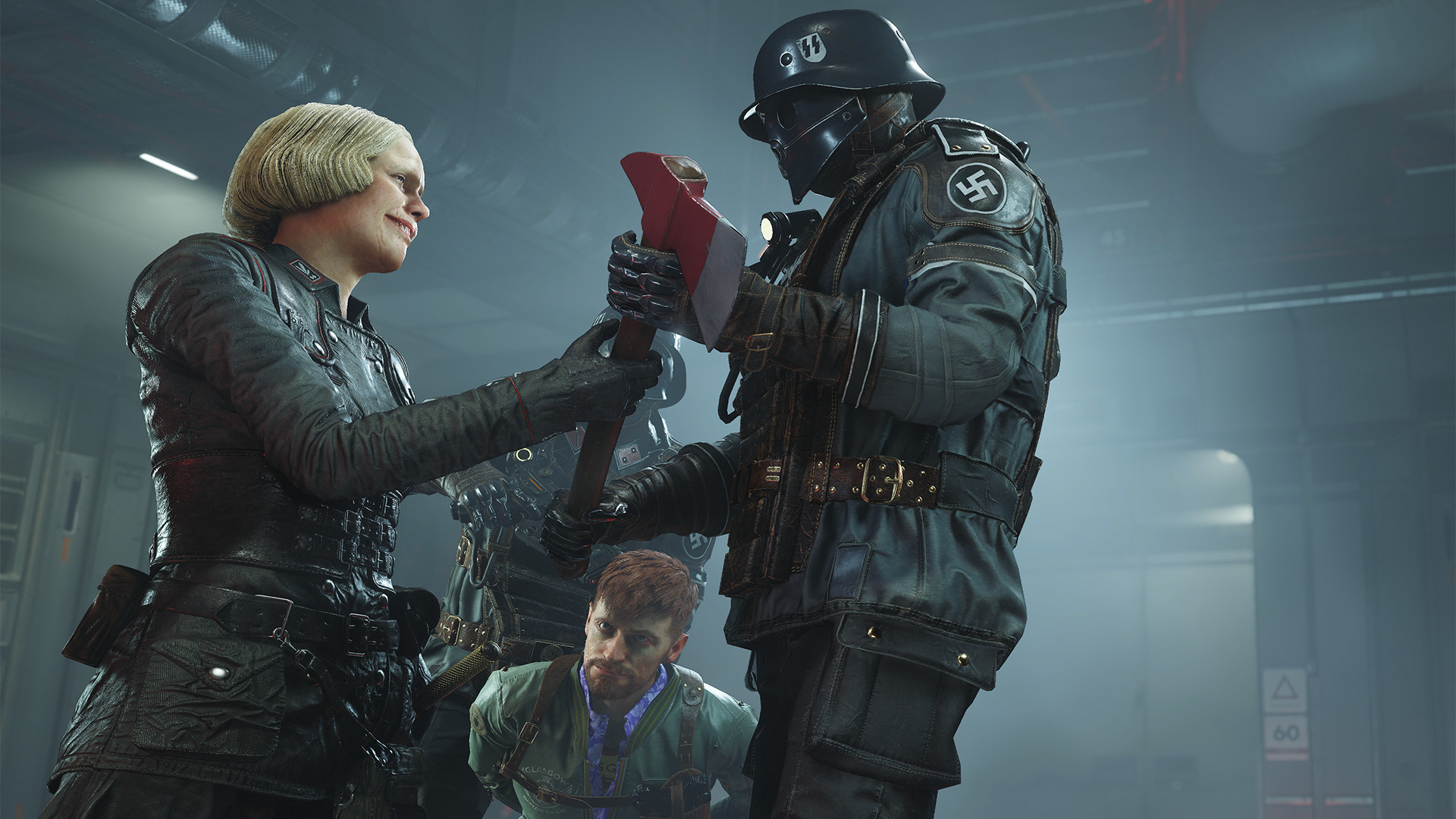
Weapon upgrade kits found during the campaign let B.J. alter the function of his arsenal. The available modifications include suppressors for the pistol and submachine gun, extended shotgun magazines, an assault-rifle scope and an EMP pulse for grenades. Each kit is a limited selection, so applying one means choosing which weapon or feature to improve instead of treating upgrades as automatic stat increases. The core weapons cover several kinds of engagement: pistols and hatchets support quiet attacks, rifles handle aimed or sustained fire, shotguns work at close range, and energy or diesel weapons can address tougher targets and mechanical threats. Health, armour and ammunition are gathered from the levels, with enemy drops and containers helping replenish supplies during a mission. Health can be pushed temporarily above its normal level by collecting more first-aid kits, but that overcharge drains over time, tying a short-lived combat advantage to exploration and preparation.
Set Roth’s contraptions add three distinct movement and combat abilities. The Constrictor Harness compresses B.J.’s torso so he can crawl through narrow ducts and gaps, opening routes that are otherwise inaccessible; remaining constricted for too long brings an oxygen cost. The Battle Walkers extend mechanical supports on his legs, lifting him to higher ledges and vantage points. Ram Shackles reinforce his upper body and let him sprint through certain walls, doors and obstacles, as well as tackle enemies. The campaign asks the player to select one contraption first, while the other two can be obtained later. Each device opens a different way to move through a level or challenge an enemy. Contraptions connect traversal to combat: a tight vent can become a stealth route, an elevated position can expose a different angle, and a breakable barrier can turn a blocked approach into a direct entry.
Perks develop from repeated actions rather than from spending a general pool of experience points. The game tracks behaviours such as stealth takedowns, suppressed Kommandant kills, hatchet throws, headshots, grenade use and fighting while overcharged. Meeting a perk’s action target adds a benefit, and several perks have multiple ranks. For instance, repeated stealth takedowns can improve movement while crouched, while using hatchets as thrown weapons increases how many B.J. can carry. This system links the player’s preferred methods to small functional gains, while weapon kits and contraptions provide separate ways to tailor the loadout and routes. The battlefield also has resources that can be used against the enemy: explosive objects can damage nearby troops, and electrical grenade upgrades can stun mechanical opponents. These interactions reward paying attention to what a room contains, not only to the enemies directly in front of B.J.
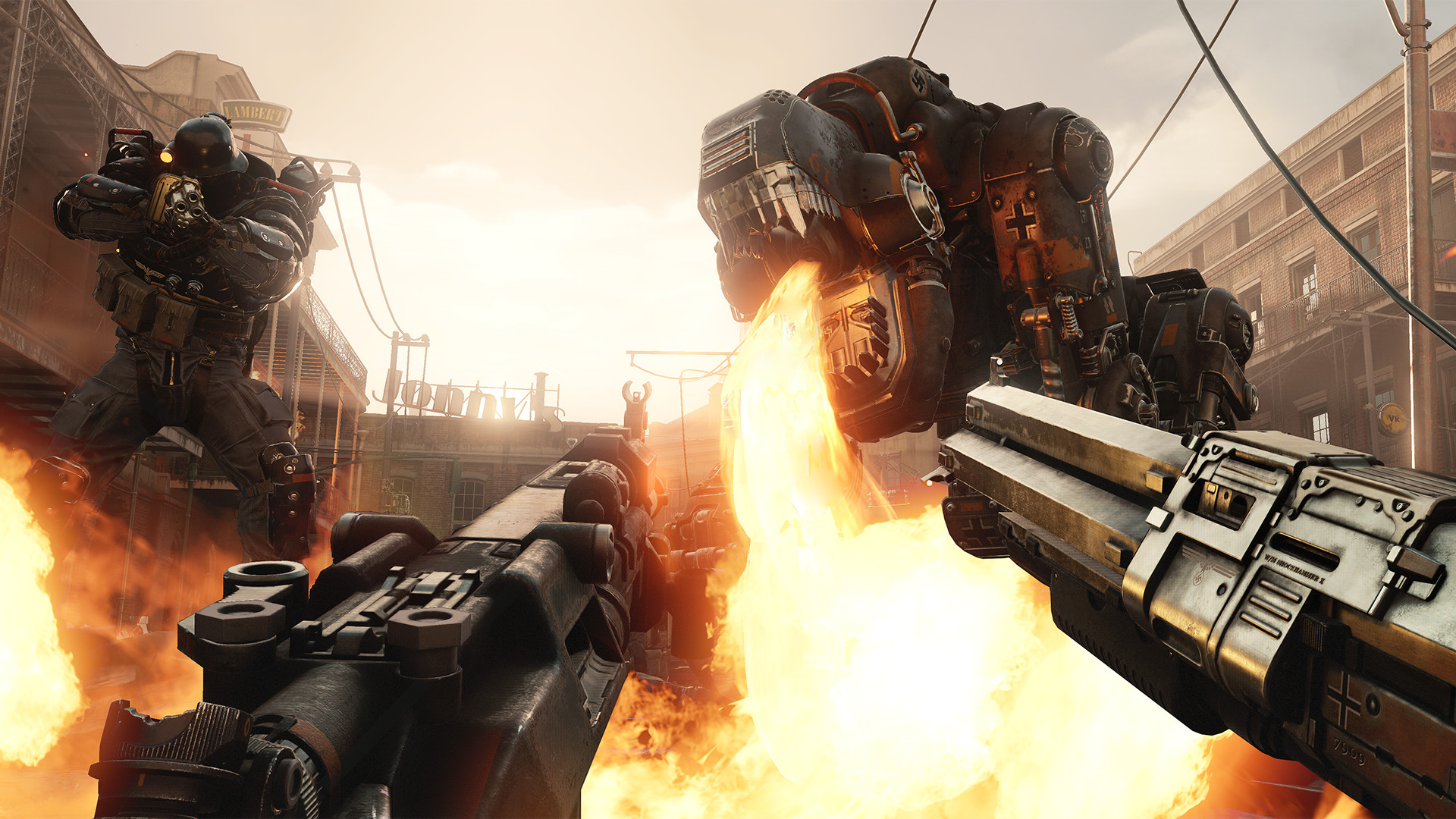
Kommandants connect ordinary missions to a separate hunt for high-ranking officers. Defeated Kommandants carry Enigma Codes; bringing those codes back to Eva’s Hammer lets B.J. use the Enigma Machine to unlock Überkommandant missions in regions he has visited. The missions send him into those districts to eliminate their commanders, providing additional objectives beyond the main route through the story. This makes stealth against alarm-raising officers matter after the immediate encounter: their codes become the key to opening later operations. Between that officer hunt, optional activities aboard the submarine, weapon modifications and perk challenges, the game layers several forms of progression onto a campaign that still centers on first-person movement and firefights.
- Developer
- MachineGames (identified directly in Bethesda's developer note and used as speaker attribution).
- Genre
- Single-player first-person shooter/action-adventure.