
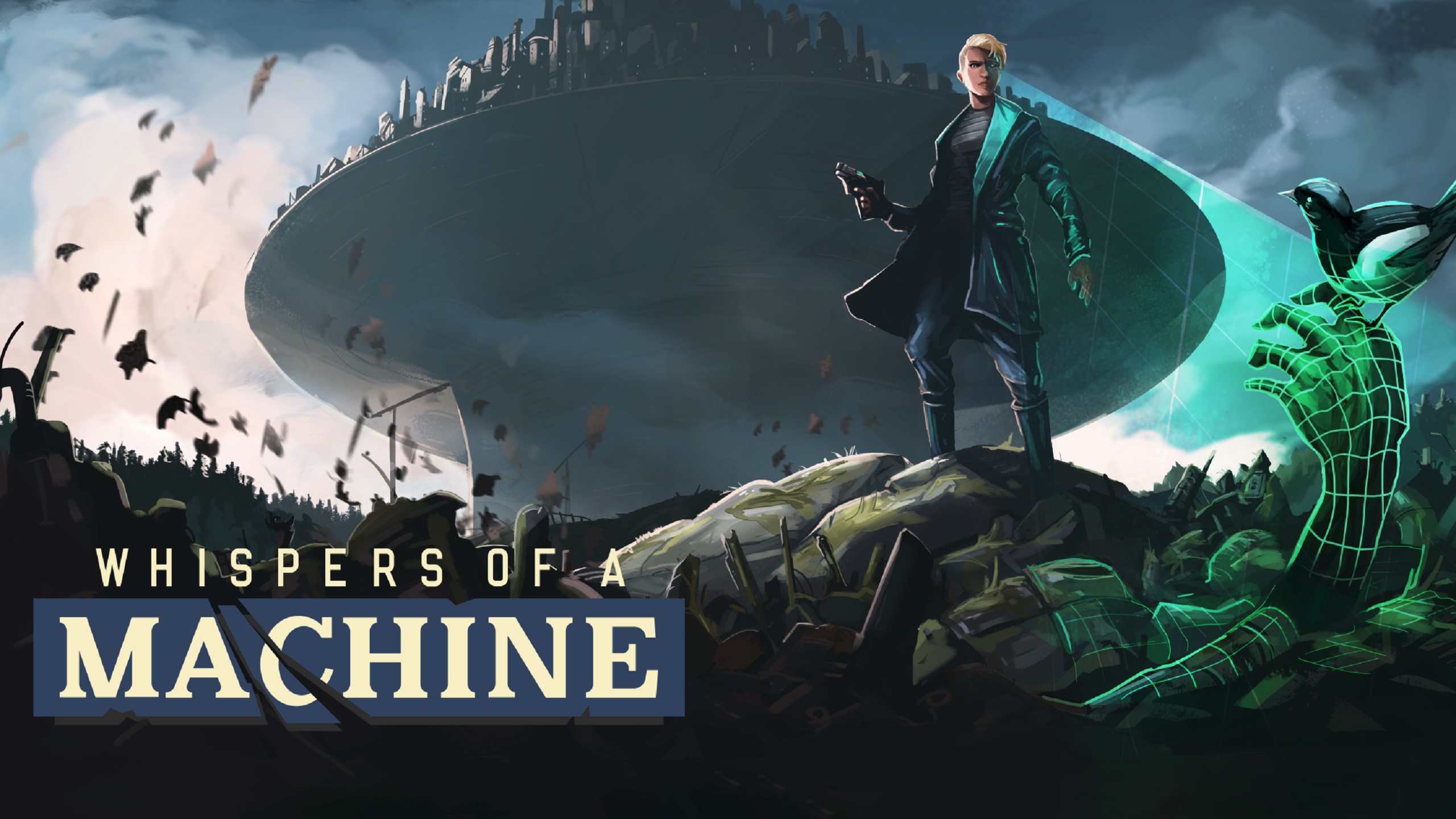
About Whispers of a Machine
In a post-AI future, Central Bureau agent Vera investigates murders in Nordsund. This point-and-click mystery combines crime-scene inspection, interviews and puzzle solving with Blue, a nanotechnology that grants investigative augmentations. Dialogue and puzzle choices shape Vera’s abilities, giving empathy, analysis or assertiveness a practical role in the case.
Whispers of a Machine places its detective story in a future shaped by the collapse of artificial intelligence. Nearly a century after advanced AI was outlawed, society has rebuilt with a wary relationship to technology: some people view human augmentation as a threat, while others see it as a path forward. Vera, an agent of the Central Bureau, travels to the remote settlement of Nordsund to investigate a series of murders. The case connects local deaths to people trying to revive the forbidden pursuit of machine superintelligence, while a loss from Vera’s past complicates her professional certainty. The setting combines familiar police work with a speculative question about where human identity ends and technological enhancement begins. Nordsund is not presented as a sprawling metropolis; its community and institutions give the investigation a contained geography in which personal belief, local authority and the larger post-AI order intersect. The mystery develops through evidence and conversation, with the conflict widening as Vera learns why the murders matter. Vera’s initial task is to make sense of a small community’s deaths, but every interview also tests what its residents believe the forbidden technology might do to them.
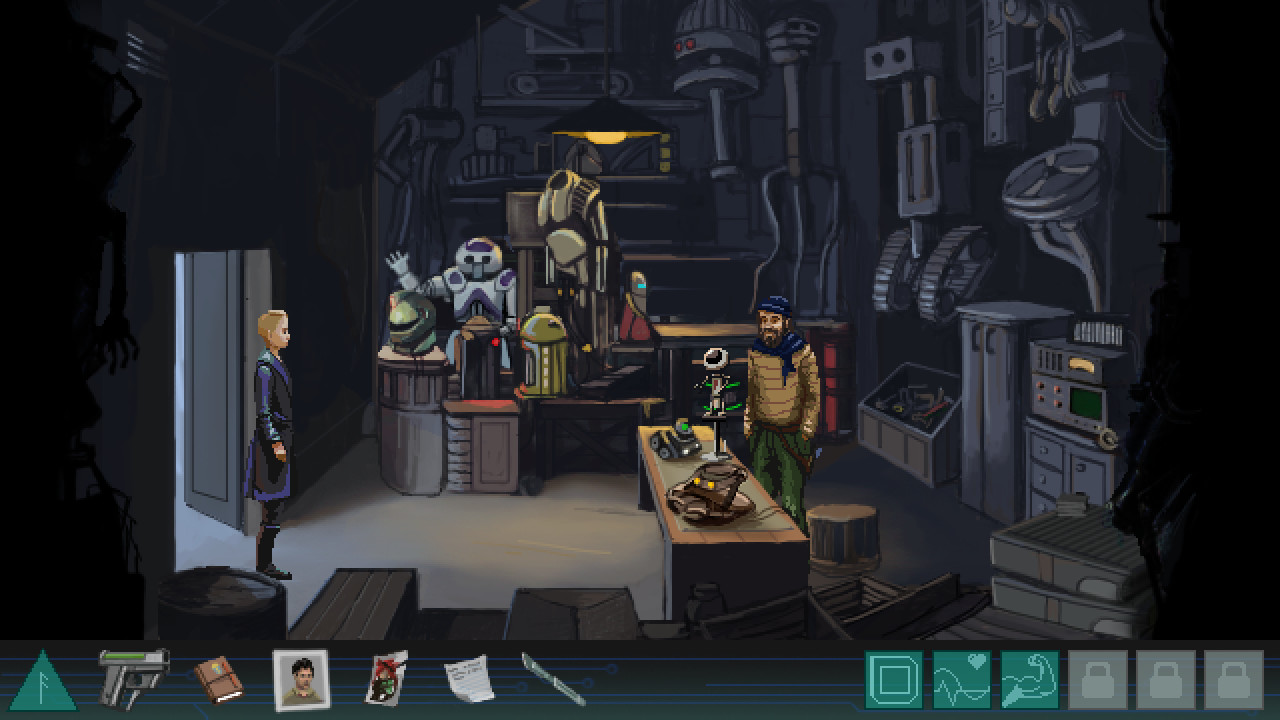
The basic play is a third-person point-and-click investigation. Vera moves through illustrated locations, examines objects, collects clues and questions people connected to the case. A contextual cursor identifies different interactions, while optional hotspot highlighting can help reveal points of interest. Finding evidence is only part of the work: observations may need to be compared with what a witness says, and questions can be approached through Vera’s investigative tools. Dialogue choices also establish how she responds to other people. The game tracks whether her manner is more empathetic, analytical or assertive, so conversation is a meaningful part of the detective activity rather than a sequence of neutral prompts. This structure keeps exploration focused on individual scenes and conversations instead of open-world travel. The player reads spaces for details, follows leads between locations and uses collected information to make sense of contradictory accounts. Some puzzles ask for conventional observation or item use, while others engage directly with the tools supplied by Blue. The adventure’s central loop therefore ties together scene inspection, interviews and problem solving, making the investigation feel like a process of building a case rather than simply reaching a marker.
Blue is the distinctive interaction system. This rare nanotechnological substance grants Vera a set of augmented abilities, including forensic scanning, biometric analysis and temporary increases in strength. These powers turn inspection into more specific detective work: a scan may reveal a fingerprint or biological trace, while analysis of a person can expose physical signs that matter during questioning. The augmentations are used in context, so their purpose is to interpret evidence, access objects or find a way through a particular obstacle. They do not create a combat-oriented action system. Instead, they broaden the kinds of questions the player can ask of a scene or person. The game combines these abilities with ordinary adventure-game actions such as reading, collecting and using objects. As Vera’s case advances, the resulting interactions remain connected to investigation: a tool is useful because of what it can reveal or let her examine, not because it supplies a general-purpose upgrade loop. This emphasis gives the futuristic premise a practical role in play. Blue is a technology embedded in the detective work, and its different applications help make the act of examining a crime scene more varied than clicking through descriptive text alone.
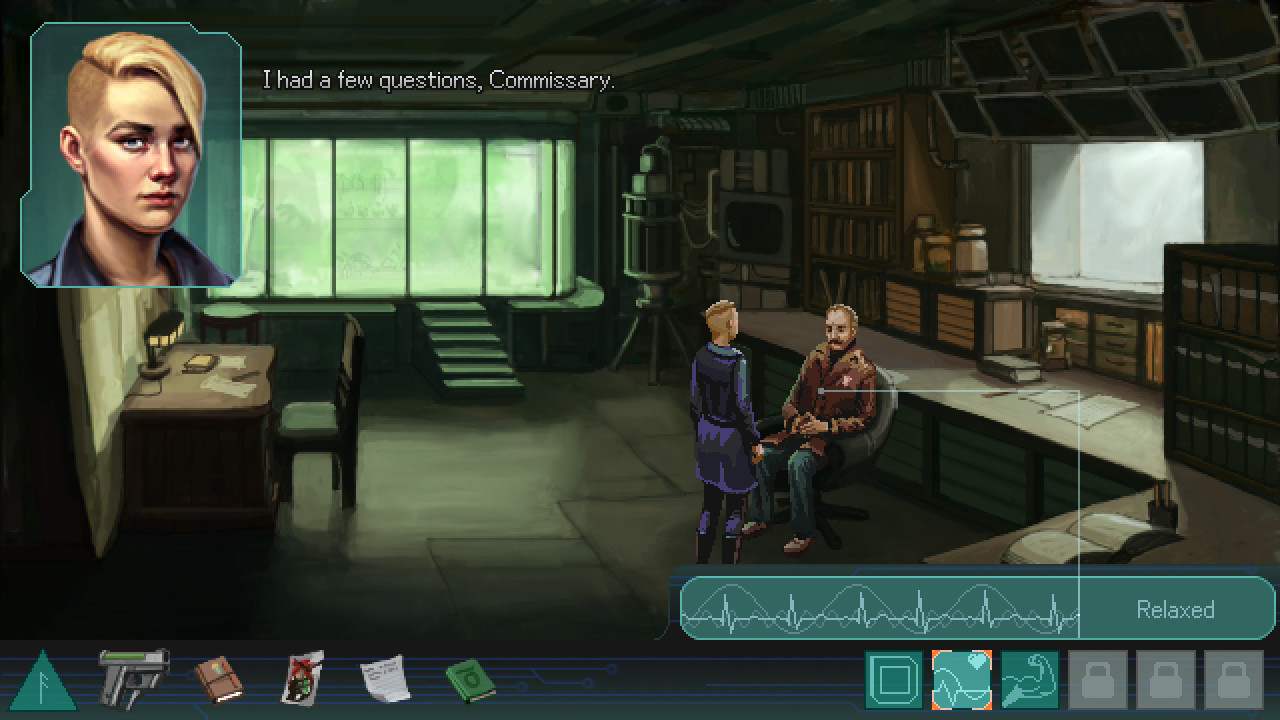
The augmentation system also responds to the way the player conducts conversations and handles problems. Empathetic, analytical and assertive tendencies shape the additional abilities Vera develops, meaning that choices gradually influence which investigative approaches are available. The game does not ask the player to select a fixed class from a menu; character direction emerges through the tone of responses and, in some situations, through how a puzzle is solved. Different abilities can open different routes through an obstacle, so a later challenge may invite a distinct response depending on the capabilities Vera has developed. This creates a connection between role-playing and puzzle design: the player’s idea of who Vera is can affect what she is able to do. Her starting tools provide a foundation, and later augmentations extend that foundation in a way associated with her behavioral tendencies. The story also has multiple endings, but this account avoids describing their conditions or outcomes. Progress is chiefly investigative and narrative, advancing through discovered information, completed puzzles and dialogue rather than through experience points, equipment rarity or a general skill tree. The result is a compact progression structure in which choices shape the available problem-solving toolkit.
The game’s presentation supports its Nordic-influenced science-fiction noir. Hand-drawn pixel-art environments depict a post-AI society where advanced technology has receded from ordinary life but remains a source of fear, desire and political tension. Vera’s augmentations introduce more overtly technological effects into otherwise grounded scenes, creating a contrast between familiar rooms and the unusual capabilities she brings to them. Dialogue is fully voiced in English, and conversations use expressive character portraits alongside the illustrated locations. Sound and music provide an atmospheric backdrop to the investigation without changing its quiet, scene-based pace. The visual design emphasizes readable spaces and recognizable clues: players are asked to notice objects and details, not navigate a three-dimensional maze. These presentation choices make the case feel personal as well as speculative. Vera’s work involves both physical evidence and the beliefs people have formed after AI’s collapse, and the mix of pixel art, voiced exchanges and restrained futuristic devices keeps those parts within the same adventure framework. The story’s broader ideas appear through places and encounters that Vera investigates, while the player’s attention stays on evidence, people and the practical consequences of using Blue.
Exploration remains local and scene-based. The player moves Vera from one point-and-click location to another as the investigation opens new conversations and areas to examine. There is no separately documented traversal system such as vehicle handling, platforming or free-roaming movement; travel serves the case structure by connecting its scenes. Likewise, the game is an adventure rather than a combat title. The central actions are looking, listening, questioning, collecting and using investigative abilities. Tension comes from what Vera discovers and how she decides to respond, not from a loop of defeating enemies. The player can revisit the details and information gathered during the case and use them to interpret later situations. Because the route through the mystery is built around evidence, the most useful progress is often a new understanding: a clue may make a witness’s answer meaningful or suggest which tool to apply next. Blue can produce physical effects such as a temporary strength boost, but that capability functions as a puzzle and investigation tool. It does not imply a broader combat, stealth or action progression system.
Vera’s tools and judgment are bound together by Blue. A physical trace may tell her where to look next, but the way she speaks to a witness can shape which augmentation develops and how she handles a later obstacle. That makes each case scene more than a static search for clickable objects. The player has to work out what an object suggests, what a person is withholding and whether a technologically enhanced response serves the investigation. Nordsund’s restrained setting keeps those choices close to the people affected by them. The central mystery concerns a society that has outlawed AI while still depending on exceptional technologies such as Vera’s own; the contradiction follows her from interviews to forensic work. Whispers of a Machine is available on PC, Mac and mobile storefronts. Its different platforms carry the same core detective premise, while this account makes no claim about identical controls on every device. The story remains focused on evidence, character and the consequences of the methods Vera chooses.
- Developer
- Clifftop Games and Faravid Interactive
- Genre
- Point-and-click science-fiction detective adventure