
About When The Past Was Around
Eda feels adrift until she meets Owl, and their relationship reshapes her life before heartbreak sends her through a surreal landscape of rooms drawn from memory. This point-and-click puzzle adventure uses everyday objects, clues, hand-drawn scenes and violin music to tell a largely wordless story about love, loss and moving on.
Eda is in her early twenties and unsure how to reach the dreams she once pursued. Her meeting with Owl brings a relationship that reorders her days: the two share ordinary routines, affection and a renewed sense of possibility. The game then follows Eda through a surreal arrangement of rooms associated with memory and time, where the player pieces together what she and Owl experienced. The story’s emotional movement runs from the warmth of companionship toward heartbreak and the effort to move forward. It is conveyed with little explanatory dialogue. A scene may show a familiar activity or a place connected with the pair, leaving the player to infer its importance from gesture, objects and the surrounding room. Owl is not introduced as a conventional quest-giver, and Eda’s journey is not framed as a series of external missions. Their relationship supplies the context for what the player sees and solves. As the rooms accumulate, repeated objects and changes in the way a memory is presented make the past feel connected to Eda’s present, while still allowing some details to remain open to interpretation.
The world is not a continuous house or town to traverse. It is made of disjointed rooms that evoke memories and moments, with doors serving as clear transitions between scenes. Each room is a self-contained illustrated space with objects to inspect and a small set of actions that can alter its state. The player may need to search a cabinet, examine a keepsake, or work out the sequence behind a familiar task before a door opens. Everyday interiors sit beside more surreal arrangements, so a transition can change both the visual logic of a place and the context of the memory. The scenes are composed around clues and interaction points rather than broad free-roaming movement. Clues, solved puzzles and unlocked doors form the route through the rooms, each transition opening a new memory. A player learns each space by testing its interactive details, then carries the resulting clue or understanding into the next room. The setting therefore works as a chain of memory chambers: one solved scene advances the route and adds a piece to the account of Eda and Owl.
Interaction uses point-and-click actions, but the interface gives the player help with finding what can be touched. An onscreen bulb highlights active points in the current scene; when an object is distant, the view zooms toward it for examination or combination. These details make the investigation concrete: first scan the room, then use the highlighted objects and clues to decide what should happen next. The puzzles can involve opening a container, assembling or placing objects, or following the steps of an everyday activity. Scenes involving a treasure chest, preparing tea and doing laundry turn familiar actions into interaction sequences. Other puzzles ask the player to connect clues found in different parts of a room, with some challenges taking the form of room-scale escape puzzles. The player does not control a character through a platforming space; navigation is chiefly between scenes and among their hotspots. Solving a puzzle changes a mechanism or reveals the next passage, making observation and object use the practical means of moving Eda’s story forward.
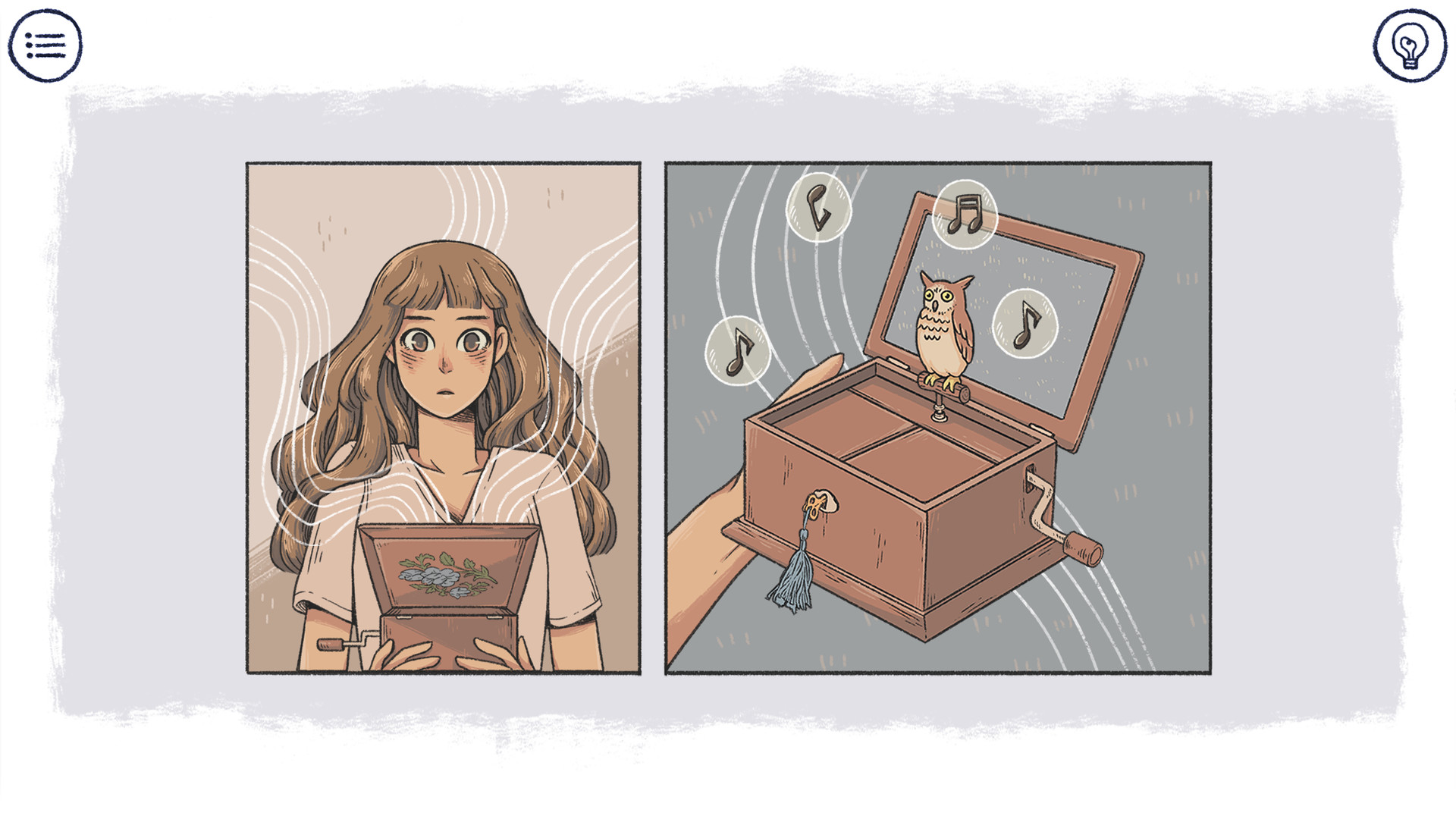
The puzzles are designed around the material present in each scene, not a general inventory of unrelated tools. An object can have a clear household use yet also point toward a shared memory, so deciding what to do with it can reveal more than the combination itself. The tea-making and laundry examples are useful because they anchor the interaction in specific routines rather than abstract switches. A puzzle may ask the player to notice several items, infer an order and then carry out the sequence; in another room, a container or mechanism can hide the clue that unlocks a door. The hint bulb reveals clickable points without solving the logic automatically. The player still has to determine which clue matters and what action follows. Some puzzles echo escape-room problems, and point-and-click actions can express Eda’s emotional struggle. That observation fits the way the story and mechanics meet: the room presents a practical obstacle, while its objects and composition place that obstacle within a remembered relationship. The game’s core challenge is therefore interpretive as much as procedural, asking the player to read a scene and then act on what it suggests.
The route through the game is a sequence of rooms connected by unlocked doors. Advancement comes from solving the current room’s puzzle and gaining access to another memory. The compact adventure advances through clues, puzzles and opened doors. This structure keeps the objectives local and visible: examine the scene, identify a useful interaction, and discover how it connects to the exit or to another object. As the player moves on, the sequence of spaces broadens the picture of Eda and Owl without requiring a quest log or branching dialogue choices. A later image can shift the meaning of an earlier object, but the game does not ask the player to revisit a large map or manage persistent character resources. The disconnected rooms allow the story to move between memories without pretending that every transition is a literal walk through one geography. Progress is measured by access to the next scene and by the growing context for the objects already seen. This gives the adventure a focused scale: each new room contributes a puzzle, a visual setting and a further part of the relationship’s history.
The story is largely silent, with hand-drawn art and music carrying information that a dialogue-heavy adventure might explain in words. Brigitta Rena’s hand-drawn illustrations provide the primary narrative language, accompanied by violin music that follows quieter and more anguished moments. Music carries narrative weight alongside the images. Colour, framing and animation help distinguish domestic scenes from the more surreal rooms, while repeated objects link separate moments. Because the environments contain the puzzle controls themselves, visual clarity matters: a hotspot, a newly accessible drawer or a changed object state must read within the composition. The hint bulb and close-up view support inspection without replacing the artwork with a dense interface. Sound helps connect scenes whose locations and times are discontinuous, and the shifts in music accompany changes in mood. This presentation keeps the player’s attention on Eda’s surroundings and on what has changed from one image to the next. The combination of illustration, small animations, object interaction and violin score gives the wordless narrative a consistent way to show both the literal task and its emotional context.
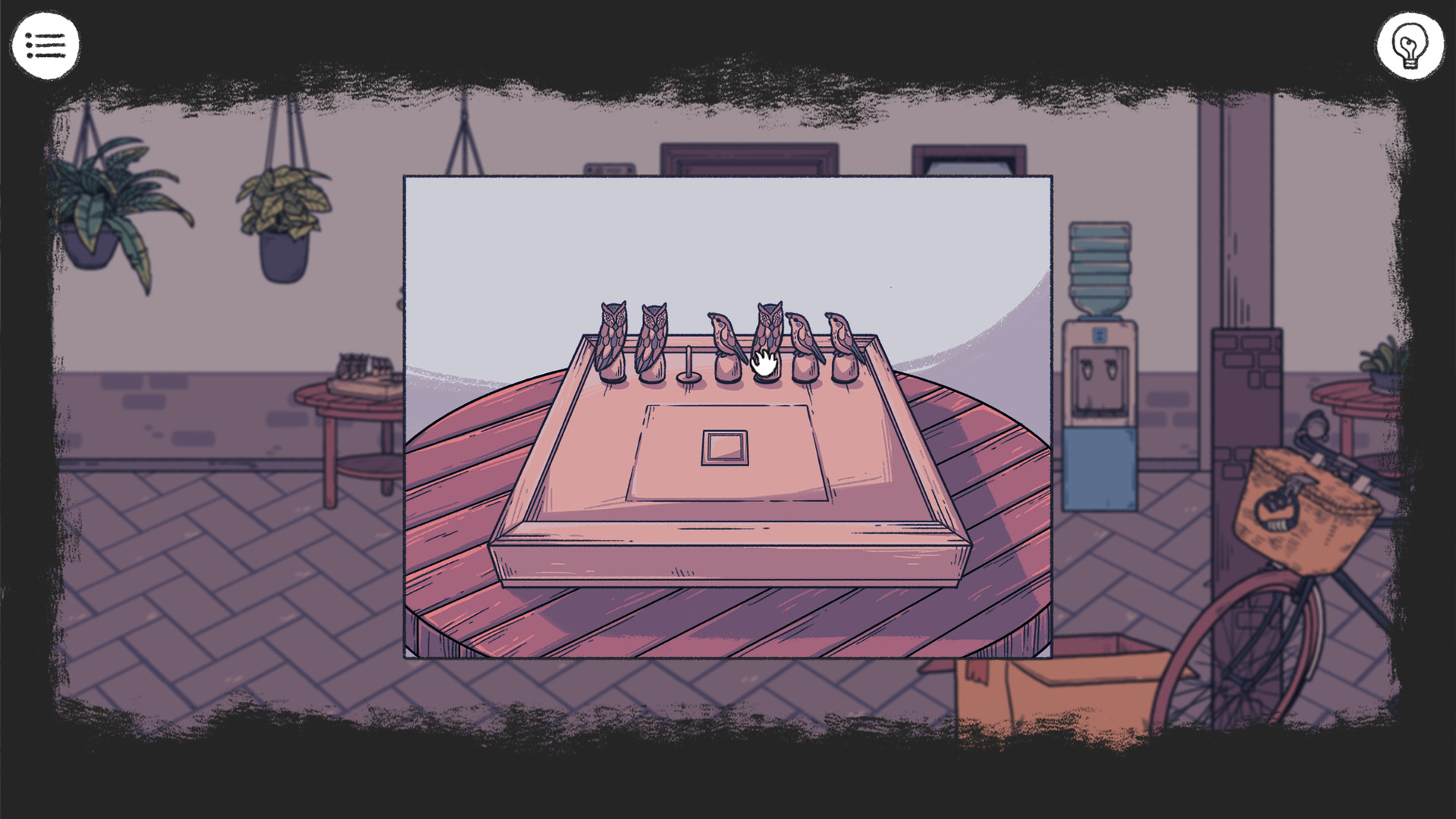
The game links room-scale puzzles to Eda’s memories through a simple sequence: inspect a composed scene, use an object or clue to change it, then pass through the opened door. The hotspot bulb and close-up view make distant or subtle interactions easier to find, while the player still has to work out what the clues mean. Treasure chests, tea preparation and laundry give several puzzles the shape of familiar tasks; elsewhere, objects and room details must be read together. Eda and Owl’s relationship emerges through these routines, recurring images and the changing spaces around her. The soundtrack provides continuity as the rooms shift between ordinary interiors and surreal memories. Each solved scene advances both the route and the player’s understanding of what the objects signify. The adventure’s focus stays on observation and object logic, with no battle or timed action system interrupting that rhythm. Its wordless storytelling lets the same room serve two purposes at once: it is a practical puzzle to solve and a fragment of Eda’s past.
- Developer
- Mojiken
- Genre
- Point-and-click puzzle adventure