
About Watch Dogs: Legion
In Watch Dogs: Legion, DedSec rebuilds its resistance in a near-future London under surveillance and private security control. The open-world action adventure lets you recruit and switch among Londoners, using their distinct skills alongside hacking, stealth, disguises and combat to investigate a bombing conspiracy and challenge the forces occupying the city.
Watch Dogs: Legion places DedSec in a near-future London where a wave of bombings has left the hacktivist group blamed and the city under the expanding authority of Albion, a private security company. The campaign follows the resistance as it tries to clear its name, uncover who engineered the attacks and oppose the systems that keep London under surveillance. Bagley, a sharp-tongued digital assistant, coordinates operations with handler Sabine Brandt, while the wider story brings DedSec into conflict with groups including Albion and the criminal network Clan Kelley. Missions move through recognizable districts and landmarks, but the central cast is shaped by the people recruited into the resistance rather than one fixed field operative.
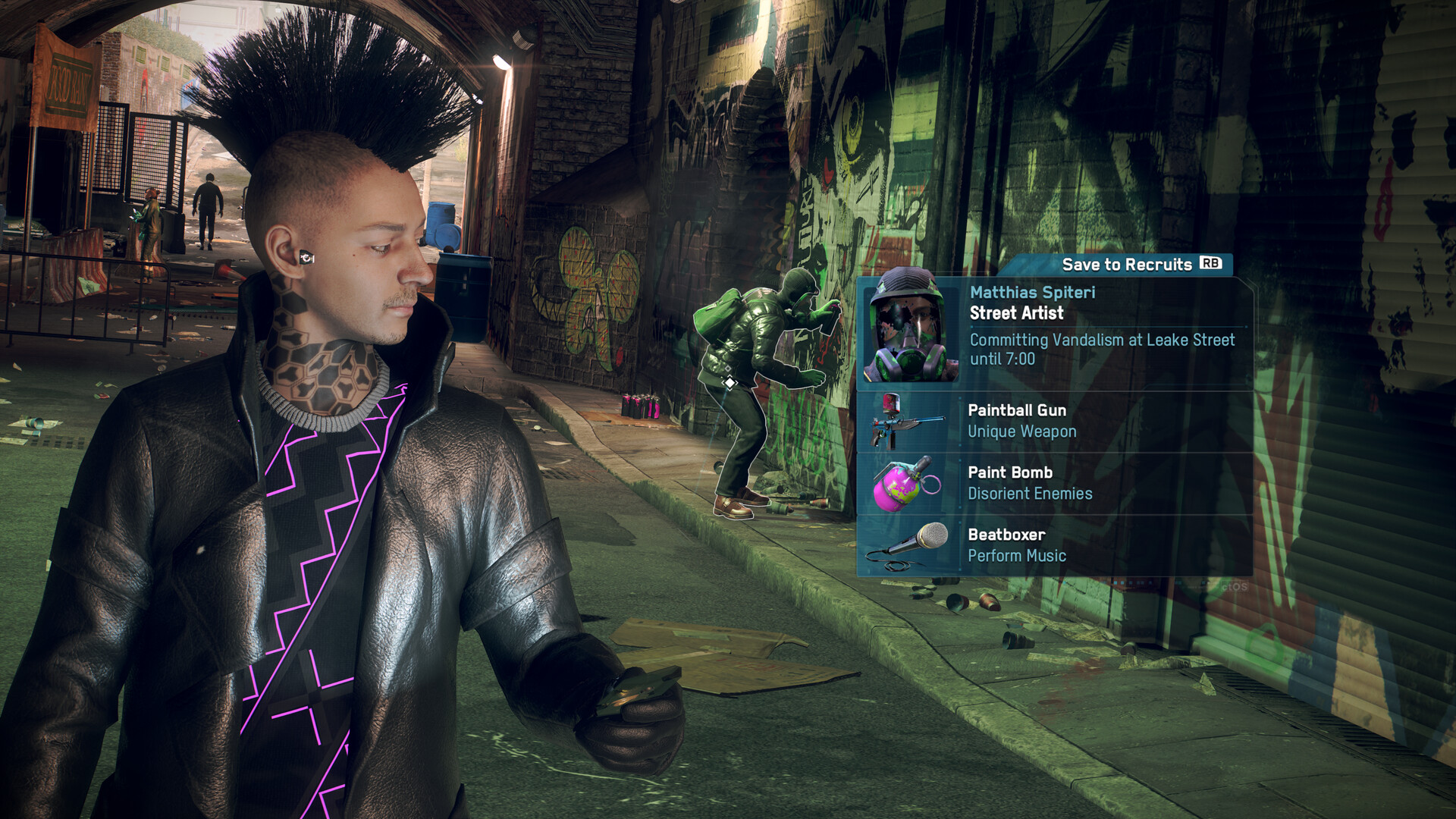
The Play as Anyone system turns the city’s population into the recruitment pool. Scanning a passer-by reveals details such as occupation, skills and attitude toward DedSec; promising candidates can be saved to the recruits list and investigated further with Deep Profiler. A neutral Londoner may need a recruitment task before joining, while someone aligned with or related to an enemy may require extra steps to shift their opinion. Those missions can involve retrieving evidence, helping a contact or entering a guarded site. After recruitment, that person becomes a playable operative with their own traits, tools and strengths, so team building is a practical part of preparation: a worker with access to a cargo drone, a uniformed guard or a hacker with network skills can open different routes through an objective. Deep profiling can reveal a prospective operative’s schedule, relationships and personal concerns, turning recruitment into a small investigation rather than a menu choice. The information can point to a contact or problem that explains what would persuade that person to help. Candidates who work for Albion or Clan Kelley are especially useful because their employment can provide access to faction clothing, but their loyalty and the circumstances around them still matter. A roster therefore develops through both observation in public and missions that respond to each person’s circumstances.
Switching operatives changes more than appearance. A recruit’s job and personal abilities affect how they handle a mission, from the weapons and gadgets they bring to the ways they can enter restricted areas. Uniformed operatives can use the clothing associated with their organization to pass through certain controlled spaces, though the disguise does not make suspicious behaviour safe. A construction worker can call a cargo drone and ride it to elevated positions; other recruits may bring a spiderbot, specialized hacking options or combat advantages. The roster is managed from the team menu, and the resistance can change its active operative when circumstances or an objective favour another skill set. This lets the player plan around the people actually available rather than upgrade a single hero into every role.
London’s connected infrastructure is another set of tools. The phone interface can take control of cameras, vehicles, drones and other networked devices, letting the player scout rooms, distract guards, trigger environmental hazards or turn hostile machinery against its owners. Spiderbots can slip through small access points and interact with devices from a safer position, while a cargo drone can lift an operative above street patrols. When a mission enters a secured compound, players can often combine remote hacking with direct entry: use a camera to inspect a room, locate a useful device, then decide whether to sneak in, deploy a gadget or fight. Tech Points found around the city unlock or upgrade DedSec equipment, so exploration gradually expands tools such as the spiderbot and AR cloak.
The campaign alternates investigations and operations with open-world activities across London’s boroughs. Albion controls checkpoints and secure facilities, while Clan Kelley operates through criminal sites and trafficking networks; each faction shapes the threats and access problems in its territory. For a restricted location, the player can search for a uniformed recruit, use cameras to trace an entry route, move through ducts with a spiderbot or approach by rooftop and drone. If stealth breaks down, operatives can use melee weapons, firearms and hacks to escape or finish the objective. Arrest and injury can make a recruit temporarily unavailable, changing which abilities the team can bring to its next task. Missions therefore connect the city’s surveillance systems, the recruited person’s profession and the consequences of a chosen approach.
Borough resistance provides a separate progression track alongside the central investigation. Completing the local defiance activities raises opposition to Albion in that district; finishing its uprising mission turns the borough defiant and awards a skilled operative. That character joins the roster, while the liberation also exposes Tech Points in the borough, helping the player expand DedSec’s hacking kit. Collecting Tech Points elsewhere and spending them in the technology menu unlocks further tools and upgrades, while recruitment missions broaden the team’s range of skills. These loops reinforce each other: investigating a district supplies new technical options, and strengthening the roster gives the campaign more ways to handle later security challenges. The game also includes an optional permadeath setting, which can make an operative’s loss permanent and give roster choices a lasting consequence.

- Developer
- Ubisoft Toronto
- Genre
- Action-adventure, open-world