
About Warhammer 40,000: Dawn of War - Definitive Edition
Warhammer 40,000: Dawn of War - Definitive Edition brings the original real-time strategy game and its three expansions together: four campaigns, nine playable factions, and skirmish and multiplayer battles. Across Tartarus, Lorn V, Kronus and the Kaurava System, players build bases, capture strategic ground and command squads in battle.
The Definitive Edition collects the original Dawn of War, Winter Assault, Dark Crusade and Soulstorm in one PC release. Its four campaigns have different shapes rather than forming one continuous sequence. The original story follows the Blood Ravens on Tartarus; Winter Assault offers Order and Disorder campaigns on Lorn V; Dark Crusade frames the war for Kronus as a non-linear planetary conquest; and Soulstorm moves that strategic contest across the Kaurava System. Together, these campaigns place the player among nine factions from the 41st Millennium, while skirmish and multiplayer provide separate battles beyond their story missions.
In the original campaign, the player commands the Blood Ravens, a Space Marine Chapter sent into a conflict on Tartarus. The campaign presents objectives through mission briefings and battlefield events, then asks the player to direct squads, builders and leaders in real time. The Space Marines are a relatively small, capable force, so reinforcing an existing squad, choosing its weapon upgrades and positioning it well all matter. Imperial Guard troops also appear in some single-player missions, but the campaign’s central army remains the Blood Ravens. This is a mission-based story, distinct from the broader territory-map campaigns included in the same edition.
Winter Assault moves the conflict to Lorn V and places control of its two campaigns in the hands of different alliances. The Order route uses the Imperial Guard and Eldar, while Disorder puts the Orks and Chaos Space Marines on the opposing side; both are pursuing a powerful Titan war machine. These are separate campaign choices, not a single route in which the player controls every faction. The Imperial Guard brings a different battlefield profile from the Space Marines, with ranks of human soldiers and heavy armour, while the Eldar, Orks and Chaos each bring their own units and battlefield abilities into the connected missions.
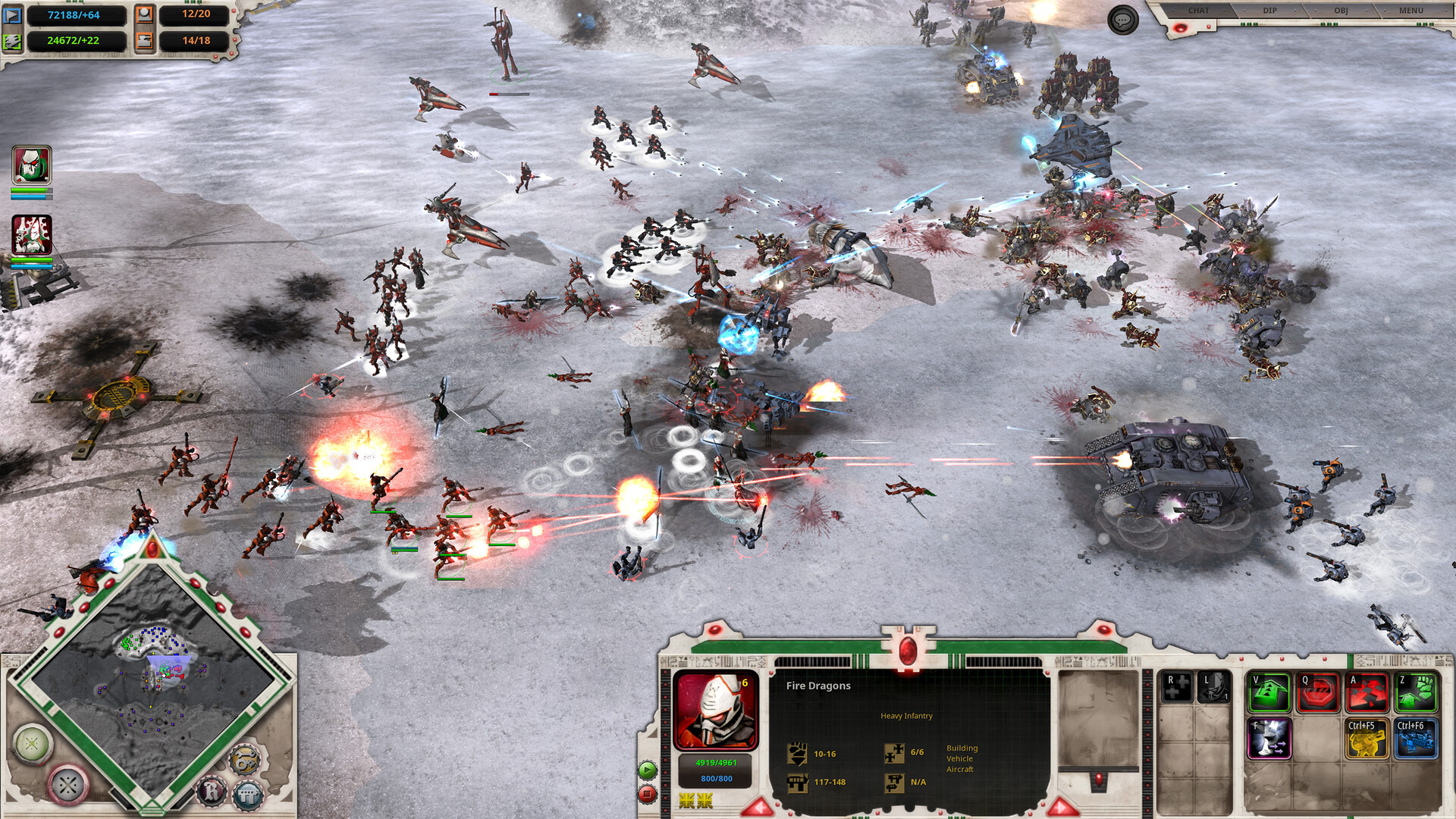
The later expansions change the campaign structure. Dark Crusade sets seven factions against one another on a strategic map of Kronus: the Space Marines, Imperial Guard, Eldar, Orks, Chaos, Tau and Necrons. Its map covers 25 provinces; on a turn, a commander can move or attack one adjacent province, then fight on that province's battle map. Planetary Requisition from controlled territory can reinforce provinces or augment attacks, and victories can award Wargear that changes the commander's appearance and abilities. Stronghold battles use distinct objectives beyond ordinary province fights. Soulstorm expands the conquest to the Kaurava star system and makes all nine factions playable in its campaign, adding the Sisters of Battle and Dark Eldar.
Individual battles revolve around taking and defending resource points while building a force. Infantry capture Strategic Points to increase Requisition, the main resource for units and structures. Power supports vehicles, heavy weapons and advanced units, while Orks also generate their own resource through settlements and Waaagh! Banners. Relics provide access to powerful units or abilities. Builders establish a base within the control area around captured points; Listening Posts can strengthen important positions. This makes expansion a battlefield task: capturing territory improves the economy, but holding it requires troops and defensive structures.
Armies are organized chiefly as squads rather than lone infantry. A squad can be reinforced with additional members, equipped with stronger weapons and given a squad leader; some powerful leaders can attach to another squad. Research at the growing base unlocks buildings, unit upgrades, weapons and abilities, while support structures and faction-specific upgrades raise squad and vehicle limits. Terrain also changes engagements: light and heavy cover reduce incoming weapon effects while slowing movement, and exposed ground can leave units more vulnerable. Morale is tracked alongside health; when it falls to zero, a squad breaks and fights poorly, although it remains under the player's control.
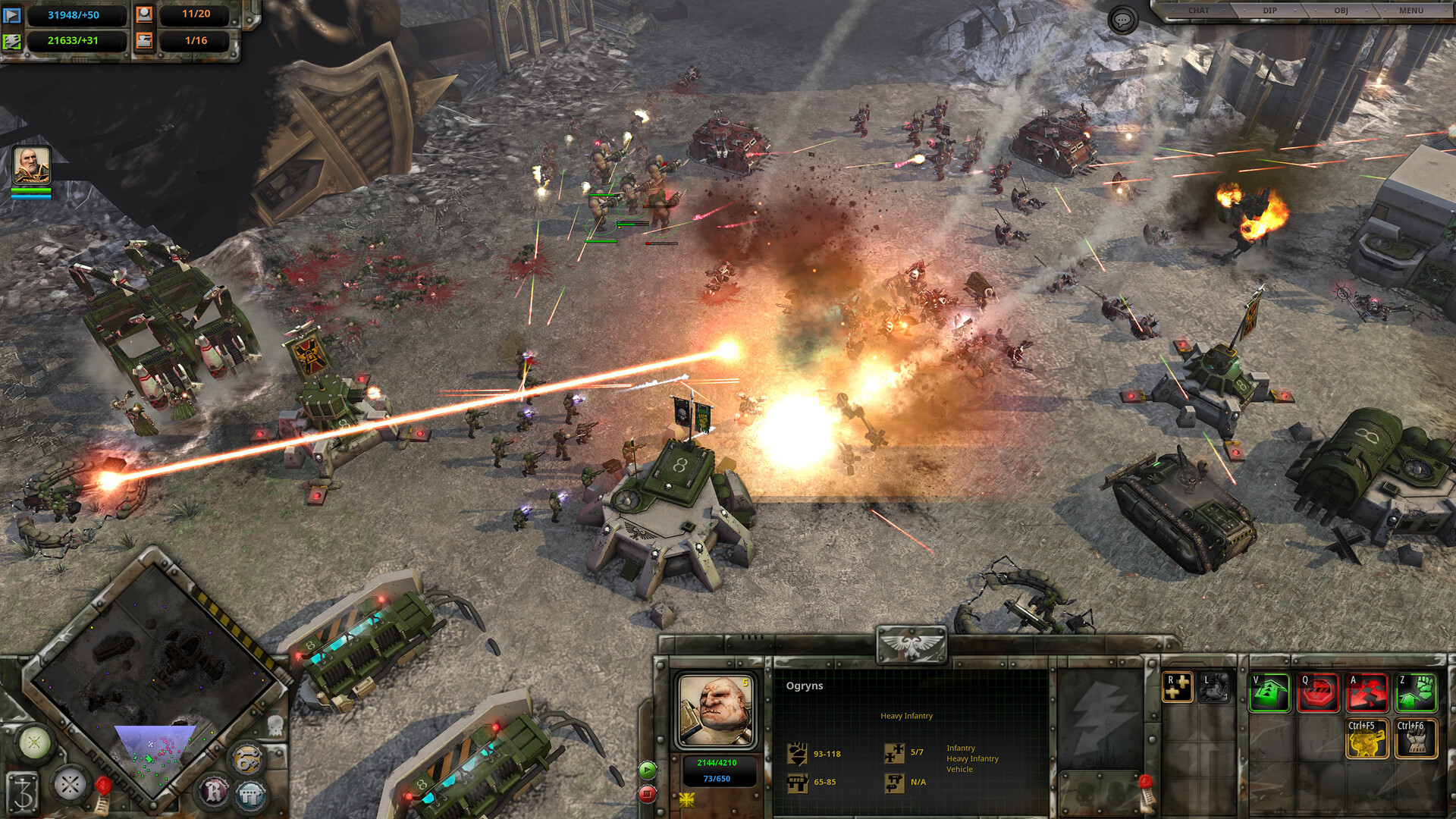
The factions use that common framework in distinct ways. Space Marines field costly, versatile squads with durable morale, while Eldar forces rely more on fragile specialists whose roles and abilities reward coordinated positioning. Eldar Webway Gates also expand squad and support caps, and let units teleport. Orks can increase their army capacity and unlock advanced structures by constructing Waaagh! Banners; their Boyz can be equipped for close combat or ranged support. These differences reach beyond unit appearance: a faction's buildings, resource flow and research shape which force can be fielded and how its squads contribute during a battle.
Beyond the campaigns, skirmish pits a player against computer-controlled opponents on multiplayer maps, and multiplayer supports two to eight players in team or free-for-all matches. The Definitive Edition keeps the classic battles while updating the presentation for modern PC play: it adds higher-resolution unit textures, refreshed lighting, an improved camera and pathfinding changes, alongside 64-bit support and an integrated Mod Manager. Those updates sit around the included original and expansion content; they do not turn the four campaigns into one continuous story. Each remains a separate setting, faction selection and campaign structure within the larger Dawn of War collection.
- Developer
- Relic Entertainment
- Genre
- Real-time strategy