
About Warhammer 40,000: Boltgun
Warhammer 40,000: Boltgun is a single-player retro first-person shooter starring Ultramarines veteran Malum Caedo. Sent to the Forge World Graia to recover a fragment of a mysterious power source, he fights through bastions, cathedrals, industrial ruins and corrupted landscapes against Chaos cultists, Traitor Space Marines and daemons, using a Space Marine arsenal and fast movement.
Warhammer 40,000: Boltgun places the player in the armour of Malum Caedo, an Ultramarines veteran sent on a dangerous mission on Graia, a Forge World under threat from Chaos. The objective is to locate a fragment of a mysterious power source while the planet is being overrun by cultists, Traitor Space Marines and daemons. The story is presented through the direct, mission-focused frame of a retro shooter: Caedo advances through hostile territory, receives guidance from his servo-skull and fights through the forces gathered around the objective. The game draws on the 41st Millennium's Imperium and Chaos conflict, with its militarised religious imagery, industrial scale and grotesque supernatural enemies shaping both the setting and the action.
Graia gives the campaign a sequence of contrasting battle spaces rather than a single repeated arena. The route moves through fortified bastions, cathedrals, corrupted canyons, furnaces and war-torn ground. These places combine recognisable Imperial architecture—heavy masonry, monumental statues, defensive gun positions and machinery—with signs of invasion and warp corruption. The Steam listing describes the mission as a search across the Forge World's surface; environments shift from built strongholds and sacred interiors to exposed terrain and industrial complexes. That variety changes sight lines, cover and the directions enemies can approach from. A narrow passage can concentrate a group of attackers, while a broad space gives room to move as larger threats enter the fight.
The campaign follows classic first-person shooter priorities: keep moving, read the space, find the route onward and manage the weapons needed for each encounter. Levels connect corridors and traversal sections to larger combat areas where waves of enemies and tougher champions can converge. Some routes loop back through previously cleared industrial areas, and progress sometimes depends on finding a way through rather than simply defeating everything in view. One early bastion sequence uses immense gun emplacements and the remains of war machines to give the battlefield a sense of scale. Later, a warp-distorted passage rearranges familiar geometry into looping gothic bridges; candles, sigils and sacrificial plinths mark a path through it. These spatial changes give navigation a role alongside the constant fighting.
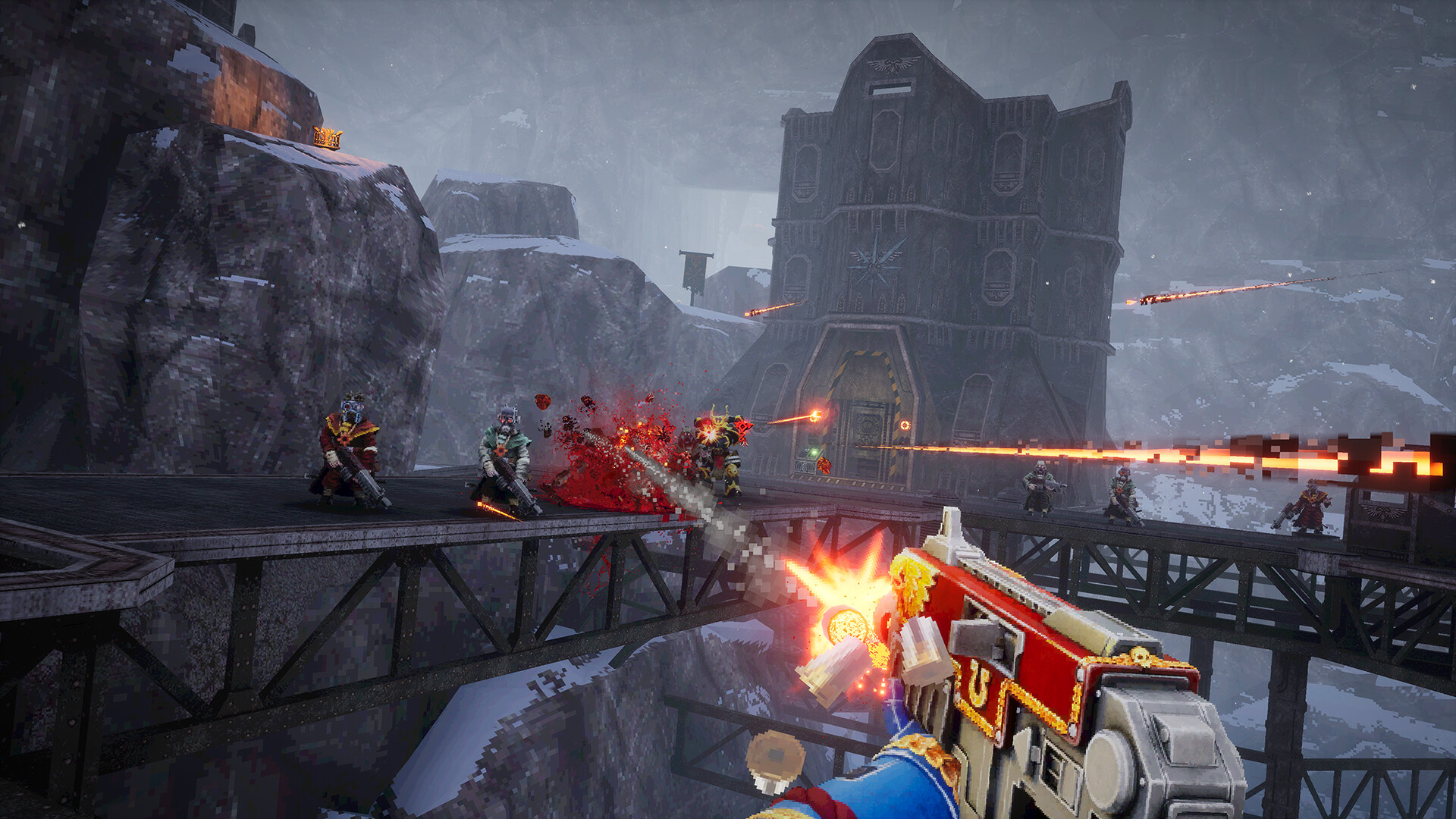
Caedo's mobility is built around aggressive forward motion. He can dash and jump through encounters, and the chainsword combines melee damage with a lunge that closes distance to a nearby target. That attack can also be used in the air, letting a successful close-range strike carry movement through a fight. The chainsword is always available as a direct answer when enemies press close, while firearms cover different ranges and threat types. The boltgun provides the central all-purpose weapon; the shotgun is suited to close groups, and the meltagun or plasma weapons offer heavier responses to more resilient enemies. The heavy bolter pours out sustained fire but constrains movement while carried. Grenades add another option when a group or armoured opponent needs a burst of explosive force.
Enemy encounters ask the player to make quick choices about target, distance and weapon. Cultists and lesser daemons can crowd a route, while Chaos Space Marines, Terminators, champions and greater daemons demand more attention and firepower. The roster includes enemies with distinctive attack patterns: an Aspiring Champion can charge with a chainaxe, and some fallen champions can return in a more dangerous form as Chosen of Chaos. Pink Horrors split into smaller blue Horrors when killed, adding fresh targets during a larger fight. The broad contrast between numerous weaker foes and a few durable threats affects how the player spends ammunition and movement. Switching weapons, using the chainsword to close a gap, or creating distance from an incoming charge all become parts of the same continuous encounter.
Weapons and equipment are found as the player advances, expanding the available responses over the course of the campaign. The arsenal includes the boltgun, shotgun, meltagun, heavy bolter, plasma weapons and a Vengeance Launcher, along with different grenade types. The weapons draw on the Warhammer setting's familiar armaments, but their practical roles remain readable in the action: a close-range blast, sustained automatic fire, explosive projectiles or a melee lunge each suit different situations. Ammunition and grenades are collected along the route, so exploring around a battle space can help prepare for what follows. The player has to remember which ammunition is available and match heavier weapons to more durable targets. This creates a rhythm of scanning the arena, choosing a tool and returning to movement as new threats arrive.
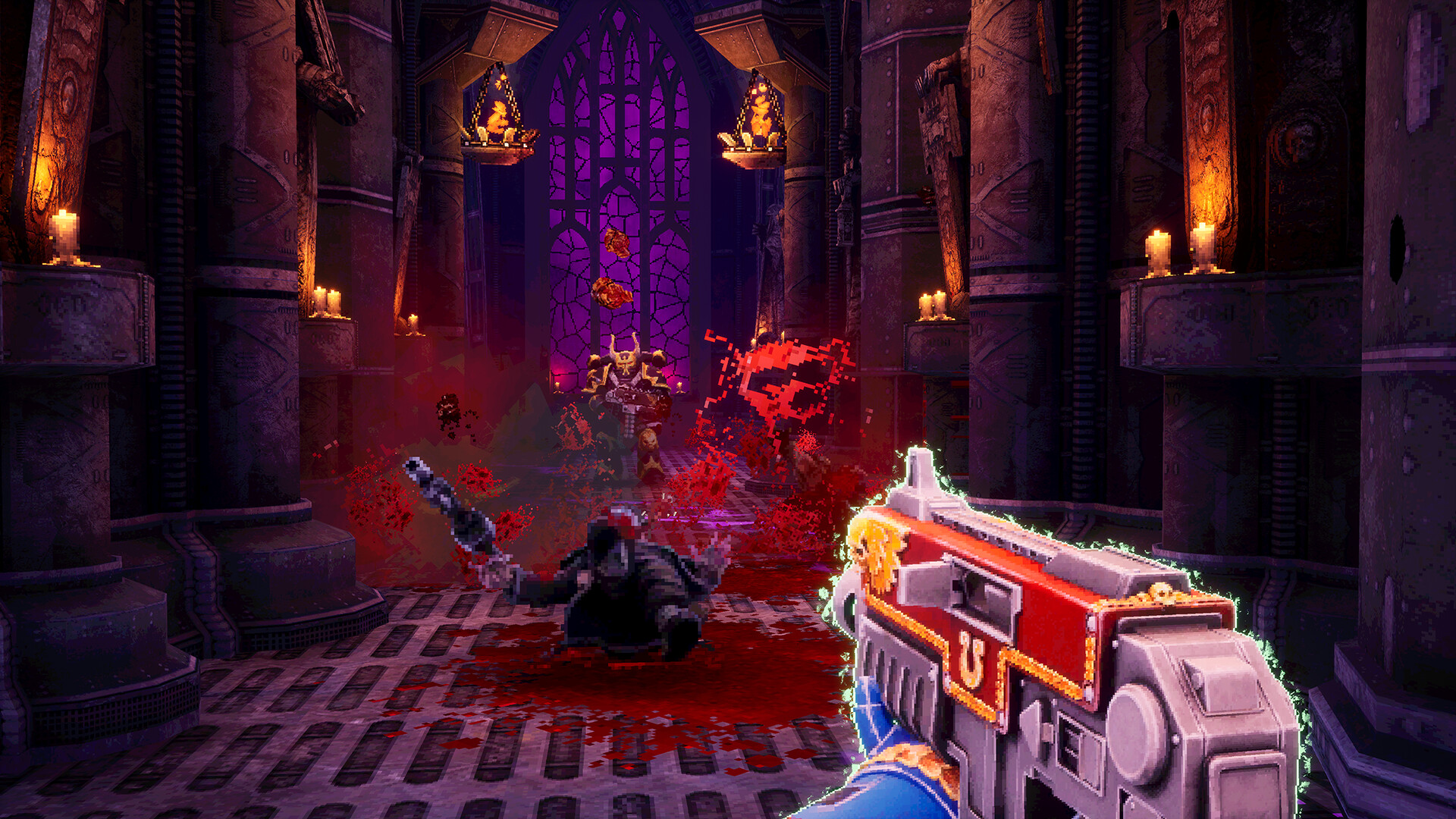
The presentation deliberately mixes low-resolution sprites and pixel art with the scale and iconography of Warhammer 40,000. Enemies burst into exaggerated gore, while retro cutscenes and pixel-art backdrops frame the mission in a style associated with 1990s shooters. Large gothic structures, machinery and battered fortifications remain central even when the action is fast and visually crowded. A servo-skull accompanies Caedo and provides mission context, reinforcing the setting's combination of military procedure and religious ritual. The soundtrack likewise draws together industrial weight and ceremonial elements, with heavy guitars and pounding rhythms alongside chants and harpsichord textures. Together, these choices make Graia feel both like a war zone and a sacred, corrupted Imperial world.
- Developer
- Auroch Digital
- Genre
- Single-player retro first-person shooter