

About Wander Stars
Ringo searches the stars for her missing brother and the pieces of a legendary map, reluctantly joining forces with the evasive Wolfe. Their journey unfolds in ten anime-styled episodes. Turn-based fights let Ringo build attacks from collected words, while changing episode routes, rival friendships and Pep Up bonuses connect the story to her growing Kiai skills.
Ringo does not set out to become the hero of a neatly organised expedition. She is a young martial artist looking for her missing brother, and the trail leads toward the fragments of the legendary Wanderstar Map. Wolfe, the scoundrel who becomes her partner, is pursuing the same pieces while avoiding questions about his own past. Neither has much reason to trust the other at first. That uneasy partnership gives Wander Stars a running dramatic tension beneath its exuberant anime styling: Ringo speaks quickly and often says more than she intends, while Wolfe knows how to dodge, bargain and conceal with words. The two travel between strange corners of a spacefaring universe, meeting pirates, witches, delinquent students, talking crows and other martial artists whose place in their journey may change. The map is a destination, but the relationships built on the way are the more immediate reason to keep following them. Story events unfold across ten episodes rather than one uninterrupted trek. That structure makes room for a new location and cast of problems, then returns to the longer mystery of Ringo's brother, Wolfe's motives and the map they both need. The characters can grow closer without the initial friction disappearing at the first sign of danger.
The world treats Kiai as both a martial art and spectacular entertainment, with fighters calling out attacks built from words. This conceit is the basis of the actual battle interface. On Ringo's turn, an action word supplies what she does: a kick, a block or an item use, for example. Modifier words can change an action's strength, reach or timing, and elemental words can attach an element and sometimes a status effect. The resulting phrase is not simply a funny name displayed above a preset move; the chosen categories and combination determine the effect. Spirit level limits how many word slots Ringo can use at once, so a longer, more elaborate phrase becomes possible as her capacity grows. An attack assembled for one opponent may be poorly suited to the next. Enemies can resist or be vulnerable to particular elements and actions, and the player may not know the answer before engaging them. That leaves room for a defensive word, a different element or a less flashy action to become the sensible choice. Kiai turns the ordinary role-playing question of which ability to select into a problem of what sentence to construct with the vocabulary currently in hand.
Words are resources as well as discoveries. Ringo can find more than two hundred across the full game, but a large collection does not mean every option is immediately available in every fight. The player chooses a loadout and must balance useful action words against modifiers, elements and defensive possibilities. Each word also has a cooldown. Using a valuable component now may leave it unavailable for the next exchange, so a strong phrase has an opportunity cost beyond its spirit-slot requirement. A word that makes an attack hit multiple targets, another that changes its speed and another that adds fire might all sound attractive, yet the enemy group, current cooldowns and remaining slots determine whether they belong together. This is where the game's deck-building influence enters a recognisable turn-based battle. The loadout shapes the range of sentences that can be spoken; the battle then asks the player to improvise within that range. Ringo's expanding vocabulary broadens strategy, but it can also make preparation more demanding. The appeal of a new word lies in discovering how it works alongside older ones, not just replacing a previous attack with a numerically larger version.
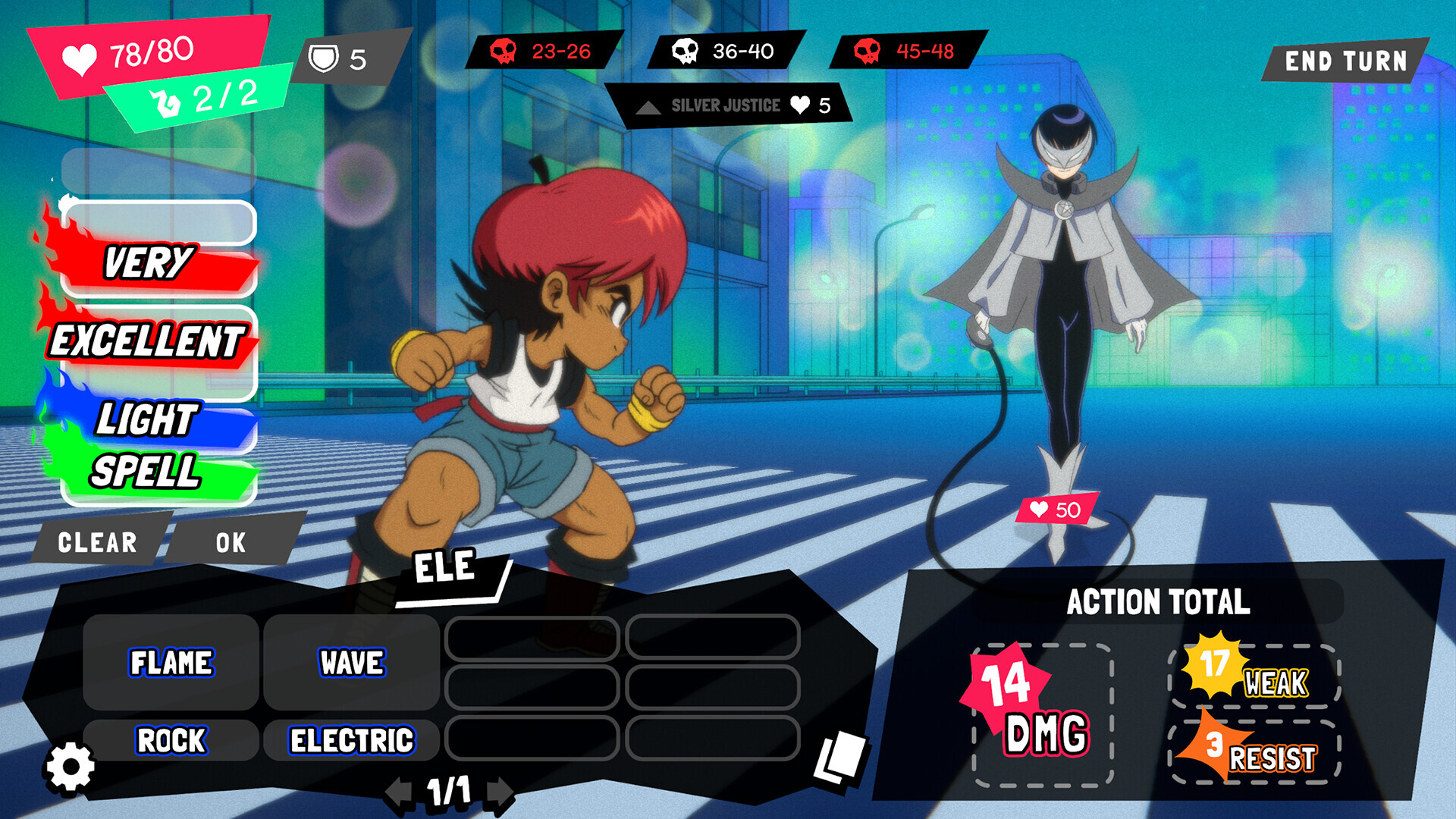
Victory has a social dimension because the code of Kiai values honour. Opponents are not automatically disposable obstacles; fighting in an honourable way can turn a rival into a friend. Those friendships yield Pep Ups, words of encouragement that can be equipped for combat bonuses. A dangerous encounter may therefore become the beginning of a useful relationship, linking the battle system to the game's story about finding companions in unlikely places. The more conventional growth track is present too. Honour earned during an episode can be used to strengthen Ringo after that episode is completed, while growing spirit power permits more complex word combinations. These systems operate at different moments: the player makes immediate tactical choices in a fight, builds a collection of words and allies over an episode, then carries some growth forward into the wider journey. That rhythm suits a story in which Ringo's technique and her ability to connect with other people both change. It also complicates the instinct to win every encounter by the quickest possible blow. The developer does not claim that every foe can be befriended in every circumstance, and the exact requirements of each encounter are something the game reveals through play.
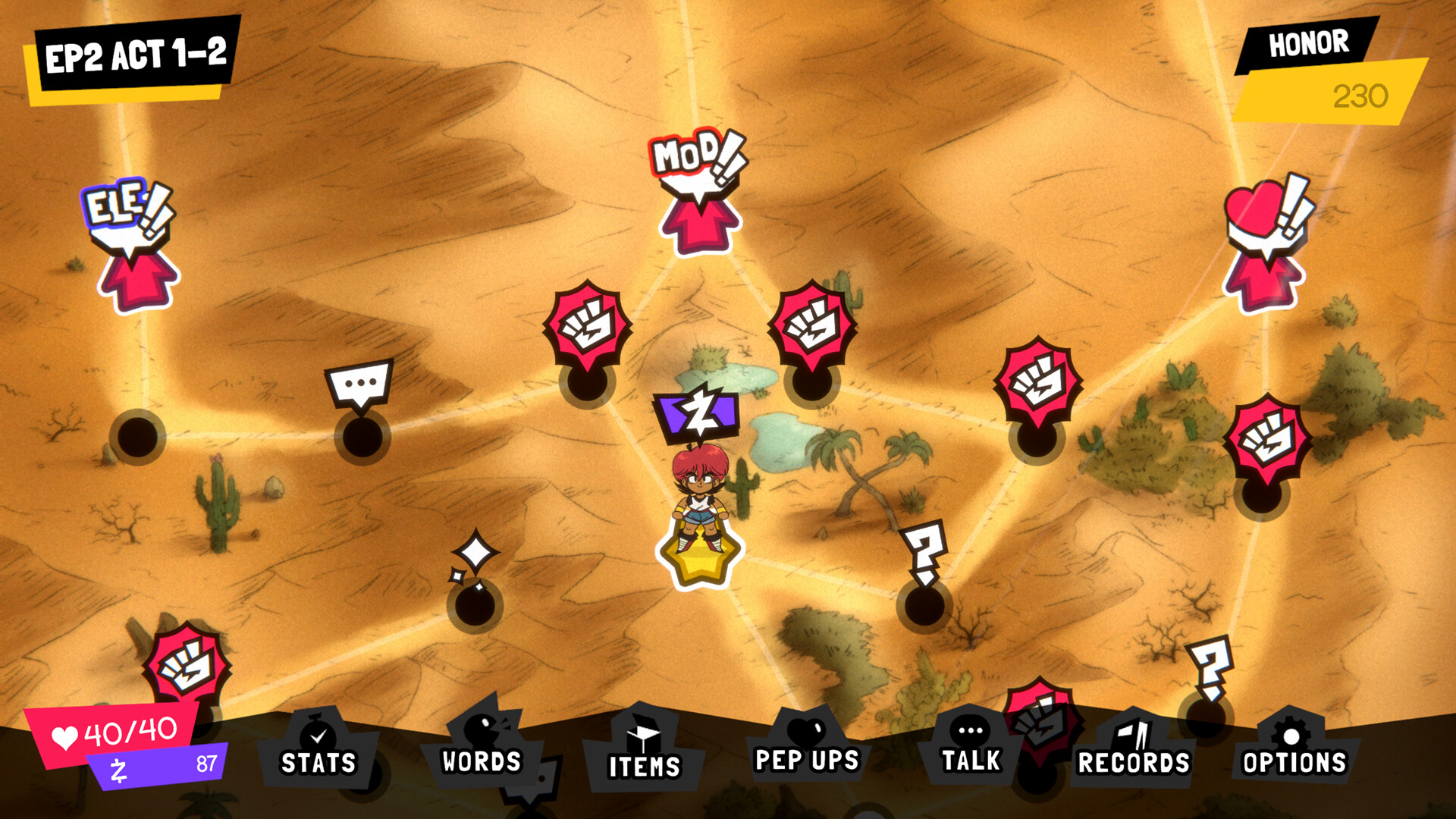
Between the authored story scenes, each episode offers a map with branching routes, battles, special events, rivals and treasures. The combat encounters and parts of the map's event arrangement change, so returning to an episode can reveal a path or side encounter missed before. Optional conversations with non-player characters and banter among companions give replay a narrative purpose alongside the hunt for words or rewards. This is not a claim that the main plot is procedurally written; the episode's story has a shape, while the route through its activities can vary. Choices about which way to go affect the sequence of risks and opportunities before the episode's conclusion. Someone chasing an unfamiliar word may accept a detour, while someone nursing a fragile loadout may prefer a different route toward the next story beat. The format allows a player to finish an episode, pause the broader adventure and later return without losing the sense of an ongoing serial. The publisher's save guidance makes the distinction practical: returning through the main menu preserves progress at reached map areas, whereas the End Episode command abandons the current run. A route is therefore more than a list of story scenes to revisit. It also brings a particular kind of tension to optional exploration: entering another encounter means spending time and resources in the hope that it will yield something valuable for later battles.
Paper Castle Games built Wander Stars around the premise that words should matter twice: they create attacks in combat and shape the bonds among the people travelling together. Narrative designer Andie Gallo has described Ringo's impulsive language and Wolfe's slippery speech as contrasting expressions of that idea. The developers' memories of anime watched in 1990s Venezuela inform the episode framing, shouted techniques, expressive character art and shifts between comic adventure and more difficult personal histories. Their Latin American background also contributes to the broader, mixed-culture space setting. The result is a role-playing game whose presentation explains its mechanics rather than merely dressing them up. Calling out an extravagant attack fits a universe where Kiai is watched as entertainment; choosing the exact words remains a tactical decision; and meeting an old rival again can matter because relationships have a mechanical form in Pep Ups. Wander Stars was made by Paper Castle Games and published by Fellow Traveller for PC and contemporary consoles. Its ten-episode single-player journey gives the word-building system time to expand while keeping Ringo and Wolfe's uneasy alliance at the centre of the trip across the stars.
- Developer
- Paper Castle Games
- Genre
- Turn-based, story-driven role-playing game