
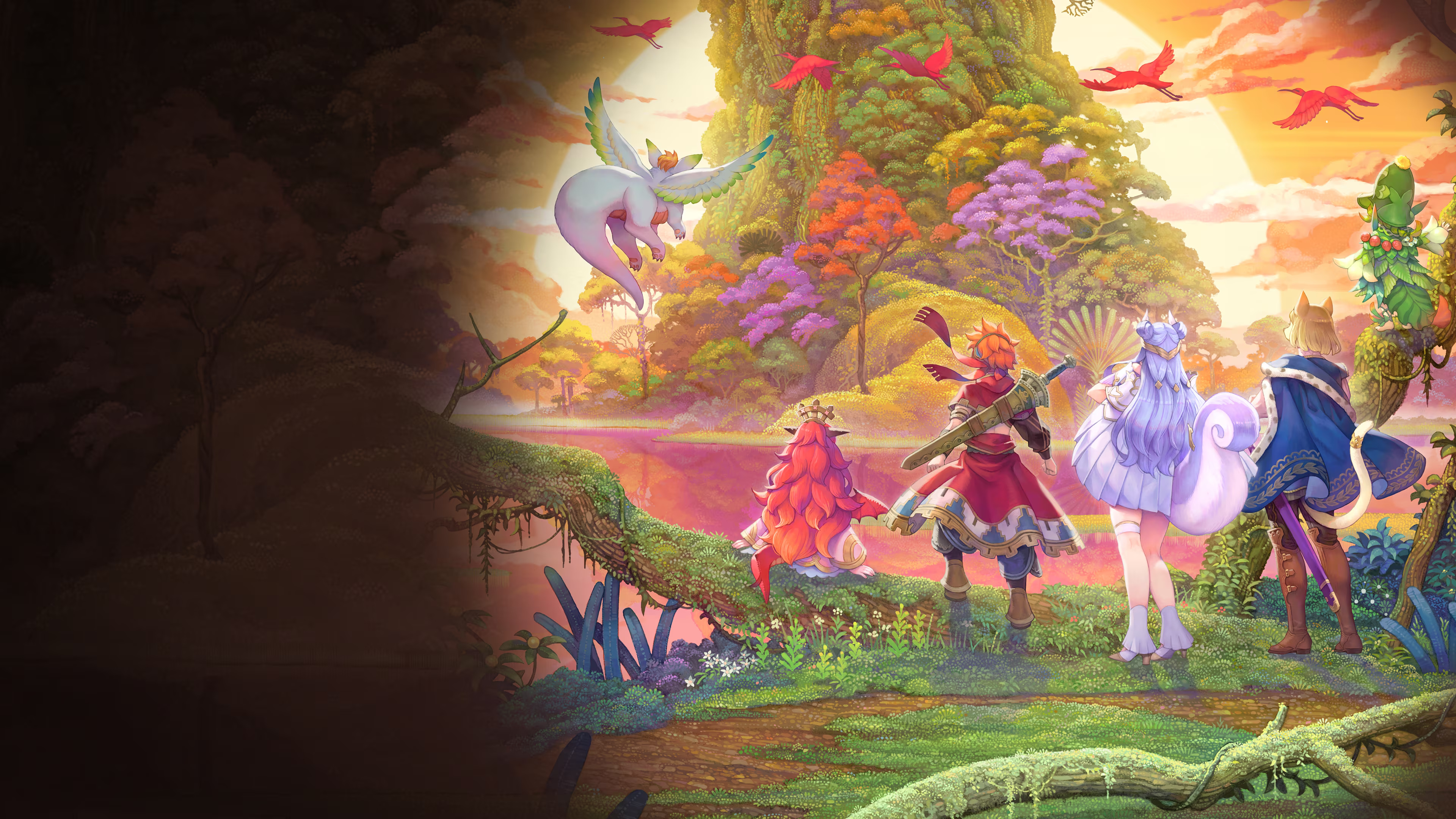
About Visions of Mana
In Visions of Mana, Val becomes a soul guard tasked with escorting his childhood friend Hinna, the newly chosen Alm of Fire, to the Tree of Mana. Their pilgrimage crosses elemental regions and brings them together with companions whose lives are tied to the world’s customs. Exploration and real-time combat both draw on the powers of eight Elemental Vessels.
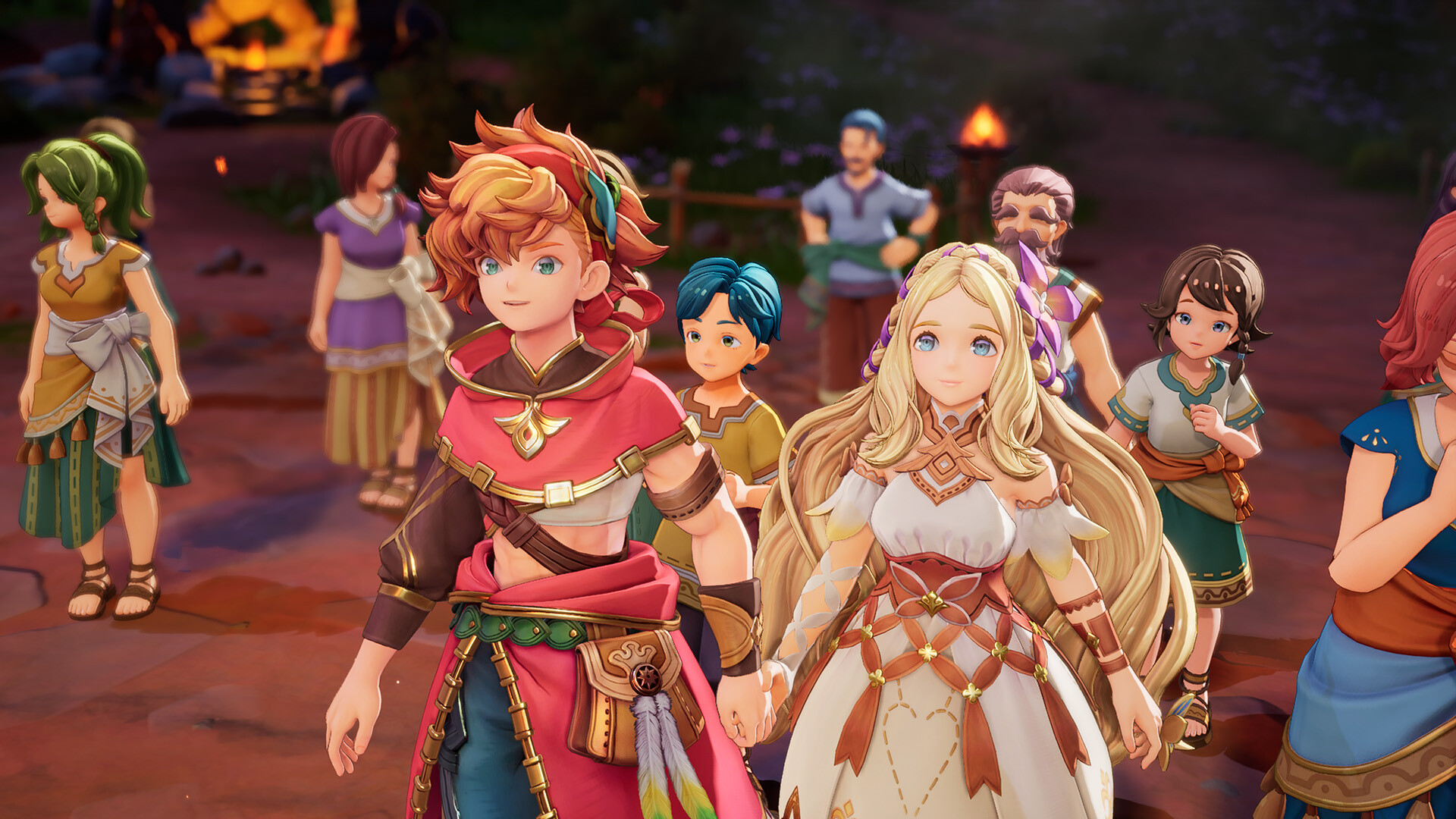
In Tianeea, the Fire Village, the arrival of the Faerie is a public ceremony with consequences for the whole world. Every four years, people are selected as alms and sent to the Tree of Mana to renew the flow of mana; a soul guard travels with them to protect the pilgrimage. Val has just taken on that guard’s role when the Faerie chooses his childhood friend Hinna as the Alm of Fire. The village sees their departure as a hopeful duty, but the journey gradually asks what it means to accept a fate assigned by tradition. Val’s route brings him into contact with the other alms and with people whose obligations to their homes are more complicated than a single ceremonial title. The story’s central journey therefore links a personal friendship to a world that depends on elemental mana, while its expanding cast gives the group different perspectives on what the pilgrimage requires.
The companions come from regions shaped by different elements and responsibilities. Careena, from Longren in the Vale of Wind, wants to see the world beyond her home despite an accident that cost her one wing; she is closely accompanied by Ramcoh, a young sacred beast. Morley comes from Etaern, the Moonlit Parish, and carries the memory of a disaster in his hometown. Palamena is the young queen of Illystana, where she must navigate political expectations while caring for her younger brother Iain. Julei is a sproutling from Verdeus Borough, responsible for tending his sleeping companions, and his routine changes after meeting Val’s party. The wider cast includes Eoren, a Gaian traveller from Gudju who repeatedly crosses paths with Val and Hinna, and Lyza, Val’s former soul guard mentor. Aesh, a scholar and head curator at the Log’grattzo Dark Archives, is driven by curiosity. These backgrounds give the pilgrimage a social geography: the party encounters communities and characters whose everyday concerns extend beyond the task of reaching the Tree. The five playable characters can be arranged into a three-person battle team, and the two off-field members still receive experience, allowing the active lineup to change without leaving those characters behind in basic advancement.
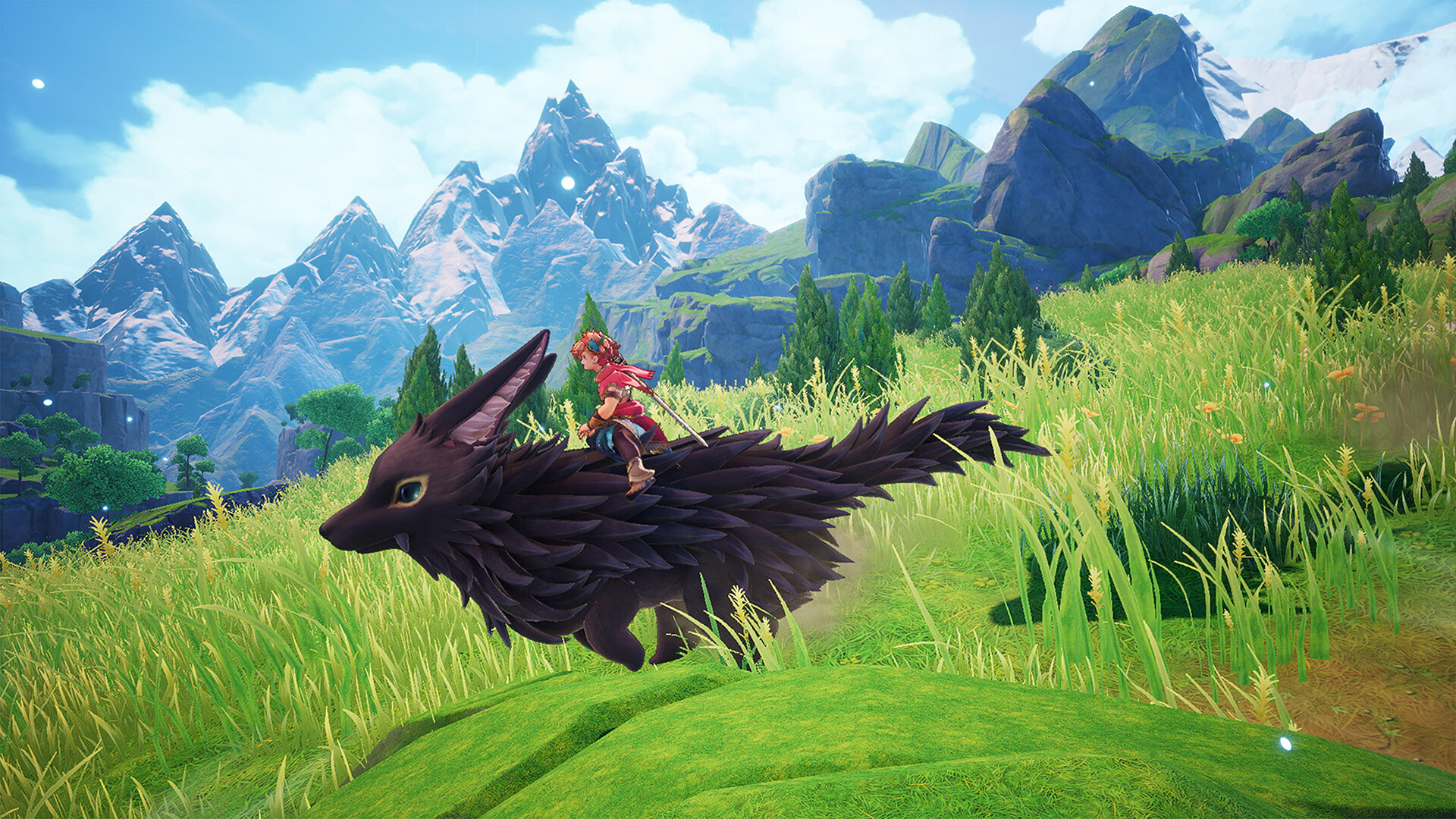
Travel moves between broad, semi-open regions and settlements rather than one continuous open world. The landscape invites the party to leave the direct route, search for chests and items, and follow side paths that rise above or dip below the main trail. Pikuls, summonable animal companions, provide quick overland travel and can trample enemies encountered while riding. As the journey grows, older areas can become newly traversable because Elemental Vessels also act as field tools. Glowing elemental triggers mark places where a vessel’s power can alter the environment: Sylphid’s wind creates gusts and raised rocky steps, Undine’s water moves floating bubbles or cools magma, Luna can slow time around hazards, and Dryad grows flowers that bridge gaps or lift the party. Other vessels manipulate fire, earth, reflected light, and gravity. This makes route-finding depend on recognising the relation between a visible obstacle and the elemental ability suited to it, and gives revisits a practical purpose when the party gains new powers.
Movement is built around readable actions that combine with those environmental powers. Val and the party can run, jump, dash, and traverse uneven terrain, while Pikuls cover ground rapidly once summoned with the Beckon Bell. Some elemental interactions extend a jump or create a temporary route, while others change an obstacle’s state: the Luna Globe can slow time to cross dangerous moving or frozen water, and the Undine Flask can move a bubble containing the character to a different height. Sylphid’s air currents can carry a leap across a broken path, and gravity-based Shade Sight can pull a character toward a surface beyond an ordinary jump or dash. These are not interchangeable traversal upgrades; each vessel has a distinct field function, so the player reads landmarks and uses the matching power. Later travel also includes Vuscav, which carries the party across open water, and Flammie, which flies over the world map. Together, the companions and vessel triggers make journeys a mixture of choosing a route, using local traversal affordances, and returning to places where a newly acquired element changes what can be reached.
Combat takes place in real time, with the player directly controlling one member of a three-person party and switching among the active characters as the situation changes. Attacks, jumps, dodges, spells, and skills form the basic toolkit; a ring menu and shortcut bindings provide access to items and abilities while preserving the action flow. The eight Elemental Vessels are also combat tools, each producing an elemental effect that can shape enemy movement or support allies. Wind can bind and suspend foes so follow-up hits burst the effect into nearby enemies; water can knock targets down or trap them in damaging bubbles; moon energy slows enemies and can shorten spell casting for allies inside its field. Earth creates a protective rocky shield, light links enemies so damage to one is reflected onto another, and darkness draws smaller enemies inward. Since party members can use different vessels, the player can layer effects by switching characters, but no enemy requires a specific switching sequence. Bosses add larger attack patterns and area warnings, making movement and positioning matter alongside damage output.
Progression connects character roles, weapons, and elemental abilities rather than keeping each hero in one fixed job. Equipping a vessel changes that character’s class, statistics, weapon type, appearance, and available skills; each of the five heroes has a distinct class for each element, so one vessel does not produce an identical role across the party. Class boards use elemental points to unlock abilities, while class-specific development adds spells, passives, and new actions. Weapon actions learned through class growth can carry across classes that use the same weapon type, so a character’s capabilities can accumulate as the player experiments. Ability Seeds provide another layer: equipping them can grant skills or alter attributes, with limited slots that expand over the course of the adventure. These systems make equipment choices and class-board spending work together: a vessel sets a broad combat identity, learned weapon actions can persist across related classes, and seeds tune the resulting kit. Class Strikes provide powerful finishing attacks, while vessel effects can be used for crowd control, protection, healing zones, or damage. Exploration feeds this growth too, because elemental field points can be gathered by attuning at places connected to vessels.
The presentation centres on a colourful fantasy world populated by spirits, monsters, villages, and large natural vistas, with the party travelling between regions whose elemental identities shape their landmarks. The design carries an action-RPG story through three-dimensional battle spaces while retaining familiar series features such as a weapon-based combat system, the Mana Sword, elemental spirits, and a prominent musical score. Field music can change interactively as the adventure unfolds; the Steam listing describes a score of around one hundred background tracks. The full game is a single-player release on PlayStation 5, PlayStation 4, Xbox Series X|S, and PC through Steam. Its elemental pilgrimage extends beyond the separately listed Steam demo, which samples selected story, battle, and exploration sections; the store warns that demo content differs from the release version and its progress cannot be carried into the full game.
- Developer
- Square Enix
- Genre
- Action RPG