
About Venba
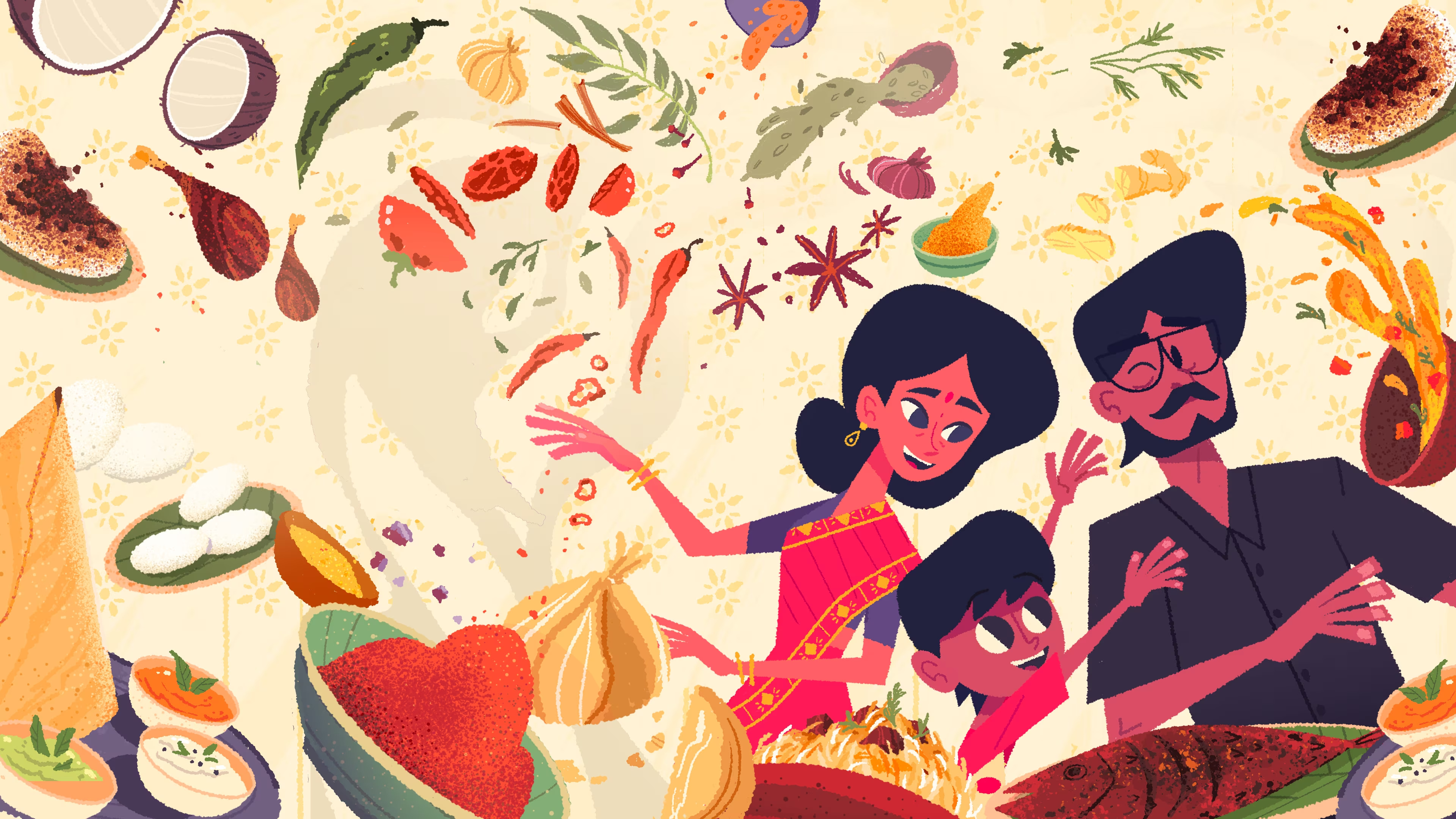
Venba is a narrative cooking game about a Tamil family building a life in Canada. Across years of family change, players help Venba reconstruct dishes from her mother’s damaged cookbook, share meals with her husband Paavalan and son Kavin, and follow the ways language, memory and food connect generations.
Venba opens in 1988, after Venba and her husband Paavalan have moved from India to Canada. The two are building a household in a country where they must adjust to a different language and culture while trying to secure work. Their son Kavin is still young, and the story follows the family through moments that are separated by years rather than through a single continuous adventure. A wall calendar, family photographs and later messages help place each scene in time, while ordinary domestic events provide the framework for larger changes. The game keeps its focus close to the family: the kitchen, conversations at home and decisions around meals become places where affection, worry and cultural memory surface. Venba’s mother has left her a cookbook, and the recipes inside it are an inheritance as much as practical instructions. The family’s move changes the conditions in which those dishes can be prepared, and the book itself is worn and damaged. That combination gives the story a concrete recurring object through which its larger concerns can be expressed. Rather than presenting immigration as a single turning point, Venba returns to the household at different ages and lets the family’s relationships shift alongside their circumstances.
Venba is the central viewpoint character, a Tamil woman who tries to keep a connection to home alive while caring for her family in Canada. Food is one of the ways she communicates when ordinary conversation is difficult: preparing a familiar dish can say something about affection, memory or belonging without requiring a long explanation. Paavalan shares the work of adapting to a new country, and the couple’s exchanges show that they do not always approach daily problems in the same way. As Kavin grows older, his relationship to the language and customs his parents brought with them becomes another source of tension and care. The story lets the family’s concerns emerge in scenes around meals, school, work and changing expectations rather than turning them into a separate lecture. Venba’s past as a teacher in India also informs her efforts to find a place in her new surroundings, while Paavalan’s employment experiences show how qualifications and identity can be treated differently after migration. These details keep the family’s challenges specific to their lives. The game’s dialogue includes choices during some conversations, but the wider narrative remains focused on the family’s passage through time. The central activity stays intimate: the player helps prepare food, reads the family’s exchanges and sees how the same household can hold different hopes for each generation.
Cooking is the game’s main hands-on activity, and each recipe turns the family cookbook into a small puzzle. The pages may be smudged, torn or difficult to interpret, so the player must use diagrams, partial directions and the tools visible on the counter to work out what happens next. In the opening idli sequence, for example, the preparation depends on arranging the steaming equipment correctly so the batter cooks as intended. Other tasks ask the player to choose and place ingredients in a particular order, sift or combine components, or move between several stages of preparation. These interactions are presented through a cursor and a series of kitchen surfaces rather than through a large cooking simulation. The challenge grows as the cookbook becomes less legible, which makes the act of interpreting a recipe part of the story’s meaning. It is possible to make mistakes and try again; hints can clarify a step, and successful sections act as checkpoints in longer recipes. That forgiving structure keeps attention on understanding the dish and its context instead of punishing experimentation. The game also supplies brief information about the food being prepared, so a cooking task can explain why a step matters as well as what input to perform. Completing a recipe produces a finished dish that returns the player to the family and the circumstances that made that meal meaningful.
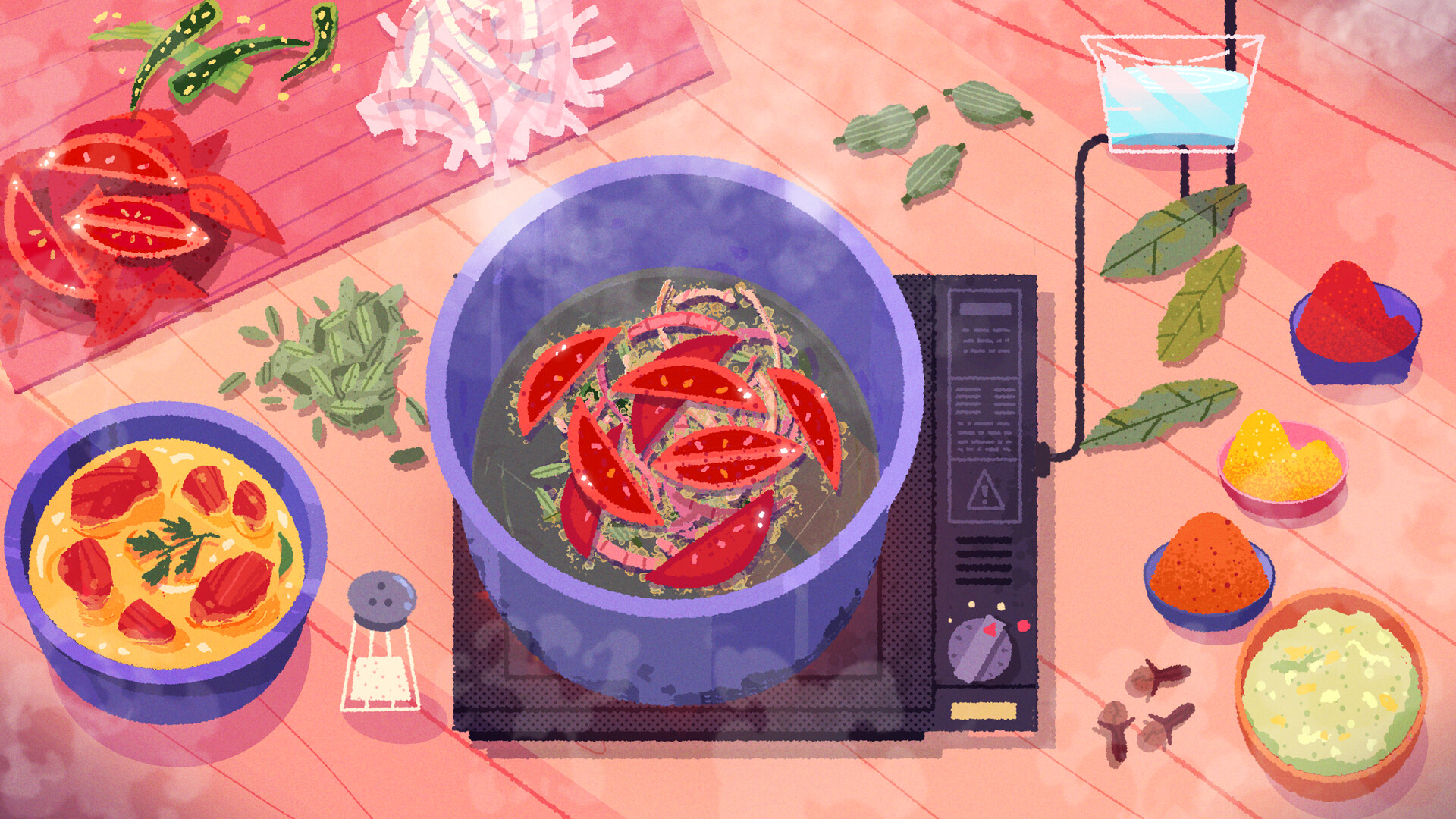
The dishes connect practical preparation with memory and communication. Venba’s inherited recipes come from a Tamil household, but the family now cooks them in a different place and under different circumstances. What the player can read on a page is not always enough, so the puzzle asks them to infer missing steps from familiar kitchen objects, illustrations and the sequence of ingredients. This is especially clear when a recipe moves beyond one counter or one instruction: the player must carry knowledge from an earlier step into the next part of the preparation. The game uses specific tools and techniques, including the steaming equipment used for idlis and the distinctive apparatus involved in making puttu, to make the process visible. Meals also mark events in the family’s life. A small change in what is served can carry meaning between Venba and Paavalan, while food later becomes one way to approach Kavin’s changing tastes and distance from his parents’ traditions. The focus is not restaurant service, timed orders or running a business; cooking is directed toward particular family meals. Instead, each cooking segment is authored as part of the narrative, and solving its steps restores a dish to the story. The cookbook’s decline in readability and the family’s changing relationship to its contents develop together across the game.
Outside the kitchen, Venba unfolds through illustrated scenes, conversations and short interactions around the family home. It does not use free-roaming exploration through a broad map; movement is limited to the scene and the points of interaction the story presents. The player’s attention is directed toward people and objects that establish what has changed since the previous visit, including calendars, photographs and messages. Those details provide a simple sense of chronology as the narrative moves forward by years. The conversation options let the player choose how Venba responds at selected moments, but the game remains a tightly authored family story rather than a branching role-playing campaign. There are no combat encounters, weapon systems, enemy types or combat progression. The main forms of interaction are reading, choosing dialogue and completing the cooking puzzles. This narrow structure links the cooking and story portions: a meal can lead into a family scene, and the scene gives emotional context to the recipe that follows. As Kavin grows older, the player sees how the household’s shared history can be understood differently by parent and child. A shift in language, the use of a different name at school or hesitation around bringing food to others can change what a familiar meal signifies. These developments are conveyed in short scenes that keep attention on the family’s changing relationships.
Progress comes through completing the sequence of chapters and their associated meals and conversations. Venba does not present a character-level skill tree, equipment system or combat build to develop. Instead, the player learns the visual language of the cooking puzzles: inspect a recipe page, identify which ingredients and utensils matter, perform the steps in order, and use clues or a hint when the page leaves too much uncertain. Later recipes can involve more stages and less explicit guidance, but the game preserves checkpoints so an error does not erase all prior work. The broader progression is measured in the family’s changing life. Scenes jump between different periods, allowing the same recipe book and home to be seen against new circumstances. The player encounters Venba and Paavalan as partners trying to make a life, then sees Kavin at different ages as his priorities and connections change. Some conversations offer alternate responses, and chapters can be revisited, but this does not turn the experience into a large branching narrative with many independent endings. The repeated structure—family moment, cooking activity, meal and conversation—gives the game a steady rhythm. Each return to the kitchen builds on what the player has learned about the cookbook, while each return to the family shows how the meaning of preserving a tradition can change from one generation to the next.

Venba presents its world through colourful, hand-drawn illustrations and food-focused animation. Ingredient handling, steaming and the appearance of finished dishes receive visual attention, while the scenes around the kitchen use calendars, family photographs and text messages to show the passing years. Dialogue is displayed on screen, with Tamil and English both represented in the family’s communication; language is part of the presentation as well as the subject of the story. The soundtrack draws on Tamil music, and the cooking sequences combine it with kitchen sounds such as sizzling and steaming. This audio and visual detail makes meal preparation feel distinct from the quieter conversations that frame it. The game is a single-player narrative experience, and its chapters form a compact, complete story. Venba is also available on Xbox, PlayStation and Nintendo Switch. Its progression is story-led from beginning to end: the player follows the family’s chapters, prepares the recipes presented within them and sees how food carries meaning across their changing home life.
- Developer
- Visai Games
- Genre
- Narrative cooking game with recipe puzzles