
About Vampire Survivors
Vampire Survivors is a gothic survival game about moving through monster-filled stages while weapons attack automatically. Collect experience gems, build a changing arsenal, and use upgrades to hold back increasingly dense enemy waves. Between runs, gold and completed objectives open further characters, stages, weapons, and ways to shape later attempts.
Vampire Survivors frames its action as a fight to last through the night. A chosen survivor enters a stage and navigates a top-down field while creatures approach from every direction. The threat grows as the run continues: weaker enemies can crowd the route, while tougher foes and bosses test whether the weapons gathered so far can clear space and protect the character. Movement is the player's constant direct input, used to avoid contact, steer attacks toward useful targets, and cross the stage for drops or objects. Weapons fire on their own, so the central task is positioning and assembling a set of attacks that can keep working as the horde thickens.
A run begins with a character's starting weapon and traits, then develops through experience. Defeated enemies leave experience gems; collecting enough raises the character's level and opens a choice of a weapon, passive item, or improvement to something already held. A weapon choice can add a new attack or strengthen an existing one, and its upgrades may change damage, area, duration, projectile count, or firing interval. The survivor can carry several weapons and passive items, so each level-up asks how to balance broader coverage against concentrating upgrades on a few tools. Gems and other stage drops remain available on the ground, letting players choose when to take risks to gather them. Because collected gems do not disappear, a route through a dangerous cluster can be postponed until the character is stronger or the path is clearer. That persistent field of drops helps make timing a tactical choice rather than a race against a vanishing resource.
The weapons cover distinct spaces and behaviours rather than relying on aiming each shot. Antonio's Whip strikes across the direction he faces; Imelda's Magic Wand fires toward nearby enemies; Pasqualina's Runetracer ricochets through the field; and Gennaro's Knife travels outward in the direction of movement. Other attacks orbit the survivor, circle the character, fall into areas, or launch toward enemies automatically. This makes movement part of offense as well as defense: a directional weapon rewards turning toward a crowd, while an orbiting or area attack can help keep nearby enemies at bay. Character traits and starting weapons give early runs different shapes, while level-up choices can broaden or reinforce them.
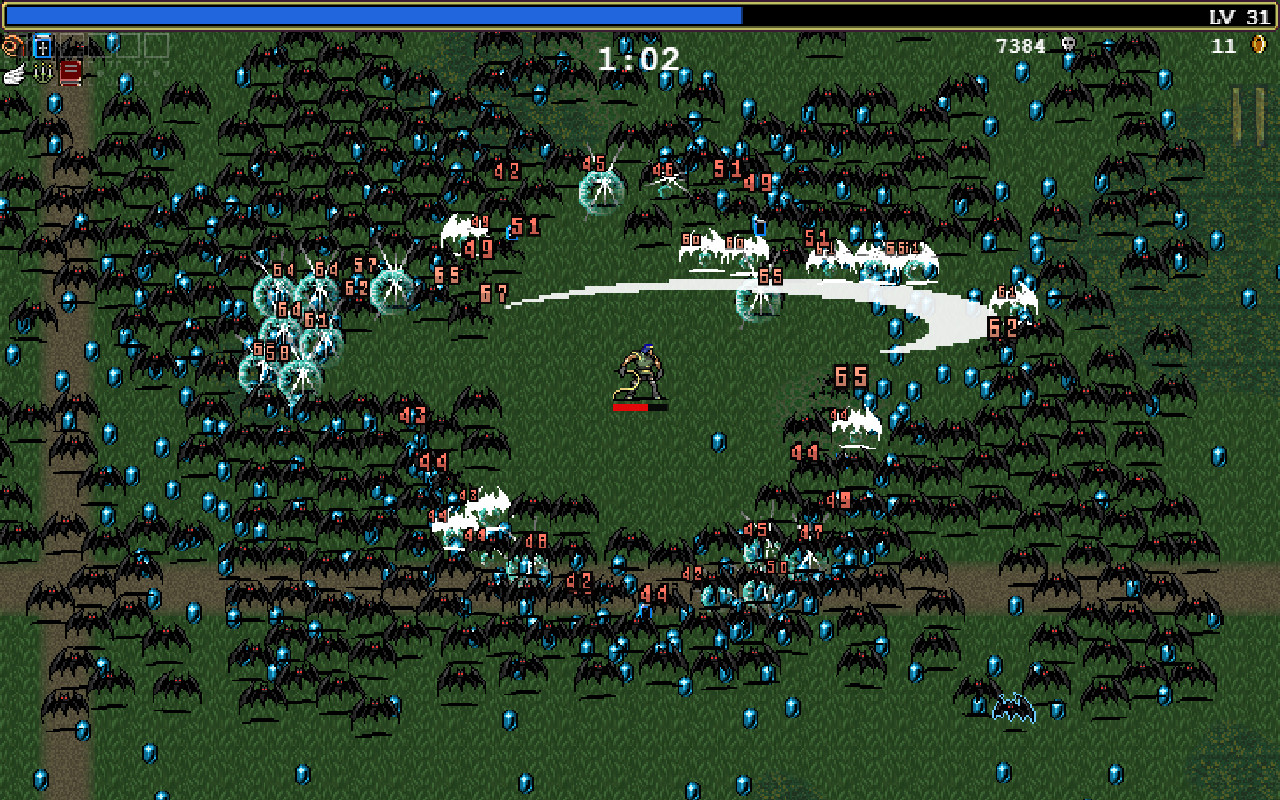
Passive items modify the survivor or support weapon combinations. Spinach raises Might, Empty Tome reduces weapon cooldowns, and Candelabrador expands the area of suitable attacks; other items can affect recovery, movement, luck, growth, projectile amount, duration, or greed. A weapon's evolution is a more specific transformation: the base weapon generally has to reach its maximum level, its paired passive has to be acquired, and an eligible treasure chest must be collected. The result replaces the base weapon with an altered attack. For example, the Whip combined with Hollow Heart can become Bloody Tear, which adds critical hits and health recovery. Recipes and requirements vary, and not every weapon evolves, so the collection of unlockable entries provides clues to combinations without making every build identical.
The stages give the survival loop different layouts and enemy rhythms. The starting Mad Forest offers open ground and landmarks to move between; the Inlaid Library is a long horizontal corridor where crowds can approach along a more constrained route; and the Dairy Plant uses separated lanes and obstacles that shape movement. Stage objects can supply useful items or objectives, giving a reason to leave a temporarily safe patch of ground. Defeating a boss may leave a chest, and collecting chests can grant upgrades or, when the relevant conditions are met, evolve a weapon. These encounters make timing and route choices matter: a chest may draw the survivor toward danger, but the reward can substantially change the run's attack pattern.
Progress continues outside a single attempt. Gold gathered during runs can be spent on persistent power-ups, with the ability to refund purchases and redistribute them for later runs. Completing listed objectives and meeting character-specific conditions unlocks additional survivors, weapons, stage choices, and relics. Relics can reveal or enable broader rules and options; Arcanas, for example, add a selected modifier that can alter how a build behaves. Once unlocked, these systems make the same early choices connect to longer-term goals: filling entries in the collection, discovering a weapon's transformation, or reaching a new stage. Defeat ends the current run, but gathered gold and completed unlock conditions carry progress into the next survivor's attempt.
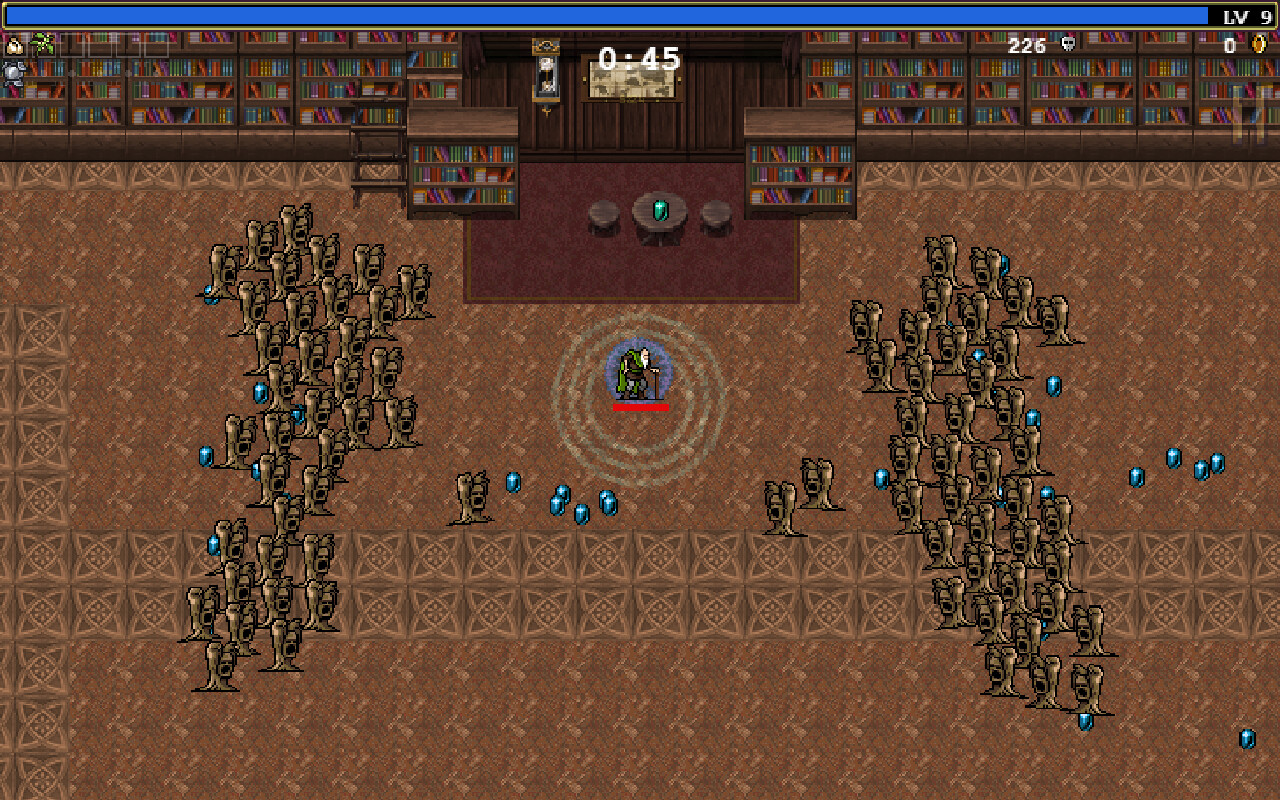
The base game also supports local cooperative play, with up to four players sharing a stage and trying to survive its waves together. In co-op, players still build weapons and gather upgrades during the run, coordinating their movement as the screen fills with enemies and attacks. The downloadable expansions add their own settings, characters, weapons, and associated progression; their material is separate from the base game's original cast and stages.
- Developer
- poncle
- Genre
- gothic horror survival game with roguelite elements