
About Untitled Goose Game
A goose wanders through a quiet English village, disrupting residents by stealing objects, honking, and turning ordinary routines into small puzzles. To-do lists point toward pranks that open the way into new areas. The complete game also supports local two-player co-op, with two geese sharing the same levels.
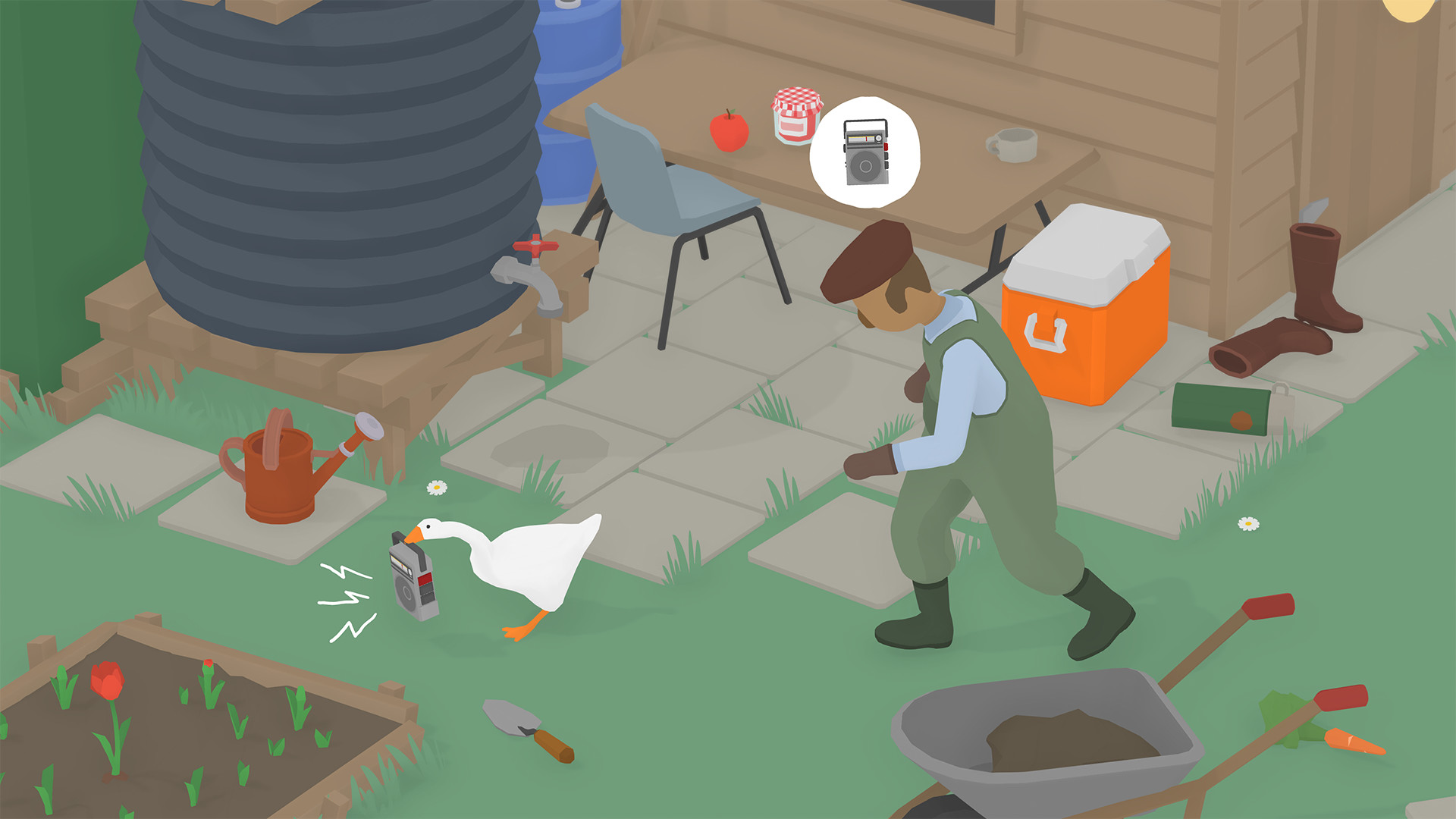
Untitled Goose Game places a player-controlled goose in a quiet English village whose residents are occupied with familiar routines. A groundskeeper tends a garden, a shopkeeper looks after a high-street store, neighbors spend time in adjoining backyards, and people gather at the pub. The goose has no spoken dialogue or elaborate backstory; its character comes through movement, the objects it takes, and the tasks it chooses to pursue. The central premise is deliberately small: enter these everyday spaces and interrupt what people are doing. The result is a chain of physical comic situations rather than a conventional battle against enemies. A resident may chase the goose, recover a misplaced possession, or resume a routine once the disturbance ends. That return to normality gives the player room to set up another prank, while each person’s habits make the same action play differently in a garden, shop, or pub.
The goose’s body is its main toolkit. It can waddle, run, lower its neck, flap its wings, honk, and pick up objects with its beak. These actions are simple, but they support different kinds of disruption: a honk can attract attention or unsettle a person, while carrying off an item can draw its owner away from a place or interrupt a task. The beak also lets the goose move things through the environment, placing an object somewhere its owner will notice or bringing it within reach of another character. The game’s puzzles often emerge from combining these verbs with the layout and routines of a space. Rather than selecting dialogue or abilities from a large menu, the player watches what people do and tries a physical action that changes their behavior. The broad, expressive movement set also makes the goose’s posture and motion part of the comedy, so traversal itself remains visible and characterful.
Stealth is woven into these encounters through attention and timing. House House describes villagers as having limited vision and distinct states for noticing a missing possession or spotting the goose. A person may use an object as part of a routine, react when it disappears, then look for it or pursue the thief. This makes an unattended moment useful: the player can approach from behind, take something while its owner is occupied, or move away before being seen. If the goose is noticed, the response is legible in the character’s movement and reactions, and the player can evade pursuit or change the situation by dropping or relocating the object. The point is not to fight residents; the tension comes from managing their attention while arranging a harmless-looking everyday scene into a prank. Repeated routines provide readable opportunities, while the human characters’ responses keep a theft from feeling like a detached inventory action.
To-do lists give these interactions direction without turning the village into a sequence of explicit instructions for every move. Each area presents goals that ask the player to produce a result, such as interfering with a resident’s activity or getting an object into a particular situation. The list functions as a prompt to inspect people, props, and routes, then work out how their behaviors might connect. House House has described creating small scenarios first and using the lists to help players discover them. Some pranks therefore depend on timing a distraction; others involve carrying an item between characters or using one person’s reaction to affect another. Objects can be temporarily displaced and villagers can restore their routines, so a failed setup can often be tried again with a different approach. Completing enough of an area’s tasks opens progression onward, while the changing locations introduce new characters and new arrangements of everyday objects.
The village is organized as a series of compact, connected spaces rather than a single open landscape. The opening garden establishes the basic relationship between the goose, a person, and belongings that can be taken. The high street adds shop goods and people who respond to the goose differently; the backyards place neighbors and their belongings within reach of one another; and the pub creates a busier setting with staff, patrons, and an entrance to negotiate. These spaces share the same core actions, but their layouts and residents change what those actions can accomplish. A fence, doorway, table, or route between yards can make an item easier to move or give the goose a way to approach unseen. Progression thus broadens the social situations the player can manipulate while keeping the controls consistent. The final journey revisits earlier areas around a model-village bell, drawing the route back through familiar residents and spaces.
Presentation supports the game’s quiet, physical style. Characters communicate through gesture, posture, and short vocal sounds rather than spoken dialogue, so the player reads a person’s intent from what they are doing and how they respond. The environment is rendered as a bright, carefully arranged village, with ordinary garden tools, shop goods, furniture, and personal belongings serving as potential parts of a puzzle. Sound helps mark changes in a scene: the goose’s steps and honks stand out against ambient village sounds, and the piano score can shift in energy or pause as activity changes. House House has explained that the music is assembled from short passages that can move between more energetic and subdued versions or silence, aiming for the impression of a pianist responding to events. These cues make a chase or successful theft easier to read without adding explanatory dialogue or a dense interface.
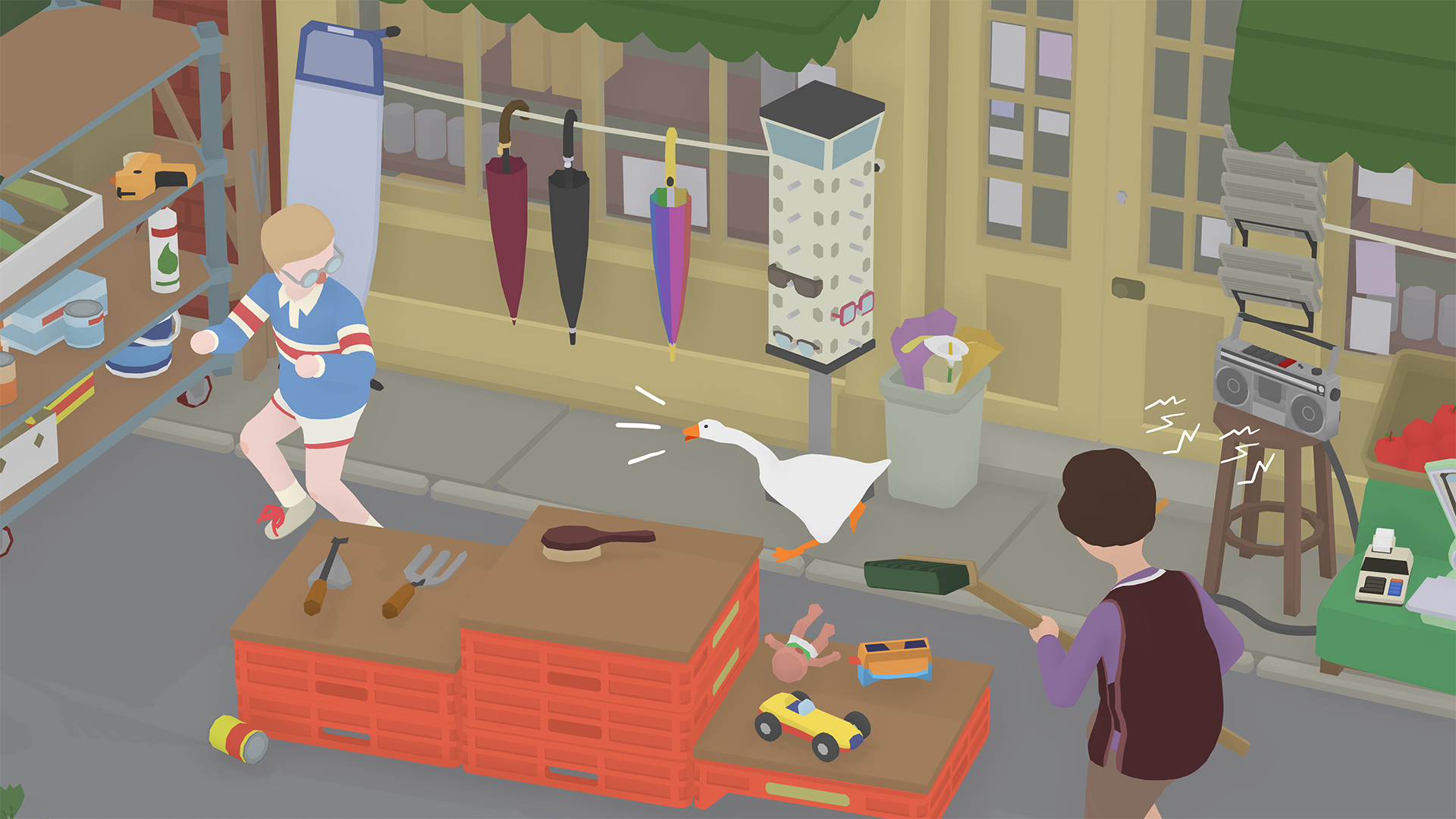
The standard game can be played alone, and it also includes a two-player cooperative mode on the same levels. In co-op, each player controls a goose, allowing the pair to coordinate distractions, carry out related pranks, or simply create simultaneous interruptions. House House’s support information specifies that this is local co-op and requires two controllers; on supported platforms, remote streaming features can provide a way to play together over the internet. The game is sold on Steam as Untitled Goose Game, developed by House House and published by Panic, and the Steam listing describes the two-player mode as an update for owners that allows the whole game to be played with two players. The pair still explores the same village and to-do lists, so two players add another way to coordinate a distraction without changing the story or replacing the single-player route.
After the main route returns the goose to its starting point, further to-do entries extend the same interaction rules into optional challenges. House House has said these entries record interesting things the player can already do, including reactions that arise from shared object behaviors and other moments the developers anticipated by filling in cases that seemed as though they should work. This makes experimentation part of the structure: the list can point toward a result, but the player still has to identify a suitable object, person, and opportunity. The system mixes general rules with handcrafted responses, so an object may behave consistently across situations while a particular character encounter has its own authored reaction. The game does not promise that every imaginable interaction will work, and the developers describe leaving some plausible actions unsupported. Instead, the player learns the boundaries by testing the village’s objects and observing the response. Optional goals therefore build on the core loop of noticing routines, handling objects, and arranging a readable consequence.
- Developer
- House House
- Genre
- Slapstick stealth sandbox / puzzle game