
About Undertale
A human child falls through a mountain into the Underground, a world inhabited by monsters, and sets out to find a way back to the surface. This single-player role-playing adventure combines puzzles, character encounters and turn-based battles in which actions, timed attacks and real-time dodging shape each encounter.
Undertale begins when a human child falls into the Underground, a world beneath the surface where monsters live apart from humanity. The child must travel through connected regions and look for a way out, meeting inhabitants who can be wary, welcoming, comic or dangerous. The premise gives the journey a clear direction, but its moment-to-moment progress comes from talking with characters, navigating rooms, solving environmental puzzles and deciding how to respond when a monster blocks the way. The game keeps its world compact and character focused: a conversation, a sign, a puzzle mechanism or an unexpected interruption can reveal as much about a place as a long explanation. Its pixel-art presentation and dialogue-driven scenes support frequent shifts between exploration, humor and tension.
Moving through the Underground means crossing rooms on foot, checking objects and speaking with the monsters encountered along the route. Puzzles ask the player to notice patterns, operate switches, move through hazards or understand a character's instructions; they often give each new area a small change of pace between battles. The spaces also contain save points and objects that can be inspected for extra lines of text. These details are part of how the world communicates: a sign may be practical, a character may interrupt the expected rhythm, and a familiar room can have a different feel after later events. Undertale does not reduce its exploration to combat encounters alone. Progress alternates between short stretches of movement and interaction, authored set pieces, puzzles and conversations that establish the personalities of the monsters who inhabit each region.
When a battle starts, the player chooses from FIGHT, ACT, ITEM and MERCY. FIGHT begins a timed input sequence in which stopping a moving marker closer to the centre increases the attack's effectiveness. ACT presents actions specific to the opponent: checking, talking or trying another response can affect how that monster behaves and whether the encounter can end peacefully. ITEM uses food or equipment carried by the child, while MERCY offers ways to spare or, where possible, flee. The available choices make an encounter a small conversation as well as a fight. Enemy descriptions and dialogue provide clues about temperament, and trying a suitable ACT can change the next turn's situation. Some encounters reward observation and a carefully chosen response more than repeated attacks.
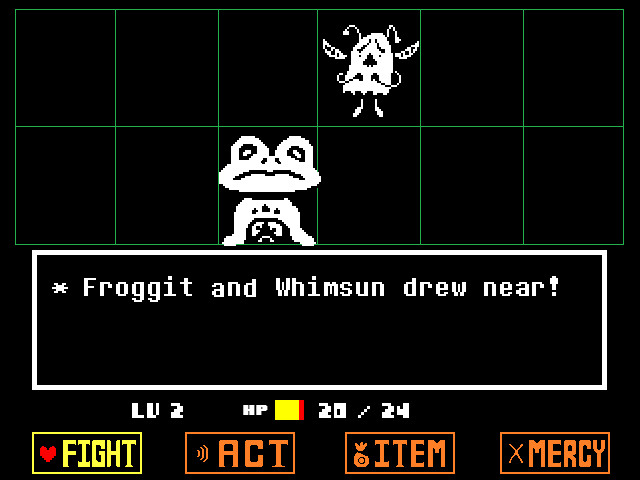
After the player's menu turn, the opponent attacks inside a rectangular battle box. The child's SOUL appears as a small heart that the player steers through moving patterns, dodging projectiles in real time until the enemy's attack phase ends. The patterns differ between opponents, so survival depends on reading their shapes and timing rather than selecting a defensive command and waiting. Certain attacks use colour-coded rules, and some battles alter how the SOUL moves, adding constraints such as jumping or choosing a shield direction. Taking a hit reduces HP; food can restore health, while equipped weapons and armour change combat attributes or effects. This back-and-forth gives battles two distinct rhythms: deliberate menu choices followed by immediate movement, with each opponent presenting its own arrangement of hazards.
The system connects a player's choices with character growth. Defeating a monster can award EXP, which raises LV and improves the child's combat capacity; ending an encounter through mercy does not provide that combat reward. Equipment and consumable items offer other ways to prepare, and the inventory has limited space, so deciding what to carry can matter on a longer stretch between opportunities to restock. A peaceful resolution may require learning an opponent's habits and selecting an ACT that changes their willingness to fight; a direct attack instead relies on timing and damage. The game does not force every encounter into the same pattern, and an action that works for one monster may be irrelevant to another. Players therefore read descriptions, test available commands and adapt their approach as the cast and battle situations change.
Outside combat, the child can save at marked points and revisit earlier spaces as routes connect. These checkpoints preserve progress and restore the ability to continue after defeat. The world uses familiar role-playing elements such as equipment, shops, healing items and locked paths, but presents them through brief exchanges with named inhabitants. Toriel, Sans, Papyrus and Undyne are among the characters the child encounters; their dialogue and reactions give the journey a social texture beyond a sequence of anonymous battles. Objects may prompt jokes, hints or optional context, and recurring characters can return in new situations. As a result, talking and examining are practical parts of the loop: they reveal how people interpret events, point toward immediate tasks and sometimes provide a fresh way to think about an obstacle.
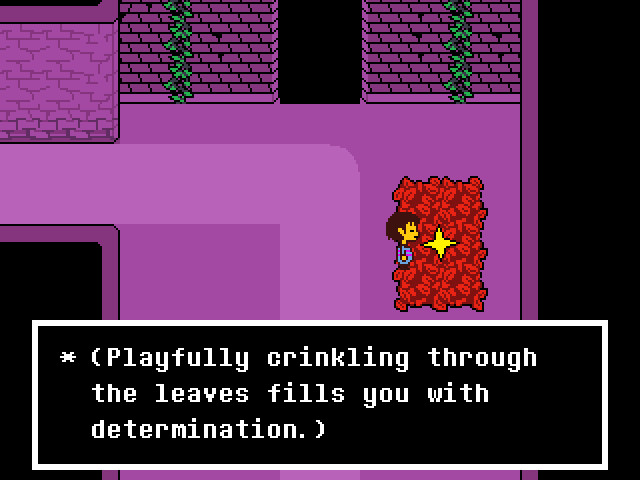
The route through the Underground moves from the Ruins to places such as Snowdin, Waterfall and Hotland. Each area brings its own residents, hazards and shops, giving the child different reasons to stop and prepare before pressing on. Shopkeepers exchange items for G, the local currency, and healing food varies in how much health it restores; some items have an additional effect during a battle. A player may spend money on supplies, keep a useful item for a difficult encounter, or use what is already in the inventory to make room for something found ahead. The changing places also alter the tone of the journey: a snowy town, a cavern and a heated industrial stretch invite different kinds of exploration, even while the familiar battle menu anchors each new meeting with a monster.
- Developer
- tobyfox
- Genre
- Single-player role-playing game