

About Twelve Minutes
A man comes home to dinner with his wife, only for a detective to burst in, accuse her of murder and turn the evening violent. He returns to the instant he entered the apartment and lives it again. Twelve Minutes is a top-down thriller in which each attempt gives the player knowledge to test during the next short loop.
The evening begins with a familiar domestic promise: a man opens the door of his apartment and joins his wife for dinner. Within minutes a detective forces his way in, accuses her of murder and makes the small space dangerous. The man is killed and finds himself back at the instant he first stepped inside. His wife has not heard the accusation yet, the detective has not arrived, and the apartment is arranged as it was before. Twelve Minutes makes that return the central problem rather than an unexplained shortcut to another level. The player knows what is coming while the other people in the room appear to be meeting the evening for the first time. Stopping the detective may seem like the immediate task, but the charge against the wife and the way each person responds raise other questions about what happened before the front door opened. The repeating scene also changes the meaning of the first few ordinary minutes. Dinner is no longer a pause before the plot begins; it is time in which the man might learn something, prepare for the visitor or decide what he can safely tell his wife. The premise depends on a small cast and a single home. There is no distant city to investigate between attempts; the same door, rooms and conversations must yield a different understanding when the man returns to them.
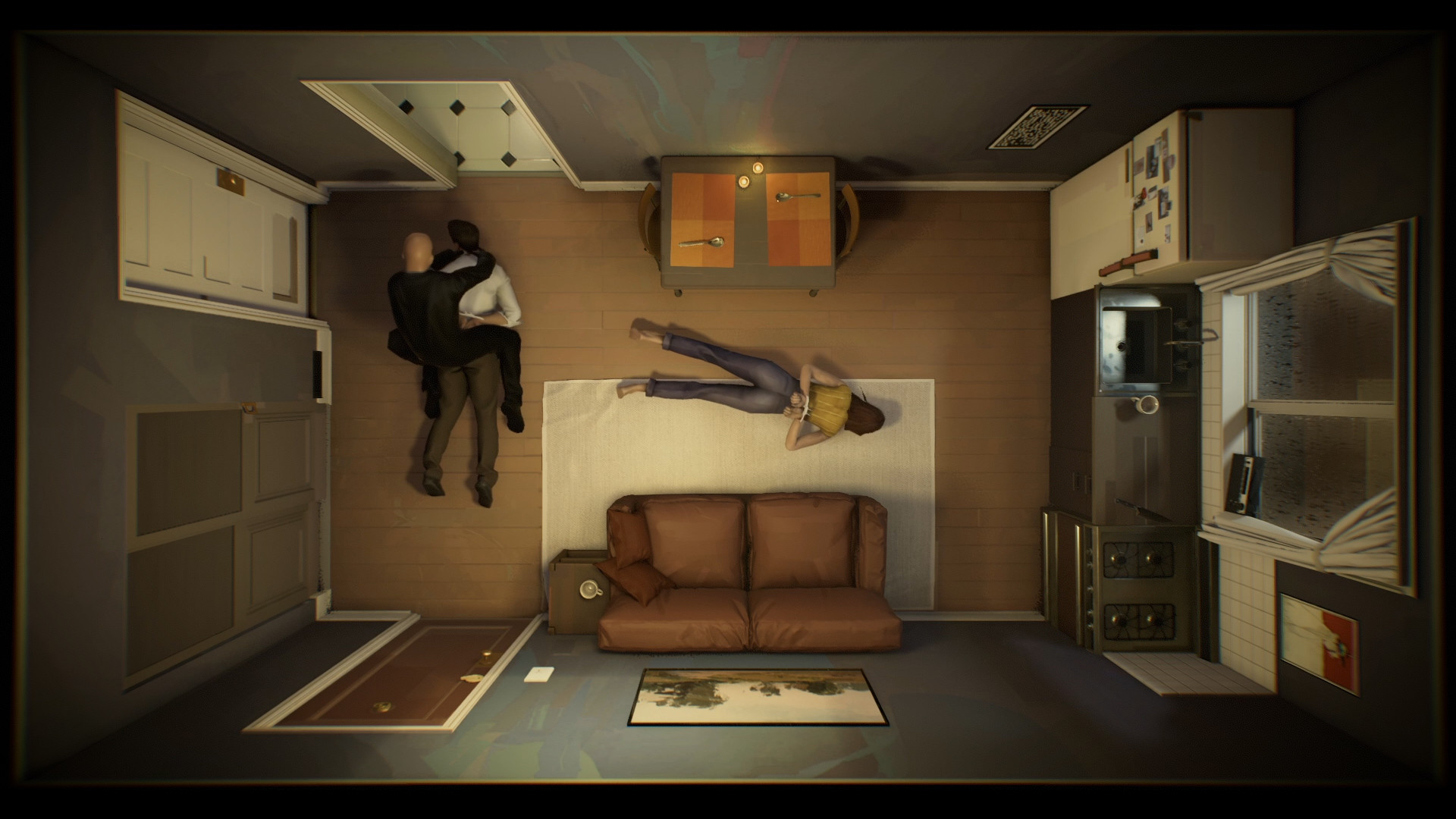
The apartment is seen from directly above and explored with a point-and-click, click-and-drag interface. The man can examine his surroundings, use objects and try actions in a different order as the evening advances in real time. A closed space makes cause and effect easier to notice. A conversation may take place while another action remains unfinished; time spent investigating one part of the room leaves less time before the detective reaches the door. The interface does not turn those experiments into a battle build or a checklist of combat abilities. It asks the player to work with what is already in the apartment and with what the characters can be persuaded to say or do. Familiar objects gain new value because their position and possible use can be remembered across attempts, even when the room itself resets. A simple mouse-driven action can be tested at one point in the evening and then again after another event has altered the situation. The top-down view keeps all three people within the same cramped stage and lets the player see how quickly an ordinary dinner can become a confrontation. Every new attempt begins in a setting that looks known, yet the player’s idea of which detail matters may have changed completely.
What persists most clearly between loops is knowledge. The man and the player have witnessed a future that has not happened for his wife, and a failed approach can still establish when something occurs or how another person reacts. A later attempt can use that information to ask a different question, act earlier or wait for a revealing moment. Director Luis Antonio built the experience around this accumulation rather than conventional levels and a prominent list of objectives. The absence of a prescribed solution gives a discovered fact two possible roles. It might point to a practical way of changing the next few minutes, or it might alter the player’s interpretation of a character without opening an obvious new action. Repetition is therefore not only a mechanical penalty for getting the evening wrong. It is how the player learns the apartment’s sequence of events well enough to interrupt it. The limited number of people and objects helps each change register. If one choice produces a new answer, the player can connect that result to an action taken a moment earlier instead of searching a large world for an unrelated trigger.
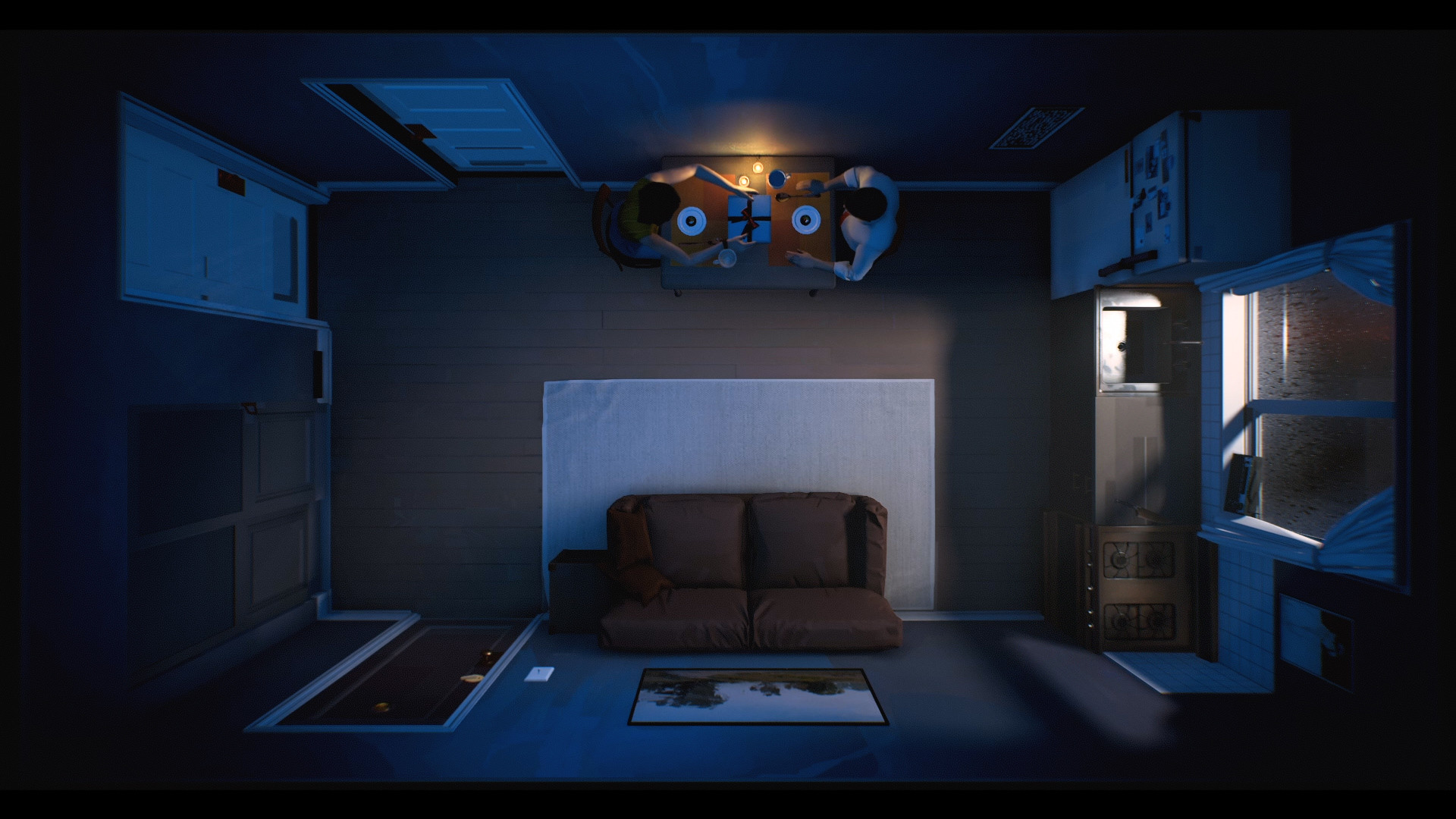
Conversation turns the time loop into a problem of trust. The detective’s claim asks the man to decide what he believes about his wife while she is still trying to understand why he suddenly knows things he should not. Telling someone about a future event is different from proving it, and pressing for information can have consequences before the visitor even arrives. A line heard on one attempt may gain a different meaning when another detail is uncovered later. That is part of the tension of a repeated domestic scene: the player may know how to interrupt a sequence without knowing whether doing so answers the accusation at its centre. Twelve Minutes does not separate a long dialogue phase from a later puzzle phase. Speech, movement and object use unfold within the same brief interval, so deciding to question a person is also deciding what not to do with that time. Some loops may end before the full twelve minutes if the situation turns violent or otherwise collapses. The short span makes it practical to try another approach, but it does not make the events themselves harmless or easy to watch. A player who spends a loop proving one detail may still have to return to an earlier question on the next attempt. That back-and-forth between explanation and intervention keeps the mystery tied to the same ticking clock.
The presentation keeps the stakes close. James McAvoy, Daisy Ridley and Willem Dafoe voice the central characters, giving the repeated exchanges recognisable personalities even as the player changes their order or context. The overhead camera holds them inside the apartment rather than cutting to a wider world that might relieve the pressure. A conversation beside the dinner table can feel different after the player knows what the detective will say at the door; the same performance is heard with more information behind it. This is a real-time interactive thriller rather than a purely observational mystery, and its material is adult. The official listings describe violence, blood and gore, sexual content and strong language. Those elements are not incidental decorations around a gentle logic puzzle. The detective’s intrusion and the relationships among the three characters give the repeated experiments their urgency. The player is asked to consider people as well as a sequence of actions, including how a remembered fact can change the way a familiar line sounds on the next attempt.
Twelve Minutes first released for PC and Xbox in 2021, with PlayStation versions following later that year; the Steam listing credits Luis Antonio as developer and Annapurna Interactive as publisher. Its separate soundtrack offer is an audio extra, not another apartment or a second playable case. The compact base game rests on a distinctive rule: the room resets, but the player has already learned something and cannot return to knowing less. That makes it possible to plan one attempt around the detective’s arrival and another around a conversation that happened beforehand. A choice need not immediately open a new scene to be useful; it may expose what a character refuses to explain, or establish that a previously promising tactic leads back to the same failure. Unlike a mystery built around collecting a growing inventory of permanent rewards, progress here is largely the refinement of a theory about the evening. The apartment changes little from loop to loop, and that constancy makes the player responsible for noticing what a new action has changed.
- Developer
- Luis Antonio
- Genre
- Single-player real-time time-loop thriller