
About Turnip Boy Commits Tax Evasion
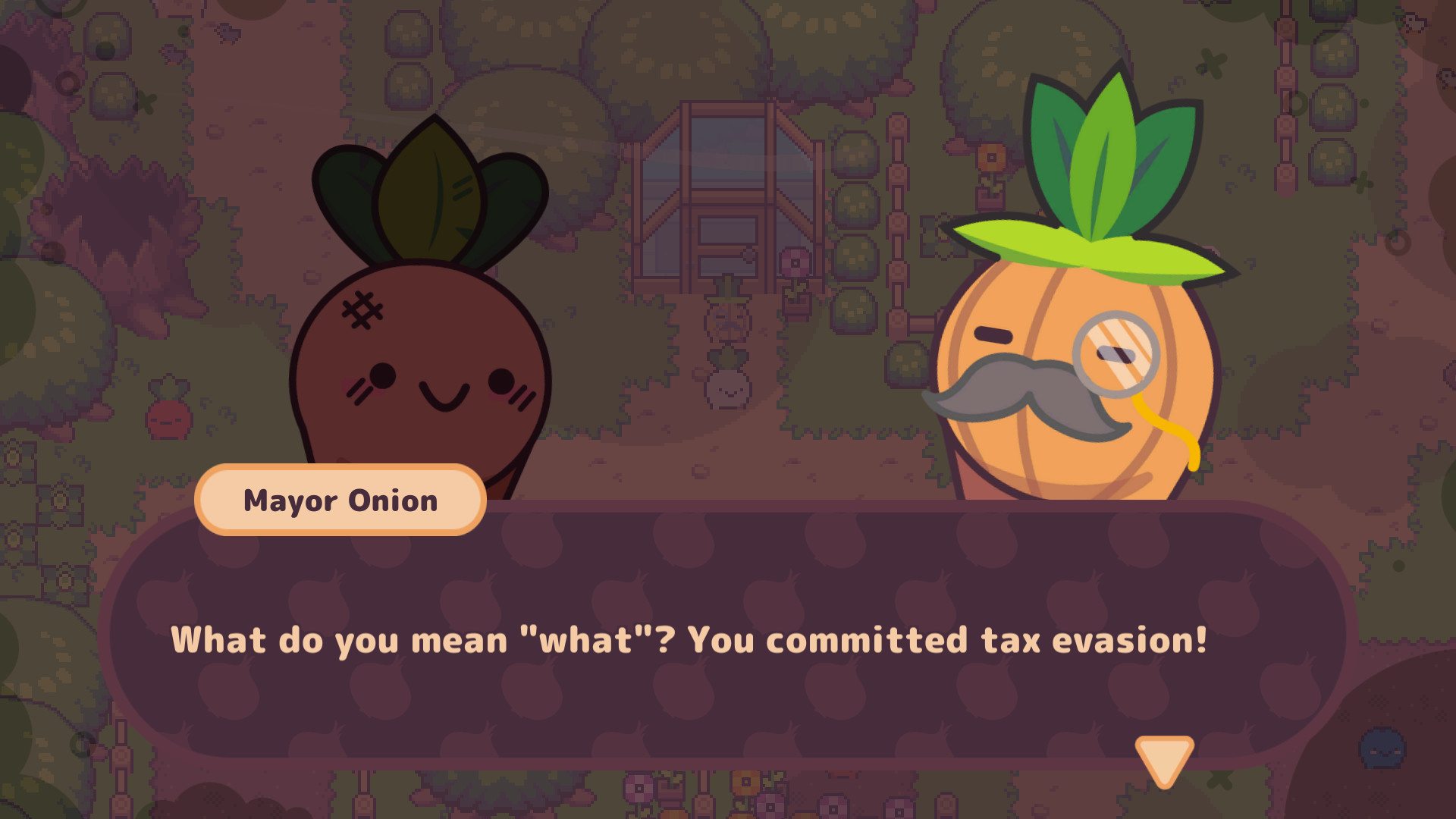
After failing to pay property taxes, Turnip Boy is evicted and ordered by Mayor Onion to work off a crushing debt. Explore Veggieville and its surrounding dungeons, complete odd jobs for food-based townsfolk, solve plant-based puzzles and fight oversized creatures as a comic tax dispute exposes a corrupt vegetable government.
Turnip Boy Commits Tax Evasion opens with a simple consequence: the turnip has failed to pay his taxes, so Mayor Onion evicts him from his home and assigns him a debt to repay. The mayor's errands send the player out from Veggieville to retrieve objects, meet residents and handle problems that the authorities would rather not solve themselves. The arrangement gives the adventure a clear structure—each task begins with an immediate request, then leads into a neighboring area or dungeon where the required item can be found. Meanwhile, Turnip Boy's habit of tearing up documents, bills and other official papers turns paperwork into both a running joke and a collectible thread. The comedy sits alongside a growing conflict with the vegetable government: a debt-collection job gradually reveals that the civic order is more corrupt than the mayor's cheerful authority suggests. Its deliberately lighthearted, goofy tone shapes the short, brisk questing. The absurd tax premise is not an accounting simulation; it is the framing device for a compact action-adventure about errands, puzzles, fights and resistance.
Veggieville is the hub for a cast of anthropomorphic fruits and vegetables, each with a small problem, request or joke to offer. Talking to residents supplies errands and clues, and some conversations are necessary to move the main route forward. Requests often work like compact scavenger puzzles: a character asks for a specific object, Turnip Boy searches a nearby location, then returns with the item or finds another person who can help. This creates some backtracking between the town and the surrounding areas, while tying optional-seeming favors to the path into later dungeons. The places named in the adventure include Weapon Woods and the Bustling Barn, where the player encounters enemies and environmental puzzles as well as characters with needs. Tax documents, wanted notices and bills can be ripped up and tracked in a collection list, giving exploration another reason to inspect the scenery. The world uses familiar outdoor routes, rooms and small dungeons rather than a large seamless map. Its food-based inhabitants and everyday objects support the comic premise, while the errands keep the player moving between dialogue, exploration and problem solving.
The game advances through a sequence of tools and abilities that serve both traversal puzzles and combat. A watering can activates plants that initially appear inert: some grow into bombs, while others become movable blocks. The player can kick bombs toward targets and use gloves to push blocks into gaps, so a room's layout becomes a small chain of cause and effect rather than a test of timing alone. The Soil Sword cuts through tall grass, attacks enemies and can be used to dig up graves; later updates even added an in-game sign to teach that use. A shovel, boots and other items broaden the ways Turnip Boy can interact with obstacles. The Potted Petalportal creates a paired portal route that can move the player and objects, extending the puzzle vocabulary beyond planting and pushing. These tools are acquired over the course of the adventure, so later rooms can combine an older ability with a new one. Switching the active item is part of moment-to-moment play: the player must choose the correct tool for the object, enemy or mechanism in front of them.
Combat uses the same readable tool set as the puzzles. The Soil Sword is the dependable close-range weapon, while bombs grown from plants can be kicked toward enemies or used to damage larger targets. Fights take place in the small outdoor spaces and dungeons that connect the errands, with bosses acting as the endpoint of several dungeon sequences. The battles are built around recognizing what an enemy or boss exposes and using the available weapon or environmental object at the right time; they are not presented as a deep equipment-stat system. Turnip Boy's heart meter can grow over the course of the game, adding some room for mistakes, while the tools also help clear grass, move obstacles and unlock paths outside of combat. This overlap keeps the inventory relevant across different kinds of rooms: a sword can open a route and defend against a creature, and a bomb can solve a puzzle or help in a fight. The developer's launch description summarizes the central mix as plant-themed puzzles, crop harvesting and battles against large beasts, all under the debt-collection premise.
Progression connects town requests, exploration and the growing tool kit. Mayor Onion's assignments establish a destination or object to pursue, but conversations with residents supply side jobs and information that may open the next dungeon. Completing requests can also turn up hats or documents, while ripped tax papers are recorded among the collectibles. The player often has to carry a solution back across a familiar route, or revisit an earlier spot after gaining a tool that changes what can be done there. That structure rewards attention to characters and environmental details more than grinding for experience or building a character through numerical upgrades. The original game's tax documents are also part of the joke: every bill destroyed makes the player a more conspicuous menace to a government already demanding payment. Developer notes describe the final plant mechanic as a revision of an earlier seed system, with the dialogue and document systems expanded to make the town's characters and tax evasion premise work together. The resulting progression is a steady sequence of errands, new interactions and increasingly tangled civic trouble.
The base adventure is joined by the Limitless Line, an infinite train dungeon added in the free Sunset Station update. It is a separate challenge built around repeated combat rooms and an escalating run rather than a required continuation of the original route. The developer's update notes identify a new boss fight, additional enemies, elite enemies, looping, a ticket currency and a shop, with hats and trinkets as further rewards. A Daily Challenge was introduced for Steam only, a platform limit the developer explicitly marks in the update notes; later changelogs describe daily contests and Steam leaderboards requiring an internet connection. That mode gives the game's compact tool-based combat a repeatable format, while the original story remains centered on Mayor Onion's debt and Veggieville's residents. The update also revised combat feel and hitboxes, and subsequent patches list fixes across Steam, Nintendo Switch, Xbox and itch.io. Keeping the main quest and Limitless Line distinct helps explain why a player may encounter the same familiar characters and tools in a very different structure after the story areas.
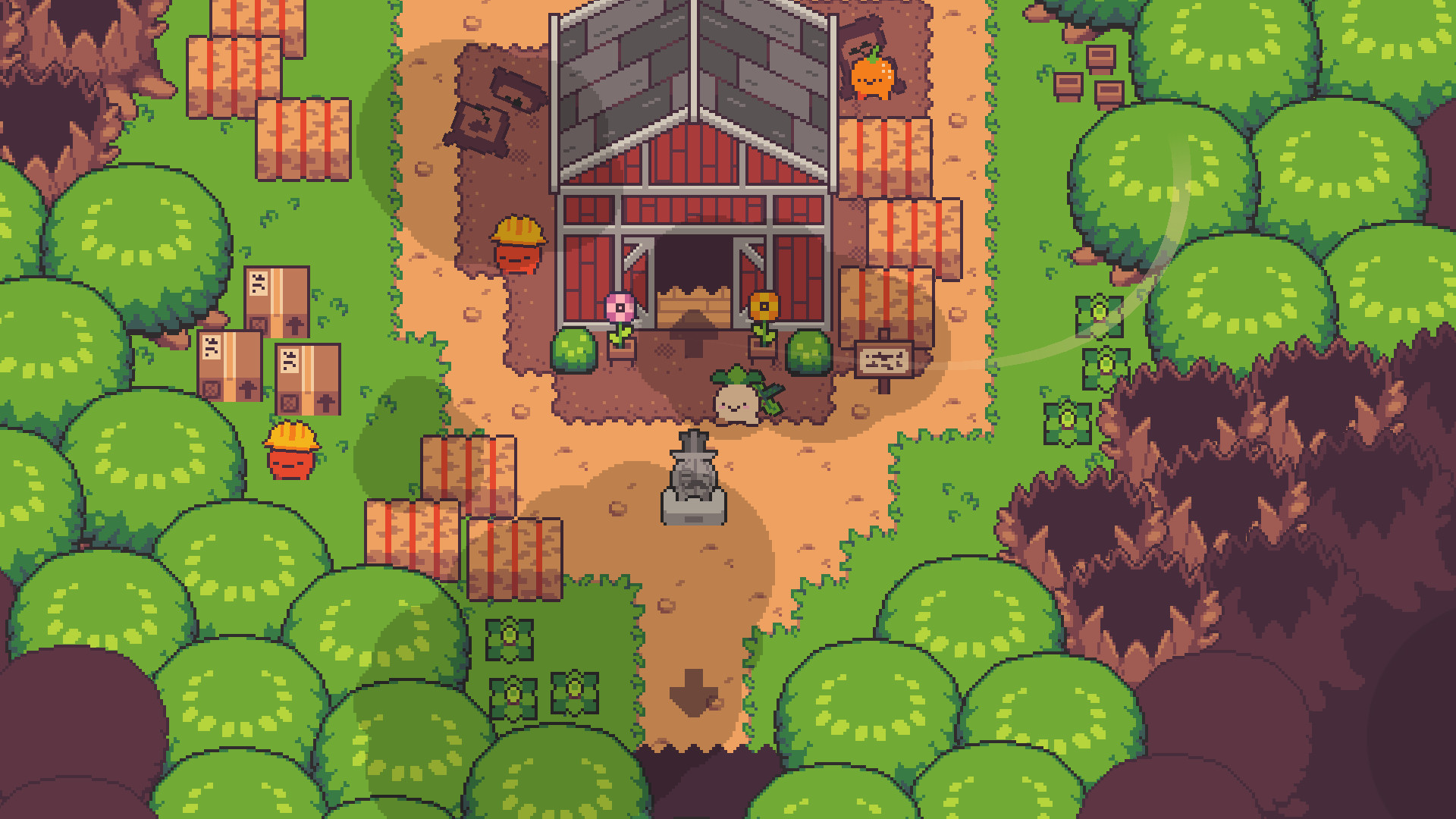
Turnip Boy's world is rendered as a colorful two-dimensional adventure populated by food-shaped characters, with dialogue and visual gags carrying much of the personality. Conversations can break the fourth wall and lean on contemporary references, while the familiar objects—watering cans, bills, hats and garden plants—are turned into tools for both jokes and puzzles. Music accompanies travel through the outdoor areas and dungeons. The project began as a game-jam prototype about a turnip searching for fertilizer, then grew to include the tax premise, plant mechanic and fuller dialogue system. That history is useful context for the finished structure: the simple opening errand grows into a wider series of connected quests without losing its small-town scale. The Steam product is a single-player game developed by Snoozy Kazoo and published by Graffiti Games, with Windows, macOS and SteamOS/Linux requirements listed. The game has also appeared in Nintendo Switch, Xbox and itch.io builds. The Limitless Line's Daily Challenge and leaderboard functions remain Steam-specific extras alongside the broader single-player adventure.
- Developer
- Snoozy Kazoo
- Genre
- Action-adventure; puzzle; single-player