
About Turbo Overkill
Turbo Overkill is a single-player first-person shooter set in the cyberpunk city of Paradise. As Johnny Turbo, a half-human bounty hunter with a chainsaw leg and other augmentations, you fight the rogue machine intelligence Syn and its forces. Wall-running, dashing, grappling, weapon upgrades and a hovercar shape a campaign built around fast movement, varied weapons and hidden secrets.
Turbo Overkill casts the player as Johnny Turbo, a bounty hunter returning to Paradise, the city where he grew up. Much of its population has fallen under the control of Syn, a rogue machine intelligence whose augmented followers occupy the streets. Johnny takes a dangerous contract to destroy Syn, while rival bounty hunters also pursue the target. The setup gives the campaign a clear direction through a neon cyberpunk landscape without making its story the only reason to move forward. Johnny’s body is part of the premise as well as the action: he is a partly mechanical fighter equipped with hidden arm-mounted rockets and a chainsaw that extends from his lower leg. The result is a world where extreme body modification feels ordinary, and where the hero’s unusual hardware directly shapes how the player crosses a room or attacks a group.
Paradise is arranged as a sequence of two dozen stages, with routes that use the city’s height as much as its streets. Tower blocks, sewers, an aquarium, a nightclub and other urban spaces give the campaign different settings, while platforms, ledges and marked walls turn those places into traversal challenges. A route might combine a jump pad, a wall run and a dash before opening into an elevated fight. Other sections ask the player to locate keys or switches, follow a path through connected rooms, or search side spaces for secrets. The level layouts draw attention upward and outward: a distant ledge may be reachable with a double jump and dash, while a wall that first looks decorative can form part of a path. This vertical structure makes finding the next route part of the action rather than a pause between combat arenas.
Movement and fighting are designed to flow into each other. Johnny can dash to evade a projectile, run along a wall to reach another side of an arena, and grapple across gaps. His chainsaw leg makes a slide an attack: building speed down a slope makes the collision more forceful, and activating the leg in midair can add a kick-like burst of movement. These skills can help reach high ground or close distance, so movement is useful even when no enemy is immediately in front of the player. The same manoeuvre can carry Johnny through a group of weaker opponents and put him in a new position to face tougher ones. Boss encounters also interact with this system, since the chainsaw slide can expose a vulnerable point for a critical attack. The game’s central rhythm is therefore to keep moving, read the space and carry momentum from one action into the next.
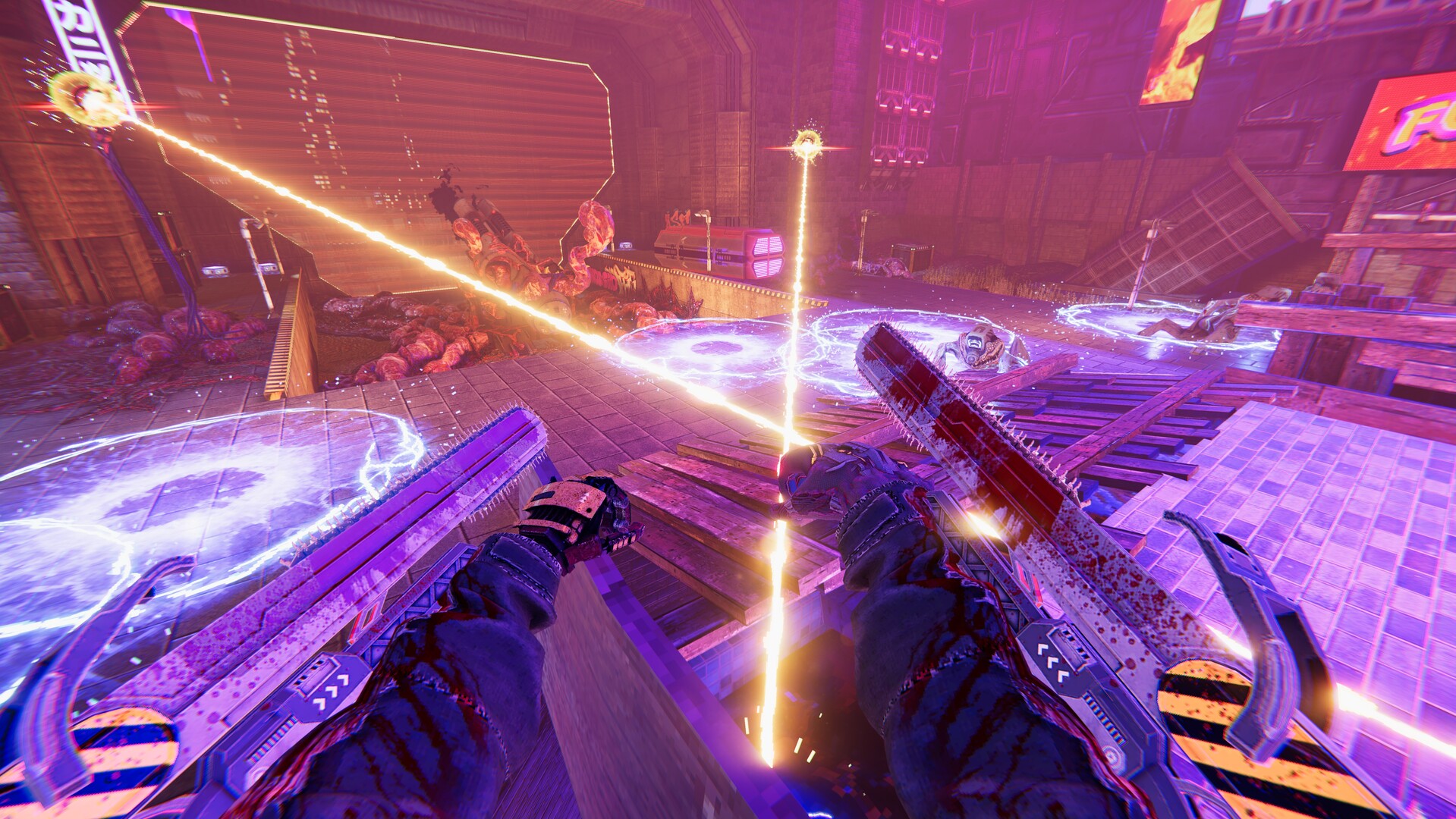
The arsenal offers different answers to enemies and situations. Johnny starts with Twin Magnums that can lock on to several targets, while the Boomer Shotgun combines close-range blasts with an attached grenade launcher. A Telefragger sniper rifle can place Johnny inside a distant enemy before it explodes, making a precision weapon part of traversal as well as combat. The Twincendiary Minigun can switch into a flamethrower, and other weapons add their own alternate modes as the campaign progresses. These changes give a familiar gun a second purpose and encourage switching according to the target, distance and available ammunition. Weapons are not the only way to alter a fight: Johnny can launch micro-missiles from his arm, use his grapple to reposition, and slow the action with Turbo Time, a brief distortion of time that creates room to choose a target or escape an incoming volley.
Progression builds around cash earned from kills, shops and changes to Johnny’s augmentations. Vending machines placed through the city sell guns, ammunition, upgrades and other equipment; a separate Splice machine lets the player tune the abilities attached to his cybernetic body. These choices can change how a run through a level feels, since an upgrade may improve an attack or change what happens around a kill. The campaign also rewards looking away from the main route. Hidden areas and collectibles offer extra rewards, and bonus arenas give the player more to discover beyond the main route. Optional exploration thus adds short detours to the forward drive and can give a player a reason to examine a ledge or side corridor after the obvious path is clear.
The stages mix combat with occasional vehicle sequences and other changes in pace. Johnny can fight from the hood of a flying car, using it to move through the city while attacking enemies, and later sections include a motorbike route through hazards. These sequences use the game’s exaggerated movement and weaponry in a different context from an on-foot arena. Boss fights provide another change, ending chapters with named or larger threats that require the player to combine weapons and movement rather than rely on one attack. Between them, the city’s keys, concealed routes and combat rooms form the campaign’s main structure. The shift from enclosed spaces to exposed rooftops, sewers or vehicle passages changes which abilities matter most, while still keeping the same basic tasks in view: move quickly, avoid incoming fire and find an opening to deal damage.
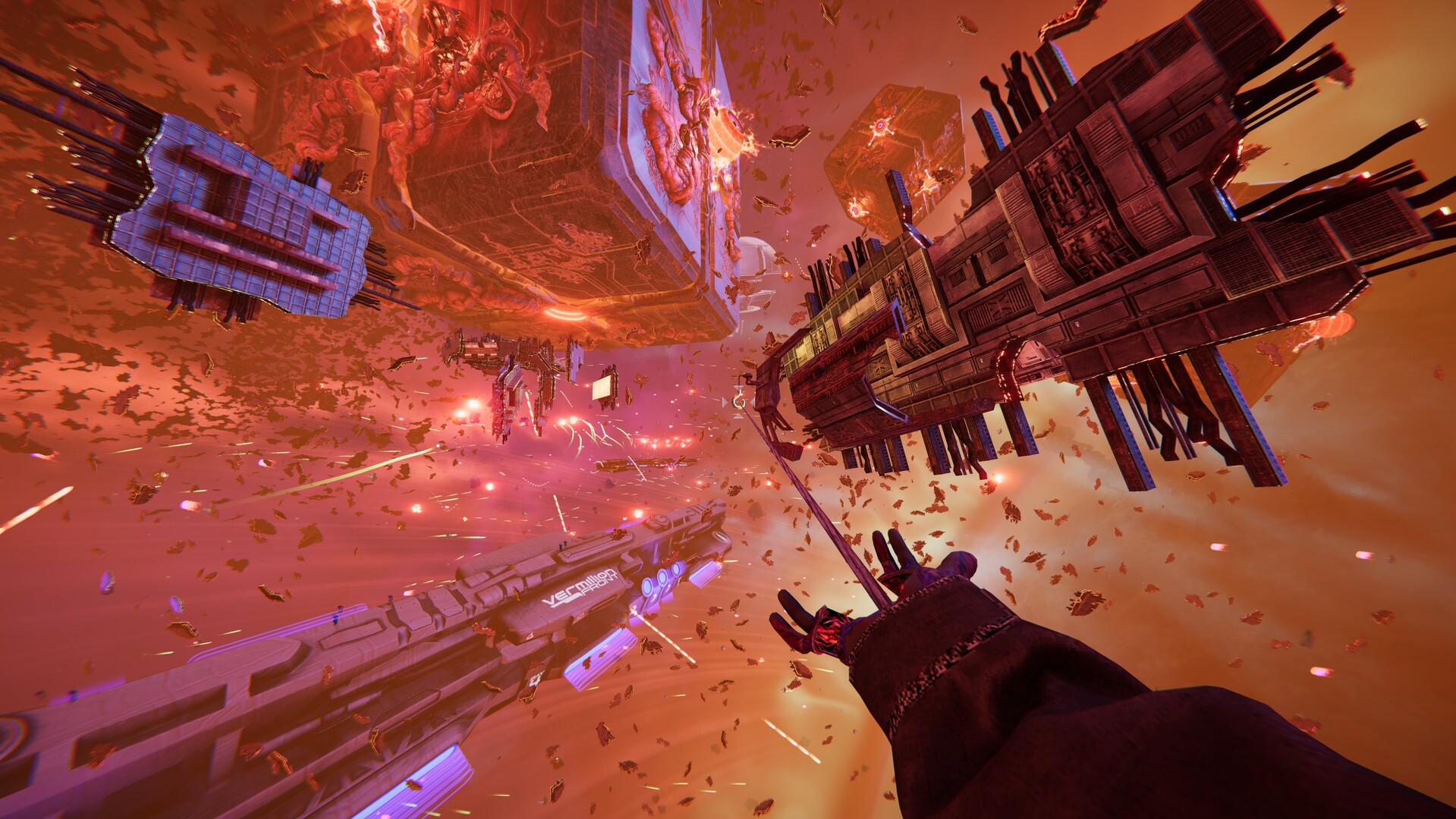
Turbo Overkill pairs pixelated, retro-inspired visuals with bright signs, metallic surfaces and a future city under machine control. Its single-player campaign is the main focus, while the Steam release also includes an editor for creating and sharing levels and supports Workshop content. The game’s identity comes from how its pieces reinforce one another: the chainsaw leg turns a slide into a weapon, wall-running and dashing make vertical routes usable at speed, and alternate fire modes give the large arsenal distinct tactical options. Collectibles and secret stages reward attention to the architecture, while boss encounters test the movement and attacks learned along the way. Across Paradise, exploration and combat remain closely linked, with the next platform, passage or enemy group often reachable through the same continuous sequence of jumps, slides and shots.
- Developer
- Trigger Happy Interactive
- Genre
- Single-player first-person shooter